I was surprised to see Jane sitting up when I arrived. I hadn’t seen her out of a hospital bed in the four years since she’d moved into the nursing home in Sutton’s Bay. Though her health was generally good, she could no longer walk. At well over 500 pounds, she’d developed neuropathy and recurrent infections in her legs.
Posts tagged #Issue #92
Book Review: Life on a Little Known Planet ~ by Elizabeth Kolbert
Elizabeth Kolbert has spent decades reporting from the fault lines of our planet—melting glaciers, vanishing species, rising seas, shifting microbial worlds. In Life on a Little-Known Planet: Dispatches from a Changing World, she gathers essays that feel at once intimate and planetary, investigative and philosophical. The title itself is telling. For all our satellite imagery and data modeling, Kolbert suggests we are still strangers here.
The Keys to Awareness: The Wholeness Work
Across many traditions, spiritual teachers have taught that the “ego” is not an entity, but an activity. What we call ego is ongoing psychological activity—memory, comparison, fear, desire—generated moment by moment. It is something that we are doing and not something we fundamentally are. Ego/self is a pattern of self-attention and linguistic framing—a contraction created through self-referencing.
Astrologically Speaking--Far-Out! The One and Only Uranus, a True Original
Uranus! It’s a funny-sounding name to go along with a quirky planet. It’s preferable to pronounce it with the stress on the first syllable. As you’ll see, this planet’s physical nature and astrological significations all go together.
When Awakening Becomes Avoidance
There seems to be this point on the spiritual path when we realize that the very practices meant to free us can quietly become ways of hiding. It often begins with sincere devotion, the desire to grow, to heal, to remember. Yet somewhere along the way, the quest for awakening starts to take the place of living.
Book Review: ~Unfiltered & Unapologetic~ Judy McCutcheon's Powerful Call for Women to Reclaim Their Voice and Lead Fearlessly
In Unfiltered and Unapologetic, Judy McCutcheon writes with the urgency of someone who has spent years watching women shrink themselves to fit expectations that were never designed for them in the first place. The book positions itself as both a guide and a challenge: an invitation for women to examine the habits, beliefs, and social pressures that encourage quiet compliance instead of confident leadership.
Kindred Journey School: Ypsilanti’s Newest Opportunity for Alternative Education
As children emerge from the cocoon of toddlerhood and begin their journey into the world, the 21st century parent must decide where and how their child should be educated. Public school is often the obvious choice, but other families may choose private, charter, or alternative schooling. A small number choose to homeschool. More wish they could, but find it unrealistic due to employment or other extenuating factors. In Washtenaw County we are blessed with a myriad of options. One such option, Ypsilanti’s Kindred Journey School (KJS), sits in the happy medium between private and homeschool. KJS is perfect for families who relish the individualized curriculum and close personal relationships that homeschooling offers but are unable to do so themselves. Serving Kindergarten through fourth grade and growing every year, KJS seeks to nurture the individual child and foster connection between peers, educators, and the local community.
Out of My Comfort Zone: Three Scary Statements
The words were out of my mouth before I’d spent even a single second considering them. Appalled, I gazed, eyes wide, at the woman in front of me, a new acquaintance whom I knew to be highly intuitive, an accomplished spiritual healer. I couldn’t fathom where that statement had come from. It was almost as if the words had been spoken to me, as much as through me.
The Art of the Vibe: Boost Your Next Event with Coffee, Music, and Kultura
When Juana Mancera graduated from the University of Michigan in December 2025, she decided that if she was going to face the daily grind, she might as well be the one choosing the beans. Sick of working for other people, sick of climbing a corporate ladder, Mancera opened Kultura, a mobile coffee-music pop-up, or as she explained it, “coffee, culture, and speakers on wheels.” The hottest thing in town isn’t just the caffeine, it’s the electric blue cart and the heavy bass vibrating through the steam of your new favorite cuppa joe. Meet the coffee experience that’s treating the local caffeine scene less like a transaction and more like a pop-up party.
Crazy Wisdom Kids: Experiencing Spring Through the Senses
Before the calendar changes, before the jackets disappear, before adults agree that winter is finally over, kids start pointing things out. The light looks different. The sidewalk feels warmer. The air smells like wet dirt, not cold metal. Something has shifted, even if no one can quite name it yet. In Ann Arbor and surrounding areas, spring reveals itself in small, almost secret ways—and those clues teach kids something important about the world and about themselves.
Think You Can’t Do Yoga? (Think Again!) A Conversation with Mindy Eisenberg, Founder of Yoga Moves MS
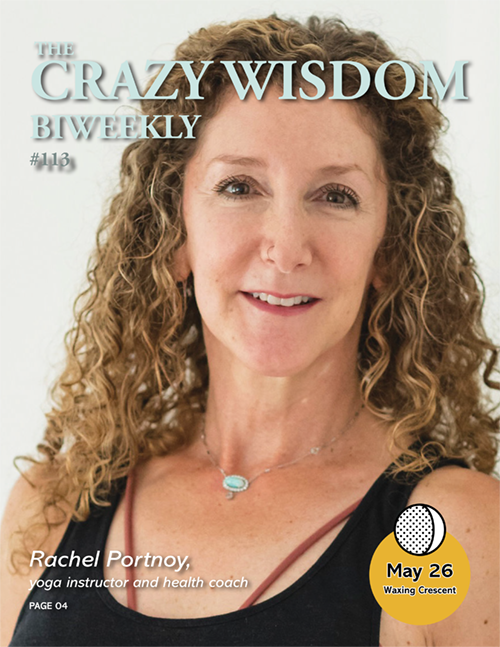
Mindy Eisenberg founded Yoga Moves MS, a nonprofit adaptive yoga organization, over 20 years ago, providing free classes to those impacted by multiple sclerosis, Parkinson’s disease, and other neuromuscular disorders. Her inspiration? Growing up with a mother with multiple sclerosis who spent the better part of twenty-seven years in bed paired with a profound belief in the healing impact of a regular yoga practice.
A Dive Into The Universe Stuff: A Q&A with Renata Portes
Meet Renata Portes, creator of The Universe Stuff; a holistic, creative brand of candles, teas, Reiki, tarot, and more. Originally from Brazil with a background in law, Portes found herself drawn to bring light and healing to people during her transition to life in the United States.
Keeping the Faith—Even When it’s Hard
It’s easy to believe we are protected, loved, and supported by the divine when life is going well. But what about when we are treading in troubled waters and the tides threaten to sweep us out to sea? Thrashing in the waves, struggling to stay above water, sucked into the deep, our breath catching in our lungs— and the darkness finally overtakes us. That’s a different story. So, how do we keep the faith even when we feel abandoned?
The Dreambody, Processwork, and Uncovering our Unconscious Desires
A few years ago, early on my path toward healing, I had a therapist who told me that the body often acts out our subconscious drives and desires, and that if we watch what our body does, we can unlock fresh understandings of what we believe, what we want, and what’s holding us back—the unhelpful patterns, the edges we’re avoiding, the cages we’ve unwittingly locked ourselves in.
Breath, Plants, and the Return to Relationship
As I got older, plants again became teachers. First tobacco, then cannabis introduced me to non-ordinary states through ritualized breath. Smoking was never just consumption for me; it was relational. Breaking apart the plant, lighting it, inhaling and exhaling with intention—these acts shaped my nervous system and my awareness.
Yoga for Life: How to Know If Your Stress Is Out of Control, Plus 6 Simple Yoga Tools to Reduce It
Unless we spend time exploring the underlying causes of our stress, ultimately nothing will change. A yoga practice can help us do just that. One of the gifts of yoga is that it helps us cultivate greater self-awareness. By getting on your yoga mat, you are taking time to slow down, be mindful, and see what you can learn about your body. With ongoing practice, you are better able to listen to your body and give it what it needs on a daily basis.
AI: Will We or Won’t We?
My audacity regarding the possibility of AI becoming an existential threat to our species does not spring from my extremely limited understanding of its current capabilities, nor from any reassuring foreknowledge of its future evolution. Neither does it arise from a profoundly misanthropic, I-couldn’t-care-less view vis a vis my fellow human beings. While I will admit to a blood red No Vacancy sign eternally lit in the bottom of my heart for some members of our species, (I know you know who you are, and I know you don’t care a whit about how I feel about you) but “good riddance” regarding my fellow human beings in toto? Absolutely not.
Southeast Michigan Spiritual Road Trip
I have been a happy habitant of Southeast Michigan for more than 15 years now, and we are blessed to have many metaphysical stores in our corner of the state. Each is filled with warm, welcoming people who are eager to help anyone on their personal spiritual journey. Join me as I visit five of them.
Weekend Getaways: Honoring The Past, Embracing the Future — The Inn at Rustic Gate
In the early 2000s, co-owners Marcia Stroko, Patricia Barrett, and Sharon Stroko were inspired by cultural anthropologist Angeles Arrien to create a place where guests could focus on self-development. In a January 2006 guest book entry, guest F. Rowe shared, “Thank you for having such a wonderful atmosphere in your home inn and surroundings,” thereby recognizing that Rustic Gate is not only a space for visitors, but also a family home
An Interview with Psychotherapist on Authentic Masculinity and Embodied Healing
Daniel DeSena is a social worker and psychotherapist who has become active in leading male embodiment and self-mastery workshops locally, and also nationally on Zoom. He is passionate about the intersection of spirituality, meditation, energy work, martial arts, sexuality and embodiment. He and his twin sister, and younger brother, were raised in the Pittsburgh area. Now 52, he’s been in southeastern Michigan for 30+ years.