
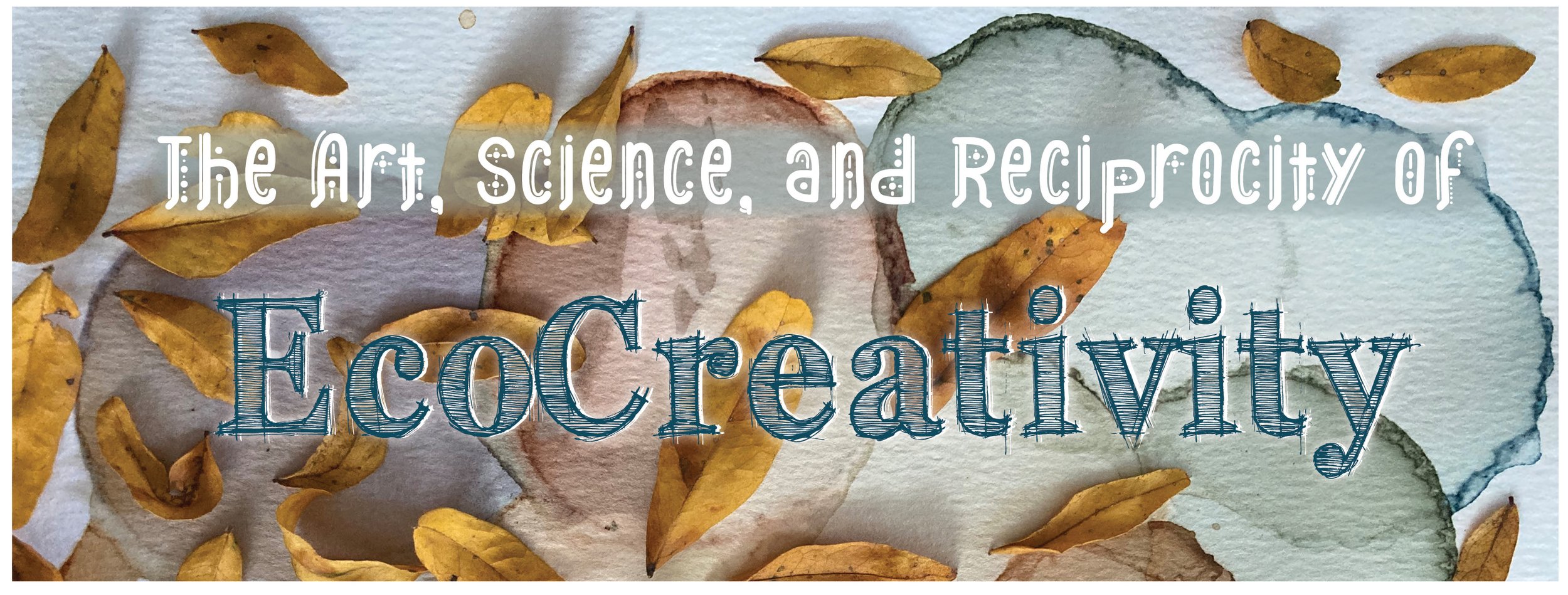
The Art, Science, and Reciprocity of EcoCreativity
Essay and Art by Robin Lily Goldberg
On a rainy spring day during the Covid-19 pandemic, I sought steadiness with my morning tea routine in an uncertain world. As wild weather howled at my window, I spilled rooibos upon the countertop, a fortuitous mistake that transported me back in time, and into the future simultaneously. Splattered beyond the confines of my favorite mug, the tea’s rich red hue captivated me in a new way. This scented stain deserved to be embraced, rather than washed away.
Humans have cherished organic colors for hundreds of thousands of years. Long before painting upon the walls of caves, Homo sapiens decorated their skin with ochre clay, filled with the same iron element that flows through our veins today. In this way, our bodies became our first canvases. Since then, people around the globe have continually drawn inspiration from bioregional soils, minerals, flora, and fauna resulting in movements ranging from Land Art (landscape installations) to Ecopoetry (poems reflecting the nature-culture nexus) to the Environmental Humanities (a field convening artists and scientists to communicate poignant environmental stories). When grounded in respect, reciprocity, and regenerative practices, collaborating creatively with the Earth conveys timely reminders about interdependence thereby fostering multispecies connection and compassion.
Like many contemplative practices, the ecological arts have roots in the traditions of Indigenous Peoples who have cultivated strong bonds with their surroundings. Through observing and listening deeply, they have learned directly from the land, water, and their inhabitants. Writers like Seed Keeper Rowen White (Akwesasne Mohawk) and botanist Robin Wall Kimmerer (Potawatomi) exemplify how articulating insights from the environment through the arts can amplify accountability. While caring for the Earth has always been essential, it has become increasingly crucial. By combining ancient wisdom and scientific innovation with soulful songs, stories, and emotionally moving paintings, we can generate momentum toward actions that improve the future for our home planet.
Long before I heard my first goldfinch or smelled prairie sage, my ancestors began shaping the arc of my ecological artistry. Before I was born, my parents chose a name for me that honors a relative on each side of our family, Robin Lily. At the time, they did not realize that the bird plus flower combination would carry interspecies and intergenerational significance, stretching back to our human, avian, and botanical ancestors, and forward toward my relationship with Mother Earth. All Homo sapiens are animals and therefore part of nature, and I feel an especially deep kinship with the natural world thanks to my feathered and floral namesakes.

Since childhood, I have relished the arts embracing dance, music, and poetry to convey my intrinsic affection for the planet. Even before formal schooling, I moved in ways that emulated gentle waves while composing poems as odes to seeds and snowflakes. Preserving time for creative expression became more challenging during adolescence and early adulthood, but eventually I found my way into an interdisciplinary MFA program. On the morning when I spilled rooibos, I was entering this immersive educational experience to integrate the arts and sciences in service of social and environmental justice. Initially, I planned to study poetry as a mode of articulating information and emotions rising around climate change, but spilling the tea expanded my academic inquiry.
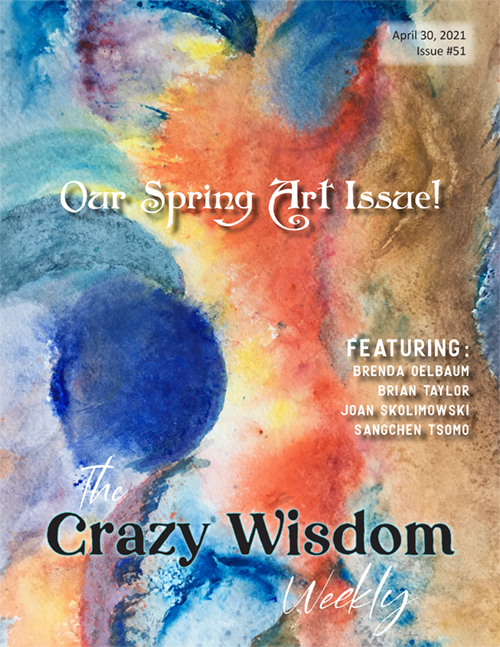
As I marveled at the vibrant rooibos, I felt inspired to experiment with visual art. Thus far, my only exposure to the medium had entailed being told to render an object with acrylics in elementary school, an assignment that felt stifling to me. Decades later, I decided to see if images could surface freely through spilling tea. By surrendering expectations, I invited my senses and plant teachers to lead. Over time, herbal prints, paintings, and assemblages emerged.
While weaving these pieces into my MFA portfolio alongside essays on ecology and climatology, I studied with faculty devoted to preserving their ancestral art, research, and writing traditions from the islands of Taiwan and Puerto Rico as well as the Oneida and Kickapoo Nations of this continent. Through their mentorship, I absorbed core lessons about honoring lineage and the sovereignty of all living beings. Additionally, I gleaned that instead of copying my instructors’ techniques as had been standard in elementary school, my responsibility was to center reciprocity and then allow creativity to flow through me in the ways that Mother Earth and my forebearers intended specifically for me. My relationship with nature began among the woods and waterways of the Great Lakes states, and although my ancestors lived oceans away from present day Michigan, they tended to the land in ways that nourished their families and communities. Generations later, their influence appears in the herbal visual art that I interweave with words and restorative soundscapes
As my explorations into different art forms started coming together, the multisensory magic felt calming, enlivening, and liberating, reminding me of meditation. This experience echoed what I happened to be learning through a gentle mind-body program called Organic Intelligence® (OI), which I began for personal development, and eventually pursued professionally. Although I had not set out to approach OI academically, I quickly realized that it was important to integrate it into my graduate research. Based upon complexity science and polyvagal theory, this growth-focused method establishes a foundation for self-healing through orientation, defined as connecting to the environment through the senses. This instinctive human action can deepen appreciation for the Earth, strengthen one’s sense of belonging, and build neurophysiological prosiliency. Both intellectually and experientially, I have found that this sensory pathway also activates artistic processes.
We live and breathe upon a precious planet thanks to beautiful blue-green cyanobacteria and countless organisms who have made the atmosphere habitable for us, so my work channels gratitude for these species into streams that support their wellbeing. As human constellations of water, stardust, and inimitable Earth elements, we all contain creative capacities. Nourishing these gifts can engender personal and planetary vitality.
Robin Lily Goldberg (MFA, RYT, OICC) nurtures the human-nature connection through accessible ecological arts courses, personalized Organic Intelligence coaching sessions, and collaborative community opportunities that support social transformation and environmental revitalization. To learn more, please visit reciprocalripples.earth or contact robinlily@reciprocalripples.earth.
Read Related Articles:




















Discover how a spilled rooibos tea stain sparked a journey into ecological art using natural plant pigments and herbal prints. Rooted in indigenous wisdom, reciprocity with the Earth, ancestral connections, and Organic Intelligence® practices (informed by polyvagal theory), this personal story explores sensory creativity, multispecies kinship, and art as a path to planetary gratitude and healing.