
By Karen Quinn
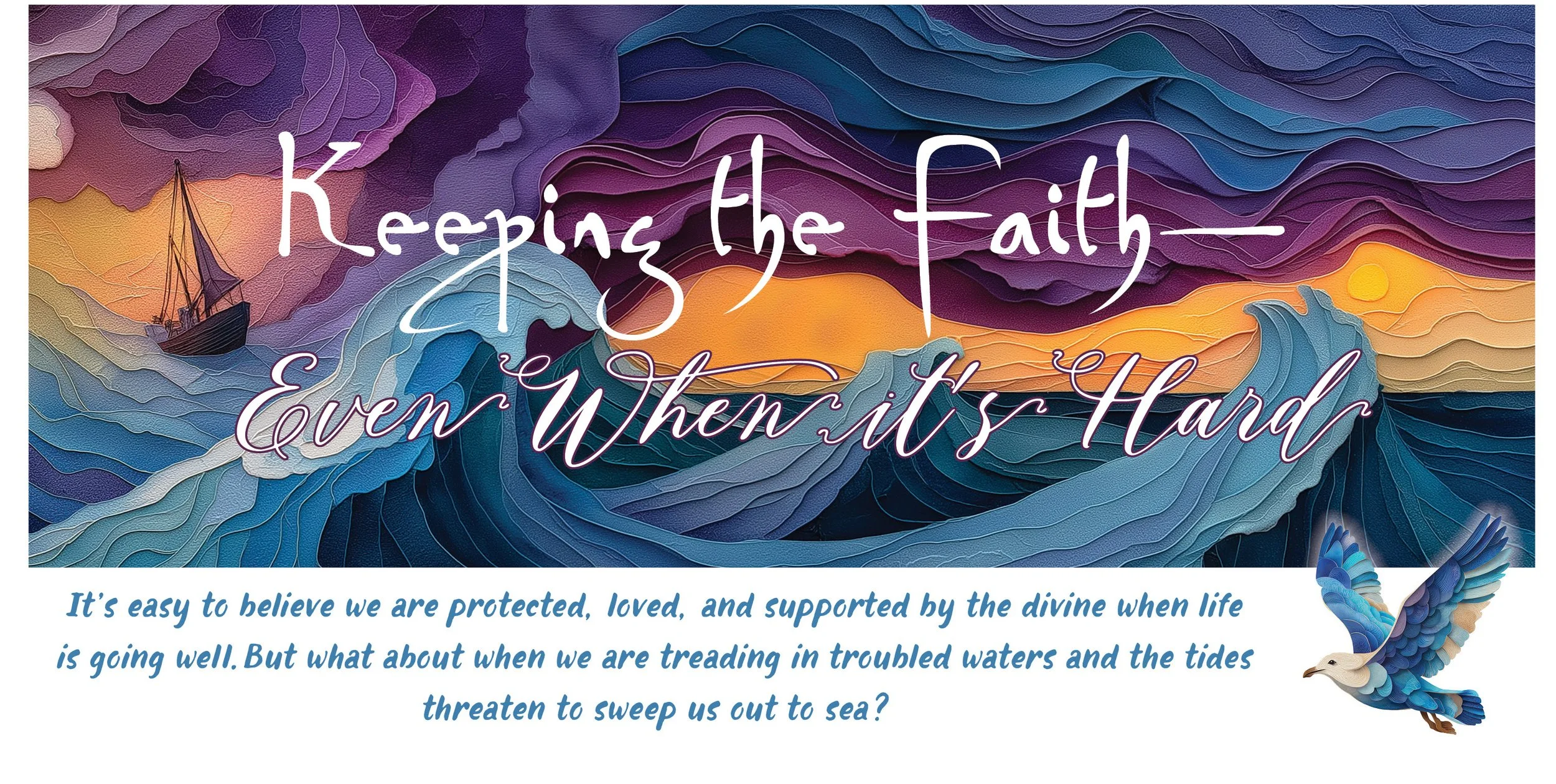
It’s easy to believe we are protected, loved, and supported by the divine when life is going well. But what about when we are treading in troubled waters and the tides threaten to sweep us out to sea? Thrashing in the waves, struggling to stay above water, sucked into the deep, our breath catching in our lungs— and the darkness finally overtakes us. That’s a different story.
So, how do we keep the faith even when we feel abandoned?
Let’s start with the birth of faith.
We, as a species, came to our faith because of hardships. When we couldn’t control our environment, when situations were happening beyond our control, when we didn’t understand why or what we were experiencing, it was in those moments that faith was born. We realized that there was more to the world than we could understand with our five senses. We saw ourselves as a woven silk strand within the intricate web of the world and learned to trust in the universe. Later, we learned that the divine was within us, and through thousands of years of theory, practice, and prayer, we connected to our own energetic signature that spans the cosmos and dates to the beginning of time.
So why, you may ask, do we lose our faith when times are tough? After all, that’s when our faith should be strongest.
Well, let’s look at the first paragraph again. Most notably, “It’s easy to believe we are protected, loved, and supported by the divine when life is going well.”
Life “going well” does not mean your faith is strong, your prayers are answered, or you’re divinely protected. Life just happens, good times and bad times. No matter what your spiritual vocation is, no matter how devout of a believer you are, nothing lasts forever. That is simply a part of the human experience. We will all lose loved ones in our lifetime. We will all experience heartache and sorrows. We will all live through trials and tribulations. Life will always happen to us, no matter how hard we try to keep the lessons of Earth at bay. We are all meant to experience the full spectrum of energies—from the divine state of bliss to sorrowful, heartbreaking desolation. Without this full range of the spectrum, we cannot grow and develop as we should. We need all our experiences to make us a whole person. It’s what creates empathy, encourages service to others, and fosters hope.
The key is to do the work before the hard times show up.
Pray when times are easy. Practice your spirituality when life is going well. Offer petitions and service in the name of something greater than yourself when you can wake up, before the weight of the world climbs on your shoulders. What you are doing is building a dock to moor yourself to when the weather turns. You’re creating a safe harbor to retreat to when the skies blacken.
Practicing spiritual gratitude when life is sunshine and rainbows helps to bolster your soul against the coming storms looming on the horizon.
Okay, that’s nice to know, but what if you’re in your lowest low as you read this? You don’t have the luxury to rewind the clock and start praying and practicing a spiritual lifestyle. You’re being swept out to sea now, and there is no port in the storm.
Here is what I can offer.
First, and foremost, do not fall into the comparison trap. Your lowest low is your own. Even if someone has fallen prey to the same trauma you are experiencing, your unique perspective, your life, and all the lessons you’ve learned up to this moment, will make you react to this trauma differently than the person beside you. Your suffering is no greater and no less than anyone else’s. Your lowest low is your own.
Now, that doesn’t mean that this trauma can’t teach you humility or help you build your own reserves of strength and empathy, because it can. But just know that your experience is your own, and you are allowed to feel your feelings. Have self-compassion as you move through these troubled waters.
Next, don’t underestimate trauma exhaustion! This is a real thing, and don’t minimize its gravity. Sometimes when we are in it for so long, with no relief in sight, we can feel like we just want to give up. That deep despair creates the proverbial straw upon the camel’s back. The best way to bolster yourself against this exhaustion is to admit when you are in it and find a part of your burden that you can set down. Even if you can’t set it down and leave it, you can set it down and rest for a few moments.

I want you to acknowledge these two things (the comparison trap and the trauma exhaustion) and be aware of them as we move forward. The more you understand these two aspects of trauma, the easier it will be to use the information and implement the tools outlined below.
Now, to cover some ways to help you navigate the storm.
Find the Silver Lining
Sometimes our sorrows and grief can make it nearly impossible to find the good in our current situation, and I encourage you to trust yourself if this feels like the case for you. A valid example of this is losing a loved one. The closer the relationship, the harder a silver lining is to find. When I lost my grandfather, I had a very hard time seeing the good in his death. It wasn’t until I was on the other side of the funeral that I realized the blessings were everywhere. They were thin, small, and certainly weren’t pivotal enough to change the pain in my heart, but they were there. I saw them as gifts from my grandfather as I looked back at them. I was able to say goodbye before he passed away. We came together as a family and let bygones be bygones for that time. My son, who was four at the time, was able to work through his first experience of death with a loving family who was there to support him and share his emotions with him.
As I said, I was only able to see those silver linings when I was on the other side of the experience. But that realization made me more inclined to seek the silver lining out the next time trauma came knocking at my door. Honestly, sometimes finding the silver lining isn’t even the point. The true point to finding a silver lining, is that it forces your brain to stop focusing on the “negative” and makes it pull itself out of the rut and look for a “positive.” This helps draw us closer to our spiritual signature, and pulls us closer to our faith, which, in the end, is what will help us weather the storm. Even as I write this, and I find myself in my own gauntlet of hardships and trauma, I readily seek out those silver linings, and they bolster my strength in my faith.
Relinquish the Illusion of Control
When we find ourselves careening down the raging river of life, and we are fighting the current to gain some semblance of control in a situation, there are times we can be doing more harm than good. We can struggle to grab branches overhanging the river’s edge and pull ourselves off course, metaphorically cut our hands, or even change our trajectory into even more treacherous waters. The best thing you can do at that moment is to relax, focus on what is truly in your control, and let the river take you wherever it is taking you.

What does relinquishing the illusion of control mean in practice? When my son was 19, he decided to do migrant farm work for six months in New Zealand. When he arrived, there was a snafu between his flight from Australia to New Zealand that ultimately resulted in his luggage being “lost” at the airport. So, here I am, on the literal other side of the world while my child is in a country where he doesn’t know a soul and the suitcase that has all his necessities has been waylaid. My “mom brain” immediately flew into an overactive reaction, but I stopped myself and looked at the situation. It was, for all intents and purposes, out of my control. I then looked at what was in my control: I found the airline online help portal and opened a ticket regarding his missing luggage. I encouraged him to reach out and do the same, but when we hung up, all that was left to do was pray, relax, and let it go. There was nothing more I could do that day. It took a week, but right before he was set to leave for his second host farm, his luggage was returned to him.
What was made very apparent to me during that time was that I could sit and fester over the situation, and ultimately worry myself into having an ulcer, or, I could focus on what I could do in those moments, and relinquish the illusion of control, pray, and hand the situation over to the universe. My son was going to get his luggage when it was ready to show up, because he had his own lessons to learn, and my worrying and fretting wasn’t going to change that.
Long story short, when we focus on what is actually within our control (which usually isn’t much), then relinquish the illusion of control and trust in the divine, we are free to relax and find peace of mind in the knowledge that it is all going to work out as it is meant to.
Is it External Trauma or Internal Trauma?
This can be tricky, uncomfortable, and just flat out hard to do. Can you identify if the suffering is external or are you causing it internally? This is something to consider when there isn’t an easily identified outside force causing trauma in your life. Sometimes we just wake up in a horrible mood and we don’t know why. Depression is a demon that is very hard to pin down, and it often uses our own minds against us. During these times you can really learn a lot about yourself and create self-compassion in the process. But, again, this is hard to do and takes patience, practice, and time. That being said, it has been one of the most invaluable exercises in my repository to help me move through my own issues.
When I was much younger, I realized that my “teenage angst” had a lot of baggage attached to it. When I got into my twenties, I learned that a lot of that weight was placed on me by childhood trauma. The more I dug into my feelings and where they stemmed from, the more I understood that a lot of that emotional turmoil was being exacerbated by me! I was adding to the problem by not being in control of my emotions surrounding the wound.
I came to this understanding at a point when I was examining a pain in my heart about feeling abandoned, but I was also isolating myself because of this trauma, further fueling my depression to keep me alone in my suffering. Once I recognized this (and had a healthy cry about it) I journaled about being abandoned, then wrote about all the ways I was letting that trauma dictate how I thought of myself, and how it made me cocoon into isolation because I felt unwanted and unlovable. Once I grasped that I was the one who was inflaming this sadness, I was able to lay some of my burden down, give myself some compassion, and reach out to a therapist.
Again, self-examination is tricky, uncomfortable, and just hard to do at times. But, if you can do this for yourself, it makes navigating hardships and healings much easier.
Avoid Isolation
It is in our more primitive and animalistic nature to isolate ourselves when we are in pain. The programming holdover from long, long ago in our genetics tells us that when we show “weakness,” we are vulnerable. So, we hide our “weakness” in order to feel “safe.” We stifle tears so that we don’t draw attention to ourselves. We pretend physical injuries aren’t as bad as they are, and we try to cover up when we fall short of expectations. Most importantly, when someone asks how we are doing, and we are suffering inside, we say, “I’m okay.” When, really, we aren’t.
Why do we do this? Why do we turn inward and avoid loved ones when we are suffering? A few responses that seem to ring out time and time again are, “I don’t want to be a burden,” and “I don’t want to make anyone else feel bad.” But when you are suffering, the best thing you can do is seek out help and love. Don’t suffer alone. There are people in your life who love and care for you. Don’t be afraid to ask for help. We are all in this experience of life together, and everyone has known hardship. Reaching out when you hurt will help you heal exponentially faster than if you continue to suffer alone.
Now that we have discussed some ways to help you strengthen your faith when the times are hard, let’s go over some tools you can utilize to help navigate the storm and move into calmer waters, faster.
The Power of Prayer
This is always my first line of personal defense—and is always my first suggestion to others. No matter what you are doing, what you are dealing with, the first thing I will always ask is, “Did you pray about it?” Not because I want to eschew responsibility, or “kick the can down the road.” It’s because I’m human—I’m not God. The Divine knows more than we could ever know. The universe already has the answer. Pray about it and turn it over to a power higher than yourself. Ask for help, then wait for the answers. You’ll always feel better.
Journaling is Your Friend

Oftentimes, journaling about your experience will help you work through your trauma more efficiently and effectively. Write about your trauma and how it affects you. If you use the systems outlined above, write about your experience. Did they help or hinder your healing? All information is helpful when you are developing your own healing process. Be sure to date your entries, so if you find yourself navigating the same trauma again later, you can see if it is a cycle. You might find that every August you seem to feel a certain way, or every time you go out to visit a specific family member, you deal with old baggage a few days later. Identifying cycles within your mental and emotional state can help give you validation on your journey.
Another important thing I want to share before moving on, is that once the trauma is done, don’t stop journaling! Journaling only when things are bad does not help your spiritual practice. Remember what we talked about at the beginning of this? Practice your spirituality when it’s sunshine and rainbows. Journal when you’re happy, write about that wonderful vacation, the good conversation you had with your mom, and even record the day you saw a wild turkey in your backyard and how it made you feel. This is the practice termed as “gratitude journaling.” Add in your tarot readings, inspiring quotes or scripture, dreams, messages from the divine, all of it. Then, over time, your journals become a reflection of you that can be referenced any time you need your own guidance. I have been keeping active journals about my spiritual practice and my life’s cycles since 1994. My own council has been invaluable to me over the years, so I feel confident encouraging you to start keeping your own.
Talking to Yourself is Helpful
I know this sounds weird, but talking to yourself is super helpful! Talking things out with yourself out loud can really help you move through your process a lot faster than you would expect. I am sure there is a psychological reason that I don’t know behind it, but honestly the science doesn’t matter. The results speak for themselves.
My husband explained to me, when I was sharing this idea with him many years ago, that in the I.T. world it is referred to as “Rubber Ducking.” When you can’t figure out why a system or program isn’t performing like it should, you talk through the problem with a rubber duck toy, and you can usually figure out the answer. The rubber duck is inconsequential to the exercise. The important takeaway is that it’s just you, talking to you, and you figure out the answer.
Trust me, it works. Just try it.
Seeking Out Someone Who is More Spiritual than Yourself
I know what a few of you are thinking. “I am…that’s why I’m here…” But that’s not necessarily what I mean. Seeking out someone who you can actually talk to can be incredibly beneficial. They will see things that you don’t, encourage practice in areas you might not be aware of, and help you adjust your thinking.
Read Sacred Texts
Every spirituality has sacred texts that they can lean on to help guide them through life. It can also be helpful to expand your spiritual boundaries and read texts that are from different spiritual backgrounds to help get insight as well. Just like many of you, my first introduction to sacred text was the Bible, and it offered a lot of good wisdom. I read Celtic folklore, since that was where my blood and bone heritage stemmed from. The stories and lessons from these two sources really made an impact on me in my youth and shaped much of my spiritual foundation. Then in high school, I read The Odyssey and The Iliad in English class, and since I had started getting into astrology at that time, it really helped me to learn more about the attributes of the planets. In more recent times, I was introduced to the Bhagavad Gita, when I began studying to be a yoga instructor, and the Tao Te Ching when I studied Tai Chi. Both these texts taught me the importance of mindfulness, meditation, and helped me understand my soul on a deeper level.
Reconnect with Nature
Finally, we are left with the most undervalued yet most effective tool in the toolbox. When you are lost to the four winds, when your life is a mess and you are at your lowest low, nothing can make a greater impact on you than going outside and experiencing nature. Even if you’re in the city, you can find a patch of green. Seek it out and immerse yourself into its embrace.
The simple act of grounding (going outside barefoot) can change the way you think and feel. Stand outside and look at the world around you. Watch the blades of grass sway in the breeze, watch the moth dance its way from one flower to another. Look deeply at the flower, notice the intricacies of the petals. Find a tree and sit beneath it, leaning your back up against the trunk and feel its support. Hear the leaves dance in the wind, listen to each tree’s unique voice. Watch the birds fly in the sky, singing their complex songs to each other. If you are able, find a river and listen to its gurgle. If it’s night and the sky is clear, look up at the stars. Remind yourself that you are a being of stardust, sharing cosmic DNA with all the twinkling lights above you. If you are lucky, you might see the moon, or a few of the planets in the blackness as well.
Notice that I’m encouraging you to sit and watch. I’m asking you to immerse yourself in the environment. Slow down, relax, and reconnect with the web you share your life with. We all belong in nature, we all fit into the intricate puzzle when we are in nature, and most importantly, we remember who we are when we are in nature. The longer you stay, the more you will heal. In this instance, you literally get out what you put in.
Now, I don’t want you to think that going outside and chatting with the bluejay on the fence is going to make all your hardships and trauma go away. It doesn’t “fix it” the way we all want it to, but it does reprogram us immediately. For those who need the science talk, it relaxes and calms the sympathetic nervous system so that your body can switch into parasympathetic mode. The end result is a clearer mind, a lighter heart, and the resolve to help navigate the chaos.
Karen Quinn is a 4/1 Splenic Projector with a Fixed Fate Gate 6- Conflict Resolution. She weaves this fate with her 30+ years of spiritual work to help others on their spiritual journey to connect to their soul’s purpose. She offers herself as a Purveyor of Spiritual Services & Life Coach. Learn more at https://linktr.ee/ZephyrineJunction.
Read Related Content:














































































































































































It’s easy to believe we are protected, loved, and supported by the divine when life is going well. But what about when we are treading in troubled waters and the tides threaten to sweep us out to sea? Thrashing in the waves, struggling to stay above water, sucked into the deep, our breath catching in our lungs— and the darkness finally overtakes us. That’s a different story. So, how do we keep the faith even when we feel abandoned?