

Interview by Bill Zirinsky • Photos by Mary Bortmas
(Daniel DeSena is a social worker and psychotherapist who has become active in leading male embodiment and self-mastery workshops locally, and also nationally on Zoom. He is passionate about the intersection of spirituality, meditation, energy work, martial arts, sexuality and embodiment. He and his twin sister, and younger brother, were raised in the Pittsburgh area. Now 52, he’s been in southeastern Michigan for 30+ years.
In addition to his MSW, he also has a doctorate in Percussion Performance. He loves drumming, improvisation, ceremonial music, dancing, and singing. He also loves to hike. We met on a fine fall day at his apartment in Ypsilanti.)
Bill Zirinsky: Thanks for meeting with me, Dan. I would like to get a little bit of context. Where were you raised?
Daniel DeSena: I was raised in Pittsburgh, and I went to my undergrad at University of Illinois, and then I came to Michigan to Ann Arbor for grad school. I was a musician. That was my first career. And I ended up getting graduate degrees in music performance. I received my doctorate in music in 2002. By 2005, I was in the Michigan School of Social Work program to become a therapist, and so I shifted gears. I was a member of the Ann Arbor Symphony, and I was freelancing in the area and then teaching students, and also getting my degree in Social Work, learning to be a therapist, and then became a therapist, and was actually juggling music and social work at the same time for a number of years. And then it just got to be too much, and I ended up giving up my music career completely. I’ve been here [in Ann Arbor] now since ‘96, almost 30 years.
Bill Zirinsky: What kind of music did you play?
Daniel DeSena: I played symphonic music.
Bill Zirinsky: What instrument did you play?
Daniel DeSena: I’m a drummer, but I got the degree in percussion performance. After I graduated, I was auditioning for symphonies, and I subbed around with Flint and the Detroit opera and played in the symphony here, and taught my students and just played gigs and freelanced.
Bill Zirinsky: Interesting. So, you went to Social Work school, and did you right away go into private practice?

Daniel DeSena: No. My internship and then my post-graduate fellowship was at University of Michigan Department of Psychiatry, outpatient clinic north of Ann Arbor. I worked there to get fully licensed, and then I ended up working at the U for the first 11 years of my practice. I was in the Anxiety Disorders Clinic and worked a lot with Post-Traumatic Stress Disorder. And then in 2012, I also joined a private practice called Ann Arbor Center for the Family. I was with them between 2012 and 2019.
After that, I knew I needed to figure out what I really wanted to do. I felt good about where I’d come with my career, but I was like, [there’s] something else that I need, and I don’t want to be a part of any organizations for a while, and I need to just figure out what’s my next step. Then COVID hit. A friend of mine and I had just gotten an office in January 2020, over on Hogback, and we’ve just been sharing an office [since]. So, I left all the institutions. I started to sort of revamp, like, ‘okay, what do I want to do with my life?’ And that’s how I found men’s work.
Bill Zirinsky: I see. So, even when you were a young therapist and doing things at the anxiety disorders clinic, men’s work wasn’t a side interest yet of yours?
Daniel DeSena: I didn’t even know it existed! I think some deep part of me knew there was something that was missing in my life. And, of course, social work is a very female-driven profession. But when I got into therapy, a huge step in my life to get me understanding myself, to be on a growth path, a spiritual path. But, and this was important, I started seeing my own therapist for the first time, a woman. And in my career I was working mostly with women. So, there was a point when I was like, ‘something’s missing,’ and I couldn’t figure it out.
I had a partner, I had a female therapist, and I had male friends, but something felt off. It wasn’t until my ex-partner led me to the work of David Deida that I started to discover what I needed. David does work around what would be called the ‘divine masculine.’ It’s a spiritual practice. So, he sees the masculine and feminine archetypally. And that’s where I’ve gone—the direction of understanding what’s called ‘sacred sexuality,’ ‘polarity,’ and working with masculine and feminine archetypal energies.
This book by David Deida that for a lot of people can feel a little bit edgy is called The Way of the Superior Man. It’s basically like a step-by-step, ‘how-to’ [program]. It’s a way to understand the archetypal masculine and feminine energies that naturally play through our bodies, psyches, souls.
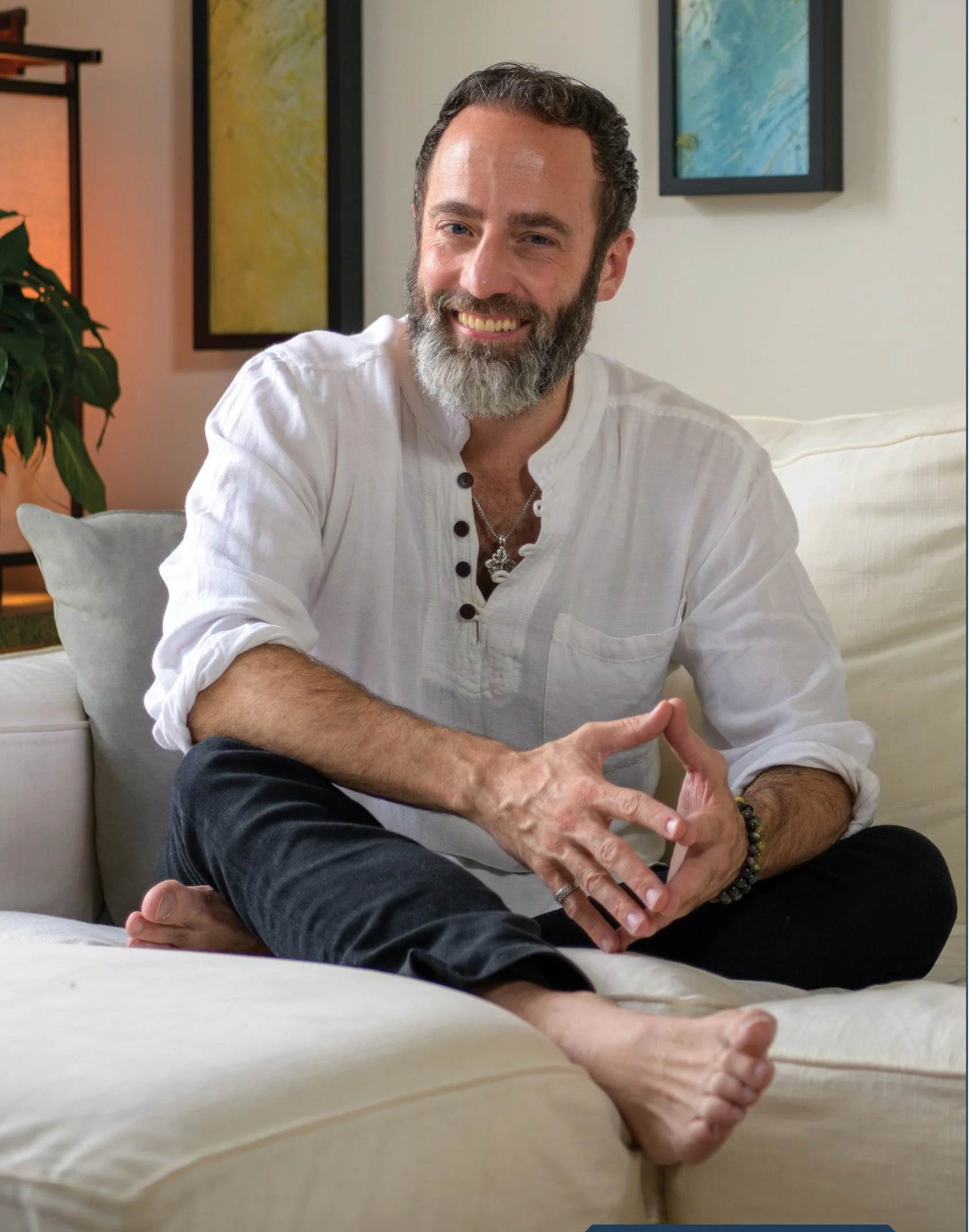
This is getting into C.G. Jung-type stuff – we all have a divine inner masculine and an inner feminine. And it’s the marriage of those two within us that allows us to become fully individuated and whole. This is David Deida working with that. It feels like very traditional male-female dynamics, but really it is not that. It is about the divine and archetypal masculine and feminine energies in all of us.
Bill Zirinsky: What’s going on in the world of understanding masculinity better? What was the thing that kind of said to you, ‘oh, I want to read this, or I want to do this more?’
Daniel DeSena: I think reading Jung was the first step, but then it was the problems in my relationship that really pushed me to explore this. My partner wanted me to read Deida’s book, because it is basically saying, ‘this is what’s not working.’ A lot of it was about what I would consider now to be ‘healthy’ masculinity, and what it showed me is that I had pretty much pushed my own masculinity out the window in favor of what would be considered a sort of a ‘nice guy’ ethic of how to be good to women, how to be nice, how to be kind. And all of that is fine, but I was also pushing away some of the other parts of masculinity that are really life-giving, like the impulse to protect, be fierce when necessary, hold space, etc.
Bill Zirinsky: That’s a really interesting phrase, ‘pushing my own masculinity out the window.’ Say more about that.
Daniel DeSena: Well, my history was that my mother was abused by her brother when she was a kid. My mother had a lot of her own struggles in life, and she was very intent on making sure that I was not going to be one of those guys that would hurt women, and she would sit me down and talk to me about that. She never told me that she was abused at the time, but she was very clear — women are not objects and sex is something that only happens under certain conditions. Looking back, I can feel that there was a lot of fear in what she was saying and I felt that. I remember thinking “Wow, this is really intense. I better not screw this up.” She would even say things like, “You’re not that type of guy… you’re this type of guy…”
Bill Zirinsky: She was kind of signaling to you as to what kind of guy to be.
Daniel DeSena: Exactly, yes. And so, I think I became very, very conscious. And the light side of it is consciousness about treating women well. I try to do that as wholeheartedly as I can. And on the dark side of it is kind of giving up my strength as a man. Any tendency to be angry or any tendency to assert myself, assert my will, was poo-pooed by my parents. Everything was about being nice and kind and loving, and I think I gave up some of the strength that I needed. And of course, other parts of me rebelled, and I had my angry side come out in other ways, of course, because you can’t just push all of that away. That all came up as shadow and would create problems in my life. So, nice and loving and kind and spiritual and all of that versus shadowy, unconscious patterns. I needed to find the balance, and integrate my strength, power, and masculinity in a healthy way.

Bill Zirinsky: And do you feel that this partner of yours handed you this book because she was conscious that you were not able to be assertive enough?
Daniel DeSena: Yes, yes, she was. I’m forever grateful to her for helping me see something…my political leanings were so far on the liberal side… everything is about equality. Everything is. She helped me see that there are ways of understanding masculinity that are very healthy, that also allow for a little bit more spark in the relationship that can’t be there when things are too neutral between a man and a woman.
Bill Zirinsky: Okay, so you began to become interested in men’s work then?
Daniel DeSena: Yes. I started studying with John Wineland, who studied with David Deida. Deida still does some public work, but Wineland is very prominent internationally and teaching this very actively. He has a men’s group, and I joined that. It was an international group that meets both online, and then in person for a couple of long weeks in California.
BZ: Once a year? Twice a year?
Daniel DeSena: [Meeting in person] was twice a year. The first dip in I took with him was what’s called the Embodied Men’s Leadership Training (EMLT) Program, and that met from January to June of 2023. So, we were online, having monthly calls and smaller groups, as well as meeting twice for these long weeks in California. There were about 50 men in this group. We camped in the desert, and also spent a week at Mount Shasta, CA. That was my first foray into men’s work. He’s got his own men’s group influences, plus training with David Deida.
BZ: So, when you attend via Zoom, there were around 50 guys there?
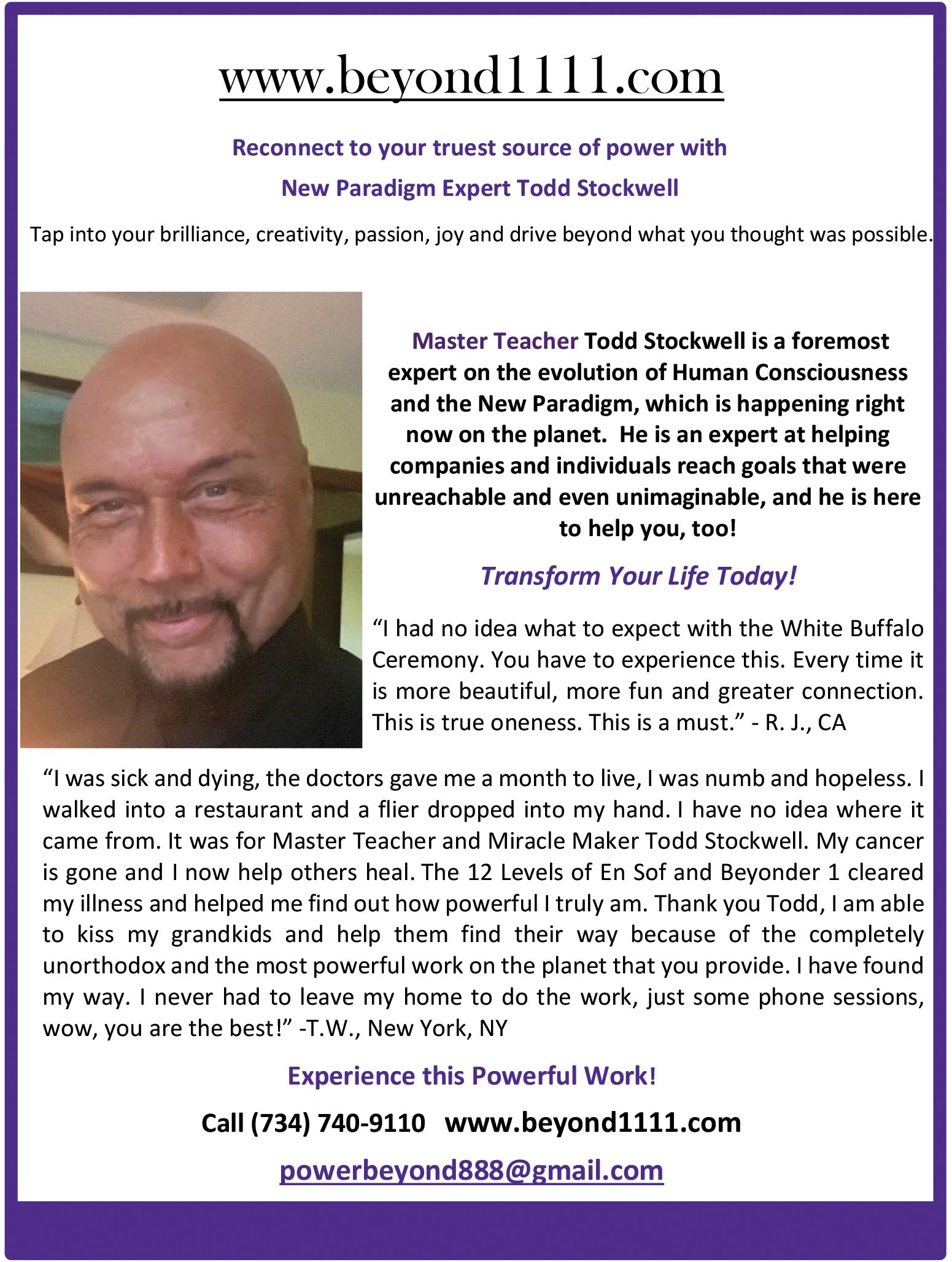
Daniel DeSena: Yeah, on the large group calls, and also we had our own small groups. That’s how I started with it [men’s work], and I never stopped. I’ve done that program three times now. Eventually I came to be on the program team of the group, helping to put on the whole thing. Then I joined another one of his programs, which is called the Teacher Training, Art of Sacred Intimacy. It is a co-ed program where you’re using the types of things you learn in the men’s program, [but] now practicing with women. All clothes on, all very boundaried, but you’re practicing what’s called ‘sexual polarity’ with women. I’m starting my third year in that program. I’ve been studying deeply with him.
BZ: Do you want to take me through each of those programs?
Daniel DeSena: Through the men’s program, I got a certification to lead men’s groups. A lot of it is about what I would consider a balance between men that are learning to shift the sort of classic macho way that men tend to be together, from all you do is just sit and watch sports, shifting away from that, and into men supporting each other. There’s not only the support part, there’s also what we would call ‘sharpening,’ which is, I think, the more masculine part of it. It is being able to sit with men and have them get to know you so well that they can actually see things that you can’t see in yourself, and offer their feedback. For example, how am I shooting myself in the foot? How am I not fully becoming the person that I want to be in the world? I actually now have two of my own smaller men’s groups with friends of mine that I met there. They’re both online because we’re from all over the world. I’ve got these two men’s groups now, of men that are there both to support and also to help me refine what I want to bring into the world.
BZ: At this point, what are you offering locally? When you, for instance, placed an ad in The Crazy Wisdom Journal, is that meant for the men to come together in person?
Daniel DeSena: Yes, I decided to start this men’s group called The Circle of Embodied Men in January of 2025. It was at Zionwell yoga studio. I rented space in the studio, so we had a nice space to come into.
I wanted to start a men’s group that was both there for men to support each other as well as to add an embodiment piece. The embodiment piece is something that I’ve learned primarily from John, my work with him. Embodiment means a lot of things. We do a lot of breath work. We do a lot of archetypal work with different masculine energies, like King energy, Warrior energy, or Lover energy. We do a lot of work with how to challenge the parts of us that are afraid of intimacy. We do a fair amount of eye gazing. I might come up with a practice where I have two men that are facing each other and looking into each other’s eyes, both of them bringing Warrior energy, for instance, and supporting each other in finding the Warrior inside of them, or the King inside of them.
Part [of this exercise] is that we’re working to bring our full selves online through our bodies and supporting each other in that, and building intimacy through that. Then when we’re in the sharing circle, it’s an embodied sharing circle. It’s not just people talking from their heads. It’s people that are really in their bodies, in the present moment, in their own energy, feeling the other person’s energy—trying to be as connected as possible with what’s happening with that person in the moment.
I find that the embodiment part brings people into the moment more. It brings them into the room with this other man, more than when we’re in our conversational, normal day-to-day minds — that’s full of a lot of extra noise that gets in the way of being really present. For anyone that meditates, we know that you have to get into the present moment in your senses, in your space, and get out of your head, right? Well, one way to do that is to meditate. Another way to do that is to get into your body. See the body as a portal through which we can access presence, heart energy, and intimacy. And so, the first part of the group is this embodiment, and it often gets them into their emotions and into their heart and into their bodies and to their energy.
BZ: So, you use certain experiential exercises to help the people who are there to wake up in their bodies and what they’re feeling and expressing themselves clearly.
Daniel DeSena: Yes. And each one [meeting] has a different topic.
BZ: What would be three topic examples?
Daniel DeSena: One was called ‘Ground and Root.’ How do we learn to be more grounded in our bodies, and what does that mean in our lives? How do we bring groundedness into relationship? We did one on ‘Play’ —for men to learn to feel playful energy. We did one on fierceness, how can men have a healthy way to access anger — that is what I would call ‘heart-led fierceness’ — in the world.
BZ: As opposed to dangerous or threatening anger?
DeSena: Exactly. Let’s just say I love my family. Am I willing to do what it takes to protect my family? Now, we don’t think about that a lot because we have a culture where most of us don’t have to do that like you might have had to 20,000 years ago. However, there’s a beautiful energy when I can access the part of me that knows that if someone were threatening my family, I would do what it takes to protect them. And I do think that someone in the family has to have that role, even if it’s just to soothe the nervous systems of the people in the family, whether or not it ever comes down to that or not.
I think a lot of men, they want to be a man in the relationship with a woman, and the ‘man’ of the family, but they’re not really taking on what it means to be a man, because we’ve been trained out of it through the cultures that are trying to protect us from toxic masculinity. Then it becomes ‘toxic masculinity’ versus ‘nice guyness.’ What’s the middle ground there? I believe that’s one thing David Deida has helped us to find. What’s the middle ground between giving up all of your masculinity to become a neutral, lifeless man versus being dominating, bossy, or violent? What’s the middle ground?
What I recognized for myself is that I was missing that middle ground because I didn’t want to be ‘that guy,’ because of what I mentioned before about my mom. There are certain energies that men need to be able to inhabit in their bodies. Fierceness is one of them. If someone wants to have a powerful sexual relationship with a partner who wants to feel the man’s strength and power, then the man can’t be treating their partner like their mommy. And a lot of men do that. You know, they kind of treat a partner like a mother figure, rather than a beautiful, sovereign woman that deserves to get the man’s full strength and masculinity in a healthy, loving way. For me, there were subtleties that I had no idea I was missing. Now I think back to my relationship with Erin, my ex-partner, and I can say to myself ‘Oh, yeah, I really dropped her there.’ She didn’t want me to take care of her in a patronizing way, but rather to have more of an energy of being a strong container for the relationship. And I wasn’t doing that.
So these are the types of things we would work with in the men’s embodiment group.
BZ: And the woman can be the protective container as well?
DeSena: Yes, absolutely. In fact, in this day and age, women are more of that than men are, because it’s culturally sanctioned now for women to be in a position of leadership, which is great. I mean, of course we want that, but then men end up becoming weaker. It’s almost a natural physics to the polarity in a relationship where someone is leading and someone is following all the time on some level.
You hear the trope of a man who is always saying, ‘Yes, honey, yeah, whatever you want, honey,’ right? And the woman is in charge. ‘Happy wife, happy life.’ Now, from this perspective, the woman doesn’t really want that. What the woman wants is for the man to lead—from a place of love and understanding of what the woman needs and what the family needs. If it is the other way around, a lot of resentment builds up. The man says, ‘well, she’s just bossy. She’s taking charge.’ That’s because no one is taking charge, and she feels like she has to do it. If the man learns to take charge in a balanced and loving way, then the woman can relax. And this is where the polarity part comes in. She can relax into the natural parts of her that are feminine. Archetypally, by definition, femininity is more about letting go, relaxing, playing, being in an energy of not thinking and trying to control but more playful and receiving and loving, and that [natural] energy most women have is now lost if you don’t how to work with these masculine and feminine energies that are looking for a particular type of interaction and outlet.
Now, when you start to learn about polarity, you start to go, ‘Oh, I see. We can be equal, and we can play with these energies.’ It’s hard to explain quickly, because it’s almost like physics—like relational physics. But it was the missing link for me. I had been doing couples work, and I’d been in relationships, and I’d been teaching my clients about relationships, and this is the piece I was missing —this piece around understanding masculine and feminine energies that both people can play with within the relationship. That’s what the men’s work and then John Wineland’s polarity work has taught me.
BZ: In the work that you’re doing in these groups, what is the age range of the men in your groups?
DeSena: I’ve had men in their late 20s. I’ve had guys in their 70s. It’s a wide range. I would say that usually it is late 30s through 50s—on average.
BZ: And so even as you’re doing these two groups that are on Zoom with people, you’re also doing this other group that you started in January. How’s that one different?
DeSena: [The group I started in January 2025] I lead it. And it’s also a drop-in group. It’s not the same group of men every time. Right now, I’ve got a group of about 21 men who are like, on the docket, and I’m looking to kind of grow the numbers, to get more people. The other groups are my own personal men’s groups. My men, who support and sharpen me.
BZ: And even as you do those groups are you continuing to do individual therapy with clients?
DeSena: Yes, I’ve been doing both.
BZ: In your day job, you see men and you see women, and do they come for the usual garden-variety range of issues? Or have you specialized your practice so you’re really bringing in, or aspiring to bring in, this masculinity work and the sacred intimacy work into your therapy practice?
DeSena: In general, it’s hard for this piece not to influence what I do. However, with my clients, especially female clients, I’m not bringing in this work—I’m doing more traditional psychotherapy with them. With my male clients that are therapy clients, occasionally, I do bring some of this in because [they are] struggling in the relationship with a woman, and we’ve worked on many other things, but we need more. Sometimes this piece around the polarity can be really powerful and help a man understand what might be causing tension in the relationship. So, I have brought that in with some of my male clients who are in a relationship.
BZ: In the more garden-variety work that you might do with a male client — that is ongoing work with a particular client — and he comes in talking about issues in his relationship with his wife, but he’s not too easily drawn into the more conceptual or esoteric learning about energies. How are you reaching him?
DeSena: It depends on who they are, and their process. Because some people understand this stuff better than others. I think the big shift is being a little more straightforward with men, especially when I can sense that they’re playing out a pattern with their wife, where their wife is mommy and they are a little boy, because that will never work. I think most men have some of this, but it’s clear when you get to a point when they’re saying things like, ‘she never listens to me. She’s not giving me what I want.’ You know all the themes that children go through, where a man is actually expecting something from a woman in order to make him feel better about himself, in order to satisfy all of his biological needs.
I’m pretty blunt with men about that. That’s not her role. It’s not her job to make you feel better about yourself. It’s not her job to give you everything you want. Relationships are not necessarily there just to make you a happy little boy. They’re there to help you grow and to come into your full manhood—like grow out of being a little boy.
So, I do go there with men, usually with men where we’ve been working on understanding their past and understanding how they may be reenacting parts of their past with their current relationships, and to understand that there has to be a point when the man takes responsibility for what he’s creating in his own life, including the woman he’s picked, who he’s not currently accepting as she is. You know that this man has chosen a particular type of life, and he’s created exactly the type of life that he wants. He doesn’t think he wants it, but he’s created it. And from a polarity perspective, the man has to take full responsibility for what is happening in the relationship. It doesn’t mean that he’s at fault for everything, but he has to be willing to take full responsibility, anyway.
BZ: When you use the phrase ‘from a polarity perspective,’ what do you mean?
DeSena: Men need to take full responsibility for what they create in the world, and then take care of what they’ve created. A man is literally choosing and creating the life that he has. It is his own. And a lot of men, when you sit with them and they’re saying, ‘Well, she’s doing this and she’s doing that,’ they’re giving up their sovereign birthright and responsibility to take care of what they have created. Men that are taking full responsibility are truly holding the relationship. This is the masculine role.
I’ll give you an example. My relationship with my partner, which ended about two years ago, was not going well. There was a point when we realized we couldn’t continue. And I took charge, and I said, ‘I’m not going to keep us stuck in a relationship where we’re fighting, we’re floundering, we are stagnant. It’s on me that this has happened. Things aren’t what we want them to be, and I’m not going to let us keep hurting each other this way. I take responsibility for allowing this to happen.’ That’s a masculine leadership role.
Now she might do the same thing – that would be her masculine. But whoever takes the role, it is the masculine that says ‘I’m going to take charge. We need to break up. And who knows what’ll happen after that, but right now, we’re hurting each other. We can’t keep doing this.’ So, that was me swallowing my fear and my pride about having a relationship that we both thought was going toward marriage, and then say ‘no, we have to let go of this, for our own growth, for our own individual selves. We need to change something.’ And I was willing to lead that. I was saying to myself, ‘I have created this. I picked this person. I reenacted my past wounds and created something that is not working with the woman I chose. I take full responsibility for this.
How do you work that out together? There’s a point when you say, ‘yes, we can,’ or ‘no, we can’t.’ I knew that we were not going to be able to work it out from the place we were. I knew in my heart that we had to shift things. As much as I didn’t want to break up, we had to do it. It broke our hearts. We love each other very much. But we had to change something. And it turned out, I think, very well in that way, because we both realized later that we needed space to get our own shit together, so to speak. And so that’s an example of not necessarily leading in order to make it work, but leading to do what is best.
BZ: I want to shift for a few minutes and see where that takes us. This is a time when a lot is being written about and talked about men and masculinity in society. There has been a host of articles and podcasts about the male vote and men. What you’re doing is very interesting work to be doing in this particular time. How does this work, from your point of view, interface with what we’re reading about masculinity?
DeSena: I love this question. Of course, I’m going to be coming from my own biased place, but here’s my sense of it. There is this pendulum that shifts back and forth. I think the reaction to toxic masculinity that led to feminism was a really good thing, because it led to certain things balancing out. Women should not have rights taken away. Women should not be patronized and disrespected. But then, what can be lost in an effort to even the score is nuance. The key is in the details and the nuance.
You can’t throw away masculinity. You have to find a way to have it be healthy. And so I think what’s happening — as we discussed before, is that we are all trying to find a middle ground between toxic masculinity and nice-guyness. Absolute neutrality, [the idea that] there’s no difference between men and women doesn’t work, because as soon as you have no difference between men and women, you lose the beauty that comes from the interplay of the differences between us—the differences are what create polarity, interest and spark.
In order to understand how to keep the spark and keep the polarity, you have to learn about the nuances. The social argument I think should be, first of all, that, from a legal and political standpoint, yes, we’re all equal. Then, I believe that women need to be helped by men to both be equal in society and also be able be allowed to keep their femininity, which is, again, this ability to surrender and relax and allow themselves to really feel the flow of feminine energy moving through their bodies, and surrender, and to trust men. This is not about women doing it wrong, this is about men stepping up!
I don’t think women have done it wrong at all from a masculine/feminine perspective. If men want to be masculine, they have to be willing to take responsibility and create a world that is safe for women. A world that is safe for women to be able to flower into their full femininity, not become just like men. To be equal to men, as fully capable as men, and also appreciated and protected as the sacred feminine beings they are.
Men need to understand how to create a better ‘macro’ structure in society, for women, as well as ‘micro’ in the family for women. That’s our responsibility. That’s why part of the business I’m building is around what I call “self-mastery,” which is for men to take responsibility for their own lives. We’re not here to get something from women. The masculine role is the one that gives. It’s not the one that takes. The feminine naturally takes in and the masculine naturally gives. Men have forgotten that the real pleasure that we can have if we want to be in our masculine role is the pleasure of giving, not the pleasure of taking. ‘Toxic’ masculinity is not really masculinity at all. It is a little boy saying “gimme.” It is about taking and dominating, which comes from fear, not love. Real masculinity is about creating safety, creating strength.
BZ: I read a certain amount of Carl Jung when I was young. He was very big in my college years, but I don’t recall much of what he had to say about sexuality. I can tell you things that he said about masculine and feminine archetypes and all that. Do you know at all what he wrote about sexuality?
Daniel DeSena: I haven’t read all of Jung’s work obviously, there’s so much. One of the most important teachings that I’ve learned from Jung is that the intermarriage of masculine and feminine inside each person is the ultimate goal of our soul. We are on a pathway of ultimately having union inside of us. It’s less about what we do with other people. It’s more about whatever it takes for us to individuate, which means to find this union inside, wholeness in a psycho-spiritual way — it’s your soul’s path to figuring out who you really are, and it’s less about the physical act of sex, and it’s more about who we are as individuals.
If I’m individuated and whole, I’m going to be impacting the world in positive ways. I’m going to be almost magnetic, because there’s a natural draw to people that feel whole. We get drawn to a particular partner because we don’t feel whole, and so we think, ‘oh, I want that part of her. She’s so beautiful. She’s so this or that.’ From a Jungian perspective, her feminine is really my own feminine that I need to see in myself. And when I can recognize that, I am closer to being whole. I’m going to feel much more integrated. And I’m going to be someone who is going to impact the world in healthy ways, in a way that’s going to feel quite attractive to people—not to have sex with—to have a particular transmission into the world that is going to inspire people, maybe to become more whole themselves, to bring their own sort of unique gifts into the world.
I guess what I’m saying is that this is a whole thing. Even with the work I’m doing with men around sex, it’s not to have a better sex life. It is that to some extent, but finding our sexual fullness is also a step toward individuation. It’s a step toward coming into more wholeness in their own lives. It’s the soul’s journey. It’s a meditative path. It’s a spiritual path. The goal is not to have more sex. Maybe you will have more sex. Maybe you won’t. The goal is letting sex be just like everything else in life, a conduit through which your alchemical growth happens.
Bill Zirinsky: There’s more to be said about all this, but I think we’ll leave it at that, for today. Thank you, Dan!
Related Content:




































































































































Mindy Eisenberg founded Yoga Moves MS, a nonprofit adaptive yoga organization, over 20 years ago, providing free classes to those impacted by multiple sclerosis, Parkinson’s disease, and other neuromuscular disorders. Her inspiration? Growing up with a mother with multiple sclerosis who spent the better part of twenty-seven years in bed paired with a profound belief in the healing impact of a regular yoga practice.