By Cashmere Morley
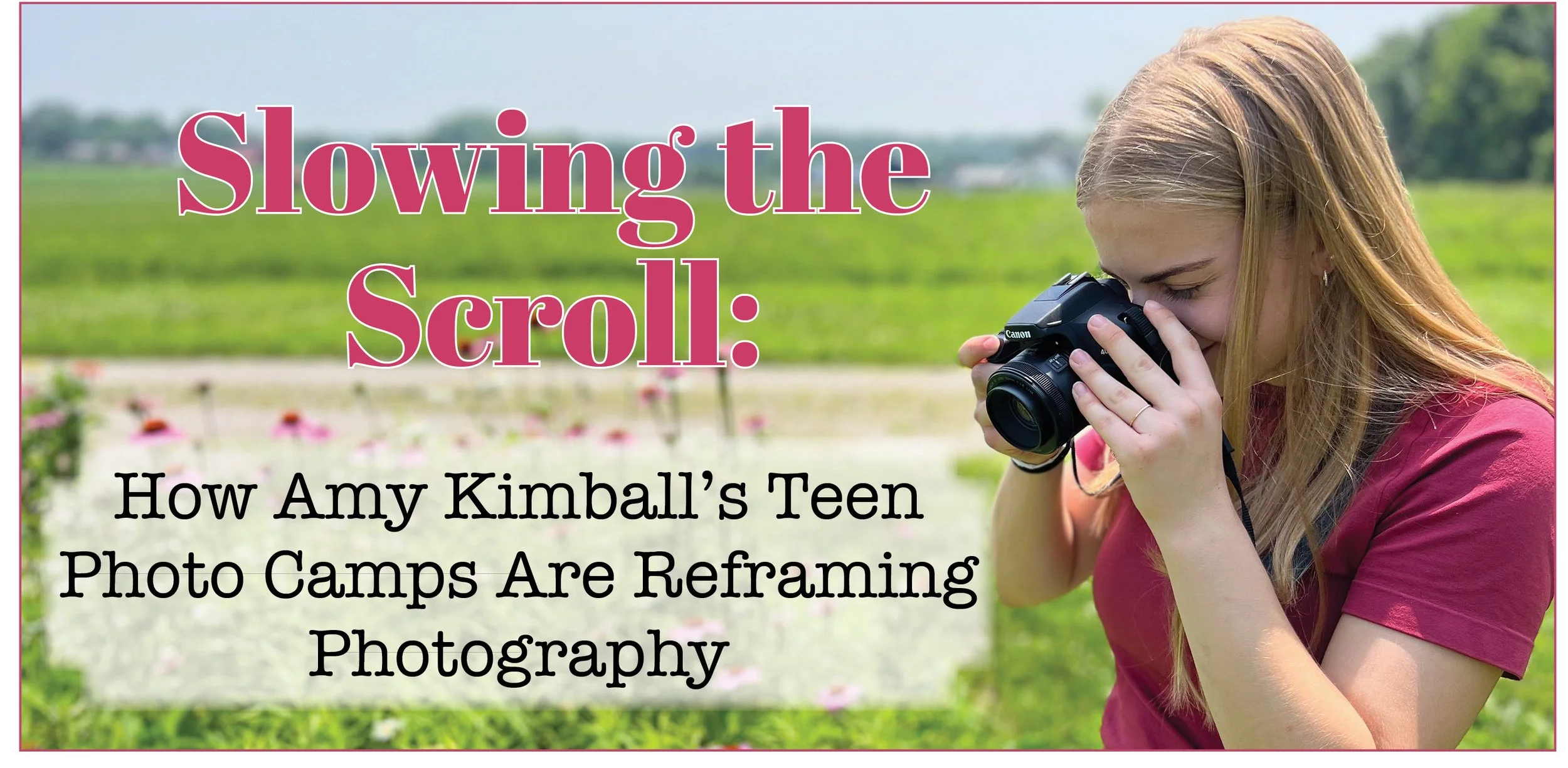
It could be said that teens these days are more inundated with imagery than ever before via the glowing box in their pockets. Everyone is a photographer in 2026. Everyone is a content creator. But when kids are chasing the perfect feed, instead of the golden hour, the art of photography becomes lost. When teens are looking without seeing, snapping without thinking, a disconnect between heart and brain forms that Amy Kimball, of Amy Kimball Photography, is trying to bridge. Enter her teen photo camps.
It’s no accident that the experience of Kimball’s camps feels different from most art camps. From the setting to the structure to the philosophy behind it, the program is built around intention, gentleness, and trust—qualities that are often missing from teenage creative spaces these days.
What Kimball hopes students leave her camp with goes far beyond improved photos. She often returns to a quote by Dorothea Lange: ‘The camera is an instrument that teaches people how to see without a camera.’
“I want students to learn to slow down and see the world differently. They are inundated with images, more than any generation in history, but the images they are exposed to are often trying to manipulate them and sell them on something. This class attempts to help them see the world differently. I want them to be exposed to images that honor, that stir, and that transform,” said Kimball.
That philosophy is part of what makes the camp difficult to compare to other camps out there. Many parents tell Kimball they couldn’t find any similar workshops in the area, and families regularly travel long distances so their teens can attend. In response to the growing interest, and recognizing that not everyone can make it to the farm, Kimball recently launched her first online course. Accessibility, she said, is important to her work and what she can offer aspiring photographers.
Kimball’s own relationship with photography started early. As a teen, she felt she had a strong internal visual world, but traditional art forms like drawing and painting couldn’t quite keep up with how she saw things. Photography did. It gave her a way to translate her perspective clearly and honestly, and it also aligned with something else she’s always loved: people. Working with people felt natural through a camera. The medium offered both expression and connection.
Years later, after being shaped by a deeply influential high school art teacher named Mr. Lambert, and spending a decade teaching photography to teens in a classroom setting, Kimball noticed something important: While she had experience teaching adults, it was teenagers who energized her most. They were fast learners, comfortable with technology, creatively bold, and unafraid to experiment. Just as importantly, she found herself learning from them in return.
The Teen Photo Camp grew directly out of that symbiotic relationship. The first camp launched in 2024, followed by a second the next summer, both hosted on Kimball’s 70-acre working farm in Chelsea. The location, Kimball said, is central to the experience. Days are split between a renovated barn studio, which is modern, climate-controlled, and intentionally relaxed, and long stretches outdoors. Students walk the land, photographing animals, wildflower fields, woods, orchards, gardens, and a pond. The property extends about half a mile back, offering space not just to shoot images, but to get some fresh air.
Technically, the camp is rigorous without being overwhelming. Students learn to shoot in manual mode, understand digital camera functions, work with composition and light, and edit their images in Lightroom [an Adobe photography software program]. They’re introduced to the work of historical and contemporary photographers, and notably, to the work of former teen students. Kimball is intentional about elevating student work, treating it as something worthy of attention and respect.

The camp is co-taught with Kimball’s son Levi, an art major in college. Levi, who is close enough in age to feel accessible, but experienced enough to be genuinely instructive, brings warmth and levity into the learning environment, reinforcing that creativity doesn’t have to be intimidating to be taken seriously.
“The biggest hurdle is confidence!” said Kimball. “Our teens are often told by social media that they are supposed to look and act like everyone else. We are hoping to offer them a break from that for a few days. We create a safe space where they can explore the beauty of the natural world around them and then give them the time to think about how they see the world and what matters most to them. I hope the online course offers this same support—a space to learn confidently and consider themselves gently.”
A typical camp day begins gently. Students arrive at the studio welcomed with snacks, drinks, and time to settle into the barn space. There’s no rigid classroom structure. From there, the day unfolds between instruction, exploration, and practice with large portions spent outside. The farm itself becomes both subject and teacher offering constant opportunities to notice how light changes, how perspective shifts, and how patience affects the final image.
Balancing technical instruction with creative development comes naturally. Teens tend to grasp the mechanics of cameras quickly, so Kimball focuses much of her energy on confidence. In her experience, most teens already have a strong creative voice, they just need reassurance that it’s worth listening to. The role of the teacher, then, is less about shaping vision and more about making space for it.
Concepts like composition, light, and storytelling are introduced through observation rather than jargon. Teens already know when an image works. Kimball simply helps them articulate why. Group critique plays a role, but it’s practiced as “kind critique.” Kimball models a kind critique first, then steps back as students learn to point out strengths in each other’s work. Peer feedback becomes one of the most powerful parts of the experience.
Over the course of camp, transformations happen quietly but unmistakably. Shy students begin to laugh more, connect more, and take creative risks. When peers affirm their work, the effect can be profound. Kimball sees that affirmation take root, meeting a need many teens don’t even realize they’re carrying. Kimball recognizes photography as one of the ways she herself learned confidence and risk-taking, and she sees the same patterns in her students.
Students bring a wide range of equipment, from DSLRs and mirrorless cameras to phones. No one is excluded based on gear. With nearly everyone carrying a camera in their pocket, the focus stays on light, framing, and composition—skills that translate across devices.
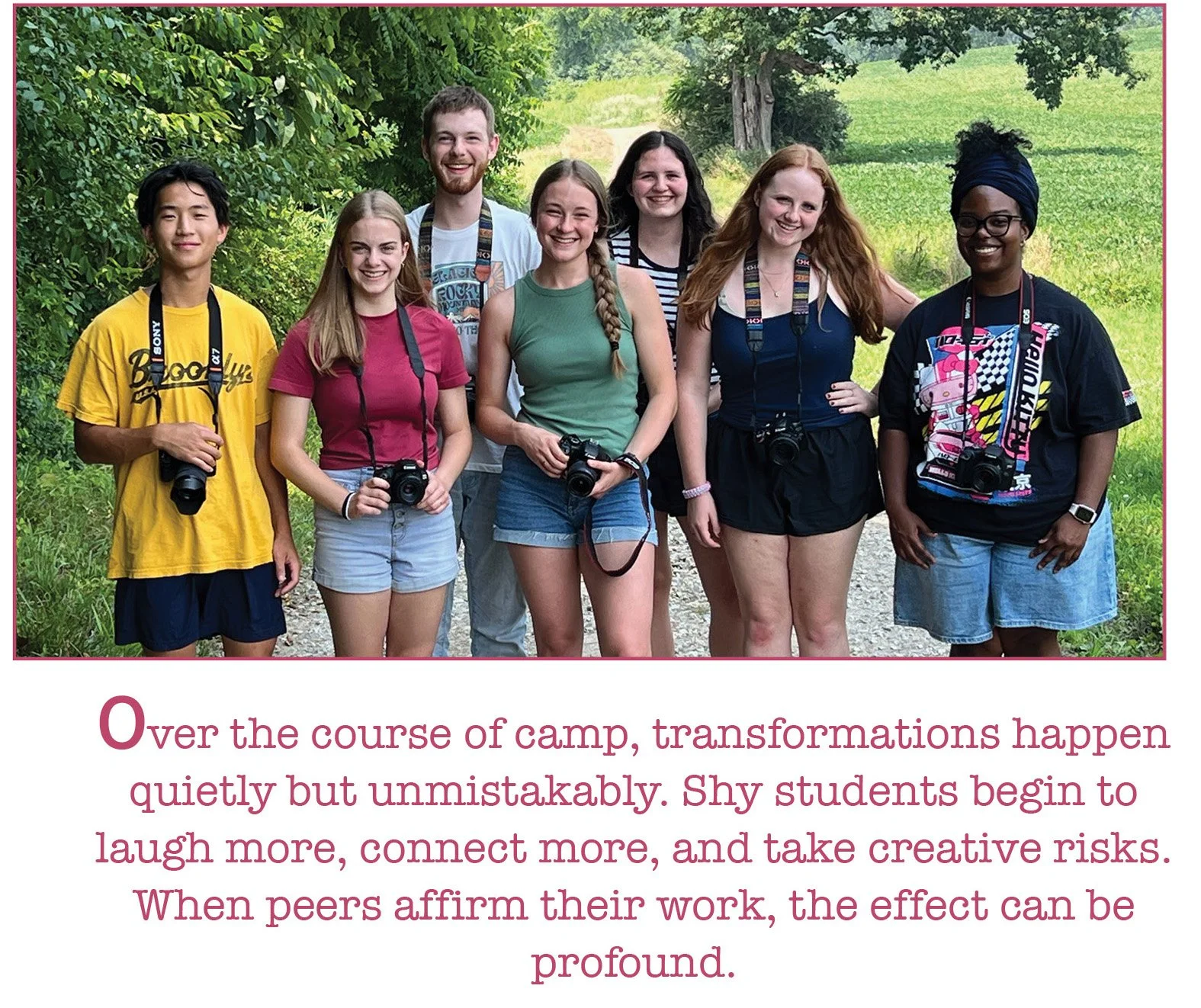
The camp is intentionally small, capped at 15 students. That scale allows for meaningful one-on-one interaction and ensures every student’s work is seen. Scholarships are also a priority. Kimball is clear that finances shouldn’t block access for students ready to learn.
Though the camp has only run for two years, Kimball is already thinking ahead, considering higher-level courses for returning students. What excites her most, though, remains constant: spending time with teens and seeing what they create.
Photography may not be the only path to confidence and voice, but for some teens, it’s the one that clicks. And when it does, the effects ripple outward into travel, family life, business, or simply a lifelong creative practice.
Working with teens, Kimball said, is a reminder of the good in the world. Their ideas, energy, and hope counterbalance the daily noise of larger problems.
“This camp is about teens being in a beautiful natural environment that is also an emotionally safe space to explore photography with other like-minded students,” Kimball said. “They will have the chance to connect with not only an art form, but with each other, and most of all, themselves.”
Discover Kimball’s teen camps online at amykimballphotography.com/2026-teen-photography-camp-ann-arbor-farm-studio or sign up using this form: amykimballphoto.myworkshops.co/workshops.