
By Julie Barron
I have always loved non-ordinary states of consciousness. Long before I had language for spirituality, ecology, or nervous systems, I learned to move between states of awareness through breath.
As a child, that exploration came through music (playing flute and singing) through swimming, and through time spent outside. Breath was my first teacher. It showed me how attention, rhythm, and environment could change how I felt inside my body.
My earliest memories of connection with plants were playful. I rubbed yellow dandelion flowers against my skin and watched them stain me gold. I blew on seed heads and scattered dandelion glitter into the air. Dandelions were a safe, early invitation into the plant world.
As a kid, I spent many waking hours playing flute and swimming. Both were deep experiences with breath, often in nature. One of my most profound musical and breath experiences was playing flute in a large outdoor symphony orchestra at night. The collective breath of the wind and brass sections—taking turns, harmonizing, sometimes breathing together—felt invigorating and deeply mind-expanding. That shared breath felt like an ecosystem in motion: many bodies acting as one living system.
Summers were also spent swimming in Michigan lakes, sometimes doing triple or quadruple lakers—swimming the full length of the lake back and forth multiple times. Immersed in water and surrounded by trees, sun, and earth, I loved extending the capacity of my breath—drawing it in deeply, holding it, releasing it fully.

As I got older, plants again became teachers. First tobacco, then cannabis introduced me to non-ordinary states through ritualized breath. Smoking was never just consumption for me; it was relational. Breaking apart the plant, lighting it, inhaling and exhaling with intention—these acts shaped my nervous system and my awareness.
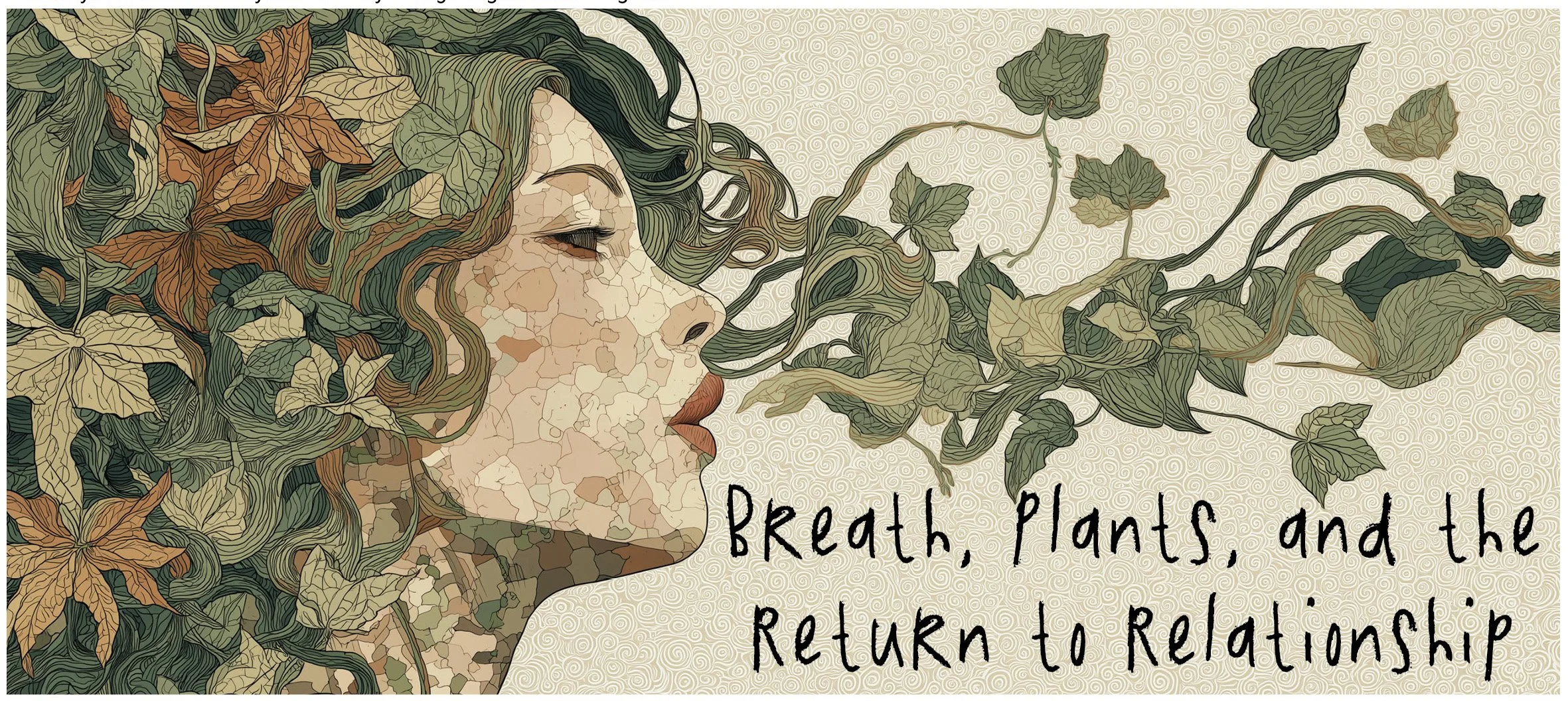
Plants meet us where breath lives, at the border between inside and outside. Through inhalation, plants enter our bodies as scent, smoke, and chemistry. Through exhalation, we return breath back to the world. This exchange is intimate and reciprocal.
Cannabis especially drew me in through the senses—the smell of terpenes, the resin clinging to my fingers, the way scent lingered on skin. My curiosity deepened into cultivation. I learned what plants need to survive and thrive: light, soil, water, nutrients. Caring for plants slowed me down and required me to move at biological time, not human speed.
That care expanded my attention outward. If we want plants to be truly healthy, we want them rooted in living soil, growing within whole ecosystems—alongside insects, microbes, fungi, and one another. Soil mattered. Water mattered. Relationship mattered. Through plants, I came to understand the plant kingdom as intelligent, responsive, and relational. While they used to be all cannabis, my gardens today are mostly medicinal herbs, flowers, and food plants, with a few cannabis plants mixed in—still there, in part, because of their beauty.
Later, fungi became my teachers. Living in Colorado, I frequently encountered Amanita Muscaria while camping and hiking—those unmistakable red caps dotted with white. Psilocybin mushrooms, like cannabis before them, invited me into deeper relationship rather than control. I wanted to understand how they grow, how environments support them, and how little mastery we actually have.
I never became especially skilled at cultivating mushrooms—contamination taught me humility—but my respect for fungi only deepened. Through study, foraging, and experience, fungi revealed something essential: connection does not always announce itself. Like breath, it is often invisible, yet fundamental.
As my personal and spiritual growth expanded through these plant and fungal relationships, familiar questions returned: How do we care for soil? What water is truly healthy? How do mycelial networks interact with plants, animals, and us? I began to see Earth’s ecosystem as an even more vast, intelligent whole—one that I am inseparable from. What I do matters, not in some abstract cosmic sense, but locally, relationally, here.
Research has begun to echo what many Indigenous cultures have long known. Biologist Monica Gagliano’s work suggests that plants not only produce electrical signals but also respond to sound—orienting roots toward water frequencies and responding to the sound of predators chewing on nearby leaves. Other studies suggest that the sound of bees signals some plants to quickly increase sugar production, making their flowers more attractive to these pollinators. Because plants do not have centralized brains, humans often discount their intelligence. As Gagliano said, they are “feeling bodies.” Plants don’t speak in words; they require a different kind of listening. How we listen shapes how we live.
For many people, “connecting with nature” can sound abstract or effortful. Plants and fungi make connection tangible. Their scents, colors, tastes, and forms attract us. Apples invite sweetness so seeds are spread. Thorns and bitterness create distance. This is not by accident—it is ecosystem intelligence. Some plants attract us by altering our states of mind.
Personal experience, ancestral lineages, and emerging research are exploring these relationships. Research on psychedelic plants/fungi suggest these substances can facilitate self-expansion by softening self-boundaries and increasing emotional and empathic awareness. Other studies have found that psychedelic experiences are associated with lasting increases in nature relatedness and psychological well-being.

Psychedelic plants and fungi can temporarily dissolve the boundary between self and other, between human and non-human. In one psychedelic journey, I experienced traveling backward through time. I felt as though I was tracing the story of my DNA—through humanity, animals, plants, fungi, water, and particles. Since then, I feel these beings not just as evolutionary foundations, but as my ancestors. Experiences like these often shift people from egocentric worldviews toward ecosystem-centered ones. As many Indigenous traditions teach, nature is not a resource—it is relationship. Reciprocity is the difference. Plants benefit from us, and we benefit from plants. For a long time, I was largely unaware of that balance, even while deeply in relationship. Over time, that awareness changed not only how I gardened, but how I acted.
My love for plants and fungi eventually grew into advocacy. I began to question how policies came to classify certain living things as illegal or dangerous, despite their long histories as teachers, medicines, and ecological partners. This questioning led me into work to decriminalize psychedelic plants and fungi—to challenge systems that treat them as contraband rather than relations. Today, I work with and for plants and fungi, and they work with and for me. This is not ideology for me; it is practice.
I believe our modern disconnection from nature is a source of profound dis-ease. We live out of rhythm, imagining ourselves as controllers rather than participants. Societies may win short-term power struggles with nature, but Earth always endures. Healing, I have learned, does not come from force. It comes from listening. From quiet. From rest.
Plants and fungi thrive in relationship, not extraction. Through scent, sound, beauty, and altered perception, they help us remember our belonging. Plants are not passive objects of appreciation. They are invitations.
And breath—shared, exchanged, and returned—is often how we learn to connect.
Julie Barron, MA, NMIT is a pioneer of the Michigan alternative healing and psychedelic community. For over 30 years she has done extensive research and training in the health & spiritual benefits of cannabis and entheogenic plants/fungi. Barron has devoted her practice at Blue Sage Health Consulting to helping clients find healing and relief as they incorporate these practices on their path to wholeness. You can learn more about practices of integrating breath, music, and plants/fungi at Blue Sage Health Consulting in Ann Arbor or email bluesagehealth@gmail.com.
Read Related Articles:
































































As I got older, plants again became teachers. First tobacco, then cannabis introduced me to non-ordinary states through ritualized breath. Smoking was never just consumption for me; it was relational. Breaking apart the plant, lighting it, inhaling and exhaling with intention—these acts shaped my nervous system and my awareness.