
By Kirsten Mowrey
“My own spiritual observation has been that a small ‘self’ suffers and causes suffering; that a love of the living world lets single identities and selfhoods expand and encompass other beings, entities and whole landscapes, such that the self becomes a spacious thing.” — Robert McFarlane, Is a River Alive?
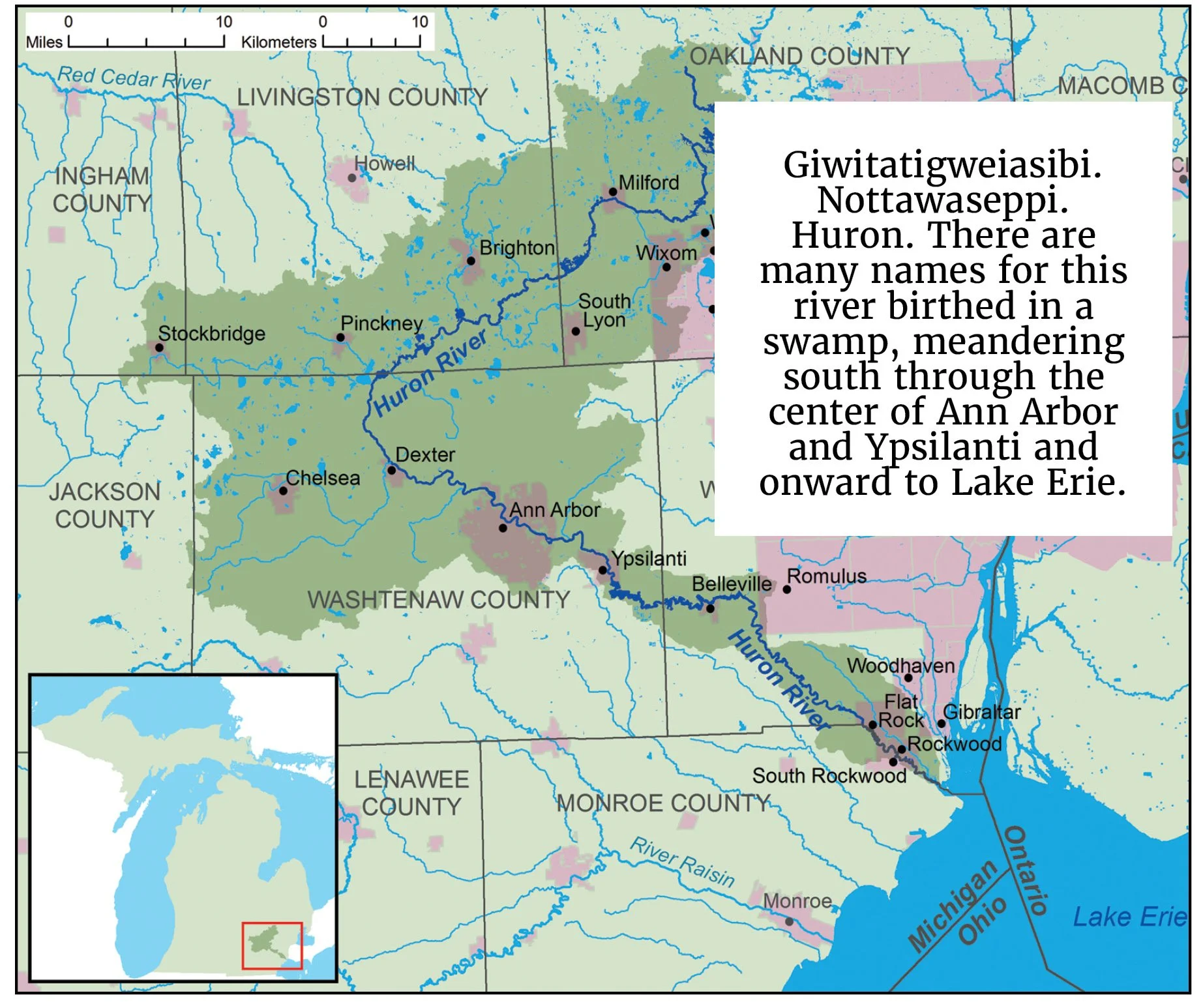
Giwitatigweiasibi. Nottawaseppi. Huron. There are many names for this river birthed in a swamp, meandering south through the center of Ann Arbor and Ypsilanti and onward to Lake Erie. Cos-scut-e-nong, sebee,“burnt oak river,” connecting upstream and down, invites us to a wider sense of self, neighborhood, and community. I spoke with Rebecca Esselman, Executive Director, and Jason Frenzel, Director of Community Engagement, both of the Huron River Watershed Council, about our local river.
Kirsten Mowrey:
How would you characterize The Huron River?
Rebecca Esselman:
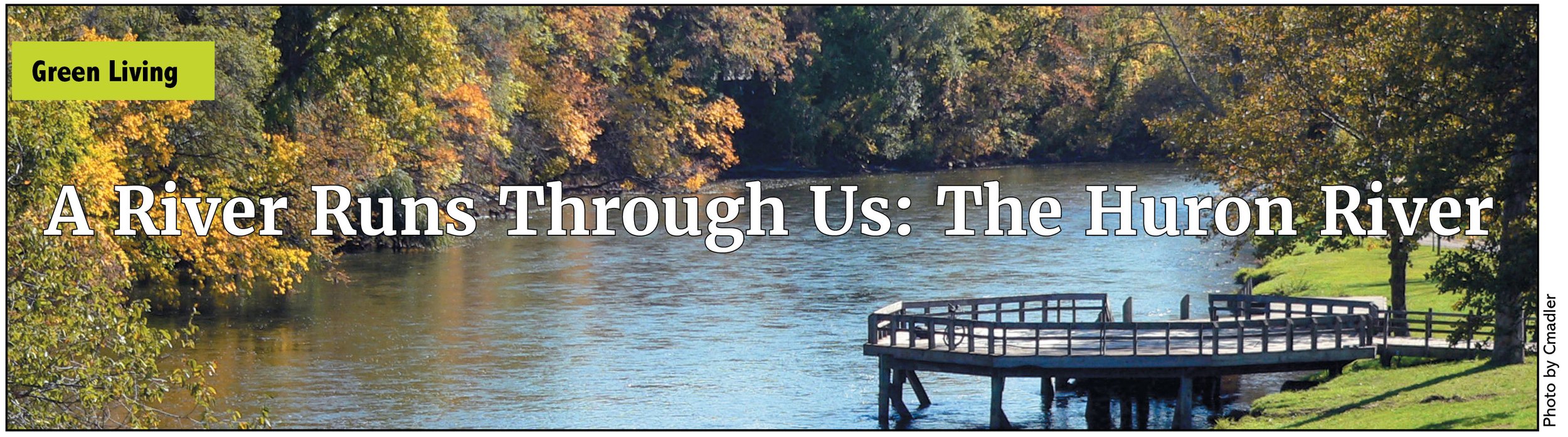
For southeast Michigan, it is a really beautiful river with lots of natural settings still. If you look at a map of the watershed, the headwaters are in Oakland and Livingston counties, which are still relatively rural, relatively forested. The Huron River has something called the Natural Rivers District, a state designation that limited the amount of development that could happen adjacent to the river. That’s why when you paddle the Huron, you see forest and not homes.
Kirsten Mowrey:
What section of the Huron is legislated as that?
Rebecca Esselman:
It’s from about Milford area down to Ann Arbor. Once you get into Ann Arbor and head east, that designation stops.
Kirsten Mowrey:
When did the idea for The Huron River Water Trail come into existence?
Rebecca Esselman:
We had the designation in 2015. The Huron River Water Trail is both a state and a federally designated water trail. The state water trail program was initiated by Governor Snyder to draw attention to our inland water resources. There’s some promotion but no designated funding from state sources.
Because the Huron River has a strong watershed council with capacity, we have become the stewards of the water trail. We did a lot of fundraising in order to build it up and make it more accessible: signage, mile markers, kiosks at entry points, docks—we fixed up portages around dams. We’ve created, printed and sold “The Paddler’s Companion,” which is a map of the water trail (now in its fourth edition).
Kirsten Mowrey:
What are ways people can connect more intentionally after they have these recreational experiences? What engagements are possible for curious children?
Jason Frenzel:
I’ll separate what we do and what one can do. Our base level work is participatory science. Volunteers come out and help us collect scientific data about water quality. It’s very educational. Many of the activities are family friendly, for those who can focus for 30 or 40 minutes. That’s great for young people.

Really broadly, all of our municipalities have stormwater runoff, which is a big concern for us. Stormwater carries pollutants, but it also carries trash into the river. Anywhere where there’s a storm water system in any of our municipalities, the road and the parks are directly connected through the pipes to the river. Collecting trash in the water, near the water, or in the parks and streets, is all important. That can be done just as we’re taking a walk with our dogs.
Rebecca Esselman:
We have an adopt a storm drain program that is really good for young people or families. It’s a great way to communicate to a young person who thinks the river’s over there [gestures to the left] that it’s really right here [points to self]. Forming that connection, even if you can’t visually see the river or a lake, [that] we are all connected via this watershed. I think storm drains are a really great point of entry for young people and adults, frankly, to understand the watershed concept and how what we do on land is directly connected to our waterways.
Kirsten Mowrey:
In Robert McFarlane’s latest book, Is A River Alive?, he writes, “We must hugely widen the space of relations,” to start to see our connection to the water. In the case of anyone who lives in Ann Arbor, their drinking water comes from the Huron, so they have a direct relationship, the river is in their bodies.
Rebecca Esselman:
There are very few places in the state of Michigan where a drinking water source is surface water that’s not the Great Lakes. There’s a unique connection to water at this spot on the map. Another beautiful connectivity piece of river work and this watershed concept is everyone upstream is an impactful neighbor. There are tangible connections between people in Wixom, Milford, Brighton, and those in Ann Arbor. Whatever benefits or detriments to the river that happen upstream, they reach this community here. Likewise, whatever Ann Arbor residents do with the river impacts Ypsilanti and Flat Rock and our neighbors downstream. These might be places that you feel very disconnected from if you’re just thinking about roadways and distance. But if you think about the way water and rivers move, you’re absolutely connected to these places and the people in them. It really expands your view of your neighborhood.
Jason Frenzel:
The watershed isn’t only the place where there’s flowing water. If you remember the water cycle—[mainly] precipitation. Historically most of that precipitation would have infiltrated to become groundwater. Now we’ve intercepted that with these impervious surfaces, which becomes storm water, which goes directly into the river. We’ve augmented the water cycle. If you think about the water cycle and the watershed, all the folks who get their drinking water, municipal or residential, from drinking water wells, the groundwater, that is part of the watershed.
Kirsten Mowrey:
That stormwater runoff affects the groundwater that they’re pulling from?
Jason Frenzel:
The stormwater is often separate from the groundwater system, but if you think about the water cycle, it’s all part of the same system. It’s [just] moving through the system in different ways.
Kirsten Mowrey:
Jason, let’s say I’m newly retired—are there ways that I can contribute?
Jason Frenzel:
[One of] our biggest two programs [a newly retired resident can contribute to] is the benthic macroinvertebrate study. Those are aquatic bugs. We do one [study] in the middle of winter, one in the middle of spring, and one in the middle of autumn. Stone Fly and River Roundup, is a four or five hour commitment once. Bring a friend or a family member, very good for folks with kids. It’s a great way to see if this is a thing that you like doing. With that program, because it is episodic, we’ve seen young people volunteer with us year after year. Some now are our peers, because we’ve been doing that program for 35 years. We have people doing research in other states about waterways that came through that program when they were children.
A slightly more intense program that we do is our chemistry and volumetric flow analysis. We have a training that happens late in March every year. It’s an orientation for how you go about doing this. We ask people to come out a few times over the growing season, spring to Autumn, and do that analysis. In both programs, there’s a small team of advanced volunteers who will make sure that new volunteers feel comfortable. It’s social fun, getting to know people who are of similar disposition or interest. Those are the two biggest projects that we have that are science related.
Rebecca Esselman:
I’d like to talk about the quality of the river. Because there are a lot of remaining forests, the health of the river is pretty good for an urban stream. But as we are getting more development, [both] industry and residential, we are starting to see some places in the Huron River where our biodiversity is declining. We are at this frontier in the Huron, as development moves west, where we have an opportunity to do right by the river. I think that that’s something that we should all be carrying as we’re thinking about how to be good river stewards at this time.
Kirsten Mowrey:
With the watershed touching so many communities, that really asks us to stretch who we’re thinking of when we’re looking ahead. All of this is happening in the context of water being a defining characteristic for our future going forward.
Rebecca Esselman:
In southeast Michigan, we are seeing more frequent large rain events. That’s the impact [of climate change] that’s hitting us first, and it does have consequences for the health of the river. We’re seeing more and more flooding impacting our built environment—basement flooding, roads getting washed out or not being traversable for a period of time. That’s our new reality in southeast Michigan, and something that we actively think about when we’re implementing water protection strategies.
Kirsten Mowrey:
I imagine that it really applies in the work the council does with municipalities around storm water runoff, because that’s changing so rapidly.
Rebecca Esselman:
It does. Rain gardens, which fall under this umbrella of green storm water infrastructure, is another thing that residents can engage with that helps the river, helps mitigate climate change, and helps reduce the impacts of those large storms. Rain gardens are usually native plants in a garden bed that has a bit of a depression that allows rainwater to collect on your property and infiltrate into the soil. It now moves slowly through the system as opposed to hitting pavement, or even lawns, where it tends to run off rapidly, hit the river too much too fast in ways that cause erosion, pollution, and other types of damage. That’s a personal action that we promote—a household level action to help with the challenge of climate change. (For more tips on planting a rain garden, read our article, “Now is a Great Time to Plan Your Rain Garden” at Crazy Wisdom Community Journal online at thecrazywisdomjournalonline/2022/12/15/green-living-now-is-a-great-time-to-plan-your-rain-garden?rq=rain%20garden.)
Kirsten Mowrey:
I know slowing water down is a big thing, but I also know that one of the most difficult things around that seems to be the aesthetic. People look at native plants and they see weeds. Do either of you have comments about that aesthetic conversation?
Jason Frenzel:
We participate in the Master Gardener training course, which we, along with all of our sister organizations, offer at the end of winter in preparation for spring. That course allows folks to design their rain garden in whatever aesthetic they would like.
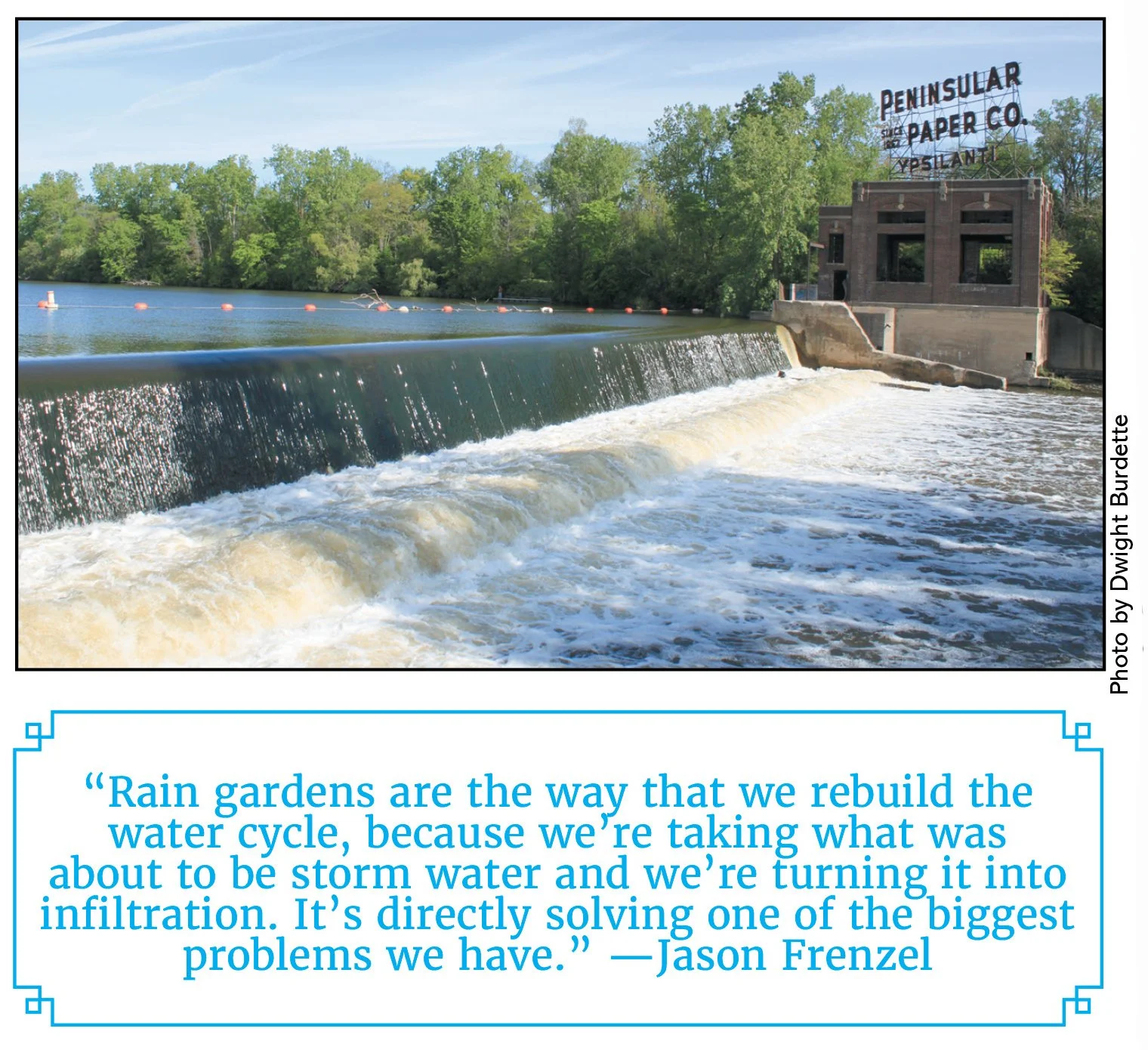
Remember earlier in our conversation, where the impervious surface intercepts the rain? It breaks the water cycle. Rain gardens are the way that we rebuild the water cycle, because we’re taking what was about to be storm water and we’re turning it into infiltration. It’s directly solving one of the biggest problems we have. That is the take home that we try to send to people.
Kirsten Mowrey:
Do you have a favorite place on the river that you would like people to discover?
Jason Frenzel:
Just downstream of Belleville [the Huron] is this really beautifully snaking river. There’s lots of Metro Park there, and so the river still can meander in the way that it wants to, unimpeded by dams. Down river from there is Oakwoods Metro Park, and it becomes a braided river where the sinewyness starts to intercept itself. It feels like a really different river and yet it’s the same water.
Rebecca Esselman:
The Huron River starts in Indian Springs Metro Park up in Oakland County. It’s just a little spring that comes out of the ground, seeping into a wetland. I think it’s a fabulous field trip for folks in Southeast Michigan to go see where a river begins, [to] know what it looks like.
One other potential idea is Point Mouillee where the river ends. It’s a marshy delta area that has amazing waterfowl. It’s a very popular stopover point for migrating birds of prey in the fall. It’s cool to see where a river enters a great lake, and it’s also very unique from a wildlife perspective.
Kirsten Mowrey:
Now I’m going to throw you a reach question which is: New Zealand has made a river a person with legal rights. Do you think that’s possible for the Huron in your lifetime?
Jason Frenzel:
If we can do it for corporations, why can’t we do it for nature?
Rebecca Esselman:
There is a researcher at the University of Michigan, Oday Salim, who is exploring this idea in the US. That is the direction I would like us as a society to head. To have a reverence, a respect, and understanding of the value of water to our health, our wellbeing, our existence, and to behave in ways that recognize those connections.
The Huron River Watershed Council is funded through members. To support their work or discover programs, visit their website hrwc.org. To learn more about Kirsten Mowrey and her work, visit kirstenmowrey.com.
Read Related Content:


















































Giwitatigweiasibi. Nottawaseppi. Huron. There are many names for this river birthed in a swamp, meandering south through the center of Ann Arbor and Ypsilanti and onward to Lake Erie. Cos-scut-e-nong, sebee,“burnt oak river,” connecting upstream and down, invites us to a wider sense of self, neighborhood, and community. I spoke with Rebecca Esselman, Executive Director, and Jason Frenzel, Director of Community Engagement, both of the Huron River Watershed Council, about our local river.