
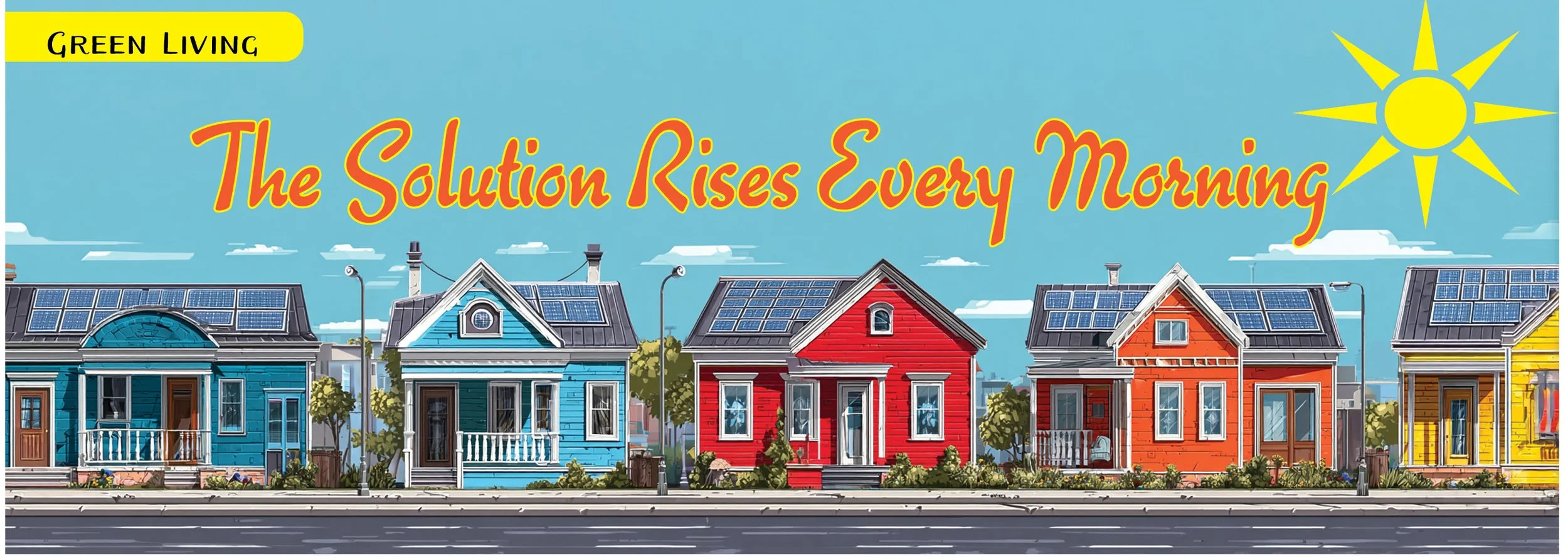
By Rosina Newton
What do you think of when you hear about solar energy?
I’m thinking that in an ideal world I wouldn’t even be writing this article. If our ancestors had greater wisdom and foresight, every structure on earth would include solar power. They would have seen the sun as the most obvious energy source with the least amount of toxic waste. Early investments in research would have led to advanced solar material recycling as part of a well-developed circular economy. We would not be debating about or fighting for solar energy in 2026.
Yet here we are, in a climate crisis of our own making paying higher and higher monthly fees to DTE whose electricity is generated using 86% fossil fuels or otherwise unsafe sources.
In 2024, electricity from DTE was generated predominantly by coal (41%), natural gas (26%), and nuclear energy (19%). The environmental hazards of coal are well-known. Hazards of natural gas have been greenwashed for decades, even before we knew about fracking. Natural gas contains 95% methane which has a Global Warming Potential (GWP) 27-30 times greater than carbon dioxide according to the EPA.
“Nuclear power may be the key to a clean energy future in Michigan,” declares an MLive news piece covering plans to reopen the Palisades Nuclear Power Plant on the shores of Lake Michigan. To call nuclear “clean energy” simply because it doesn’t produce greenhouse gasses is like saying automobile crashes are not dangerous because they don’t cause cancer. To have faith in nuclear energy we must have amnesia about Three Mile Island, Chernobyl, and Fukushima. To believe that nuclear energy is “clean,” we must ignore the facts about the massive, embedded energy, toxicity, and environmental racism in the industry, from mining uranium and building reactors, to building immense radioactive waste storage facilities. Finally, we have to agree to forget about lethal radioactive waste. In her Forbes article, Christine Ro says that the high-level nuclear waste, “according to some, needs to be safely stored for up to a million years.” That’s too big a number, so “regulatory authorities” decided that “nuclear waste sites operate on [a] much shorter [timeframe]: often 10,000 or 100,000 years.”
As Nathaniel Johnson writes in his Grist article, “Nobody…wants to get stuck with nuclear waste that stays radioactive for 10,000 years—but perhaps some would prefer that to coal waste which contains mercury and lead and remains toxic forever.”
If coal and nuclear were our only options, our choices look bleak. Yet sometimes the simplest and best solution is in front of us. All life on earth depends on solar energy; our homes and businesses can too.
The U.S. Department of Energy states that, “enough energy from the sun hits the earth every hour to power the planet for an entire year. There are obvious advantages to solar PV technology. It produces clean energy. It has no emissions, no moving parts, it doesn’t make any noise, and it doesn’t need water or fossil fuels to produce power. And it can be located right where the power is needed, in the middle of nowhere, or it can be tied into the power grid.”
I met two neighbors in Southeast Michigan who are putting solar energy to work in their local community. Rev. Joan Ross and North End Woodward Community Coalition of Detroit (MyNEWCC.org) have completed 19 solar projects in addition to other impressive social justice work. When Detroit neglected to repair streetlights, they installed solar-powered streetlights for safety. They installed off-grid Wi-Fi/charging stations so that residents can stay connected during DTE power outages. NEWCC also installed no-cost rooftop solar systems for low-income residents. Speaking about their solar energy and climate change school curriculum, Rev. Joan said, “The sun shines on more than just the rich people. It shines on you. Let’s show our children how they can use what God’s given u—the sun.”
When Dave Strenski started SolarYpsi.com in 2005, he wanted people all over the world to be able to find the solar energy information they needed on his website, and he wanted Ypsilanti to be the place for solar. He, along with a network of volunteers, install solar power on any roof they can, including the Ypsilanti fire station. In 20 years, Solar Ypsi has brought in over a half million dollars in funding for solar projects, and Ypsilanti became ranked as a “solar leader” in a 2019 Environment America report.
Both Dave Strenski and the NEWCC are seeking funding for upcoming projects; unfortunately, they both lost crucial potential funding when the Trump administration cancelled all Solar for All grants.
The federal solar tax credits were axed also. This is a blow to clean energy industries, as well as residents and businesses who want to disinvest in DTE’s dirty electricity. Not only that, as Chris Hopper points out in Fortune.com, it “weakens domestic energy output just as the country faces surging demand—weakening our energy resilience and adding at least $2.8 trillion to our national debt.”
However, Mark Hagerty of Michigan Solar Solutions shared a refreshing perspective. Their research showed that, because of DTE’s incessant rate increases, by investing in solar now a household or business could still get the equivalent of that federal rebate soon enough. Adding solar energy mitigates these volatile rate hikes. In addition, Strenski says that with the elimination of the federal tax credit, “there might be a glut of solar panels on the market lowering the price.”
I was surprised to learn that the photovoltaic effect—the science behind solar panels—was discovered in 1839. The first solar panel was installed on a rooftop in New York City in 1884. Photovoltaics (PV) starts with extremely thin solar cells that absorb the sun’s energy and turn it into electricity. Multiple cells are embedded into a sturdy panel that is approximately 3.5’ x 7’, less than two inches thick, and weighing about 50 pounds. An array of several panels can be installed on a roof or the ground.
The electricity produced by solar panels is DC, or direct current. To function in our homes, DC electricity is converted into alternating current (AC) by adding an inverter to the system. Voila! This is the simplest PV arrangement to offset our electric bills and reduce our contribution to global warming.
To get power during an outage and bigger savings on our electric bill, a battery system is added. How long you have power in an outage depends on the battery size, how much of your home is managed by the battery backup, how energy-conserving you are, and what time of year it is. Hagerty said, “The same battery might last for days in the summer, but hours in the winter.”
With the most advanced system – with a generator and a smart home load panel that manages usage – power can last for days, weeks, even months. This is called a microgrid – it provides power if you’re connected to DTE or in the “middle of nowhere.” Generators could be powered by natural gas, propane, or diesel. Some “preppers” who plan for grid failure choose diesel so they can use biodiesel.
Home solar energy system costs range from $7,700 to over $34,000, with the average being $16,600 to $20,500 for a 6.5kW system, according to a 2025 Forbes article. For a typical Michigander who uses about 20kW per day, it may cost a minimum of $15,000 to install 5kW of solar panels at $3 per watt. To add enough battery to cover a couple of days’ blackout, it might cost a couple thousand dollars. This again, depends on what all is connected to the battery and how conservative you are with energy. The Great Lakes Renewable Energy Association (2glrea.org) is a great place to learn more about solar, and they provide a list of installers.
Even without the cash for this large upfront investment, residents can still acquire solar energy. First, Forbes and Nerdwallet compare several lenders and provide information on solar financing options with no down payment. Second, groups like NEWCC and Strenski’s SolarYpsi actively seek funding for low-or no-cost solar. Finally, the Honnold Foundation funds solar energy projects all over the world. In fact, NEWCC was a 2019 Honnold grantee.
Once the investment is made, a solar power installation pays for itself in energy bill savings within an estimated seven to 12 years. Hagerty said, “It’s like getting a pay raise.” If you combine solar power with conservative energy usage, it’s possible to reduce electricity payments to the eight or nine dollars for basic connection to the DTE grid. Solar power is a good financial investment and an investment in our planet’s future—away from fossil fuels and nuclear waste.
Solar panels can last decades. The U.S. Department of Energy reports that “The estimated operational lifespan of a PV module is about 30-35 years, although some may produce power much longer.” “Panels are made from tempered, shatterproof glass and are designed to withstand up to 1” diameter hail strikes at over 50 mph as well as wind and snow loads up to 112 pounds per square foot (psf) according to Srinergy.com.
Isn’t Michigan too cloudy? Too far north? What about snow? Strenski explained in his TEDxEMU talk, Michigan gets about four hours of peak solar power per day–direct, perpendicular sunlight on our panels. Germany is the world leader in solar energy, and they get three hours of peak solar. By comparison, California and southern Arizona get six hours of peak solar. “Google Project Sunroof” (sunroof.withgoogle.com/sunroof.withgoogle.com) is where you can see how viable solar energy is for your structure.
Solar panels emit a small amount of heat, so snow may melt, or it can be brushed off with a snow removal tool made for solar panels.
Is solar energy the truly ecological energy choice? Yes, and…we have a dire challenge ahead of us. In Maddie Stone’s Grist article, “The solar e-waste glut is coming.” Right now in the U.S., it costs more to recycle PVs than to landfill them. In the 2021 Harvard Business Review article entitled “The Dark Side of Solar Power,” authors Atasu, Duran, and Van Wassenhove wrote “The International Renewable Energy Agency (IRENA)’s official projections assert that “large amounts of annual waste are anticipated by the early 2030s” and could total 78 million metric tons by the year 2050. We need much more research and development into solar technology now, instead of retarding the science. An August 2025 press release from SolarCycle reports, “Illuminate USA, the largest single-site solar panel manufacturer in North America, has signed a five-year agreement with SOLARCYCLE to purchase domestically-manufactured solar glass....SOLARCYCLE, a technology-based solar panel recycler and materials company, will produce glass using recycled materials from retired solar panels, further strengthening the circular economy for clean energy manufacturing.” This is good news, and we need more of it.
Dave Friedrichs, founder and principal of HomelandSolar.com, takes the long view. He says, “the cost of power direct from Mother Nature, versus cost involving fabrication of ‘fuels,’ is absolutely less for solar (and wind or waves). We believe economics and science alone will drive us into a more natural, hopefully sustainable, future for our planet.”
Is solar energy the panacea to all our energy problems? Can we ditch all other forms of energy and survive on solar energy alone? We don’t know yet, because we haven’t come close to utilizing solar energy to its fullest potential. However, it is heartening to know that we can have personal power regarding our own energy usage. Additionally, by investing in and advocating for solar energy, we can benefit financially, reduce our impact on global warming, and be a good ancestor. As Arthur Ashe said, “Start where you are, use what you have, do what you can.”
Rosina Newton is an ecological horticulturist with over 40 years’ experience, specializing in organic gardening, native plants, and landscape design for biodiversity. She is a writer, herbalist, and creative visionary who enjoys planting the seeds of a wiser and healthier future for all. Say hello or find out about an upcoming co-visioning project by emailing rokanew@proton.me.
Read Related Articles:




















































































































































For many, ghost stories belong solely to the crisp nights of October. But for Crysta K. Coburn and Kay Gray, the minds behind the Haunted Mitten Podcast, the eerie history of the Great Lakes State is a year-round passion. Having recently wrapped up their seventh successful season, the duo has spent years transforming dusty library archives, maritime tragedies, and local folklore into a gripping, highly successful narrative podcast.