
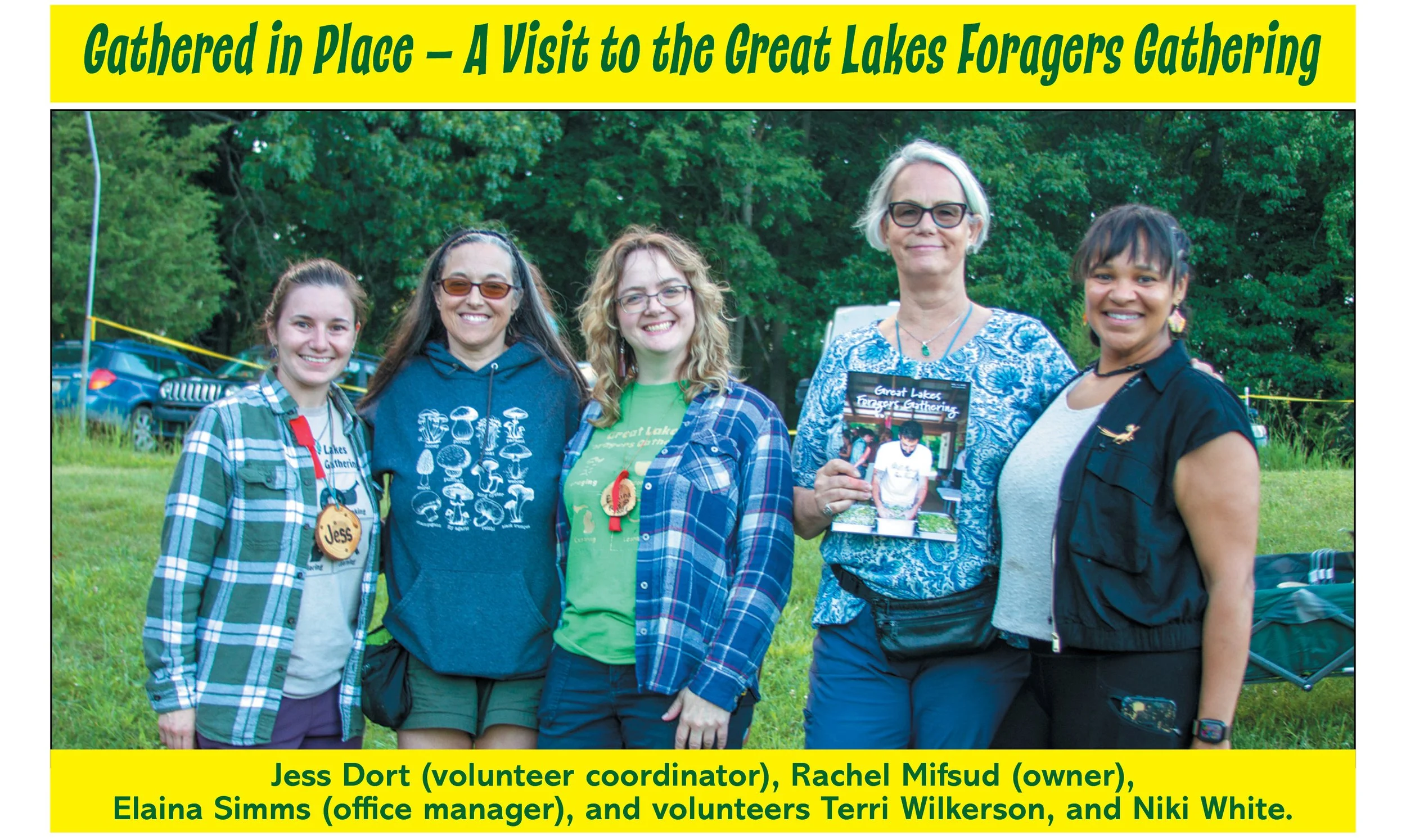
By Kirsten Mowrey Photos by Susan Ayer
“Try this—doesn’t it taste like it should be grown someplace tropical?” said Rachel Mifsud, one of the organizers of the Great Lakes Foragers Gathering. She hands me a plastic spoon with a yellow glob on the end. At first, I notice its buttery texture, smoothness, then brightness—if yellow had a taste, this might be it. The taste lingers on my tongue, resonating and activating a sleeping sense, a feeling of rootedness and connection, and a sharp attention to the present. “Mayapple jam,” Savvy Boyd, another of the organizers of the event, said. “They’re growing in the woods right there.”
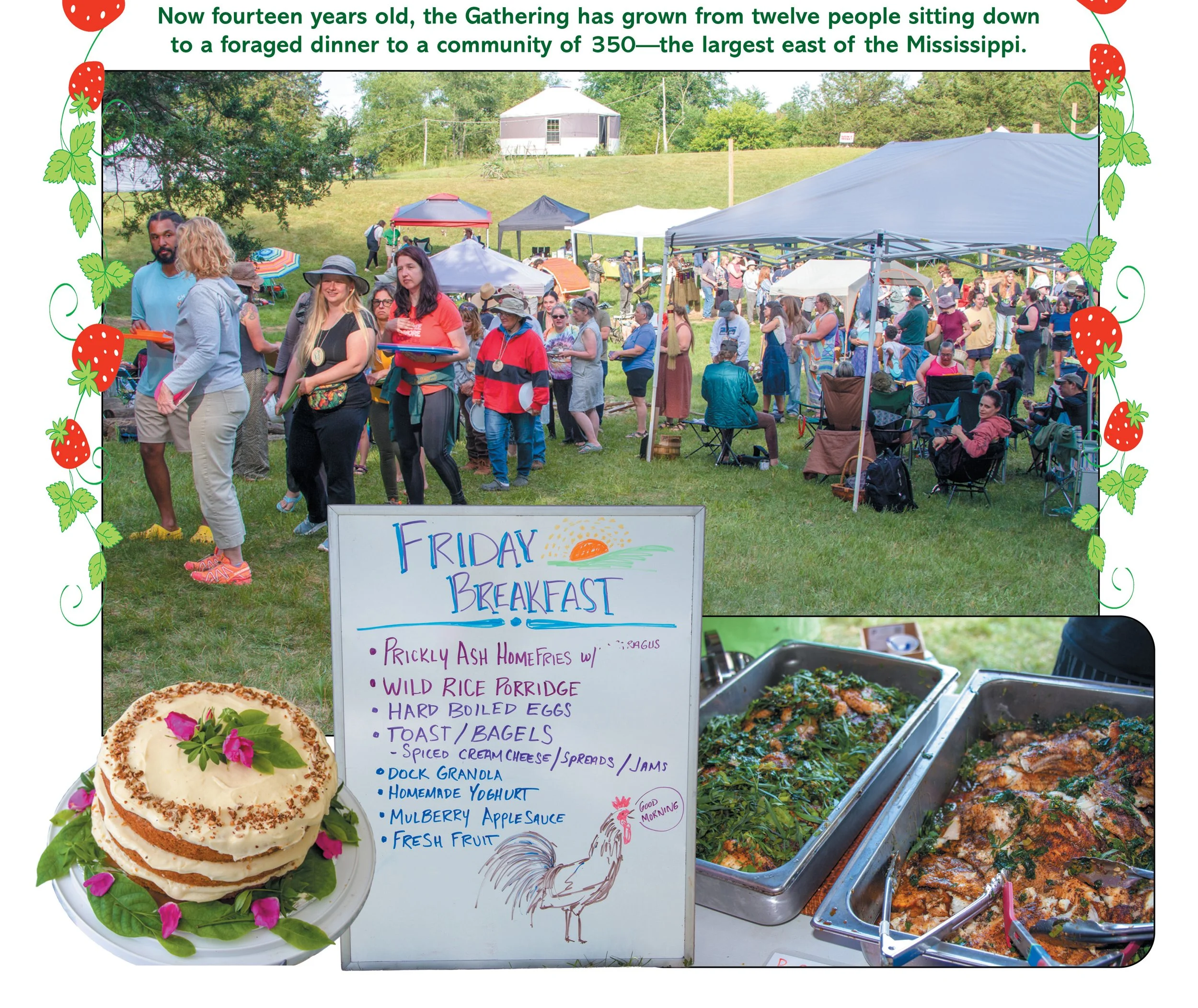
It’s almost Solstice, and I am in the Irish Hills at the Great Lakes Foragers Gathering. Now fourteen years old, the Gathering has grown from twelve people sitting down to a foraged dinner to a community of 350—the largest east of the Mississippi. Mifsud, Boyd, and Elaina Sims are all organizers of the Gathering as well as foragers in their own right. We sit in a long open-sided roofed structure overlooking a grass-swathed hollow dotted with tents and scattered groups of people while I interview them. Along the rim of the hollow, I spot vendors with plants, glassware, salves, baskets, jewelry, ceramics, and a long line in front of a bakery. A steaming pot sits in the middle of a stone-rimmed fire circle at the center of the depression.
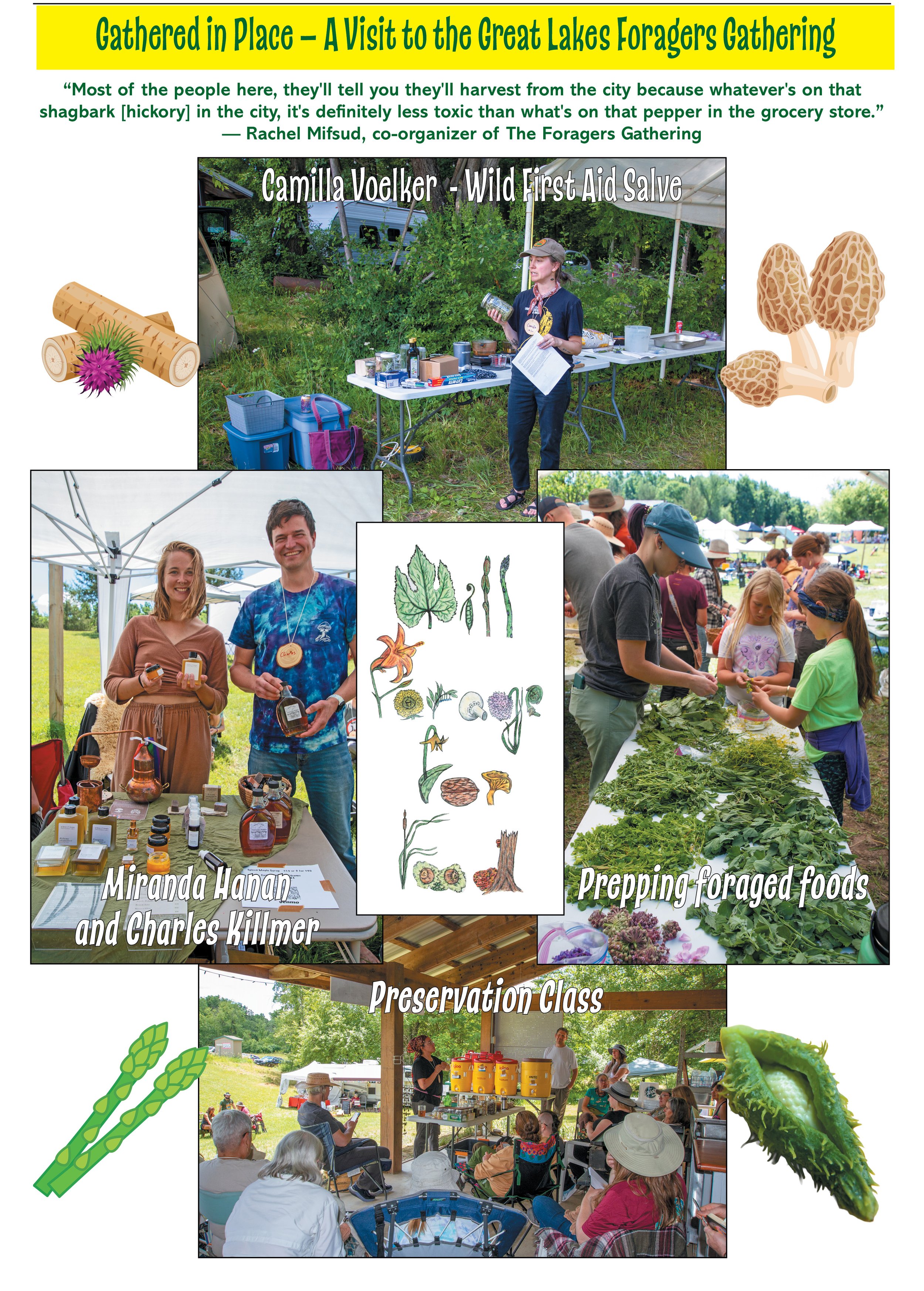
“You cannot get these flavors at a grocery store. There’s nothing similar,” Mifsud said, as we exclaim over the wood sorrel sorbet. It is citrusy with a green flavor like seaweed or green tea. “Good with fish,” Boyd told me. “This grows in your lawn,” Mifsud continued, the two women handing the conversation back and forth. They’ve known one another for many years and moved to the Irish Hills to live close to one another so they could forage together at nearby Watkins Lake State Park. They also forage on state land in northern Michigan for items they cannot get downstate.

“You have to have a territory,” said Mifsud “It takes years [to become a forager] because you have to have a territory. When you go to the grocery store, you know where you can find stuff. If you go to a strange grocery store in a strange city, you don’t know where to find stuff. You have to reorient. It’s the same thing with foraging. Where is the milkweed patch? Where is the blueberry patch? It takes a few years to get that map in your head.”
As the scent of searing venison blows past our faces from the adjacent kitchen Sims added, “A lot of people have a more esoteric take about trying to build relationship with the land around us; foraging is one way because it makes you pay attention to what’s in season. What’s the temperature out? I walk outside and I [notice] the birds are singing this morning, that means the maple’s about to start to run. You get in more touch with that [nature’s cues].”
Building relationship to place can start anywhere; there is no ideal environment. I mention hickory syrup and when I point out that I live in a city, Mifsud shoots back with, “Most of the people here, they’ll tell you they’ll harvest from the city because whatever’s on that shagbark [hickory] in the city, it’s definitely less toxic than what’s on that pepper in the grocery store.” The city may even have plants you cannot find in the woods. Boyd and Mifsud tell a story of being unable to find serviceberries in the woods but picking five gallons in the Costco parking lot. For beginners, Boyd said, wood sorrel and plantain are good plants to start with, as they grow in multiple environments. “They’re probably in your lawn. They’re definitely at the local parks,” said Mifsud. “They both come out in like early April to mid-April and they are out until October. Wild rice is not a beginner plant. Why? Because it’s got like a two-week season and in that two weeks you have to get exactly the right weather for the right day. Then you don’t see it again for 364 days, and so you’ve forgotten everything that you learned in that one day. Whereas with wood sorrel or plantain, you see it every day. It’s in your yard. You make a relationship with it. You spend the whole summer getting to know it.”
Being in relationship long term requires manners and behaviors. “You thank the plant,” Boyd continued, “because they are giving their life to you. And you practice reciprocity: pull the invasives; pick up the garbage.”
“You use what you pick,” Mifsud said. “I want to caveat that though; when you’re learning, you pick things, and they go to waste. That is part of learning. That is not something to feel guilty about. You have to pick the plants. You have to get to know them. You have to develop a relationship. The only way you can do that is to pick them, and look at them, and try them. And maybe you don’t like it, and you never harvest it again. That’s an important thing, too.”
After our conversation, I decided to stroll around and pause at the ample fire circle while Jay Zatkovich of Chelsea, one of many attendees and volunteers, stirs a two-foot-wide skillet full of mushrooms. “Maitake,” he answered, when I ask him what kind they are. “Also known as hen of the woods. I foraged them, dehydrated them, and rehydrated them for lunch today.” Zatkovich hunts, and five years ago, began foraging and attending the Gathering. “I backpack and I like cooking,” he said. Foraging went along with those activities. He pauses to speak with someone about their contribution to the bubbling soup pot and I spot my neighbors El Lower and Sarah Woloshuk from Ypsilanti.
“We came here during the pandemic,” said Lower, “to be around people again outdoors. It was a soft reentry, and we made friends. Now it’s a reunion every year.” Woloshuk added, “I’m always excited to unplug here. People are brought together by shared interests and commitment to sustainability, having conversations with people in real life, in person. It’s also a great place for intergenerational conversations and to learn how to be outdoors.”
The Gathering offers “classes and workshops covering foraging, cooking with wild foods, bushcraft, herbalism, ecology, and sustainability.” Food clearly is center stage here: Saturday’s breakfast menu offered dock granola; mulberry, spicebush, and pear applesauce; mayapple or spruce tip cream cheese along with wild rice porridge and cheesy nettle grits with bellflower and lambs quarter greens in mixed mushroom broth. I hear a lone voice call, “Acorn!” and the loud repeat as the community cheers the leaching of acorns for the famed Sunday breakfast of acorn blueberry pancakes. Everyone is trying to offer me food: duck sausage, goose pasties, wood sorrel sorbet, marshmallow-linden iced tea, sourdough rye crackers, and more.

I stop by the tent of this year’s guest speaker, Gabrielle Cerberville, author of Gathered: On Foraging, Feasting and the Seasonal Life. Copies sit in front of her as we talk. Cerberville describes her book not as a field guide but more “learning how to pay attention in an embodied way to landscape, to the plants.” Her entry into foraging began at age five, with wild berries. “You get blueberries in a clamshell at the grocery store, and they are garbage,” she said. “But taste a wild blueberry, it’s like a whole different plant.” She enjoys that “your food is directly linked to your labor. We don’t experience food as our ancestors did. Rather than hunting, foraging, or gardening, our labor is disconnected from our food. There are super long distances. But when I pick those berries, they are precious to me and bring me joy.” At thirty- four, Cerberville is a next generation forager articulately speaking of the experience for millennials and younger generations. But older foragers often don’t teach or promote, so “It’s a place to connect with all kinds of experts who may have no Internet presence; this [gathering] is a way to find them” said Lower.
Meanwhile, there’s also the experience of community. Zatkovich commented, “I like that you get both political leanings here: the left (angled back to the land) and the right-angled Preppers—everybody getting along.” Woloshuk agreed. “You can connect with local hunters, Indigenous elders, primitive skills people—[all] who offer different ways to be a knowledge keeper.”
As with all living entities, the Gathering is on the cusp of change. Driving to the event, I saw many signs in the Irish Hills about a proposed gravel pit that would abut Watkins Lake State Park, the prime gathering spot of Mifsud and Boyd.Concern for how this would affect the soil, water, roadways, and ecosystems of the area led to a petition for signatures at the Gathering. Time too, is having an effect: Mifsud, Boyd, and Sims are eager for others to step forward and the Gathering to become more of a community led, sustained event. In some ways, this is already beginning. Mifsud explicitly named the Open Grown School as essential to this year’s event. Open Grown offers foraging classes and skills lessons for groups and individuals, and they managed the kitchen at the Gathering.

Robin Wall Kimmerer, author of The Serviceberry, writes of mutual flourishing, abundance, and the generosity of the plant world. At the Foragers Gathering, I watched these principles in action. People bring their harvest of the year, or freshly foraged foods to contribute but, “the community never leaves somebody out for lack of being able to give,” Boyd stressed. “Everybody has something to give.”
“Scarcity mindset is a lie,” said Cerberville. “Abundance is everywhere—abundance and sharing.” At this event, I see that as a lived truth.
To find out about the 2027 Foragers Gathering, or to discover foraging classes, visit willforageforfood.com.
More information on Gabrielle Cerberville and her book, Gathered: On Foraging, Feasting and the Seasonal Life can be found at chaoticforager.com.
Interested in learning more about foraging? Open Grown School lists classes at opengrownschool.com.
Kirsten Mowrey is a somatic practitioner with a passion for flavor.
Read Related Articles:
























































































































It’s almost Solstice, and I am in the Irish Hills at the Great Lakes Foragers Gathering. Now fourteen years old, the Gathering has grown from twelve people sitting down to a foraged dinner to a community of 350—the largest east of the Mississippi. Mifsud, Boyd, and Elaina Sims are all organizers of the Gathering as well as foragers in their own right. We sit in a long open-sided roofed structure overlooking a grass-swathed hollow dotted with tents and scattered groups of people while I interview them. Along the rim of the hollow, I spot vendors with plants, glassware, salves, baskets, jewelry, ceramics, and a long line in front of a bakery. A steaming pot sits in the middle of a stone-rimmed fire circle at the center of the depression.