
By Christine MacIntyre
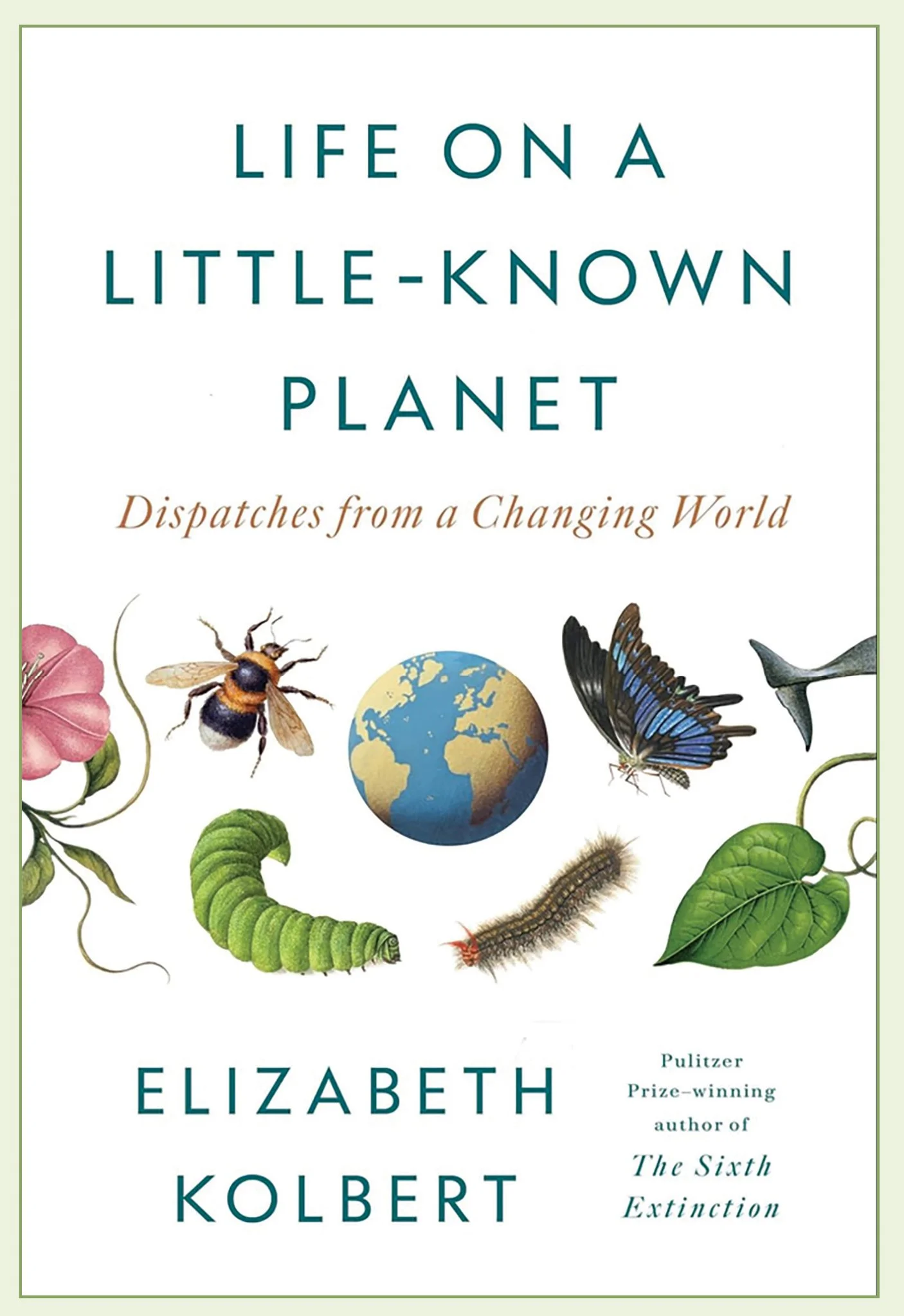
Elizabeth Kolbert has spent decades reporting from the fault lines of our planet—melting glaciers, vanishing species, rising seas, shifting microbial worlds. In Life on a Little-Known Planet: Dispatches from a Changing World, she gathers essays that feel at once intimate and planetary, investigative and philosophical. The title itself is telling. For all our satellite imagery and data modeling, Kolbert suggests we are still strangers here. Early in the collection, she points to what biologist E. O. Wilson once called the “ultimate irony of organic evolution.” The human trajectory has become “increasingly destructive in its impacts” even as it grows “increasingly sophisticated in its insights.” Kolbert notes that this paradox animates the book, and the essays that follow explore it from multiple anglesthrough collapsing ecosystems, emerging technologies, and the scientists trying to understand both.
Readers familiar with Kolbert’s The Sixth Extinction will recognize her calm, surgical clarity, but this collection feels different in scope and rhythm. Instead of building one sweeping argument, the book moves in dispatches—compact, carefully constructed pieces that zoom in on particular moments: a researcher decoding whale vocalizations, an entomologist obsessing over a new species of caterpillars, lab-engineered solutions that border on science fiction. Each essay stands alone, yet together they accumulate into something heavier—a portrait of a planet mid-transformation.
Kolbert excels at grounding abstract crises into tangible scenes. In one essay, she describes “leafing through beekeeping catalogs, weighing the advantages of wooden frames versus plastic ones”—a detail so small and procedural it might seem mundane. Yet, from that simple act, she widens the lens to show entire ecosystems tipping. Elsewhere, she follows researchers as they send an enormous drill through an over-eight-thousand-foot ice sheet, boring into genetic archives. The emotional tension lies not in dramatic prose but in restraint. Kolbert does not sermonize. She observes. She documents. And that restraint is precisely what unsettles.

Stylistically, Kolbert writes with a reporter’s discipline and an essayist’s ear. Her sentences are clean, controlled, and deceptively simple. She avoids rhetorical fireworks. Instead, she builds momentum through accumulation—fact layered upon fact, anecdote placed beside data. The tone is measured, occasionally wry, often quietly incredulous. There is an undercurrent of astonishment in her work, but it is expressed through juxtaposition rather than exclamation.
Structurally, the dispatch format works powerfully. The essays vary in length and focus creating a rhythm that mirrors the unpredictability of the natural world itself. Some pieces linger in fieldwork; others pivot quickly to emerging technologies or policy shifts. The fragmentation feels intentional. Climate change and ecological collapse are not linear narratives but patchwork realities unfolding unevenly across geographies. Kolbert’s structure reflects that reality.
There is also a subtle philosophical thread running beneath the reportage. The book continually raises the question: What does it mean to know a planet? We catalogue species, measure atmospheric parts per million, and engineer synthetic biology, yet we remain surprised by cascading consequences. In this way, the “little-known planet” is not simply Earth; it is Earth as altered by human action. We have become a geologic force, but not an omniscient one.
Kolbert does not offer easy hope, nor does she collapse into despair. Instead, she inhabits complexity. She examines geoengineering proposals with skepticism but not dismissal. She profiles scientists who believe technological innovation may help mitigate disaster even as she underscores the moral and ecological risks. The result is a book that feels intellectually honest—unwilling to simplify or sensationalize.
For readers, this collection resonates on a deeper level than environmental alarm. It is a meditation on attention. Kolbert’s work asks us to notice the fungus on a bat’s wing, the chemistry of a warming ocean, and the bureaucratic language of climate policy. Attention, she suggests implicitly, is a form of responsibility.
What makes Life on a Little-Known Planet compelling is not just the urgency of its subject but the craft with which it is rendered. Kolbert trusts the reader. She trusts evidence. She trusts quiet revelation. In an era saturated with opinion and outrage, her steadiness feels radical.
By the final pages, the title lands with quiet force. The planet is not only changing, it’s becoming unfamiliar. The dispatches read like field notes from a threshold moment in history—a record of what we are witnessing and, perhaps, what we will one day struggle to explain.
Kolbert leaves us not with answers, but with a sharpened awareness that we are living on a world we are still learning to understand—and that the cost of not paying attention may be irreversible.
Read Related Articles:


































































































































































































Donec id justo non metus auctor commodo ut quis enim. Mauris fringilla dolor vel condimentum imperdiet.