
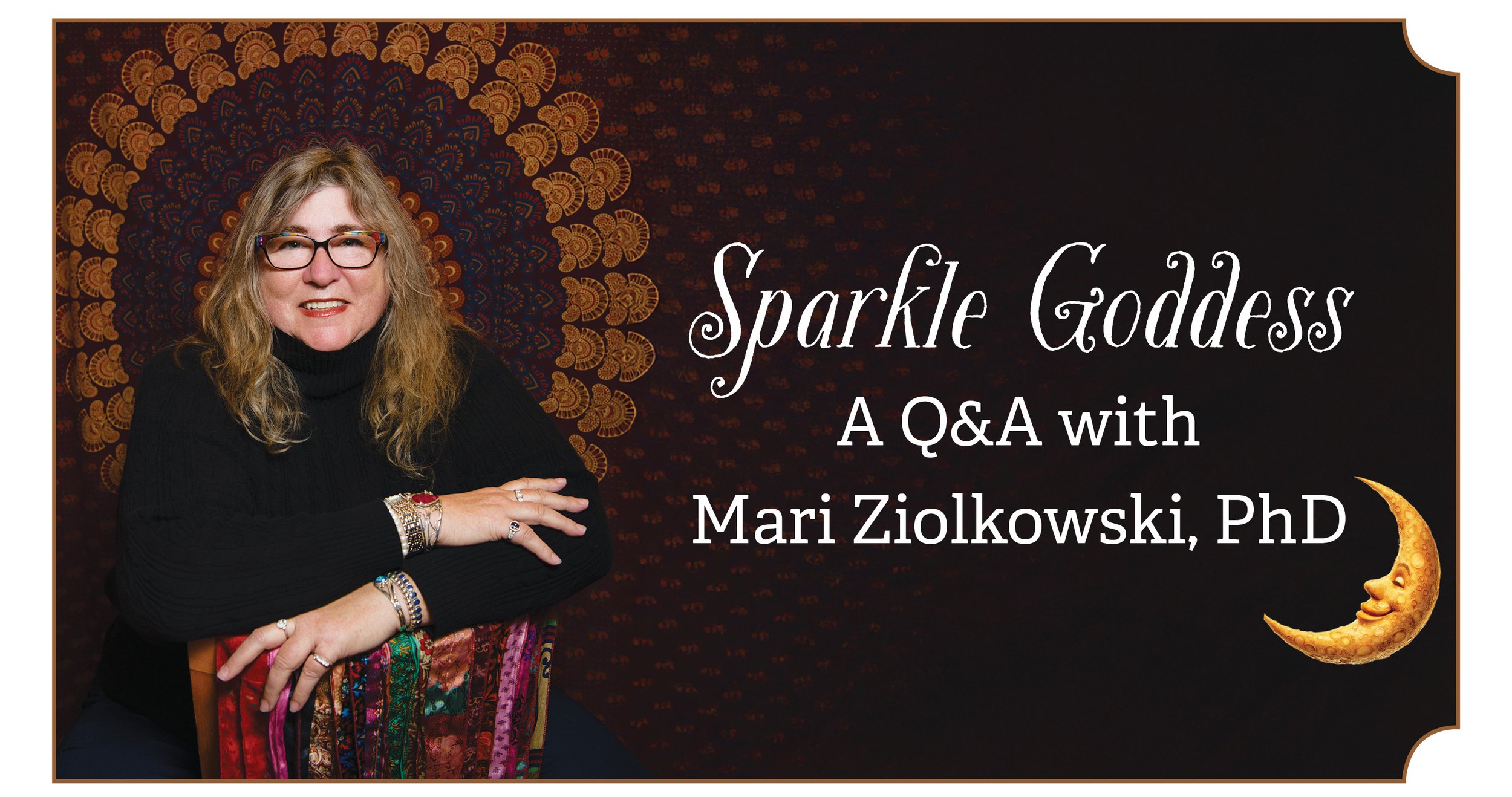
By Leif Laufeyjarsen • Photo by Mary Bortmas
Mari Ziolkowski, PhD, embodies a remarkable breadth of multicultural experience. Her background spans academic and experiential/altered state study of the Hindu goddess tradition to living and working with traditional African spiritual practices in New Orleans and even risking her own safety while researching human rights abuses in Guatemala. Culturally, she is truly well-rounded. Despite her extensive experience, she remains grounded—warm, approachable, and full of bubbly enthusiasm, her presence brightened by a childlike, sparkling smile.
Leif Laufeyjarsen: Your earliest international experience was researching human rights abuses in Guatemala. How did this shape your understanding of the world? Were you naive in any way in doing this?
Mari Ziolkowski: This was in the early ’90s, and on my first visit to Antigua, I saw army tanks outside the city gates. It was surreal. I had been active in protests back home focused on getting the U.S. out of Central America, so I knew what was going on, but even so, it was surreal. Yes, I was, in a sense, naive—on some level–feeling that, even while I was living there, I was safer as a U.S. citizen to ask such questions—but on another level, I knew the risks. In fact, I was cautioned about the “orejas” (ears) that were everywhere. So, I stepped back from getting actively involved in the protests in Guatemala City and instead continued more covertly.
I wanted to know how one could live—how anyone could function—with the threat of the “death squads” hanging over their heads (I had read firsthand accounts, but still, it was beyond my emotional comprehension). In response to my queries, I was shown a list of “asesinados” (assassinated) on the wall of a church near Lake Atitlán. Others shared their levels of high anxiety and too much drinking. And someone else took me to watch a Posada—women in black walking slowly and rhythmically through streets strewn with carpets of flowers carrying a huge platform with a life-size Madre de los Dolores statue (Mother of All Pain).
Leif Laufeyjarsen: You lived in New Orleans for eight years and learned something about one of the traditional African religions, Voudou, while there. That still gets negative coverage in the media and even gives some people in the New Age community the heebie-jeebies. Was your time there spent sticking needles into dolls?
Mari Ziolkowski: [Laughing] No. That [sticking needles into dolls] is actually a tradition known to be handed down from pre-Christian Europeans. Not sure how all that got attached to Voudou. My training in the tradition was rather focused on the healing spirits of Voudou, called Lwa/Loa. Even if you weren’t initiated, there were spirits interested in helping. This is simplifying it, but for example, Erzulie Freda could help with love, Ogoun with protection, Papa Legba with abundance. These Lwa were mediators between Le Bon Dieu (the Good God) and humans and were here to assist us.
I also attended public and private Haitian trance rituals and found them very powerful ways of invoking/calling in the Lwa. Once the spirit came through an initiate, they would share the energy and blessings of the Lwa with others present.
Leif Laufeyjarsen: You specialize in the Divine Feminine. In one way, what that means is very obvious; in another way, there are probably as many definitions of “Divine Feminine” as there are people who use the phrase. What does it mean to you?
Mari Ziolkowski: For me, there are many layers: the creative energy within women (and if we all carry a continuum of feminine and masculine within us, then also within men)—sometimes also known as the kundalini at the base of the spine; also the female power to bring a new soul across/give birth; the female archetypes within the collective (e.g., maiden, mother, healer, teacher, lover, witch, warrior, queen, wise elder); the very many goddesses represented across cultures and spiritual traditions; and the Great Cosmic Creatrix.
Leif Laufeyjarsen: You are a goddess initiate in the Tantric Hindu tradition as well as the Peruvian High Andes Q’ero tradition. Could you tell us how those two traditions are unique?
Mari Ziolkowski: My experience in the Shakta (Goddess) Tantric tradition involves the realization that all the universe is within us—all the beauty, all the challenges. We are a microcosm of the macro. The Goddess is within us. And we are Her—we are “all that.” It is a path that asks us to accept the paradoxes within and outside ourselves—which can be challenging.
The tantric yoga tools I find most helpful are meditation, to include mantra (chanting), yantra (focus on images and symbols of the Goddess), and tantra (honoring the warp and weave of the universe within). Because the path also honors the raising of the kundalini and the ecstatic in meditation—which includes sexual energy as a sacred (part of “all that”)—and because this involves rebalancing the sacred feminine/sacred masculine within us and/or with a partner. The larger Western culture often focuses only on that aspect of Tantra. It is that, but, as you can see, not only that.
Interestingly, my five-year-long introduction to the Peruvian High Andes Q’ero tradition was with an Inca priest and priestess—the sacred masculine and sacred feminine—doing ritual together, sharing initiations with us, always together. Their approach and their teachings work with Pachamama/Mother Earth as sacred, as the chief of all ceremonies, while at the same time honoring the diverse sacred feminine aspects of nature, like oceans and lakes (nustas), and sacred masculine aspects like mountain spirits (apus). Working with them felt very Tantric, both in practice and in initiatory experiences that opened us up to be in ecstatic communion with Pachamama. And then I found out later that the Q’ero, in fact, consider the Tibetans in the high Himalayas (who also have Tantric practices) to be their brothers and sisters!
Leif Laufeyjarsen: You were raised Catholic, where the only feminine divine role model you were exposed to was the Virgin Mary. While you appreciate her, she did not resonate with you. How many women—or indeed people—do you feel have been drawn to New Age traditions because of a lack of sacred feminine models they can identify with?
Mari Ziolkowski: I think many, as Western culture has historically and intergenerationally whitewashed the Goddess out of our hearts and minds, under pain of death (e.g., the Burning Times and Inquisition). And how do women see the sacred in ourselves if we don’t see images of the Divine Feminine around us? However, I will say I have come to respect Mother Mary, as I believe she held the archetype of the Sacred Feminine in Western culture when nothing else could.

But growing up, I felt she was too purified and homogenized by the Catholic Church for me to identify with. I felt much closer to Mary Magdalene, who had clearer connections to the physical and sensual world we find ourselves in. And after I found Magdalene’s links to the Gnostic Gospels, Sacred Temple Priestesses (like those of Isis), the Holy Grail, Black Madonnas, and Tantric Yogini practices around the turn of the century (aka the year 2000), I exhaled. There was a Sacred Feminine presence I could be in communion with from my religious tradition of origin! (For more specifics, see “Resurrection of Magdalene” on her website research page.)
Leif Laufeyjarsen: You were a licensed mental health practitioner for 15 years. How do your spiritual practices overlap with your past clinical practice? Does your multicultural experience factor into this at all?
Mari Ziolkowski: So, I bring both—15 years of holding safe space for emotional healing as an MSW-level counselor, and 25 years of meditation and trance-state spiritual practices—to the spiritual counseling container. I also bring a respectful degree of cross-cultural understanding after living and working in predominantly Mexican-American, Central-American, and African-American cultures for 35 years. As well, I bring experience across spiritual traditions with what I call the BIG LOVE energies. That means when you walk in the door, you have access to my BIG LOVE spiritual team, and we also get to connect with yours!
Leif Laufeyjarsen: You offer too many services for us to list here, including meditative tarot. However, I am especially interested in light language channeling. What is it, and who would it benefit?
Mari Ziolkowski: Light Language Channeling is like a sound vibrational attunement. Your guides are invited in to bring you healing energy and direct messages. When your spirit guides/angels/ancestors/or deities come through, it sounds like I am “speaking in tongues.” This is the language of spirit, and your only job is to sit back, relax, and receive the energy, as well as notice any emotions, vibrations, or movement in your body. Light Language Channeling thus provides a way for you to directly connect with your spiritual team and experience these Big Love energies for yourself!
Mari Ziolkowski offers a range of services centered around the Divine Feminine. She also has a blog, YouTube channel, and book, and offers spiritual readings locally both at Crazy Wisdom and Enlightened Soul Center. You can learn more about what she has to offer at her website at sparklegoddessspiritualservices.com. Her book Fierce Shakti/Fierce Love is also available for a limited time at Crazy Wisdom Bookstore.
Read Related Articles:


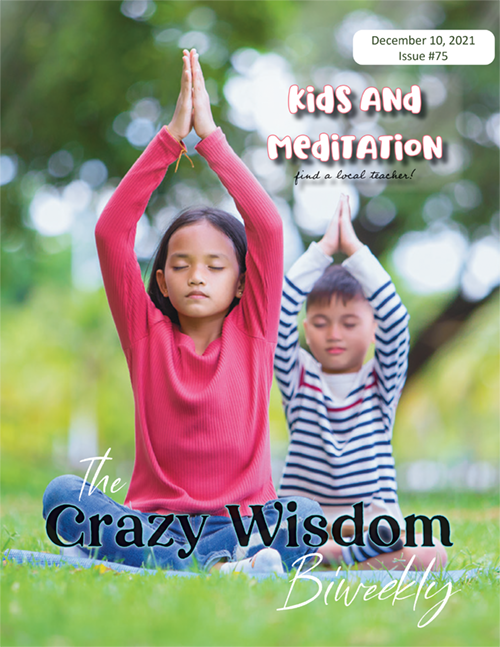






Mindy Eisenberg founded Yoga Moves MS, a nonprofit adaptive yoga organization, over 20 years ago, providing free classes to those impacted by multiple sclerosis, Parkinson’s disease, and other neuromuscular disorders. Her inspiration? Growing up with a mother with multiple sclerosis who spent the better part of twenty-seven years in bed paired with a profound belief in the healing impact of a regular yoga practice.