
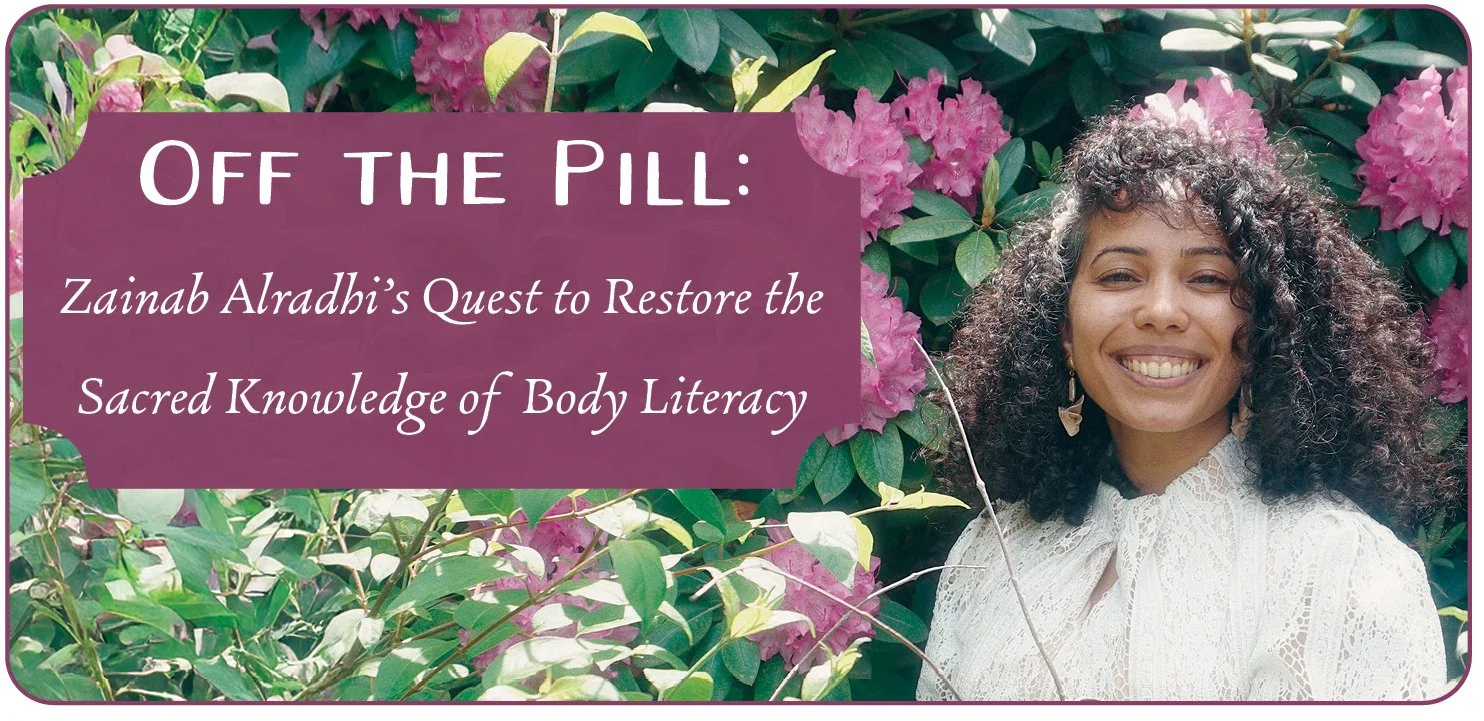
Zainab Alradhi on Body Literacy, Fertility Awareness & Niswa
By Kaili Brooks
Zainab Alradhi’s practice cannot be limited to the title of her business, Niswa [niswə]. Translated to mean “collective of women,” Niswa contains the living knowledge of women across the ages. Seeking to reconnect all women with their bodies in a reverential and intimate fashion, she works with women across Michigan and the Middle East, placing them back in control of their fertility.
Kaili Brooks: How did you discover the topic of body literacy and how did your business come to fruition based on your findings?
Zainab Alradhi: In my last year of college, my husband and I were looking for contraception methods, and we wrote a list of the qualities we wanted this contraception to have. One was hormone-free, side-effect free, environmentally-friendly, and as effective—if not more—than the hormonal methods available. We didn’t know what was out there waiting for us. After so many months and phases I started reading the book Taking Charge of Your Fertility. I devoured that book. To me it was an initiation for myself—a rebirth. I entered womanhood and understood my body in a way I never had before. It was the first time I had read about my body in an honoring yet neutral way. It was amazing. I started to chart my cycle; I took a course with a Fertility Awareness counsellor. It truly felt like I was learning a new language. I remember sitting with my husband and he asked me, “What do you think about starting your own business?”
It almost felt like a weight had been lifted off my shoulders. I was subconsciously thinking about starting a business and sharing this information with people, but in five or ten years. Once he asked the question, I knew maybe it could be now. When I think about Niswa, it has its own soul, its own entity, and it wanted to be born right then and there. I started to create the materials for body literacy, then fertility awareness, all of the language that’s associated with the biological processes of the body in Arabic, in a way that I felt them—not in a sterile way. How would I speak this in a way that wasn’t a biology lecture? Arabic is a very poetic language; nothing is more fitting than describing the miracle of the body in this way.
Kaili Brooks: How would you define body literacy, and how does the Fertility Awareness Method align with this?
Zainab Alradhi: We have had the term body literacy for a very long time. To me, body literacy is self-knowledge of the menstrual cycle as the fifth vital sign of health. It is the ability of women to understand their biological markers, signals, and signs to make informed decisions based on their health, lifestyle, and reproductive decisions. When I look at how Fertility Awareness works, once you start charting your cycles, you are literally paying attention to your biological markers and getting to understand your body in a way that is unavailable in any other way. In the privacy and comfort of your own home, you are not only able to identify your fertile window to achieve or avoid pregnancy very accurately, but you are given health records every single cycle. I am able to assess my hormonal health and balance: do I have a deficiency in something? I am able to see it on paper, and my body is communicating with me. When I talk about the Fertility Awareness method, I am not talking about the Rhythm Method. I am speaking of the Sympto-Thermal Method which requires monitoring of the basal body temperature as well as cervical fluids. We’re talking about an accurate, scientific, well-studied method of monitoring based on real-time signs to determine fertility.
Kaili Brooks: What are the differences between the medical forms of birth control? Are there spiritual changes as well as physical?
Zainab Alradhi: It’s hormonal and side-effect free, both short and long term. When it comes to fertility awareness, one of the major forms of differences between the IUD or the shot, is that it doesn’t put the burden on the woman alone. It puts the responsibility on both partners. When it comes to hormonal BC, [the few attempted] studies on men have been stopped before conclusions can be made because of all the side effects. Women have been enduring suffering and even death in these studies. Those methods have been made safer in time, but it usually is put on the woman.
When a woman is on the pill, the chemistry of her brain is changing. The book This is Your Brain on Birth Control goes deep into the physiological changes within the body. Hormonal contraception shuts the communication between the brain and the body down by flooding the system with synthetic hormones. When discussing spiritual impact I think, “Am I truly myself when I am on the pill? What is this version of me?” I am preserving my true entity if I am not taking those drugs. The Sympto-Thermal method is unique because it is knowledge and awareness based. Once you learn it, it’s yours. You’re not relying on a drug, a company staying in business, or laws and regulations. No one can take it from you. You are truly independent.
Kaili Brooks: What are some examples of how birth control changes a woman’s brain and body?
Zainab Alradhi: You hear of women coming off the pill and they have different preferences or hobbies; they begin liking or disliking their partners differently. Based on the studies that we have, women who are on the pill are more attracted to men with less masculine features or attitudes. The body is not trying to be pregnant or looking for a reproductive mate. The idea of finding someone as a partner is not taking the biological process of reproduction into account. You’re not looking for a sexual partner, you’re looking for a friend to provide comfort. We know now that the level of estrogen the body produces is related to the level of testosterone in the body of the other person. On hormonal BC, the level of estrogen is very low.
Kaili Brooks: Why is body literacy necessary in today’s world? Are there advantages to putting in the work when controlling fertility is seen by some as an exclusively medical process?
Zainab Alradhi: It’s multifaceted. I cannot emphasize how much it’s needed in today’s world to be body literate and to have that self-knowledge. Body literacy is a soft power; it has the ability to shift communities, families, and societies. It can be passed through generations. I do believe that a body well-understood is a body easier to trust. If I don’t understand my body, I’m not able to trust it. By digging deep and understanding this language, I am able to honor my body because it’s my best friend.
When we think about friendships, they don’t just happen. You invest time, energy, and support—you are there when they need you and when you need them. We need to make that investment. When we do that, we start honoring it in how we eat, how we move or choose to rest, our creative process. It divorces the idea that we have to be the same every day and on a linear timeline because we are cyclical beings. Once we realize the fact that there is nothing wrong with us when we need to rest and recharge, when we’re not as fast, when our words come quicker or more slowly from week to week, we discover superpowers in every aspect of the cycle.
It’s a disservice to minimize it to ‘period’ and ‘PMS.’ Once a woman learns to trust and honor her body, she is empowered, able to advocate for herself when seeing professionals, and seek the help she deserves. There is a great remembrance that occurs. I can’t tell you enough that when I look at another woman, I can’t not see the intelligence of her body. I started seeing women in a different light because I now understand what her body is capable of being and bringing into this world. Women start gathering. This is what I’ve seen in my own practice. Women start sitting in circle together again and remembering their stories. You can think of this girl who had an unpleasant, maybe surprising or scary experience with her first period, now she’s a woman and rewriting her story. Her daughter, or her niece will never have to experience that because the woman will not be mirroring the negativity in her life the way her mother did. There is a personal, community, and generational aspect. Once women recognize the cycle within their bodies, they’re more in harmony with themselves, with nature. That is the point—we bring more healing into the world. It’s not just within us; we have a ripple effect on our whole environment.
For more information or to connect with Zainab, email info@niswa.com or visit her on Instagram at @niswaorg. Her website, currently available in Arabic-only, is niswa.org.
Kaili Brooks is a mother, writer, and teacher based out of Ypsilanti, and the editor of The Crazy Wisdom Community Journal calendar. You can, contact her at kaili@crazywisdom.net.
Read Related Articles:







































Perimenopause brings fluctuating hormones, irregular periods, hot flashes, brain fog, and fatigue—often called the "second puberty." Discover what's happening in your body and explore natural, non-medical ways to find relief through nervous system support, nourishment, blood sugar balance, rest, and radical self-care. No one-size-fits-all—personalized steps to reclaim energy and peace.