
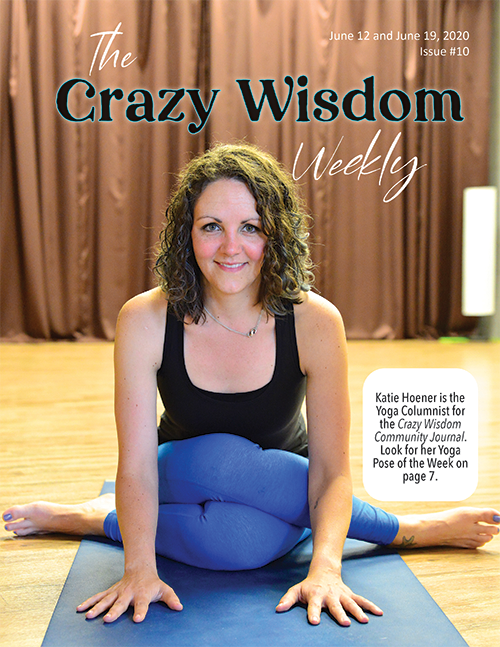
Namaste, Katie... Whether you're a seasoned yogi or getting ready to roll out your mat for the first time, here you'll find a variety of useful tips from local yoga instructor, Katie Hoener.
The Art of Humanizing Robots: An Interview with Cre Fuller

By Cashmere Morley
In the heart of Ypsilanti is an artist’s studio that feels, at times, both rooted in the future and the past. Glass eyes of various colors stare at you from every direction. Dentures riveted into metal figures bare wild grins. There is a nostalgia here; a feeling of things lost and found again. But there is also a sense of creation, of assemblage. It is a peek into a modern-day Dr. Frankenstein’s mind. A human-meets-robot dreamscape brought to life in rivets and metal. This is Cre Fuller’s studio.
Christopher “Cre” Fuller, 46, didn’t plan on building tin creations for a living. In fact, when he graduated from Mt. Pleasant High School, he went into building chimneys with his father, and later, working at Whole Foods when he moved to Ann Arbor in 1997.
“Like most corporate jobs, it could be frustrating, but I valued my time there,” Fuller said. “From there, I went to Plum Market, in a similar capacity, and tried my hand at the wholesale racket. I’m good at helping people and being honest and genuine. Wholesale was a bit of a smarmy… you kind of have to be greasy. And I wasn’t good at that.”
But he was good with his hands. After saving money and leaving that job to invest in himself and his art, Fuller decided to spend time chasing after a job that would be more fulfilling.
“I think I’d had every creative hobby under the sun. Around 2000, when I bought the house I still currently own, I spent all my money on the house, so I just needed an art. I had seen things around, you know, people making humans and robots out of junk and trash and whatnot, so I just decided to try my hand at it.” The first robot Fuller created was around 2000, 2001. To date, Fuller guesses he’s built around 600 robots. He’s best known as the guy that makes the “Tin Angry Men,” a name he’s trying to distance himself from. His web presence only bares his name, and no mention of the moniker, since Fuller doesn’t feel it fits his creations anymore.

“At the time, I set up a little spare bedroom for all my glasswork and jewelry making. As I went along, I would make these little robot creations. I never took it too seriously. They were just little gag gifts and things like that.” Fuller said. “But I’ve always liked taking things apart, as a little kid, seeing how the guts work. What does what. So taking things apart wasn’t a stretch for me. And then just kind of reimagining what those parts could be once you have them unassembled, or disassociated from their previous purpose, whatever that purpose was,” Fuller said.
“I tend to gravitate toward vintage aluminum, I can get the look of it that I want, I can either keep it brushed and have it kind of dull and matted, or I can polish it, into a chrome-like shine. It has that mid-century vintage feel already, and a lot of the things I prefer to use, is early century stuff.”
Fuller frequents places like Recycle Ann arbor, and local antique shops to find his goods, though he admits it’s been a bit harder to find pieces as of late since he’s “depleted the local supply.”
The Ann Arbor/Ypsilanti area welcomed him and his creations with open arms. “In Ann Arbor, people value art,” Fuller said. “And in its soul, it’s got people that respect and applaud the art. Ypsi has this humongous heartbeat of art and people who appreciate and applaud it.”
His work can be assembled quickly, if Fuller has the right parts.
“If I have all the stuff just sitting there, I can get a simple piece done in a day,” Fuller said. “Taking the time to let paint dry, and to let glass eyes cool, I can get a small piece done in a day. But sometimes, I’ve searched for those parts for a year. A huge component of this, of any assemblage artist, is their pile of goodies.”
While he does consider a lot of his work as “assemblage,” Fuller also admits that not all of his work falls under that category in art shows, so “found art sculpture” is also an acceptable way to describe what he creates.

If you look at his work, there’s a sense of past-meets-future. “I think I was just trying to make that ‘50s version of a future robot. You know? Certainly, a departure from the modern take of robots. That’s what I really wanted to do: [embody] the romance of the vision of the future. When I first started doing this, I wanted them to look like vintage robots from the future. Cross between a little bit Star Wars, a little bit Mystery Science Theatre. I was always a fan of MST. The guy just made robots from crap laying around the shop, and that’s exactly what the deal is over here.”
For a vision that personifies parts of the past, Fuller’s work seems to capture the minds of young and old in the present. “I was surprised by how much of the population were into robots: whether they knew they were, or they found out they were from looking at my work,” Fuller said. “Certainly, young kids, boys and girls, all love it. The lamps I make, I try to make them touch sensitive, to turn them on. The kids love that. So do comic book nerds, movie geeks, sci-fi people. I consider myself part of the tribe there.”
But his work doesn’t stop at robots. Fuller considers himself an artist and event-organizer, who describes himself as a “jack of all trades, who can handle just about anything,” with other projects including Dypsi, an indie art far in Ypsilanti, and simple, vintage-looking light up signs for personal use as well as business. Fuller has made signs for Side Tracks and Wurst Bar in Ypsilanti.
Fuller said, “When I’m working on a piece, I like seeing the personality develop and unfold. Right when I’m done with one piece, I put it on a shelf, and I turn around and start on the next one. I like seeing them come to life. And I like moving on to the next one. And I like learning from the last one. I think it helps the evolutionary chart, if you line them all up, you can see how they all progress.”
One of Fuller’s muses is H.R. Giger, the Swiss artist most recognized for his work on the film Alien.
“He was just a weirdo and had a dark style, all that biotechnical stuff. It struck a chord with me as a kid.” Fuller said. “When I’m looking to build something, I’m looking for shapes, maybe some texture… just something I can remove from its original purpose and misplace it. Maybe I don’t see it right away, maybe later.”
As of late, his work has taken on a different feel, thanks to the glass eyes and dentures he’s inherited from friends, family, and locals who fell in love with his work.
“I started getting dental molds, plaster casts, usually used, all busted up,” Fuller said. “I think I was discussing this at one of my Dypsi shows, and one of the onlookers said, “Hey, I have some of my father’s old dentures. Would you like those?” and I’m guessing he doesn’t need them anymore… so I was like sure.”
Fuller said he hung onto those dentures for a few years as he gathered the right parts and pieces for the robot he wanted to make. “I waited until I had a couple of cool pieces to go with it because I thought those were special,” Fuller explained. “It helped normalize that person’s life.”
“People were like ‘what the hell is this guy doing?’” When I completed the piece with the dentures, it turned out really, really good. It was one of my favorite pieces. It was creepy, it was cool, I felt like I had made a complete piece. I was happy with it. I ended up finding her email, sending her a picture of the piece, telling her, ‘I finally got around to using your father’s dentures, I hope you approve, had a lot of fun…’ and she just loved it, her uncle ended up buying it for her. When I talked to her, she ended up sending me a picture of her father, and I swear to god it was so creepy, how much it looked exactly like him. It was an old man, bald, kind of gaunt, and that’s exactly how the piece ended up looking. I was like… get this thing out of here.”

But the dentures weren’t the beginning of wild part-human, part-machine creations. “The one with my aunt’s glass eyes, that was the precursor to starting to get really weird with it,” Fuller said. “My aunt has a glass eye, apparently you have to get them replaced because your physiology changes, so she has some glass eyes and I was like, “Aunt Sally, you have to give those to me,” because she was talking about throwing them away, I thought that was absolutely crazy, you don’t throw away glass eyes.” Fuller said. So he decided to incorporate them into his work.
“She’s tickled pink about me using it. It was the gateway of getting super weird. Then the teeth… the way the whole thing came together. Kismet-ly looking like him. That was probably the weirdest thing I’ve ever made.”
For Fuller, there’s a humanness to what he creates. “You can go online and buy [glass eyes or dentures] and there’s a million of them out there. But that’s not the point of what I do. I’ll search eBay for some stuff, but things like that I don’t want to buy. It’s not the point,” he said.
“The way I make something personal is like if you have a certain piece of kitchenware that grandma used to use. Something that has her soul in it. His or her soul. A lot of the times, I’ll find an old biscuit cutter where the wood’s all worn away. I just picture someone in the 50’s, 60’s, little old grannie or whoever, cutting biscuits out with love, wanting them for her family or grandchild, so that love, that energy is in that handle. When I look for pieces, I look for stuff like that. Pieces with scuff marks, the handle that has seen so many biscuits cut. It’s hard to make something look like someone, but there are ways to instill their soul in something.”
To see more of Cre Fuller’s work follow his Instagram @crefuller or visit him online at www.crefuller.com. Contact Fuller at tinangrymen@gmail.com
Related Content:
Featured


Treat Your Pet! Clean Eats For Our Four-Pawed Friends from the Brown Basset Bakery for Dogs
With more and more people identifying their dogs as not just a pet, but a very important part of their family, it’s no surprise that the demand for increased quality in dog food and dog treat options has risen. This thought process led me and my team at The Brown Basset, a local bakery for dogs based out of Chelsea, to start digging into our recipe books to create the best dog treats possible using simple,
clean, organic, and all-natural ingredients with no preservatives. Your pups will flip
for these scrumptious treats, and our menu of approximately 20 different cookies,
muffins, and cakes fall into this “clean” category.
Bringing Mindfulness to Students and Educators: MC4ME – The Michigan Collaborative for Mindfulness in Education Has Been Leading the Charge
Almost three years ago I wrote about the work of transforming schools with mindfulness practices in Michigan for the Crazy Wisdom Journal. So many amazing moments have happened since then! School communities—students, staff, administrators, and parents alike, are beginning to understand how essential mindfulness skills are to the embodiment of social emotional learning (SEL) skills and to facilitating learning.
The Birth of the Doula Agency-- Why Hiring a Doula Agency Might Be the Right Choice for Your Family
A doula is a professional who is trained in childbirth and the norms of the childbearing months. A doula provides emotional, physical, and educational support to a mother who is expecting, is experiencing labor, or has recently given birth. The use of doulas has risen dramatically across the United States as more data becomes public about the rising rates of unnecessary intervention in childbirth, the increasing rate of cesarean section delivery, and how a doula can help lower the rates of both. With so many choices when it comes to hiring a doula, how does one decide?
Crysta Goes Visiting, Spring 2019
In this column, Crysta Coburn writes about crazywisdom-esque people and happenings around Ann Arbor. This issue features local blogger Chrissy Barua, Author Judy Wenzel, and owner of Petals + Butters, , Sri Lankipalli.
Tea Time With Peggy: Stressed? Drink Tea!
Life these days can be stressful. If you don’t believe me spend five minutes driving on I-94 between Ypsilanti and Ann Arbor during rush hour. Stress is not good for the mind, body, or spirit. It can cause inflammation, high blood pressure, and even anxiety. In order to maintain a healthy lifestyle it is recommended that an individual decrease their level of stress—often easier said than done!
Book Review: Spring is the perfect time for Liver Rescue by Anthony William
“As within so without” is a universal law. What’s going on outside of us is often times identical to what’s going on inside of us. Reflections are everywhere. So it makes perfect sense that, in this time of overflowing landfills and homes bursting with too much stuff, our own internal trash receptacles, that is to say, our livers, are being inundated with an abundance of waste
Rediscovering Recycling
Recently in the United States, the recycling movement is under attack. The federal government is dismantling one major environmental policy after another, and new quality-based restrictions by Chinese scrap buyers have sent the value of many recyclables into a free fall. This is hurting all recyclers, but especially those in Michigan, where landfill overcapacity had already put recycling at a disadvantage.
The Deeper Benefits of a Day of Silent Meditation
At the end of a silent meditation retreat at Triple Crane Monastery, we often hear that people experienced many kinds of benefits such as: increased flexibility, increased energy, a reduction in stress and anxiety, a feeling of being more connected to their own senses, more happiness, a discovery of their innate abilities, more insight, and an increase in wisdom. However, some may say these are only the superficial benefits of meditation. Are there greater benefits from a truly deep meditation?
An Interview with Billie Wahlen, practitioner of the Sat Nam Rasayan® Healing Technique
Sat Nam Rasayan is the name of a sacred healing technique that has recently become available in Ann Arbor, through Billie Wahlen (also known as Mohinder Singh). Wahlen is a gifted healer and massage therapist, and is well-established and known in Ann Arbor’s healing and bodywork subcultures.
Coffee Buzz — The Art, Science, and Community of Coffee. A Round-Table Discussion with Local Experts.
Coffee has always been this rather predictable dark beverage served upon waking or with a friend while we engaged in deep conversation. I never gave the making of coffee much thought except for finding a roast I like and a brewing method that worked for my taste and lifestyle. These two things have changed over the years—the only consistent being that I like it simple and on the stout side. I recently became more curious about specialty coffee, especially our local artisan scene.
Anne Ormond: A Vessel of Crazy Wisdom. Music, Moving, and Life Lessons from an Octogenarian
When I emailed Anne Ormond to ask if I could interview her for this profile in the Crazy Wisdom Journal she replied, “Sure, why not? For Crazy Wisdom? That is a pretty good description of me—crazy wisdom.” The answer is typical Anne; brief, perceptive, a little self-deprecating, and witty. In a later conversation I said to her, “A lot of people your age are doing a fraction of what you’re doing,” she shot back with, “A lot of people my age are dead.” Anne is 83, and still busily engaged in a dizzying array of organizations and activities. “Well, I got to be 83, and I am still healthy—through pure luck and heredity, and maybe also thanks to my healthy life-style. I am constantly doing things; physical, mental, social, and spiritual. Many things that I do fit into more than one category. I choose to do things that I love. I have passions.” And she seems compelled to seize every opportunity to wring as much as possible out of every single moment.
Mapping Your Purpose Through SUN SHEN One Prayer

By Joanna Myers
Many of us don’t know what our purpose is. It either seems vague, or worse, we feel like our life is at odds with our purpose. We have competing responsibilities, but many of them don’t line up with what we want to do. Fortunately, these days there are many systems for identifying purpose and areas of strength or opportunities for growth in our careers or personal lives. The SUN SHEN One Prayer is one of these systems. It’s not therapy, but rather a system of journaling and cultivation through contemplation, insights, and growth to help us identify which areas of our life we would like to nurture.
The SUN SHEN One Prayer is your own “virtual monastery,” where you get the benefits of a life that’s totally catered to your needs as someone seeking personal growth, without requiring you to leave home or family. It’s designed for the challenges and diversity of lay life. Simply put, living in a mountain meditating in a cave is not congruent with most of our circumstances these days, but that does not mean we cannot have access to our own inner riches and resources. One Prayer allows you to go deep within yourself but in a sustainable way. You start with the resources and time you have.
The One Prayer System was created by my own teacher, Master Sang Kim, a Tai Chi Master and lineage holder in both the Taoist and Christian traditions. Master Kim comes from Korea and has inherited traditional cultivation systems that have been passed down from generation to generation, but he is also a modern person who has lived in the west and trained as an engineer, has a family, and worked in the corporate world.
Purpose in the One Prayer is something that you discover in the details of life. Purpose is what gives you energy, feeds you emotionally, and inspires you. You identify those areas where you feel that already, even if it’s a small pocket of your life, or a vision of what it could be, and you give it attention, nurturing it like a seed.
The foundation of the One Prayer System is the concept of cultivation. Cultivation is not fixing what’s wrong with you, but learning how to use how you’re made, as a uniquely designed person, with awareness. Cultivation is not just a concept for a specific discipline like martial arts or a spiritual practice, but how you relate to yourself as a whole person. It is about taking our hard wiring, our patterns and our practices, and embracing the truths they teach as a way of nourishing our whole being. We are always cultivating something, because whatever we do accumulates to a certain outcome. The question is not whether you’re cultivating but, do you like the direction of your cultivation? Are you cultivating in the area of your purpose? If so, you will feel more energy, more fulfillment, and more clarity.
I started studying with Master Kim because I loved how much he loved his life! Since I have known him, he has always had this energy of being genuinely happy and also full of purpose and fun. He works extremely hard, but never seems burdened by it. The kind of attention he has for a person makes you feel really special, because he’s put that kind of attention into himself. He has cultivated deep presence and self-understanding, and that carries over into all of his relationships. I was attracted to his example of how to live with freedom and ease, how he knew where to put his effort and attention in a way that was effective and added up over time. And what’s more, he was having a great time in the process, not sacrificing in order to get there. That’s what I wanted.
The One Prayer is a tool designed to give everyone that freedom. It’s one giant feedback system toward your purpose. It is a system of tools to organize your life around self-mastery. And this whole system updates with you in real time as you grow.
The system starts with a map where you take a full inventory of yourself. Most of us are familiar with ourselves in the parts where we’re developed, and then we have blind spots, or parts we’re not as aware of. Ironically, our blind spots can often be the areas we’re strong in, and are so fundamental to how we operate that we don’t even see what we’re doing. In my case, I didn’t realize how fundamental it was to seek connection.
When you’re triggered by something and it’s bothering you, this is when the One Prayer kicks in. You have a reference list that is a summary of the latest things you are working on. You have a whole inventory of yourself that gives you perspective on who you are. You have a journal where you track your victories and get a reminder of who you’ve been and who you are becoming. You start to understand the problem from the perspective of growth and not as a failure. If none of that works, you have a section where you deep dive into the problem until you understand what perspective you were missing. When you have this way of working deeply with yourself, you feel like your own best friend.
This process was really eye opening for me. The One Prayer helped me identify how my purpose was hidden in pain. I used to think of myself as a plant person. I’d spend up to 20 hours a week in my garden and I thought that I wanted to design spaces that invited people to have a transformative experience. I was pursuing things like garden design, and I went to a permaculture workshop. I thought I liked sustainability and design, but what I realized through the SUN SHEN One Prayer System was that I was in a tremendous amount of social pain. I was all bent out of shape because I had no idea how to interact socially and I felt like an idiot. My emotions were telling me I lacked some skills I never even knew I needed. I realized I had been hiding behind garden design and behind working with plants because they were safer than people, but what I really wanted was a more direct way to impact and work with people. Because of my lack of skills to relate to people — communication skills, not taking things personally, navigating conflict — I was stunted in that area.
Once I saw this pain clearly, I was able to look at how to develop these skills. What I did externally didn’t change, but how I used what I was doing in my life changed. I ran events at SUN SHEN to see how I could better work with people. I designed to see how I could integrate other people’s ideas into designs. I worked with people individually to understand different perspectives and remove my own blind spots. I continued to work with my Feldenkrais clients and healing clients to improve my interpersonal skills.
Because SUN SHEN is a school of cultivation, everything is seen from a place of growth. The premise is we’re all cultivating something, we’re all doing things every day that add up to a certain result. For instance, if we slouch, then we cultivate having a slouched posture; if we keep standing straight, then we get better and better at having a straighter posture. The question is, do we like what we are cultivating, the direction and the result we’re getting?
As a disciple, you’re expected to teach what you learn, and you learn by teaching. So I began working with people individually on their One Prayer. While I was cultivating my own growth, I was also cultivating the skills to help others.
The One Prayer System has three parts: a detailed map of yourself, including your vision for what you want your life to look like, emotions you seek, and how you naturally take action; emotional processing tools; and tracking of daily practices and strategies for how you want to grow into this purpose. When you put the parts together, it becomes a giant feedback loop to help you understand yourself.
Imagine you knew what kind of emotions you like to experience, and could set up your whole life around experiencing them. Imagine you knew what kind of activities give you energy and could distill the elements of those experiences. Imagine your whole life was set up around this awareness, where all day long you’re feeling ease, feeling meaning, feeling purpose — where if you have pain, the pain gives you direct feedback about your purpose and how to hone it further.
Now imagine you had a group of people who are doing this all together, encouraging each other and supporting each other, adding that structure and validation for one another and having a guide to help you all through the process, someone who’s been through it and can relate to the fears and challenges and who has a really good handle on all the tools. It makes for great bonding and really rapid growth.
The ONE PRAYER Journaling System is the branch of the SUN SHEN System that allows a person to understand themselves deeply, so that their life works the way they want it to work. It’s a tool to bring together everything they’re working on under one umbrella, and can be used by anyone. Whatever your path or calling, the One Prayer is a way to make that calling more clear, more doable. When I started my studies with Master Kim he had us journal every day. We started where there was already energy, explored the area of our interests and dreams. It gave me a way to center my life and make sense of the transition I was in. I was a new mom, felt depleted, and had set my career and external role aside. Even though I was developing in the areas of healing and studying the System, I wasn’t very inspired or confident at the time. I was used to having a strong professional identity, used to feeling capable. And here I was, very much a beginner in this new territory.
About three years after meeting Master Kim, I was invited to join a small group of people who were becoming his disciples, to learn the whole SUN SHEN System in a dedicated way. This is a serious undertaking, because it’s a complete Tai Chi lineage, the journaling and self-understanding part of the system, and studying the Scriptures. It is a set of integrated tools based on Christianity, Taoism, and the modern scientific view. All with the goal of maximizing a life geared toward my purpose.
I met my fellow disciples before we started our formal discipleship training. My husband had been a student of Master Kim’s for several years and had already learned the Tai Chi forms and was instructing in the class. He was a shy, techy guy from Taiwan, very physically gifted and enthusiastic about Tai Chi. Another close colleague, Alexis Neuhaus, had come to Master Kim with some life-threatening health challenges and was getting support from him. He had come to Ann Arbor to get work from some gifted healers and was gradually turning around. He was extremely bright and intellectual, had gone to Princeton. Soon after he started getting support, Master Kim discovered Alexis had a talent for organizational direction, and he was put in charge of the business aspect. He came from a Buddhist background and was familiar with how to transmit a lineage and the kind of agreements and conditions that are necessary for that. He is actually responsible for us setting up the discipleship in the way it is. The three of us continue to work closely and mentor the newer disciples who joined later (there are now 26).
Because we had such a tight structure, and boundaries on our time together, we had a lot of safety. What that meant practically is we could go really deep and be vulnerable. I remember going through our visions for our lives together and reading them out loud, processing through really tough things. The One Prayer allows you to get to the cutting edge of where you are growing as a person, meaning your identity keeps updating and becoming closer to the real you. We had each other to witness and reinforce each breakthrough.
My deeper need for connection was too vulnerable for me to access until I started working on the One Prayer. My whole life I’d been skirting around this need, thinking I was an introvert. If I didn’t have the One Prayer System I would have probably done what I’d done half a dozen other times in my adult life, and started off in a different area without addressing the underlying need. My own career has included being a professional musician, teaching movement, and pursuing design. I literally had no idea that the underlying drive, and the thing that ties them all together, is the desire to connect deeply with people. Without this I’d be chasing after empty skill sets, none of which hit my purpose, or hit it so haphazardly that I’d give up.
I was focusing on performance but I ended up developing skills that made me feel capable. But I was still missing the skills that would help me actually navigate through close relationships: facing conflict, apology, and repair. I learned that we all have these areas, these developmental “holes.” It’s really tricky to be able to hack into them and satisfy the needs hidden inside them, but when you do a whole new world opens up. You transcend the problems you had before.
When teaching the One Prayer System, I love when people discover a need that they didn’t even know was there, the more fundamental need than what seems apparent on the surface, the need that is hidden from our own awareness because it’s so vulnerable. I love when it becomes safe enough to stumble upon this need, because discovering our real needs is a place of invention and agency.
In my case, with developing social skills, I was able to break it down into small pieces and set up ways to track it, journal about what my subjective experience was, and get the feedback I needed. I get support from my teacher. I get encouragement and examples from other students who were working in their own “holes.” The One Prayer brings together many necessary experiences in the whole vast project and everything else that is happening in my life. As a bonus, I now really like my relationships.
I love bringing people into the place where they can safely explore their purpose from a place of creativity and self-acceptance with this most amazing set of tools. I love seeing them able to do things they’ve never been able to do before, and bringing the kind of attention to their lives in the places that need it the most.
Samo Joanna Myers is a practitioner of the SUN SHEN System, a complete system of physical, mental, emotional, and spiritual transformation, integrating Christianity, Taoism and the modern scientific approach. You can reach her at (734) 395-8486 or samomyers@sunshen.org. More information about SUN SHEN is at www.sunshen.org.
Related Content:
Featured


Spiraling Up!
Do you have areas of your life where you feel ‘stuck,’ even though you’ve tried many ways to make changes? What lasting upgrade would you like to make in your health, finances, or relationships? Beneath every problem are beliefs, feelings, and often-traumatic responses with which we resonate unconsciously. When we resonate with what is positive, we spiral up; we’re able to access opportunities for change in a creative and self-empowered way. We feel confident in our capacity to handle what life brings us with clear thinking and an open heart. Basically, our system is energized by these positive beliefs and feelings.
Christmas for Duffy
Many people are unaware that there are natural healing options for pets that are similar to methods used for humans. I am often asked how pets respond to these natural healing methods. “Do dogs really sit still for acupuncture?” “How do you get them to do their exercises for rehabilitation?” “Do you actually see any response to herbal therapy in pets?” “How do you do massage on a painful pet?”
Ann Arbor's #MeToo Storytelling Salon, One Year Later
It has been more than a year since the #MeToo hashtag rippled through the collective consciousness. Inspired and moved by the hashtag, a team of southeast Michigan-based activists, educators, parents, survivors, and community members came together to host a community-based healing initiative called the #MeToo Storytelling Salon. The first #MeToo Storytelling Salon took place in late 2017 in Ann Arbor, and over 60 people attended from all over the region.
Comedy, Drama, Music and More...Ann Arbor Civic Theatre Shares Secrets of Success
Alexandra Berneis smiles slightly. She leans back in her chair in her crowded office in the distinctive purple building on a quiet street in downtown Ann Arbor.
The executive director of the Ann Arbor Civic Theatre ponders the question at hand: “The secret to our success? Let me think for a minute. She knows there is one — maybe more than one. After all, the community theater group has celebrated its 90th anniversary and is still going strong, producing mainstage productions, junior theater, workshops, new play readings, and improv every season.
Four Seasons of Fresh Inspiration at Brighton’s Stone Coop Organic Farm & Learning Center
When my business partners and I bought the property that Stone Coop Farm lives on in November of 2011, I knew we had to save it as farmland for future generations. Our farm is on 30 acres, but it is zoned residential. 1000 new homes in four new subdivisions are being built on both sides of us. I can hear the excavation equipment every day. A wastewater treatment plant is being built and the high-pressure sewer line will be connecting these subdivisions along our property line. Developers are approaching us to sell the farm, so that more homes can be built. The value of our land is increasing as residential lots, not as farmland. I know my mission is to save the farm, but that often feels like an insurmountable task, given what’s going on around me.
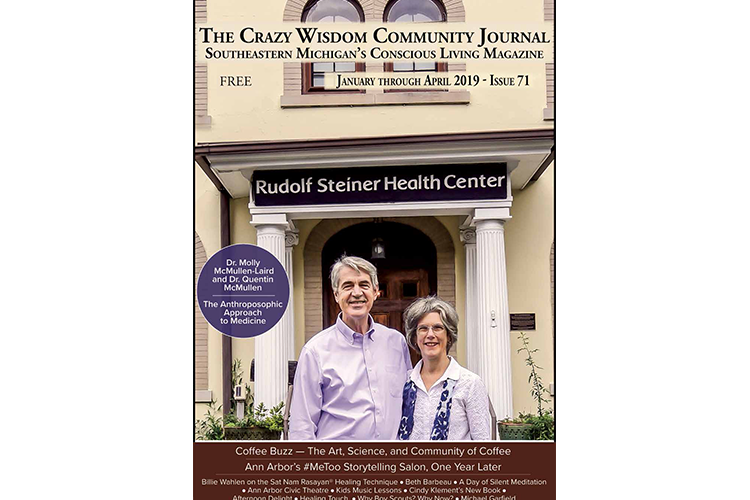
The Crazy Wisdom Interview with Dr. Molly McMullen-Laird and Dr. Quentin McMullen, Founders of the Rudolf Steiner Health Center, on Anthroposophic Medicine
Quentin McMullen and Molly McMullen-Laird are a husband-and-wife doctor team and the founders of Rudolf Steiner Health Center, which is one of Ann Arbor’s leading alternative medical practices. Now celebrating its 20th anniversary, Steiner Health is unique as a “community-supported medical practice,” and it focuses on anthroposophic medicine, which combines conventional and integrative approaches to medicine and is based on the teachings of Austrian philosopher Rudolf Steiner.





























Discover how a spilled rooibos tea stain sparked a journey into ecological art using natural plant pigments and herbal prints. Rooted in indigenous wisdom, reciprocity with the Earth, ancestral connections, and Organic Intelligence® practices (informed by polyvagal theory), this personal story explores sensory creativity, multispecies kinship, and art as a path to planetary gratitude and healing.