
By Michelle McLemore
Editor’s note: A typical definition of ‘Grimoires’ is a book of magic, often referred to as a spell book. They usually contain instructions on how to perform magical spells, create magical objects, summon or invoke supernatural entities, and perform rituals and divination. These books often also include lists of magical ingredients, correspondences, and preparations for magical tools. Some grimoires are believed to possess inherent magical powers, in and of themselves, but in this article, our writer expands that definition into a book of collected family wisdom, recipes, and tips for living that can be used and passed down through the generations, no matter your spiritual beliefs.
In 1994, the movie Hocus Pocus brought the concept of grimoires to the general U.S. populace in a whimsical eye-winking, Salem-spooky way. Yet, I was intrigued to discover 1600’s European Christian clergy also compiled healing prayers and ‘practices grimoires.’ The concept of astral magic, influenced by knowledge from Arab cultures, featured prominently in European medieval grimoires to channel universal energies through spirits and angels. Preceding that, collected practices for power, safety, and life manipulation may be traced back to ancient Egypt, the Middle East, Far East cultures, and various religions.
To see actionable practices of protection still in use today, go to any vendor show and you are likely to still find Mariam’s Hand/Hamsa hand aka Evil Eye pendants for sale to ward away curses from ill-wishers. Multiple cultures and practices still advise drawing salt across thresholds and window ledges to prevent negative spirits from crossing. Additionally, the Jewish Passover is still kept as a reminder of when Israelites smeared lamb’s blood on their door posts to keep their family safe from the passing Angel of Death. Perhaps you may even cross your fingers for lucky outcomes? (As a supposed pre-Christian practice, it provided a junction to draw friendly spirits who may help hold and nurture a wish into reality.)
Folklore customs as well as generational practices for healing, heartbreak, and dealings with the mystical still abound. However, oral tradition of teaching family wisdom is dwindling, and family “books” for many have been reduced to genealogy charts and possibly a Bible in which obituaries or birth announcements are stuffed.
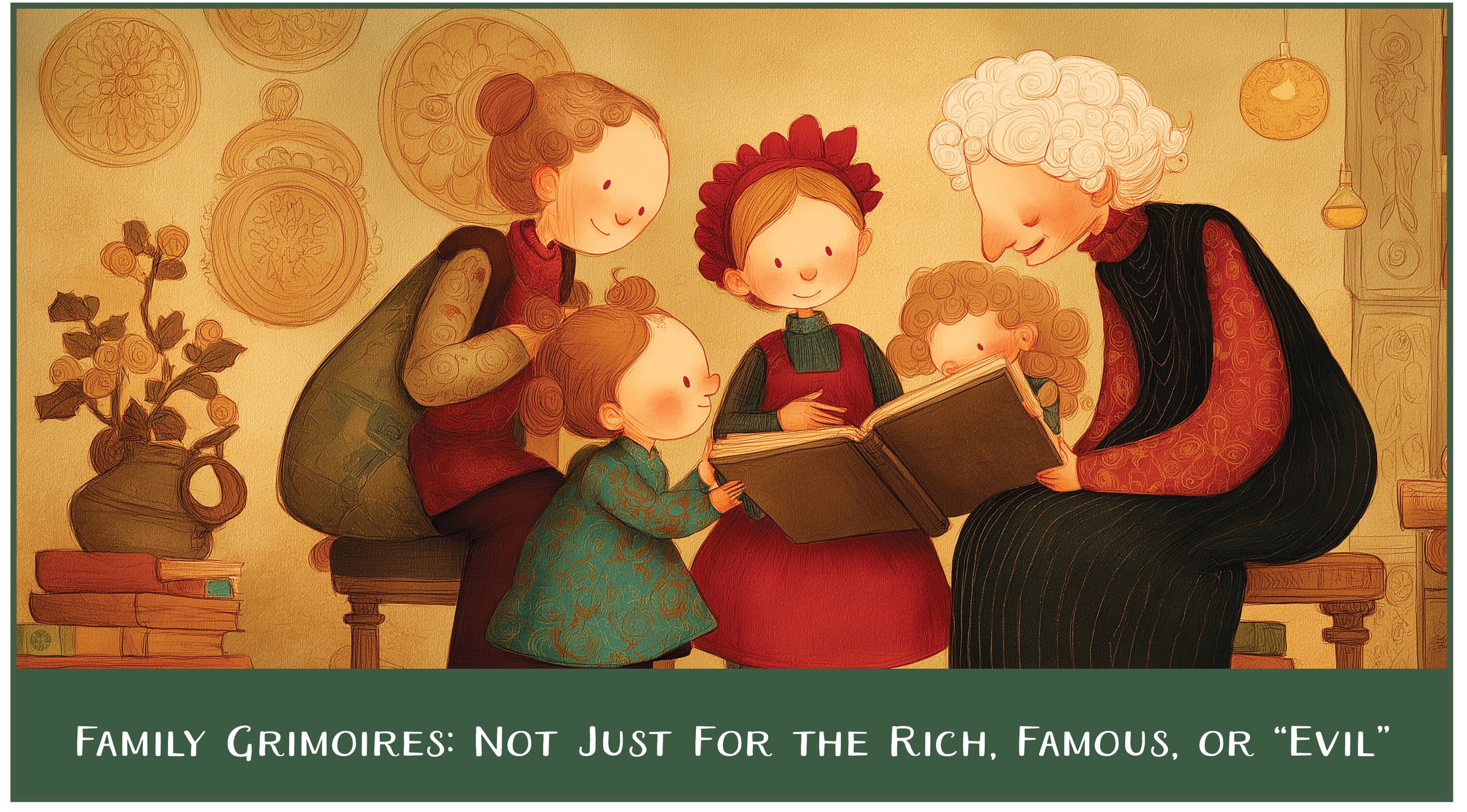
At the most basic level, a grimoire is a book of collected wisdom to be kept within a family and passed down through the generations to family members who would preserve, and add to, the knowledge. During the last few years, I was drawn repeatedly to wishing someone before me had collected and written down a variety of family knowns—aging tips, histories, recipes, solutions to every-day hazards, and so on. That desire became the impetus for me creating a grimoire for my family. (Well, that and a cheeky personality streak to bite my thumb at overly fear-filled belief systems.) Perhaps you will safeguard your family wisdom before it becomes lost to your descendants. Keep reading to explore possible section topics and formatting.

Grimoire Topic Sections
Recipes—Tried and true recipes that make it into the grimoire are the Holy Grail concoctions that became integral parts of family memories and all cozy affiliations. For me, some of these include Mom’s famous chili, Sister Sue’s broccoli salad, Dad’s kielbasa hobo stew, my mother-in-law’s banana pudding, my crumb-topped pumpkin pie, and my husband’s special hamburger patty recipe. Pairing charts for charcuterie, wines, and fragrances are also included. This isn’t a full recipe book, but the ones that family and friends clamor over. What would be sorely missed in your family if someone passes and hasn’t shared a recipe? Include the recipe, who it came from, and possibly a picture of them in the kitchen if possible.
Remedies, Potions, and Lotions—This section combines essential oil and herb use, energy healing techniques, smudging directions, stretches for common muscle strains, vertigo relief postures, and helpful hand mudras. Whatever non-pharmaceutical assistance to ailments were found helpful across lifetimes should be preserved here. (Even if it is castor oil for some of you.) I also suggest incorporating tips for taking care of children and aging parents. I want younger generations to know what sundown syndrome is, what life to death transitions may incorporate, how to handle caregiving with grace, how to change bedsheets with someone in the bed, and so on. Remedies could incorporate the respectful language or methods to use with someone with dementia. The category goal is to soothe, heal, and cure when possible.
Power Prayers, Meditations, and Motions—Every grimoire needs a few spoken spells which break down into powerful words, affirmations, prayers, poems, mantras, and possibly how to address specific archangels or other dimensional beings. What do you or your family say for protection, appeals, or life guidance? Do you keep table salt handy? Do you make crystal grids? Do you find it’s helpful to pray at certain times of day? Include the what, how, when, and diagrams if relevant.
Be creative. “Thank you” and “I’m sorry” can be powerful words for healing relationships. When I visited a relative in a mental health facility, she had a poem taped to the wall. It was “After Awhile” by Veronica A. Shoffstall. It is a beautiful, but direct poem, about how to strengthen and recover from a broken relationship.
Symbols, Talismans, and Journeying—Power tools aren’t always from Duwalt or Milwaukee. Whatever we trust to enhance our spiritual connection, could be shared here. Do you have holy water in your house? Do you wear a cross, carry an angel coin, or hamsa hand pendant? Which are your most used crystals? How do you use and care for them? Have you hung a dream catcher? What are the basics to understanding its use?
Journeying, dream analysis, and intuitive visions could be explained regarding their process, common symbols, and wisdom revealed if they have been part of your path. Are certain animals, plants, or ancestors common guides for you or other family members?
Family Folklore, Wisdom, & Humor—This section provides brief narratives and anecdotes to preserve family stories of importance. Some may be serious such as my mom’s determination to stand at an intersection collecting signatures to make it a four-way stop, or brief, like the wisdom she learned as a child of the U.S. Great Depression to squeeze an ear lobe to temporarily forget about being hungry. Then, there was Grandma Virginia’s adamant belief that one’s shoes and nails should always be clean and polished as they are often first line of judgement by others. Other stories may be mystical encounters with nature spirits and UFOs or practical like, “Don’t lick a metal pole in winter.”
Traditions—Did you marry with “something old, something new, something borrowed, and something blue?” Then you were participating in a Victorian England tradition to protect and draw happiness to the bride. How about drying and breaking a turkey’s wishbone at Thanksgiving? That wish-winning activity dates back to ancient Etruscans and Roman life.
As a U.S. mainstream multi-ethnic family mix of Scottish, Irish, English, French, and German, my family had few actual “traditions.” The ones we had mostly revolved around holidays. Christmas BINGO at grandma’s, Tooth fairy visits, watching the Perseid meteor showers—whatever brings you together or is a practice of love and kinship should be recorded. New traditions can be started at any time. For instance, when my kids had families of their own, we began Thanksgiving morning brunch to still gather on the day but allow them to begin making their own family traditions.
Ancestry, Genetic Concerns, and Talents—Tracking family genealogy can reveal interesting patterns of first and middle name choices. Also, charting genetic health conditions can provide awareness to make healthy choices based on ancestors’ health diagnosis. Some medical and psychological conditions have strong genetic components which can impact inheritability. Samples include cystic fibrosis, sickle cell disease, Huntington’s disease, Turner syndrome, schizophrenia, bio-polar disorder, OCD, ADHD, and types of anxiety. Being aware of family potential genes could empower descendants to do genetic screening to determine risks of having children, or to help them choose healthy life choices to avoid triggering the latent genes.
Finally, skills and talents are often seen across family patterns: art, writing, design integration, insightful understanding of history, intuitiveness, green gardening thumbs, musicality, and more often shows up across family trees. This can help youth explore if they have the gift as well and to take pride in a lineage of workers.
Recommended Readings—the works we’ve read, heard on audiobook, or watched as movies deeply influence our beliefs and convictions. For me, this section includes books from my childhood, spiritual and metaphysical studies, as well as works that enriched my life. You may list these as one alphabetical list or break it up into lists from each family member.
Grimoire Cover Construction
I still enjoy books that I can hold in my hands. Because I desired a tome that could be added to and rearranged as needed, I envisioned a three-ring binder. A crafty former student of mine asked me to choose a theme, main color, and symbol and then she decorated a binder for me to use. I used plastic sleeves to put in typed information, photos, and physical artifacts as needed.
Other more fastidious, better-organized creators may choose a bound paper journal in which to handwrite and add sketches or pressings. Regardless, if your grimoire is digital or physical, the importance is the content.
In 2026, the movie Practical Magic II will be released. Bound in a toad-skin-like material, the grimoire within the movie contains personal information and dictates it be burned if no family member is designated to inherit it. That brings up one final key point: Who do you trust with preserving and honoring family knowledge? If your grimoire is in digital form, you may share it with several descendants and perhaps give joint editorialship in Googledocs or a similar platform. If a family line dies out, what then? I guess, if dangerous secrets are involved, designate who will burn it. However, if it’s primarily wisdom, medicine, and general family information, I’d consider donating it to a close family friend or local history museum. Hopefully someone will preserve your ancestral journey and may it benefit others for years to come.
In the meantime, “Lang may yer lum reek.” (It’s a Scottish saying for, “Long may your chimney smoke.”) And may you gather strength from your ancestors and lineage—the good, the bad, the ugly, and the potential that you get to cultivate to share every day in your way.
Michelle McLemore is a freelance writer, workshop speaker, energy practitioner, and stress management guide working on courses. Her background as a psychology and writing teacher supports personalizing client self-care to boost balance and vitality. Learn more at facebook.com/MichelleMcLemoreHealingGuide, michelle.mclemore on Instagram, and mclemore.substack.com. Email inquiries to energy@michellemclemore.com.
Read Related Articles:













Folklore customs as well as generational practices for healing, heartbreak, and dealings with the mystical still abound. However, oral tradition of teaching family wisdom is dwindling, and family “books” for many have been reduced to genealogy charts and possibly a Bible in which obituaries or birth announcements are stuffed.