
By Julia Minerva Rhodes
I made Minerva my middle name as a show of devotion to Wisdom. Little did I know that in doing so, I was signing up for a fascinating encounter with the Greek wisdom goddess Athena and her Roman counterpart Minerva.
As my curiosity about philosophy grew, I discovered in the writings of philosopher Baruch Spinoza the same ideas about God, nature, free will, and joy which I had embraced independently: God is nature, there is no free will, and the meaning of life is to enjoy it. Nietzsche once joked that Spinoza wrote as if Athena herself imparted her wisdom to him. I agreed, but to me, it was no joke; I felt her calling to me through these ideas.
I viewed the altered state I experienced from psilocybin mushrooms as a window of communion with her. Since writing in these states proved too difficult, I had to wait until afterward to channel my idea of what I felt her telling me. But these attempts were overconfident. At the time, Athena for me was more an abstract personification of wisdom than the warrior goddess of Greek myth. I hadn’t made a serious effort to know her yet, and so I could never get the words right; my writing felt like it came more from me than her.
Still, I remained haunted by Athena’s character. I surrounded myself with owls (one of her main associated symbols) and kept reading religion and philosophy. In turn, she signaled her presence in my life, each sign increasingly difficult to ignore. Other Greek god devotees came into my life and we traded advice. They helped me see how Greek gods could be divine forces of nature, and, at the same time, flawed personalities like ourselves. Strangest of all, I found myself working at, of all places, a bookstore named “Crazy Wisdom.” And so, I began to take Athena more seriously.
In addition to being the goddess of wisdom, Athena is also the goddess of war, the arts, the crafts, and related spheres of civic life. She wears golden armor, and while known for being wise and caring, is also known for being egoistic, short-tempered, and virginal. For this reason, I sometimes doubted if I was the right person to be her devotee. My personality is more feminine, peaceful, and amorous. Was this masculine, warlike, and at once too-flawed and too-perfect goddess really the energy I wanted guiding my life?
While working at the bookstore, I stumbled upon a book called Living Theurgy by Jeffrey Kupperman. Theurgy is a form of magic whose name means “god-working,” which was practiced by the Neoplatonists of late antiquity. In the spring, I attended a meditation on Athena hosted by Mara Evenstar and her spiritual group Sophia unfolds. During this ceremony, I gained an appreciation for aspects of the goddess I hadn’t taken into consideration before—like her colors, her incense, and her armor. Finally, I bought and read Athena: A Biography by Lee Hall, the most comprehensive book about the goddess I could find.
In her book, Hall accuses Athena of being a traitor to her sex, and she’s not the first person to make this criticism. In the myth of Athena’s birth, Zeus eats Athena’s mother Metis, who gives birth to Athena inside Zeus, upon which Athena bursts forth from his head a full-grown adult in golden armor. For Hall, archeological evidence suggests this myth symbolizes how Athena originated from a pre-existing goddess who was subsumed by and made subservient to patriarchal Hellenic culture. From birth onward, Athena was Zeus’ right hand, and her role in mythology has largely been to guide heroic men—Heracles, Perseus, Achilles, Odysseus—and punish women (such as Arachne and Medusa) who defy the gods. But I had to wonder: would Athena really forgive Zeus so easily for killing her mother? Instances of Athena defying Zeus are rare, but not inexistent… for example, Hall cites a lesser-known myth of Athena challenging his authority by collaborating with Prometheus in creating humans, a truly scandalous crime! Having finally gained a better idea of who Athena was, I knew what I wanted to ask her when we met: Did she obey Zeus because she wanted to or because she had to?
Even better, my theurgy book gave me a new technique for meeting her: divine possession, a ritual method which allows a god to inhabit a person for purposes such as divination. A person does this through dressing up as the god, surrounding themselves with their associated objects, burning their associated incense, and entering a trance. Following these instructions, I assembled the materials and performed the ritual.
First, I surrounded myself with her associated objects, which for me meant my owl figurines and my idol of her. Second, I burned cedar incense, one of the recommended scents for communing with her. Third, I prayed to her by reciting the Orphic Hymn to Athena in my own words. Fourth, I entered a trance by means of psilocybin mushrooms and a hypnosis tape I had recorded for myself. Fifth, I donned her vestments—inspired by the paintings of the Athena–obsessed 17th century painter Rene-Antoine Houasse, my costume consists of a white lace dress, a blue sash, and a brass helmet.
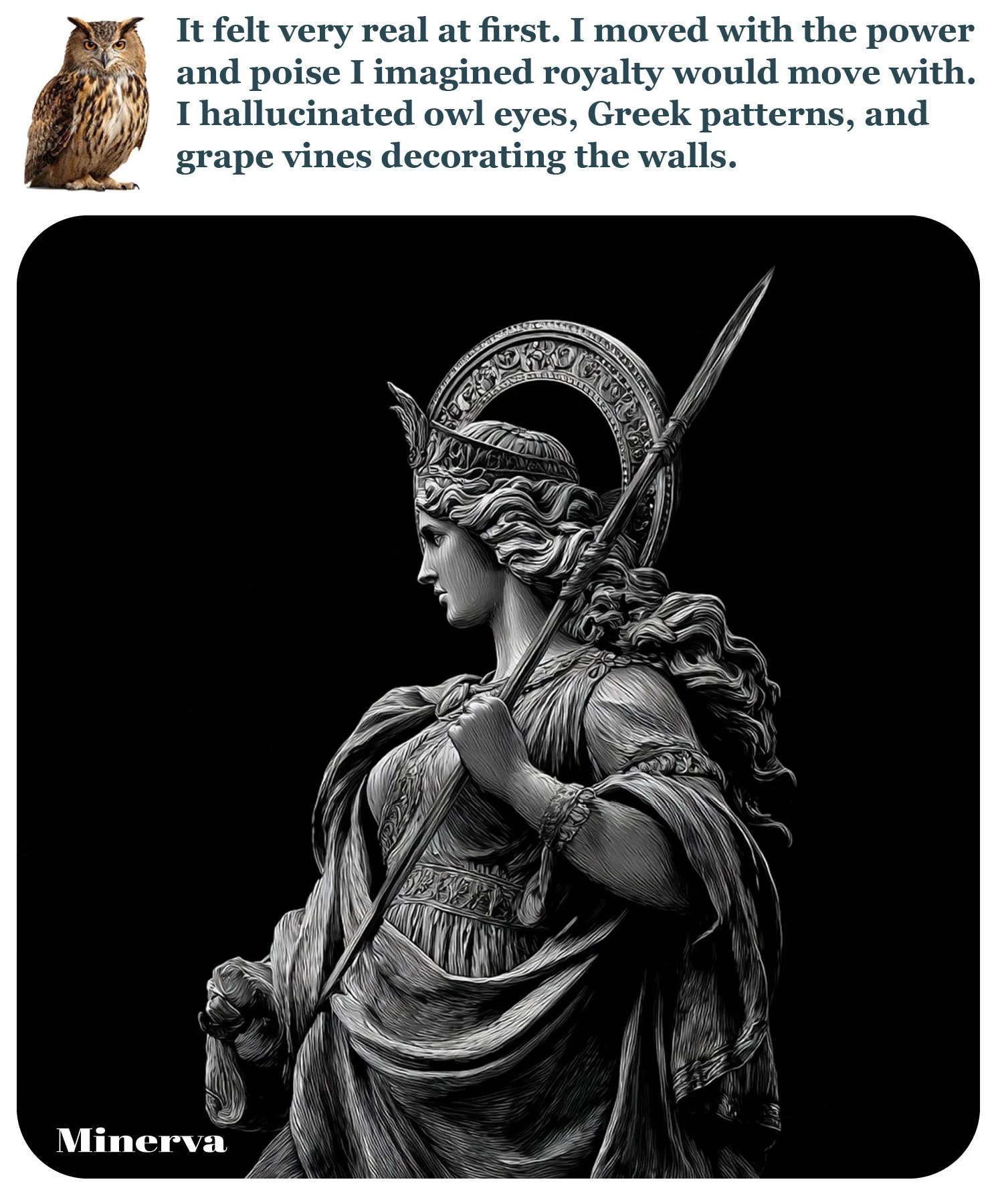
It felt very real at first. I moved with the power and poise I imagined royalty would move with. I hallucinated owl eyes, Greek patterns, and grape vines decorating the walls. Most interestingly, when I reached for a drink, my hand recoiled at the realization that, as Athena, this was not my glass, and the apartment was no longer my home, but a place I was a guest in. However, drinking out of the wooden chalice on the altar, set aside for spirits and the sacred, felt perfectly natural. The physical difference mirrored a spiritual shift: I had stepped out of the house of my own mind and into the Olympian halls of Athena’s mental palace. I could look on myself as an outsider, and from her vantage point, she seemed to feel toward me the mix of gratitude and irritation which a celebrity might feel toward an obsessed fan.
In the living room, I had set up a chair in front of a camera and tripod so she could sit down and deliver a recorded message for me. At first my question—“What would you say if you could tell Zeus how you really feel about him?”—seemed to emotionally trouble her, but when she sat down in the chair, she became peaceful… too peaceful. No words were coming. Moments after I got her, I lost her.
But I was determined. I changed out of her clothes and into my own, and I was me again. I took a walk in the September air to get my blood pumping, as she is an athletic goddess, after all. Upon returning indoors, I realized I’d have to beg for her to come back. So, I prayed, this time not with candles and incense and prewritten prayers, but by looking up at the ceiling and speaking from the heart.
“I know there’s an untold story here you want told,” I prayed. And in that moment, it became clear: just as relying entirely on myself wasn’t the answer, relying entirely on her wasn’t the answer, either. Those few minutes of deeper possession I had experienced at first were interesting, but not stable. What she wanted from me was something more akin to method acting, where I channel her not so much as a shaman, but as an artist, albeit an artist incorporating theurgic techniques into her process. If I wanted to work with her, we had to work together. I saw that she called me for that same soft artistic temperament that made me doubt if I was worthy of her. She wanted me for me.
So, I sat back down in the chair, this time planning, not to lose control and have her take over, but to simply hold her energy and let it flow. Watching the camcorder footage afterward, I found the Athena I got was neither weepy and indignant for being made an accomplice to Zeus’ rapes, nor was she smiling in an angelic bliss detached from any trace of humanity. This Athena was scheming and Machiavellian in a way that surprised me. With the sex crimes of patriarch tyrants fresh in the news, this was an appropriate time to confront Zeus about his injustices which had so enraged her when she saw them portrayed in Arachne’s tapestry. But her stance was not open rebellion; instead, she seemed to be attempting to use social pressure to persuade Zeus to consider abdicating and leaving her the throne. It was a short monologue, and open-ended. We don’t get Zeus’ response, but I imagine the throne of heaven is not gained easily. If Heracles is any example, proving one’s divine worth is a long journey filled with many difficult tests.
Is Athena going through these tests as we speak? Who can say? Personally, the story compels me, and it would explain a lot. I can see myself devoting a great deal of time to exploring it artistically. She seems a part I was born to play. And if anyone asks, “Are you acting or channeling?” I’ll direct them back to what I’ve written here. The answer is a bit of both. Now, when I put on her clothes, it’s an act of creativity, but having paid homage to her traditions, I believe she’s there guiding me also. As for how much of her presence shines through, that’s for the audience to judge.
Julia Minerva Rhodes is a video essayist and musician with interests in cinema and mysticism. She has worked at the Michigan Theater Foundation, Crazy Wisdom Bookstore, First United Methodist Church, and University of Michigan. She can be found via her YouTube channel (youtube.com@JuliaMinervaRhodes) or contacted via her email at xanaduforever@proton.me.
Read Related Articles:
































































































































In Hamtramck, a unique neighborhood establishment is redefining what it means to gather for a drink. Founded in 2023 by owner and creative director Zoey Ashwood, The Black Salt bridges the gap between a traditional craft cocktail bar and a dedicated space for metaphysics and ritual. For Ashwood, a former New York City painter, professional psychic, and lifelong practitioner of witchcraft, the integration of cocktails and magic is entirely natural.