

By Susan Slack
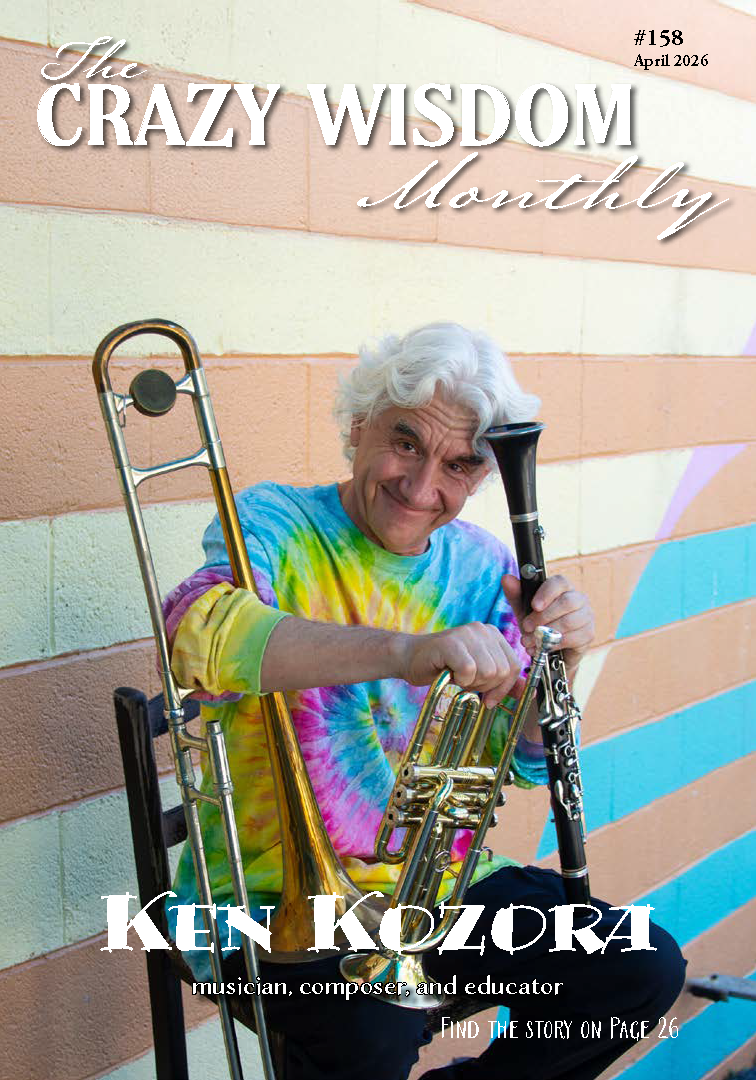
Ann Arbor musician, composer, and educator, Ken Kozora, is a one-of-a-kind gem. I asked him on a quiet afternoon at the Interfaith Center for Spiritual Growth, a favorite music venue and hang out, what was the pathway that led to receiving the Love Award from the Artist Advocacy Foundation in Detroit this past September. Our conversation was delightful as he spoke with energy, expression, and conviction.
But before we get to the Love Award, let’s flashback to 1996. Kozora had been working all sorts of jobs. “I’d managed a music store for many years and people used to come in and bring instruments like clarinets and trumpets, but we were a rock and roll store with high end synthesizers and audio stuff. We didn’t really do band instruments, but they’d bring them in all the time and wanted us to buy them. Sometimes we’d give $20. So, I knew there were all these instruments in people’s closets.”
A few years went by. A nice guy with a nice music store offered Kozora a nice new position there, but he’d been there and done that. It was the week of Thanksgiving, and he just wanted to go serve in a soup line and help people. He wanted to contribute to society. While the nice music store owner waited for a call back, Kozora debated with himself. How can he do something musical? He remembered the many instruments sitting in closets. They’d get put in the landfill to become waste. His inner light bulb lit, and the idea came to him about how he could merge both concerns. “I thought to myself, ‘there are kids in need, and I can do an ecological recycling program!’”
He knew the instruments were there, he knew teachers in the school system, and he knew some repair people. His big idea became clear within 15 minutes after that music store offer. Boom! Horns for the Holidays was born. He made a poster and called around looking for collection sites. Sooner than he expected, he received a bunch of instruments that were repaired and put into the hands of deserving kids.
“Over the years more instruments showed up,” Ken recalled. “We expanded to five collection sites. But it’s just me with help from folks like the extraordinary repair guy, Michael Westhoff, who’s been replacing clarinet pads and repairing trumpet valves for ten years. For me it became a full-time effort, but not paying full-time. Since I started, with the help of many people (it takes a village) I’ve probably collected, refurbished, and redistributed well over a thousand instruments. That’s not tons, but it is for one little local program. Instruments find their way to me. I don’t own them,” Ken told me. “I just pass them through and into the hands of kids.”
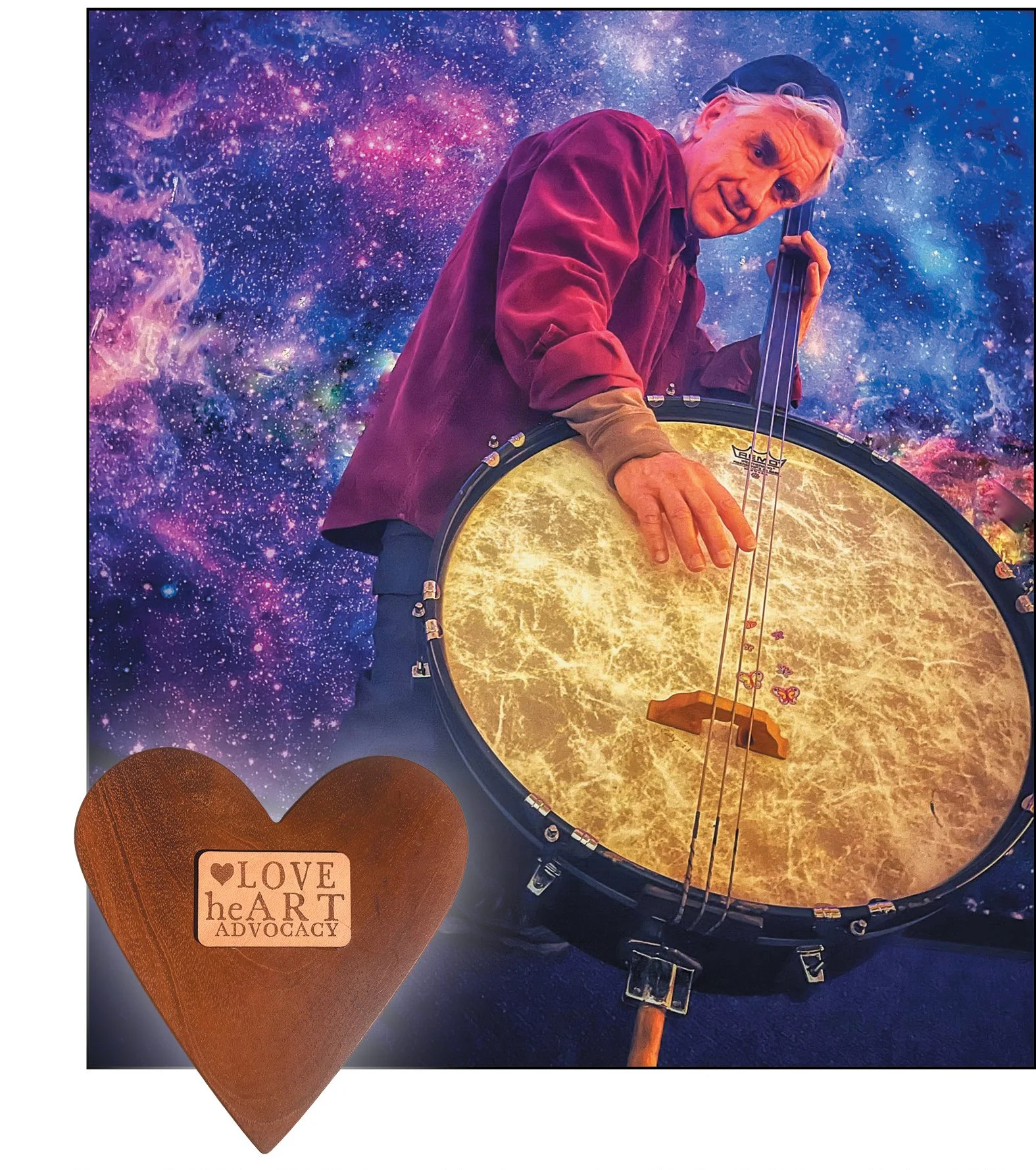
Kozora knew it was important for kids to have instruments. It wasn’t until a few years into the program that he realized his motivation for it, beyond what he was conscious of. As he was being interviewed by The Ann Arbor News about the program, the journalist asked how he got started. A memory revealed itself in that moment. “I remembered in fifth grade, somebody had donated an instrument to the school. We couldn’t afford an instrument. When I was telling him this I started crying. I was like, full circle, right?”
People have urged Ken to turn this venture into a nonprofit. “I answer, I don’t want to. That’s a lot to keep track of. And I say if one kid’s life changes and is affected as much as mine was by somebody donating an instrument, I’ve done my job. Any of us can pitch in if we discover our barrier to doing something. Often, we think it has to be something bigger; it has to be something complicated; it has to be an important thing. So, for me, a non-profit is way too big. It’s just too much to do. But helping somebody, like holding the door, or carrying groceries, whatever it is, that’s part of it. Figure out where your niche is. And do that.”
Four years ago, the Detroit Symphony Orchestra (DSO) started a very similar program called Detroit Harmony that distributed donated instruments throughout Michigan. They were financially set up to market and get the program rolling. Kozora informed them that he had been doing the same thing for years. So, he donated instruments from his program into theirs and a relationship was formed. They agreed if ever a reciprocal opportunity happened in the future, they should stay in touch.
In 2024 Kozora heard from Ron Colone, Executive Director of the multi-state Artist Advocacy Foundation (AAF). For eighteen years the foundation has given grants to artists who provide special inspiration. The AAF was really into Horns for the Holidays which is one of the many things Kozora does. “Learning about your instrument repair program,” the grant notice read, “we enthusiastically voted to award you the Artistic Merit Grant, acknowledging your positive presence, the good work you do as an artist, and thanking you for the inspiration.”
Though very appreciative of the award, Kozora found something even more valuable. “What I’ve discovered through the program is the good feeling of helping people.”
Then in January 2025 in Los Angeles, the worst happened. The city was on fire. Neighborhoods were wasted. Ken recalled, “When you see something like that, you never know quite what you can do [to help]. There’s so much in the world going on, and you’re like, how can I help? I’m not very good at internet fundraising and all that. I saw photos from L.A. and I thought, what about the kids? The schools probably burned down too. I texted Ron Colone at the AAF and asked, what about the schools?
Mr. Colone responded, “My niece is the principal of a school that totally burned down to the ground. They’re teaching in a rented third floor office and they’ve lost all their instruments.”
Kozora told him, “We’ll start a drive here and we’ll help. We’ll figure that out.” He called the Detroit Symphony Orchestra and let them know the situation. He and a team soon had 67 instruments to send to the L.A. kids. But they needed to be shipped across the country which required special packing. That was his biggest concern. He was going to do a drive in Ann Arbor, but in order to ship, you need pallets and shipping material—a whole business in itself. The DSO stepped in. They knew how to pack them. They had a shipping dock right there in their building and the stage crew volunteered to pack them up. A truck came and away they went. So, the kids in California have instruments. That first school was supplied. And for that kind and unselfish work he received yet another award from the AAF. At a very fancy party in Aretha Franklin’s now public Rose Estate, Kozora was presented the “Love Award.”
Kozora remarked, “In any situation, you can ask, ‘What can I do?’ For me it was just a call, a vision that came clear in 15 minutes. I said, boom! I know how to do this. Many of us think, ‘I should do something.’ I was like, I could do this, and I actually acted on it. When I called the nice guy that was trying to hire me and told him, ‘No thank you,’ that was the turning point, motivating me because I wanted to do something else, something more compassionate. Not that sales and management isn’t.”
We paused as quiet drumming sounded from the Interfaith Center’s sanctuary as the drum circle for those with Parkinson’s started. Our conversation turned to his approach to living.
“Everything we do, the heart of it is, it doesn’t matter what we’re doing; it’s how we’re being as we’re doing. I’ve done many things: truck driver, computer programmer, a million things. It doesn’t matter what we’re doing. It matters how we’re being and then the doing becomes irrelevant. That being said, I love doing music. So doing music while I’m being is a nice combination. But if the doing goes away, the being doesn’t. How do I want to be? Do I want to be love? Do I want to be compassion? Do I want to be sharing? Do I want to be friendly?”
Kozora teaches trumpet and drum kit at Oz Music on Packard (a drop-off site for Horns for the Holidays). “Some of my students are going through the school band program. They learn the technique and all that, right? But I have this being speech with them because they get to 10th grade and already, they are asked what college are you going to? What are you going to do the rest of your life? I ask them my question and then tell them not to answer, but rather to think about it: ‘How do you want to be while you’re doing? I think that fundamental question helps them make a better choice.”
I asked Kozora why is it important for kids to have instruments? Does music serve in a spiritual or unseen way?
He thought before answering. “There’s been so much written about brain stuff and all that. Music makes you smarter and teaches you teamwork. Part of the arts community mission, which is a good thing, is to quantify the arts to get the funding: to justify: to validate. But for me, the joy of musical engagement is validation with value in and of itself. Because other stuff makes you smart, too. Business makes you smart. Sports teaches you teamwork, but we must sell music specifically because [some] funders want to cut the purse strings.”
“We’re all creative beings, not one more than the other. A lot of people feel they’re not being creative. We quantify everything and put all of it into categories: This is creative. This is not. To me the joy is the validation for everybody. And if we get rewards beyond that—money or recognition—that’s all nice.”
It’s downright difficult to list all the genres and venues Kozora plays: The Kozora Quartet, for which he composes and plays bass, is a global fusion, high-energy group. He also composes soundtrack music and is a solo artist playing original pieces at book signings, art galleries, modern dance concerts, and of course, Haiku Jazz. He plays rock and roll drums with Marissa and the Starter Pack and synthesizer with Muruga. Another project, Landfill, recorded an improvisational CD right there at the Interfaith Center.
Ken Kozora and Steve Oz, owner of Oz Music, founded and facilitated the eighth annual Know Obstacles Special Needs Summer Camp. Oz works with three special needs bands year-round. Kozora nods as he commends Oz for his work. “He knows the value of joy.”
As we wrapped up our conversation, I asked Kozora if he had any last bits of wisdom?
“I’m involved in 100 different projects, grateful for everything and everybody. I’ll say, just go out and be love—be grateful. Don’t let the complication or the difficulty of things keep you from engaging and doing whatever it is you can. Because it’s all ONE anyway, right?”
Ken Kozora can be reached by email at zenkora@gmail.com or on his personal page on FB at ken.kozora. Those wishing to donate to the Horns for the Holidays program can drop used instruments off at Oz Music located at 1920 Packard Street in Ann Arbor. Discover open hours and more on their website ozmusic.com.
Susan Slack is an author, musician, and leads Dances of Universal Peace. She can be contacted at peaceinacircle@gmail.com. Learn more at her website, slacksusan.wixsite.com/susan-j-slack or visit the Dances of Universal Peace Facebook page @AnnArborDancesofUniversalPeace.
Read Related Articles:













































Art has always been vulnerable to public concerns, stemming from its ability to raise complicated feelings. Music is especially targeted because it’s everywhere. A 2021 Harris Poll found that among American adults under 30, 72% reported listening to music by choice and among those, 77% reported choosing music listening as a daily activity.