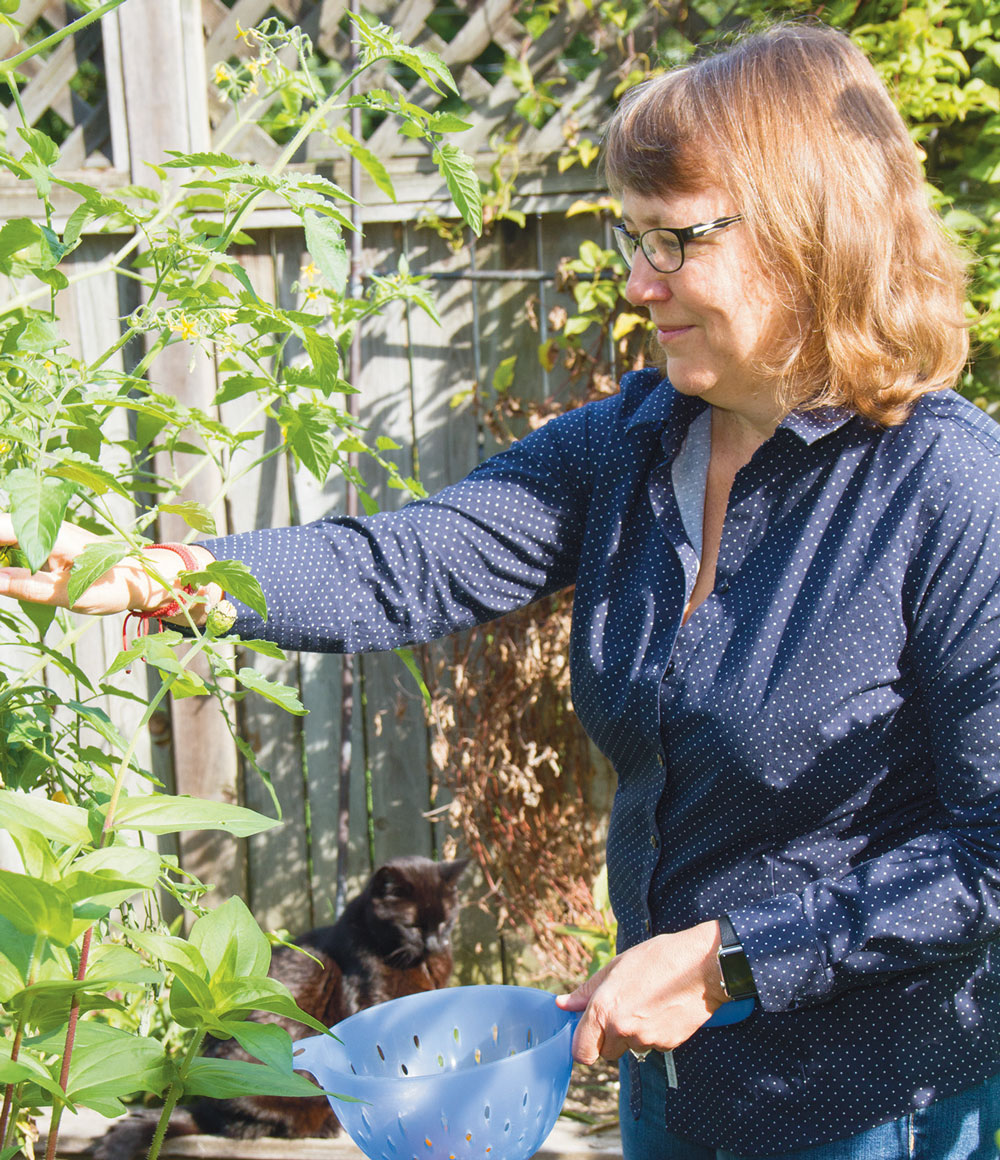
Kim Bayer: Proponent of Slow Food, Champion of Farmers and Marketers

By Rachel Urist | Photos by Joni Strickfaden

In her blog, Kim Bayer was the “Farmer’s Marketer.” When MLive invited her to write about restaurants and the local food scene, she brought a following. Her prose is a good reflection of the person: direct and lucid. Consider the following, written in May of 2011, about one of her favorite subjects.

My number one place for food in Ann Arbor is our amazing year-round Farmers’ Market. With over 120 vendors (and a waiting list of 100 more), this historic 90-year-old market takes place weekly on Saturdays between the cobblestone streets of the Kerrytown historic district. From April through December the market also runs on Wednesdays. And this summer it’s testing out a nighttime market on Wednesday evenings starting in June!

In person, Bayer measures her words and avoids the limelight. She hesitated before agreeing to be profiled here. Yet she has become a local force in the “good food” movement. She works to promote sustainable agriculture, healthy eating, and ways to create a safe, caring place for ourselves and those around us. She personifies the adage: “think globally, act locally.” She has championed local farmers, markets, and restaurants.

“Kim is our local food hero,” said Kris Hanna-Hirth, owner of Old Pine Farm in Manchester, which raises sustainable and heritage animals for meat. Hanna-Hirth, who is committed to animal welfare, went on:

I don't think you could find anyone more instrumental in the “farm to table” movement in the state of Michigan than Kim. She literally put our farm on the map. She is passionate about helping anyone and everyone create and discover good, local food. Farming can be a tough occupation with many ups and downs. When the drought of 2012 came and just about closed our doors, Kim was there to encourage me. She wrote about our farm to help generate business. She gave us tips on how to generate business. She gave us moral support. During our second year, Kim asked about having people out for a tour to introduce them to our farm. For the business, it was the attention and interest we needed. I truly believe that the Ann Arbor food movement would be lost without her guidance.

Cathy King, of Frog Holler Farm, added:

In her quiet and humble way, with dedication and passion, Kim has changed the face of the local food environment in Ann Arbor. She is the creator and/or prime mover of many local organizations that raise awareness about locally and sustainably produced food. First and foremost, however, she acknowledges the source: the local growers. She has been a great friend to area farmers, and I'm proud to consider her my friend as well!

Bayer’s current focus is the Washtenaw Food Hub, located on Whitmore Lake Road. Our first meeting took place there. It was a cold day in March. We sat for a long time in the large, unheated main room of the farmhouse, the site of meetings, potlucks, and marketing. I had not anticipated such an indoor chill. Bayer offered me her woolen gloves, which I accepted. When my fingers grew numb from cold, we left. We found a warmer site in town, where we continued our chat. I still did not understand the meaning and nature of the food hub. What is it, exactly? Why is it so important? I had read her blog and her MLive articles. I contacted some of her friends and colleagues. But until I researched the food hub phenomenon, my understanding remained sketchy.

Reading about food hubs taught me that they are centrally located facilities designed to collect, coordinate, process, store, distribute, and/or market locally produced food. A healthy food hub consists of a variety of fully integrated businesses, social services, and safe public spaces. They collaborate in innovative ways to leverage profitability and sustainability. For small and mid-sized farmers, food hubs offer greater equity within the food system, since their access to wholesale markets is often challenged.

The U.S. Department of Agriculture estimates that there are about 240 food hubs in more than 40 states. These food hubs help return profits to the farmers of the region. Without them, farmers lose billions of dollars in prospective revenue, given the ubiquity of supermarkets and the convenience they afford. But the produce offered to consumers in these mass vending sites is typically shipped in from afar. Local farmers are left in the lurch. The food hub has, therefore, become a cornerstone, if not a lifeline, for farmers in many regions.

The Washtenaw Food Hub, now in its fourth year, describes itself on its website as “a limited liability corporation…. a single point of contact for local food purchasing, processing, aggregation, storage and distribution.” The Food Hub has three prime movers: Kim Bayer, Deb Lentz, and Richard Andres. The sixteen-acre property, currently owned by Lentz and Andres, lies three miles northwest of downtown Ann Arbor. It contains a farmhouse, a pond, a former feed store building with a front retail area and 95-person event space, storage areas, large loading docks, nine freestanding agricultural structures, and a (recently expanded) 145-space parking area. The Food Hub’s two 600-square-foot, professionally outfitted kitchens are used by several local businesses, which include Locavorious, a business which preserves local fruits and vegetables, several granola businesses, and bakeries. The other large kitchen is occupied by The Brinery, the artisan fermentation business which is the Food Hub’s “anchor tenant.” David Klingenberger, founder and C.F.O. (Chief Fermenting Officer) of The Brinery, can often be found there. He and Bayer have been friends for many years. “She lives to nurture people,” he said. His nickname for her is “Care Bear.” The two friends call themselves “co-conspirators in the good food movement.”

“I’m excited about CSAs — the antidote to the industrial food system. The CSA model provides a real connection between farmer and eater, food and place. It fosters biodiversity. It improves the environment. It’s a win-win situation.”

After winning a U.S.D.A. grant, Richard Andres and friends installed a 150,000-watt solar array on the roofs of two of the buildings. The Food Hub now produces all its own electrical energy. Andres and his crew also did much of the buildings’ interior renovations. Andres is a skilled carpenter, having spent years earning his living in that trade, before buying Tantré Farm, a half hour’s drive from the Food Hub. He did most of the renovations to his farm’s homestead and outbuildings. The Hub also has its own vermi-composting system, run by Jesse Raudenbush of Starr Valley Farms, which turns all kitchen waste into soil fertilizer. “Vermi” is Latin for “worms.” Worms are the key ingredient of the system. Raudenbush sells worm castings and “castings tea” to generate income, promote his classes, and improve soil fertility. Bayer and her fellow organizers are thrilled that the Food Hub site, whose promise they saw so clearly, has become the nexus of farm, food businesses, and community.

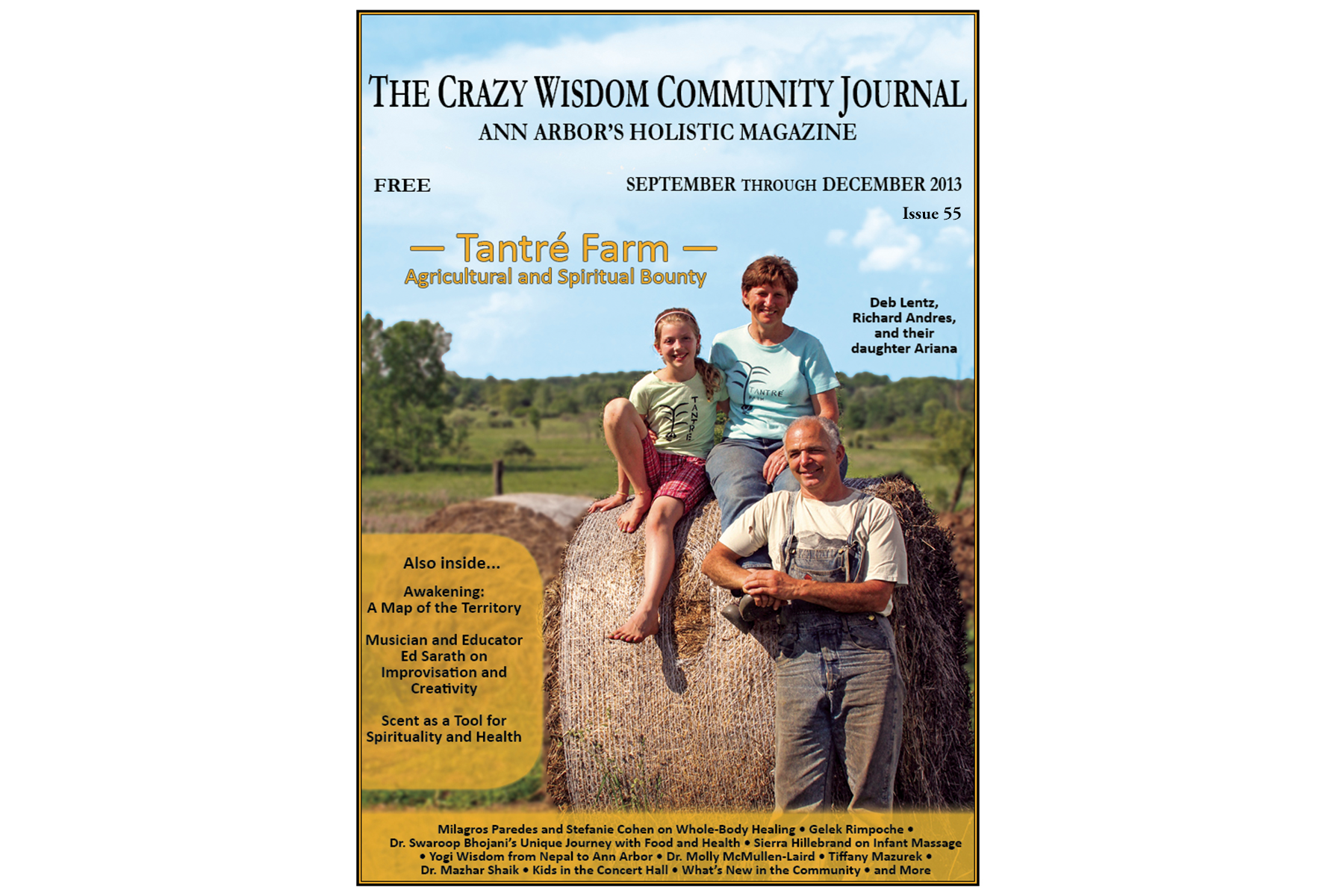
Recently, Bayer and her husband of fifteen years bought 187 acres down the road from the Food Hub. They plan to use this land to create a formal partnership with Richard Andres and Deb Lentz, owners of Tantré Farm (profiled in CW Issue 55). The four are good friends. Andres says the organizers are indebted to Bayer for her “vision and support.” He also appreciates her background in information technology, which comes in handy at the Hub. Her involvement with Slow Food Huron Valley means that she is among the folks “with broadest perspective.” They examine “not just our food network,” but that of “every region of the world.”

Bayer  has been a member of the Tantré Farm program for Community Supported Agriculture (CSA) these eleven years. Like many CSA members across the country, she rhapsodizes over the development of this institution.

I’m excited about CSAs — the antidote to the industrial food system. The CSA model provides a real connection between farmer and eater, food and place. It fosters biodiversity. It improves the environment. It’s a win-win situation.

She contrasts this situation with the “lose-lose” conditions of industrial systems, which “torture animals, produce unhealthy processed food, disconnect food from people and place, and contaminate the environment.” The Washtenaw Food Hub provides a network for area farmers, a sustainable base where produce can be collected, processed, and sold, a nexus for meeting citizenry and prospective CSA members, and a place where local citizenry can learn more about sustainability and meet the people who grow their food.

The more I learn about Bayer, the more impressed I am by her array of skills and interests. One of her few non-volunteer services was that of a CSA consultant, for which she tapped her encyclopedic mind to match individual preferences and life-styles with specific area farms. Her technological savvy is also impressive, though she hardly acknowledged it. Her bio for the Washtenaw Food Hub hints at these skills, but the bio’s compression is dizzying. It reads:

KIM BAYER is a project manager, communicator, and strategist as well as a veteran community organizer and coalition-builder with deep knowledge of local food systems. Her background includes a Master’s degree from the University of Michigan in Information and Library Science and 15 years of experience at U-M where she and her staff guided strategic direction in technology for teaching and learning. Kim is currently involved in the development of the Washtenaw Food Hub with the goal of establishing health as the standard for economic, environmental and social well-being. Kim has led the creation and implementation of numerous collaborative food system projects, including conferences (Local Food Summit 2009–2014), festivals (HomeGrown Festival 2008–2012), and she teaches workshops and lectures on food system issues. In addition, Kim is a published author and restaurant critic, and she writes on food-related subjects for regional publications and has written several guides to local food in the Ann Arbor area. Kim is the founder and President of the Great Lakes CSA Coalition, a 501c3 created to promote CSA farms and establish wellness rebates from insurance companies. Kim is Chair of the non-profit Slow Food Huron Valley, a board member on the Executive Committee of the Food System Economic Partnership, and the Slow Food Governor of Michigan.

The picture is clearer if we look at her work history. After earning her master’s degree at the University of Michigan in Information and Library Science, Bayer worked for fifteen years, starting at the U-M’s Office of Instructional Technology. Within that office, her team’s mission was to support teaching and learning by helping faculty to understand and use the increasingly rich technological resources at their disposal. To this end, she worked directly with faculty and with technology specialists. She became the team leader for learning technology. Later, she was in charge of support for online courseware. Eventually, her office was moved to North Campus’ Media Center, now called the Duderstadt Center. Her networking initiatives helped create a climate in which faculty learned to share ideas and resources.

Bayer also did strategic planning for LS&A faculty. This involved incorporating technology into classroom learning. For instance, in a lecture hall, an instructor could, with the aid of a simple PowerPoint presentation, have his students respond in the moment in a way that could be immediately calculated. Each student had a device, a “clicker,” with which to answer survey questions on screen. Responses would then be measured electronically, and the professor could assess what worked and what didn’t. For a while, different venues required different clickers. Since students were expected to purchase one for each course, this was expensive, inefficient, and cumbersome. Bayer helped coordinate the technology, so that, eventually, one clicker served all. Bayer pointed out: “It was great for instructors to get feedback from a large group of students, and ascertain in an instant whether they understood or were confused. These technologies tracked attendance, too.”

Among her many achievements during her stint with the University, the one she recalls with the most pride is the “Teaching and Technology Collaborative,” which was her brainchild. She saw that there was a lack of communication among faculty and staff; separate departments did not coordinate their efforts. “They’d get mixed messages or hear different things about what tools to use, or hear that they’d not find what they wanted.” So she organized staff leaders across the University to create the Collaborative to enhance group communication, centralize resources, coordinate efforts, minimize duplication, and inform faculty members about where they should go for different services.

The biggest coordinated effort of this federation was an annual conference: “Enriching Scholarship.” The initial conference, held in May, grew to bring approximately 500 faculty and staff for a week-long extravaganza at the University. Typically, the program includes a keynote speaker, training sessions, films, and open houses. Each year, the technology available for both the conference and general faculty use gains in sophistication.

Through these work experiences, she honed her organizational and networking skills, both of which benefit her current projects. Those include the Local Food Summit, a Slow Food event that she helped to create (and still guides) with colleagues Shannon Brines and Jason Frenzel. The Local Food Summit is a one-day conference which brings together the region’s food system stakeholders (farmers, CSA members, food entrepreneurs, educators, policy makers, health professionals) to develop relationships, strengthen networks, and help develop “the food system that we need.”

The many venues for Slow Food events further testify to Bayer’s organizational skills. Under her baton, events have taken place at farms, in parks, at the Michigan Theater, Washtenaw Community College, the Dexter Train Depot, Matthaei Botanical Gardens, Zingerman’s Events on Fourth, the Ann Arbor Farmers’ Market, Hathaway’s Hideaway, Brines Farm, Food Gatherers, U-M campus, and the Ypsilanti Ladies Literary Club among others.

The local community’s profile in the larger Slow Food movement is significantly enhanced by the Washtenaw Food Hub. A bit of context: the Slow Food movement was conceived in Italy in 1986 by one Carlo Petrini as an alternative to fast food. The goal was to promote traditional and regional cuisine, encourage sustainable farming methods, benefit the local ecosystem, and promote local, small businesses and foods rather than globalized agricultural products. The movement now has over 100,000 members in 150 countries. Its activities now include efforts to support indigenous cultures and create a fair and just food system for all.

Every other October, in Torino, Italy, there is an international Slow Food gathering of people engaged in creating “good, clean and fair” food around the world: the Terra Madre conference. Kim Bayer has gone twice, in 2010 and 2012. She went as a delegate from the “upper Midwest” region, which includes Michigan, Wisconsin, Ohio, Indiana, and Minnesota. The Terra Madre conference brings together more than 1,000 exhibitors from 130 countries, including over 300 Slow Food chapter leaders, chefs, farmers, fishers, eaters, authors, advocates, academics, artisans, international representatives from wine and gastronomy, and Slow Food’s network of small-scale producers and food communities on six continents. The conference features taste workshops, classes, and sessions of various sorts to reveal the impact of our eating and consumption habits on the planet’s inhabitants and ecosystems. Terra Madre (literally, Earth Mother, or Mother Earth) reflects the purpose of the conference, which addresses such topics as climate change, population growth, animal welfare, food waste, land grabbing, and more. Bayer remains actively involved as a chapter leader of Slow Food Huron Valley. She is also the Slow Food Governor of Michigan and a member of the Midwest region’s delegation selection committee.

As a consciousness-raising enterprise, Slow Food has gradually gained purchase across much of the globe. It hasn’t been easy. Competing with big food corporations is a challenge. Megastores truck in produce from all over, eliminating seasons and contributing to the culture of convenience. Small farmers, on the other hand, are sustained by their CSA members: committed individuals who get their food straight from the source, who shop at farmers’ markets, who are determined not to succumb (just) to convenience. Slow Food urges visits to farms, to see nature’s bounty at the source, and to shop at farmers’ markets. People like Kim Bayer have helped us learn to eat mindfully, to be aware of the dangers of rushed convenience. Oven-to-table meals, once called “TV dinners,” may have filled the belly, but they did not always nourish the body, let alone the soul. The Slow Food movement reminds us that process, not processed, is more soulful.

Slow Food proponents are pioneers in a quiet revolution, one that men and women of the Western world will continue to fight in kitchens laden with conveniences. But those conveniences serve inconvenient truths: that careful, deliberative cooking is healthier and more satisfying than food zapped mindlessly in a microwave. Proponents of good (slow) food combine the best of technology with elements of pioneer days. Bayer is one of our latter day pioneers.

Bayer traces her interest in good food to childhood summers she and her sister spent with their paternal grandmother. Given that the girls’ parents worked, summer stays with grandparents were a serendipitous solution to childcare. The girls loved it. Bayer recalled:

We always had dinner from the garden. We helped our grandmother take care of the garden. We helped with the food things, too: canning, freezing, picking peas and shelling them — an entire bushel! I had two different experiences of food growing up. At our parents’ house, it was Campbell’s soups and macaroni and cheese. At our grandmother’s, we picked corn and raspberries in the mornings — in our nightgowns! It was a treat.

She continued: “Learning to bake pies with Grandma was a rite of passage. She taught us patience, too.”

The sisters were different. Bayer was into books, her sister into volleyball. But, said Bayer, “We were Irish twins — born the same year.” They relished their summers in the country. There was a vegetable garden, berries, fruit trees. “Our grandparents were rooted,” she said. “Our parents were nomadic.”

“My parents were hippies, searching, trying to figure things out for themselves. They moved around a lot when I was a kid,” she added. Bayer’s mother, who worked first as a legal secretary, then as a courtroom clerk, put her husband through school. “Dad wanted to be a minister after college,” Bayer said, “but he was drafted and shipped off to Vietnam. When he returned, he no longer believed in God.”

Bayer was born at the Marine Corps Base Camp Lejeune, in Jacksonville, North Carolina. After her father’s tour of duty, the family moved between California and Michigan several times. When she was ten, her parents divorced. Bayer spent ninth grade in San Diego and the last three years of high school in Hastings, Michigan. Those last three years of high school, she said, “were my first experience of being in one school longer than two years.”

Bayer’s father had been an athletic young man. In high school, he played football. Later, he was a paddleball champion, marathon runner, and cyclist. Vietnam cost him his bearings. He worked most of his career directing operations at a racquet manufacturing company. As he became more involved in meditation, he lived alternately between San Diego and Pune, India. Then, in his last twenty years, he traveled the world doing meditation workshops. In a sense, he returned to his early calling. He became a spiritual leader. About five years ago, in what Bayer called a “sad and unexpected” turn, he died in a car accident in Turkey.

Her mother, now remarried, lives just over an hour from Ann Arbor. Mother and daughter are close. “She changed a lot over the years,” Bayer said. “She started doing a lot of sustainable lifestyle things. She [and her husband] have 10 or 12 acres. They have a flock of sixty chickens. She cans, has a greenhouse, a big garden, and cooks wonderfully.” Recently, mother and daughter took a beekeeping class together. Each now has her own hive.

Bayer’s journey has certain parallels to that of her mother. Both married young, divorced, then remarried. Bayer’s 28-year-old daughter, the product of that early marriage, now lives in New York City. As a graduate student at Columbia University, she focused on Public Health. She now works at her alma mater. She is fluent in both Spanish and Mandarin and lived in Mexico (one year) and in China (two years). Bayer is fiercely proud of her daughter, but speaks of her only when asked.

As Bayer talked about her current involvement with food, she unwittingly revealed a connection to her father. For her, food represents a road to spiritual enlightenment. She searches for ways to make the world a better place. She said: “There are lots of avenues into that better world. For me, food has provided that avenue into caring about a place and about our relationships with the community; trying to create the world as it should be.” This caring, this pursuit of a better world, may be the passion that fuels her activism. She continued:

“There are lots of avenues into that better world. For me, food has provided that avenue into caring about a place and about our relationships with the community; trying to create the world as it should be.”

One of the things I appreciate about rebuilding the food system is the fact that there is so much creativity and collaboration and hope and justice in that picture. When President Obama was elected, Michelle Obama said that their goal was to build the world as it should be. To me, creating a food system that reflects what we need is a way of creating the world as it should be.

In July 2007, during Bayer’s nascent involvement with the Slow Food movement, a quirky event caught her attention. It was the “Pie Across America” bus tour, which made about a hundred stops as it crossed the country. Organizers of this bus tour saw pie as a symbol of, or a connection to, place. The tour inspired Bayer to launch a festivity called “Pie Lovers Unite,” which was a stop on the bus tour. The local event, which was held in Ypsilanti, won the tour's "Best Pie Event.” It is now a fixture on the Slow Food Huron Valley calendar. In July 2011, writing in MLive, Bayer quoted from Pascale Le Draoulec’s 2003 book American Pie: Slices of Life (and Pie) from America's Back Roads:

By the turn of the century, it was not unusual for an American to eat a slice of pie daily. In 1902 when an Englishman suggested this was gluttony and that, perhaps two slices a week would be plenty, the New York Times responded thusly: ‘It is utterly insufficient...as anyone who knows the secret of our strength as a nation and the foundation of our industrial supremacy must admit, Pie is the American synonym of prosperity, and its varying contents mark the calendar of the changing seasons. Pie is the food of the heroic. No pie-eating people can ever be vanquished.’

Pie Lovers Unite is an annual celebration of food, community, life, and the skills our grandmothers taught us. There is live music — a pianist (PIE-anist), themed pie walks, a pie contest with prizes, a haiku (PIE-ku) poetry recital, and of course, pie eating. There are also pie quotes and a recipe swap. In 2015, the event entered its ninth year. Over sixty homemade pies were on hand at the extravaganza.

There are many more events on Bayer’s monthly and weekly schedule. She is involved in food-centric book club meetings. She rattled off titles of some of her favorite books: Rebuilding the Foodshed: How to Create Local, Sustainable, and Secure Food Systems (Chelsea Green, 2013) by Philip Ackerman-Leist; The Omnivore’s Dilemma: A Natural History of Four Meals (Penguin, 2007) by Michael Pollan; Animal, Vegetable, Miracle: A Year of Food Life (Harper Perennial, 2008) by Barbara Kingsolver.

I think everyone should read Leist’s book,” Bayer said. She is working on that.

I’ve contacted the Ann Arbor District Library about the Ann Arbor Reads project. I’m looking for a bookstore to partner with us. Slow Food would buy 100 books to help get people to engage with the subject. We’re just developing the idea for it. We could partner with the library to do an Ann Arbor Reads event. Then, either Slow Food or the library would buy and promote the book. We’d develop events around topics in the books: farm tours, urban farming, and gardens. We would get wider community engagement with ideas from this book, which could lead up to next year’s Local Food Summit. We would get the author as keynote speaker!

She mentions Love Where You Live: Creating Emotionally Engaging Places (Creative Cities Productions, 2015) by Peter Kageyama, who talks about using creativity and ingenuity to take existing social capital and expand on it. Bayer focuses on Kageyama’s injunction to take action. She channels him when she says: “That step of taking action — any action — in a positive direction, is a crucial thing. You have to take one step; it will take you to the next.”

Wendell E. Berry is another one of her role models. Now in his eighties, he remains active as a novelist, poet, farmer, environmental activist, cultural critic, and academic. Berry was born and raised in Kentucky, where he still lives. His many honors include The National Humanities Medal and the 2013 Richard C. Holbrooke Distinguished Achievement Award. In 1989, Berry gave a commencement speech in which he exhorted the graduates to:

Make a home. Make a community. Be loyal to what you have made. Love your neighbors — not the neighbors you pick out, but the ones you have. Love this miraculous world that we did not make, that is a gift to us. Find work, if you can, that does no damage. Beware the justice of Nature. Understand that there can be no successful human economy apart from Nature or in defiance of Nature.

Berry talks about husbanding the world and is often cited for his pithy philosophical ruminations, much as Oscar Wilde is cited for his aphorisms. Choice Berry maxims include:

The care of the Earth is our most ancient and most worthy, and after all our most pleasing responsibility.

To cherish what remains of the Earth and to foster its renewal is our only legitimate hope of survival.

Better than any argument is to rise at dawn and pick dew-wet red berries in a cup.

The past is our definition. We may strive, with good reason, to escape it, or to escape what is bad in it, but we will escape it only by adding something better to it.

Whether we and our politicians know it or not, Nature is party to all our deals and decisions, and she has more votes, a longer memory, and a sterner sense of justice than we do.

Berry is a fellow of Britain's Temenos Academy, a society devoted to the study of all faiths and spiritual pursuits. Such pursuits dovetail with Bayer’s approach to life. She is an active optimist. She focuses on the here and now. She looks for ways to improve the world around her. She is not blind to the world’s cruelty, but she chooses to keep the more terrifying globe events outside her purview. “The news will always be bad,” she said. “The media relies on negatives, fear-mongering, and sensationalism. But there are good things, too.” She explained:

The problems of the world can make us feel hopeless, or paralyzed. But to me, that’s where the power of collaboration and creating a place that we love — even in our own small sphere — is critical. None of us can do anything big alone. But anyone, any ordinary person, can do something significant with other people.

Bayer owes some of her philosophical nature to maturity and native grace. She has also learned from various local heroes. Among them is Grace Lee Boggs, the Chinese-American Detroiter who died at age 100 this past October. Philosopher, writer, and activist, Boggs is said to have done more for civil rights than most black leaders of our era. Bayer echoes Boggs in saying: “We need to grow our souls. Every single person can contribute in some way. We need to create the world anew.”

Ann Arbor’s Jeanine Palms (profiled in CW Issue 53) is another hero. Bayer calls her “one of our national treasures.” Bayer learned from Palms that any ordinary person can touch the lives of hundreds of people. Bayer resembles Palms when she says: “I’m not anything extraordinary. Any ordinary person can do something.” Bayer adds: “Jeanine is an example of someone who lives her values. It’s incredible how one person can greatly influence so many lives.”

“It’s a challenge because it’s not always easy to know how well restaurants match their marketing with their values. Those that do live by good values pay their staff a living wage. The realm of values goes together.”

Bayer delights in such Ann Arbor events as the Urban Farm & Garden tour in July, which involves visiting different gardens in the Old West Side neighborhood. One backyard has a hoop house. Another homestead has native and edible landscaping. Erica Kempter, a board member of Slow Food and owner of Nature and Nurture Seeds, a local seed company, grows and develops regionally adapted seeds. Her home is on the tour, as is that of Eileen Dickinson, who does biodynamic beekeeping. Bayer and Dickinson talk bees. Bayer said she has learned a great deal from Dickinson. In the wake of Colony Collapse Disorder, they are determined to do their bit to help restore the bee population. Bees are among the most important vectors for plant fertilization — along with wind, water, butterflies, birds, insects, bats, and other animals that visit flowers. Since the bees’ disappearance, crops have suffered.

In at least one of her articles, Bayer mentioned Ann Arbor Restaurant Week. I wondered how it earned this mention, so I asked whether these restaurants use only local or organic foods. Bayer said it’s impossible to know. She asks questions. If a restaurant boasts about using locally grown food, she asks: “What farms do you work with? Where are they? What do they specialize in?” She notes that some restaurants will buy a couple of packages of herbs from a local farm and then say they support local farmers. “It’s a challenge,” she said, “because it’s not always easy to know how well restaurants match their marketing with their values. Those that do live by good values pay their staff a living wage. The realm of values goes together.”

“Whether we and our politicians know it or not, Nature is party to all our deals and decisions, and she has more votes, a longer memory, and a sterner sense of justice than we do.”
— Wendell Berry

She delights in community-driven events that have taken root. She cited “Festifools” as an example.

It started out as an April Fool’s parade. Initially, it was a bunch of crazy people, students. They made huge puppets and paraded down Main Street. It turned into this huge event. It spawned Fool Moon. It brings hundreds of people into the process of creating puppets for these events. It brings luminaries. No one wins anything, but it brings people together in a place of creativity.

Such events reflect a love of community, one of the central tenets of environmentalist philosophers such as Berry and Boggs. Bayer herself has become an inspiration, role model, and source of moral support to many in and around Ann Arbor.

Bayer’s close friend, Diana Dyer, testifies to Bayer’s influence.

I consider myself amazingly fortunate to have met Kim, to have had so much time with her, to have had so much of her insight and support. She has had a great impact on my own life. It was Kim who made the comment that, to her, learning about and supporting local food was about forming community. I didn't fully get that right away, but I always remembered her words. I remember exactly where I was, when I realized how enmeshed I was in our area's local food movement. I had acquired a community of supportive new friends with common beliefs and purpose. That moment brought tears to my eyes then and still does today — tears of happiness and purpose and pride.

Dyer is a nationally known dietician, author, and educator. She is also co-owner, with her husband, of the Dyer Family Organic Farm. They grow forty varieties of garlic. They have a CSA. Dyer and Bayer met eight years ago. They began to meet weekly, along with Ruth Blackburn, a mutual friend, at Café Verde on Fourth Street, near the farmers’ market. Blackburn is the Nutrition Services Director at the University of Michigan and has a long history of work in food service, education, and farm to school programs. She called Bayer the most “amazingly creative thinker and the best listener I have ever met.” Recalling lunches, Slow Food events, and interviews Blackburn felt privileged to attend, she noted that Bayer’s “calm, welcoming manner,” sans urgency or judgement, puts others at ease. Blackburn considers Bayer a personal role model, someone whose friendship and example she cherishes. The women have helped one another through personal as well as business challenges. They discuss how to live according to their values, “with purpose and joy,” as Dyer put it.

Dyer composed a list of things she admires in Bayer. That list includes:

Kim's quiet nature and natural kindness; exceptional listening skills; sincere interest in the person speaking; her practice of taking notes about ideas and connections; her wide array of friends and acquaintances; her willingness to call people she does not know; her belief in cooperation versus competition.

“Without Kim's support,” Dyer added, “I don't know if we would have actually had the courage to take the leap in 2009 to become ‘old-new’ farmers.” (Dyer was 59 when she and her husband bought their farm.) “Kim and her husband, Bob, quietly but persistently nudged us to start a CSA for our garlic farm. They were the first to sign up for our CSA back in 2011.”

Knowing that Bayer considers her a close friend is a great honor. Dyer, like others, gushes when talking about this “treasure” of a friend. “Kim has done so much for me. I don't know if I can reciprocate fairly. But I learned long ago that life is not about fair or 50/50, or even reciprocating. It is about sharing and helping where we can.”

It took work to get to know this much about Kim Bayer. With her low-key, soft-spoken, unassuming manner, her private and modest nature, her reticence about her expertise in many areas, she is a curiously endearing presence. When she smiles, the dimples in her cheeks, along with her twinkling blue eyes, light up her face. She is not physically prepossessing, but she casts a spell. People are drawn to her. She is thoughtful and deliberate. She wastes neither words nor energy. Working towards a sustainable future gives value, meaning, and purpose to her days. “It’s all about finding home,” she explained.

It’s about creating home and a future I want to be in and a future for the people who come after me. I didn’t have a home place growing up, and I know how lost I felt without that. And now when I think about how to be the best version of myself, that version of me aspires toward what the inimitable Mr. Berry suggests: ‘Make a home. Help to make a community. Be loyal to what you have made.’ When you love something you fight for it and protect it. If I could do anything it would be to inspire every person to love their home place and their community, to fight for it and protect it. I have observed that we evolve personally as a result of that struggle.

In a paper entitled “Leverage Points: Places to Intervene in a System,” Donella “Dana” Meadows wrote: “I believe the food movement is simply the most powerful place that I can try to intervene in the system of corporate hegemony that creates climate change and the poverty and structural racism that plague our country.” Bayer embraces that ethos heart and soul. Yet, in her predictably self-effacing way, Bayer added: “I haven’t done much of anything on my own.” She credits many others with the advances made in the local food movements. These others include Deb Lentz, Richard Andres, Diana Dyer, Shannon Brines, Jason Frenzel, the late Chris Bedford, and many others. Farmers Ken and Cathy King, along with other farmers, are “masterful community builders.” They produce food that is good for people and planet. Together, the group has worked to establish what Dr. Martin Luther King called the “beloved community.” The collaborative achievements of this group of people are, as Bayer put it, an example of Margaret Meads’ words: “Never doubt that a small group of thoughtful, committed citizens can change the world; indeed, it's the only thing that ever has.” Bayer said that she feels fortunate “to follow in other footsteps, to find my tribe, and to work alongside incredibly creative, caring, and committed people.” She is deeply grateful for the friendships and partnerships she has forged in her pursuit of a better world. She firmly believes in the notion that an alternative universe is possible. It is a universe in which we care for our place and each other. The problems that plague us, said Bayer, “are issues we must solve in our time.”


For more information about the Washtenaw Food Hub, visit washtenawfoodhub.com. For more information about Slow Food Huron Valley, visit slowfoodhuronvalley.com.



Posted on December 31, 2015 .

Finding Your Heart Play

By Heather Burcham

Play — the word conjures up memories of favorite childhood games and playmates, imagining, competing, creating, and discovering the world around us as we grew up through play. It may remind some of us of board games or video games, or perhaps our favorite sport. For most of us play is just a memory of childhood or something we enjoy watching our own children engage in. But what if someone challenged you to incorporate play into your every day as an adult?

First you might examine what play means to you. Play comes so naturally to children, and yet play takes on such complex meaning after crossing the threshold into adulthood. Certainly you don’t expect me to build a town out of LEGOS at my age! And it’s true, play looks different for adults.

According to psychologist and play researcher Stuart Brown, play is a state of mind more than an activity. It often appears purposeless, yet is automatically reinforcing. When we are truly engaged in play, we lose track of time and achieve a sense of diminished self-consciousness, no longer criticizing ourselves or worrying about how others might perceive us. Play results in joy and leads us into a state of flow, or being “in the zone.”

What constitutes play for one person may not be play for another. Barbara Brannen, author of The Gift of Play: Why Women Stop Playing and How To Start Again (iUniverse, 2002), writes about finding one’s “Heart Play,” which she describes as being “unique to every human being on earth. It allows you to be totally in the moment, involves no unwelcome work, and comes without responsibility. It creates an ecstasy that may not be apparent to anyone but you.” What is your Heart Play?

Junichi Shimaoka, Psy.D., staff psychologist at the University of Michigan’s Counseling and Psychological Services (CAPS), has studied play extensively and started a campaign across campus that urges students to “Do Something and Play,” aiming to change the culture of campus from an all-work-and-no-play achievement-focused value system, to one that values personal development and wellness through play, in addition to academic learning. In a recent interview, Shimaoka explained that he has adapted the play personalities outlined in Stuart Brown’s Play: How it Shapes the Brain, Opens the Imagination, and Invigorates the Soul (Avery, 2009) to urge students to examine what play means for them. “In the book, he started to talk about different personalities, or preferred play activities that people have. So that’s where I borrowed this idea of eight different play personalities, thinking, ‘that would be a fun way for people to think about, what do I like to do?’ We thought it would be fun to have — what kind of play personality are you?”

The eight play personalities Shimaoka outlined, based on Brown’s book, include the Explorer, who enjoys visiting new places, whether they be physical, mental or emotional; the Director, one who plans events or organizes activities; and the Kinesthete, who plays through movement. Shimaoka himself identifies with kinesthetic play, finding joy in practicing flow arts. He shared: “I started getting into flow arts: spinning poi, circus arts… hula hooping, spinning fans…[These are called] flow arts because you can really feel the flow, manipulating objects, really expressing yourself.” Adding, “But also the mindfulness kind of thing, you’re really in the moment, connected with yourself, but also your prop that you’re spinning or manipulating. That positive psychology of the positive and optimal — the idea of flow, being in the zone, being in the moment. That’s a really nice place to be.”

Other play personalities include the Collector, who finds joy in holding onto the objects or experiences that they find most interesting; the Artist, who loves creating things; and the Storyteller, who engages in play through getting lost in a story.

There is also the Competitor, who enjoys the thrill of winning and engaging in competitive games. Josh Sherry, Director of League Operations at the Ann Arbor Sport & Social Club (“where Ann Arbor comes to play”), enjoys team sports as a way of incorporating play into his everyday life. His club offers opportunities for adults in the community to join a recreational sport if they find their “Heart Play” in sports. “When you think about that word — play — that word is kind of juvenile. It reminds me of being a kid in elementary school, and asking someone to come out and play.” He added that at the Ann Arbor Sport & Social Club, “We really focus on elementary school games, so we do kickball, dodge ball, flag football, beach volleyball, indoor volleyball, corn hole. We do bowling. Everything that we do is co-ed, [and] everything is super social.”

The eighth of the play personalities is the Joker, the one who loves to make others laugh. Carolyn Christopher, local Laughter Yoga Leader, fits the bill, leading others in laughter, not by telling jokes, but by sharing laughter as a way to achieve wellness. Laughter yoga is a unique concept that combines yogic breathing with laughter exercises that foster wellness in the body, mind, and spirit, as well as social connections with others. “I find it so marvelous in terms of getting folks to look at the world from a different perspective,” Christopher divulged. Christopher went on to describe the value in setting one’s inner child free to express itself through the playfulness of laughter. “I truly believe life is so stressful now from so many different angles that people just need to let go, and laughter yoga surely does that.”

Many adults don’t readily buy in to the idea of play, however. “The exercises we do are pretty playful — that alone is the playfulness aspect of [laughter yoga]. I don’t stress the playfulness of it. I really focus on the health benefits of it,” Christopher explained. “When you start talking about playfulness people just don’t seem to warm up to it as easily, so I started to focus on the health benefits.” Shimaoka agrees that adults seem to have a hard time wrapping their heads around play. “[Regarding the] differences between kids and adults, I think the essence of the playful activity would be the same. I think adults would have a much harder time, because over time, I think we are molded into thinking everything we do should have a purpose, some sort of outcome or reward,” he suggested. “Play feels like there’s no concrete reward. It’s not going to give you money, it’s not going to give you a reputation, [so adults think] you’re just wasting time… I think people really enjoy it but they just feel bad to take ownership of it. They are doing playful stuff, but there has to be an excuse.”

For adults looking for an excuse to play, look no further. Research shows numerous health benefits of play, not only for children, but for adults as well. Shimaoka said:

There’s plenty of literature [showing] the benefits of play for kids — creativity, socialization, resiliency. More and more there’s literature for the benefits of play for adults. People are noticing the benefit of play. The productivity actually goes up, [and] the work-life satisfaction goes up when people are able to take breaks and encouraged to play. So creativity goes up, they are reenergized, it’s stress-relieving, really connected in the present moment. All the benefits are there for adults.

Work places like Google are recognizing the productivity and creativity implications of play and have incorporated play into the workplace. Still, play rarely crops up in the culture of the average adult workplace, making play a personal choice that must be thoughtful and intentional.

To encourage young professionals to find time for play during the work week, Josh Sherry’s Ann Arbor Sport & Social Club schedules events on weeknights. By being a part of a sport Monday through Thursday, “it breaks up your work week, so you have something to look forward to during the week,” he suggested. “An opportunity to go play some sports and bring back some of your grade school days with some fun.” His club also partners with local bars and restaurants to host post-game social hours with discounted drinks and food for team members. Playing together beforehand breaks the ice to foster new friendships and a sense of community.

In addition to play’s productivity, creativity, and work-life related benefits, play also offers adults increased energy and self-confidence, a renewed sense of vigor for life, exercise through kinesthetic or movement-related play, and stress relief. Researchers have also found that play increases positive mood, and helps us to develop resilience, independence, and resourcefulness. Play can also lead to stronger social bonds and overall positive psychological functioning.

Play can change our lives if we let it, providing a pathway to reconnecting with our younger selves. It can help us rediscover ourselves and our worlds without self-criticism or concern for the judgments of others. It can remind us of all that life has to offer beyond the confines of our careers or adults responsibilities; freeing our minds, bodies, and spirits to experience life fully, with energy and enthusiasm, creativity and connection with others. Finding your Heart Play can open the door to countless other personal discoveries and experiences waiting to enrich your life. So I wonder, how can you incorporate play into your every day?

For more information about Junichi Shimaoka’s “Do Something and Play” campaign, visit Mitalk.umich.edu/play. For more information and to sign up for the Ann Arbor Sport & Social Club, visit aasportsclub.com. To learn more about laughter yoga and opportunities to laugh with Carolyn Christopher, visit thelaughterproject.org

Posted on December 31, 2015 .

Have Bikes, Will Travel

By Sandor Slomovits

At one point or another, many of us who bicycle casually — whether to work, to shop, to exercise, or simply to go for an occasional leisurely ride along Huron River Drive — have probably daydreamed of a longer trip; perhaps across the state, or even across the country. Last summer, Karin Roszell and Adam Kern, a couple of young Ann Arborites, both recent U-M graduates, turned daydreams like those into reality. Roszell and Kern, riding a pair of cyclocross bikes, bicycled from San Francisco to Ann Arbor, pedaling approximately 3,500 miles in nine weeks, occasionally biking over a hundred miles in one day.

With bulging panniers on either side of their rear tires stuffed with camping gear, clothes, food, and water, the pair were mostly self-contained, self-sufficient travelers. They camped about a third of the trip, stayed in motels for another third, and the rest of the time they overnighted in peoples’ homes. To find people who would host them, they relied on two apps on their phones, Couchsurfing.com and Warmshowers.org. Warmshowers in particular is designed solely for bicyclists like them who are touring across the country. Using the apps they found people in the towns on their route. Roszell explained:

We’d text them and say, ‘Can we stay with you?’ Usually they’d respond pretty quickly, and usually with, ‘Yeah, absolutely.’ On the day of! It was such a mind-boggling thing. I never expected people to be so open, so last minute, but they really were. Many of the people who host other bikers have done a trip like this themselves, so they understand what it feels like to have someone give you a place to stay. Their generosity and trusting were almost uniform.

Kern added, “Sometimes people would respond with, ‘You know, I’m not even home right now, but if you arrive, the key is under the mat, you can make yourselves at home.’”

They tried to stay on small roads, avoiding interstates whenever possible, and managed to ride mostly on minor highways and service roads that turned out to be not busy at all. “Biking was such a good way to take in the country,” said Kern. “Slowly see what’s around you, take in what’s going on around you.” At the same time, while one of their goals in planning the trip had been to have a real change of pace from their structured school and work life in Ann Arbor, they discovered that the road imposed its own structure. “In a sense they were very free, kind of plan-your-own days,” said Kern. “There were no constraints except we had to get from point A to point B. But, even though it was kind of an escape, it also became a 9 to 5 kind of job.”

Roszell, who handled many of the day-to-day logistics throughout their trip, added,

I was surprised by how much time we had to spend doing three things: finding a place to stay at night, biking eight to ten hours, and making sure we had enough food. I’ve never spent so much time in my life just trying to cover those basics. That was our day; there was actually little time outside of that. We were exhausted and we wanted to rest and sleep. The last tiny portion of the day was exploring. But we did a lot of exploring on our bikes each day. In eight hours of biking you see a lot.

We met a lot of people along the way who were also bike touring. We weren’t the only ones by any means. Especially on the western side of the country we would see other bikers with their panniers loaded up, almost every day. Sometimes we met people in the loneliest places; we would become friends and bike together for a bit. We met three men in the middle of nowhere in Nevada who we biked with across the state. They were in their seventies and retired and still biking. You see all different ages, all different kinds of people. We met other groups, a lot younger, some in college, some just graduated, one from Australia. You just meet everyone.

“We met a Frenchman who was on his third straight year touring,” said Kern. “He has been on his bike for three years! Amazing the people you meet, just by happenstance.” And of course everywhere they went they found that people were excited by their venture. “When we’d stop at gas stations we’d always get people asking us, ‘Where are you going, what are you doing, where can I follow you on social media, what’s your website?’”

In planning the trip, Roszell and Kern were not only seeking an adventure. They were also hoping to raise funds to help support two organizations close to their hearts. Roszell had been volunteering at the Joy Southfield Community Development Corporation for the past three years and wanted to give “a big goodbye gift to the clinic.” Kern traveled to Kenya in 2012 and worked at an orphanage called the Grace of God Children Center. He wanted to donate to the Harambee Foundation, which helps Kenyan orphans go to school. Their goal prior to leaving had been to raise $10,000 through donations, and they met that goal almost exactly. Seventy percent of those funds Roszell and Kern have given to those two organizations, and the rest went to defray their trip expenses.

Roszell and Kern had been together for a year when they began planning their trip, and embarked on their jaunt six months later. The two-month-long journey also transformed and strengthened the young couple’s relationship. Kern said:

It’s been a really key experience in getting to know each other. This kind of trip, where you’re together all the time and you’re using each other to accomplish what’s in front of you every day, we kind of expected that there would be some conflict every now and then, and we’d just have to communicate and get over it. And there were times when we’d have small arguments, but I think all in all, in the end, we’re much stronger and able to communicate much better. We learned a lot about each other, and about ourselves.

Roszell continued:

I had crazy worries before we left and one of them was, ‘What if we just argue every day and what if we’re sick of being around each other? What if that happens? That would be horrible.’ But surprisingly, because we were such a team — we were really all we had — we were each other’s greatest asset to make it, like getting up a mountain, or finding food, or a place to stay, that at the end of the day we felt so accomplished that no matter what little petty arguments we’d had, they didn’t matter.

Kern added, “Most of the time, when we’d get on edge, was toward the last two hours of a ten-hour ride, when we were hungry, thirsty, and just ready to be off the saddle. Anger didn’t come from anywhere other than hunger.” Roszell picks up the thread, laughing. “I’d say, ‘Adam, just eat this granola bar and things will be better.’ And twenty minutes later he’d be smiling again.”

Since returning, Roszell and Kern have resumed their pre-trip work and school lives, and, perhaps surprisingly, have even been bicycling. “We took off a week and then have been back up in the saddle,” said Kern. “We have done some nice rides, and we’re preparing for some triathlons.” He’s back at work at the University of Michigan Institute for Social Research as a research study coordinator studying mental health at universities across the nation. He plans to be there for a year and then will attend grad school. Roszell, who just graduated this past spring, said, “I thought I wasn’t going to miss school at all, but, surprisingly enough, I already miss it, so I’ve been studying a bit, refreshing myself on the science material that will be on the MCAT.” She also will renew her E.M.T. license, and is looking for work, either in a hospital E.R. or in a clinic, and plans to go to medical school. Someday they’d like to ride from Ann Arbor to the East Coast to finish their cross-country trip, but “the hardest thing will be to find time, now that we’re in the full swing of things, taking the next steps of our lives,” said Kern.

“One of the big life lessons we learned,” Roszell said, “is something that I realized is two sided — almost in conflict with each other.” Adding:

Before this trip I was really nervous. I didn’t feel prepared, I didn’t think I’d biked enough, trained enough. ‘What if I just don’t make it up the mountains?’ So I was amazed in the beginning that it was way easier than I thought it would be. So I have a new confidence in my abilities. At the same time there were days that were really long, really tiring, really hot, where I was like, ‘Oh man, twenty more miles, I don’t know if I can do it.’ On those days I had to dig really deep. You do that in school too, buckle down for a test; but it’s different in other ways, when it’s a physical limit you haven’t pushed through before.

“It really was a life changing experience,” said Kern.

We found out we were more fit than we thought, so there was never a time that we were ever thinking of quitting, but there definitely were challenging times. And one of the things that got us through those challenging times was the willpower we had, and reflecting on the willpower that people in the charities that we were supporting have. The Kenyan orphans that I’m supporting and the Detroit citizens that Karin’s supporting, it was easy for us to reflect on the struggles that they are going through. Not to compare our struggles to theirs, but that came into our minds a number of times and really helped us push through our daily tasks, having that purpose. This whole trip would not have been possible without all the people and organizations — our parents, sponsors, donors, the U-M’s optiMize, who helped us along the way.

Roszell added, “The biggest thing I take away from this trip, [is recognizing] the immense amounts of kindness, from people we didn’t even know.”

To learn more about Karin Roszell and Adam Kern’s trip and for information on how you can contribute to their causes, please visit www.pedalingforprogress.wix.com/2015.


Posted on December 31, 2015 .

Forest in the City: A Meditation on Present Deer and Absent Wolves

There is a forest in the city. The ground holds the memory of it. In the night, animals hunt and mate and weave starlight with scent.I wake one morning from a dream of family. In it I am a misfit in my generation, my eyes blinking in sunlight that streams through porch windows. Yet I sense that I am close to distant ancestors. I go outdoors. I am holding the leg bone of a doe. I throw it into a dark wood, and a herd of deer springs forth.

Posted on December 31, 2015 .

Where Language Can Take You — An Interview with Poet Fiona Chamness

For better or worse, I’m an intense person, and I’m drawn to language I can experience viscerally — language that can conjure smells and tastes and textures, that feels physical in some way. I need and employ that language because it speaks to the intensity with which I experience and interpret, not because I have any particular reverence for the shocking or the destructive. I need to be free to go to unhappy or discomfiting places when that’s where I’m going, and I relish the way language can be evocative, but it’s the evocative rather than the provocative that generally guides me. 

Posted on December 31, 2015 .

What’s New in the Community

By Lynda Gronlund

This ongoing column features upcoming events within Ann Arbor/Washtenaw County and surrounding areas’ Body/Mind/Spirit communities, new (during the past year or two) practitioners and holistic businesses, new books written by local/regional authors, new classes, as well as new offerings by established practitioners and holistic businesses.

Local doulas Cynthia Gabriel and Catherine Fischer have started a new Mother Baby group in Ann Arbor for new and expectant moms. The group meets at the Great Oak Cohousing Common House on Little Lake Drive, and starting in January, will meet on Mondays from 10 to 11:30 a.m. Gabriel and Fischer facilitate discussions on a different topic each week: birth stories, the unexpected emotions of motherhood, sex after having a baby, postpartum bodies, sleep, infant feeding, negotiating changed relationships, and building a support system. The goal of the group is to provide an opportunity for new mothers to make friends and share understanding and support to enhance their confidence and help them enjoy parenting more. The group is ongoing and women may join at any time.

Noting that she attended several Mother Baby groups when she was a new mom in New York City, Gabriel said that there are other similar groups in the area, but, she said, “the more, the merrier.” Both women have extensive backgrounds. Gabriel has written a book about natural hospital birth and has studied birth not only in the United States but also in Russia, Canada, and Brazil. Fischer spent years as a postpartum doula before also becoming a birth doula; she also helps moms with breastfeeding. Both have years of experience as support-group leaders, doulas, educators, and mothers.

Gabriel emphasized that while there are lots of competing philosophies about best parenting practices, she and Fischer believe in supporting what works for the individual mother and child, not preaching particular parenting choices. “There are as many different ways to parent as there are parents,” she said, and added that this is a “non-judgement group.”

The cost for participating in the group is $10 to drop in, or $56 for 8 meetings. There is a Facebook group where participants can confirm the group meetings and topics for each week at www.facebook.com/groups/697063093771680/. Catherine Fischer can be reached at catherine@supportforgrowingfamilies.com or (734) 395-5244. Cynthia Gabriel can be reached at motherearthbirth@yahoo.com. The Great Oak Cohousing Common House is located at 500 Little Lake Drive, Ann Arbor, MI 48103.
Sahaja Yoga Meditation is a meditation technique and movement founded by Shri Mataji Nirmala Devi, who taught that meditation should be taught free of charge, and “knowledge should be paid forward, not back.” Vic Divecha, a local teacher of the technique, recently introduced a “digital badge”-based learning program, which allows learners to “personalize their learning and get recognition for their rich learning experiences outside the confines of the classroom walls.” He described the digital badges as an alternative to certificates. “So much in meditation happens spontaneously, in one-on-one and informal settings,” he said, and with the digital badges, learners can earn them by demonstrating knowledge they learned from peers, instructors, online resources, or the community. The badges can be displayed on a website or just used privately for a student to track his or her own progress. Divecha said that the badges can help clarify where a student is and what to work on next, especially for “busy working professionals who don’t always have the bandwidth to think, ‘Where am I and what’s next?’” He said that the badges have created excitement for learners who are eager to earn their next badge.

Information about free local Sahaja Yoga Meditation meetings is available at http://Meetup.meditatewith.us and at www.facebook.com/AnnArborMeditation. Vic Divecha can be reached by email at vic@meditatewith.us.

A2GetFit is a women-only fitness studio offering group fitness classes and one-on-one training sessions. The studio is located in personal trainer Debra Clark’s home. Last year, Clark added a comprehensive set of nutrition services to the studio’s options, headed up by nutritionist Kelly Sager.

The TakeDown Challenge is a 28-day kickstart program that A2GetFit offers three times per year — in January, May, and September. Participants receive a food journal, menus, recipes, and shopping lists. “Everything is laid out for you,” said Clark, including what to eat, how to make the recipes, and when to eat. Weekly weigh-ins and food journal checks help keep everyone on track. The women receive support in person and online, not only from Clark and Sager, but from each other. “It’s very community-oriented,” said Clark.

Results so far have been consistently positive. The average weight loss for one 28-day challenge has been 8 to 13 pounds, and women who have done multiple challenges have lost 35, 50, and, for one woman, over 70 pounds.

A second program, the TakeDown Lifestyle, is an eight-week personalized program which goes more in-depth. “At the end of the eight weeks, you’re going to know how to eat for the rest of your life,” said Clark. This program is available year-round. Clients meet one-on-one with Sager 6 times for support, and to be accountable for their lifestyle modification. They receive a binder full of information, a food diary, recipes and instructions, and continual email support.

Clark and Sager also offer a corporate wellness program they can tailor to help groups of people improve their eating habits.

The studio has partnered with Wildtree Organics, a company that offers all natural, peanut-free cooking products (like spices, flavor-infused oils, and more) with no dyes, fillers, MSG, GMOs, or preservatives. A2GetFit offers tastings and workshops with Wildtree products, where clients can assemble complete meals from meat, fish, poultry, spices, and vegetables, and then store the meals in a freezer bag to take home, freeze, and eat at any time.

They have also partnered with Local Grown Harvest, a farm in Milan, Michigan, to offer fresh produce, meat, and eggs grown without pesticides, growth hormones, or GMOs. The farm can offer produce year-round because of its indoor aquaponics system, which fertilizes plants with the waste from organically-fed koi fish, and hydrates the plants with the water the koi swim in. Local Grown Harvest delivers to A2GetFit weekly, and women can pick up their orders when they come in for their group workouts or personal training sessions.

Clark explained that A2GetFit’s “all-in-one” approach to fitness and nutrition is unique to the area, and has helped her clients achieve great results.

A2GetFit is online at www.a2getfit.com. Debra Clark can be reached by email at Debra@a2getfit.com or by phone at (734) 395-0771.
The Nutritional Healing Center of Ann Arbor has several pieces of news. First, founder Dr. Darren Schmidt, D.C., has designed a new line of nutrition bars called Good Fat Bars. Based on the idea that American diets are deficient in good, healthy fats (such as fish oil, extra virgin olive oil, and avocados) while being overloaded with sugar, Good Fat Bars meet a need in the nutrition bar industry that has not been recognized, Dr. Schmidt said. “Even the protein bars are full of sugar,” he said, and there are no bars on the market that provide significant amounts of healthy fats. Good Fat Bars provide 9 grams of good fat, 4 grams of protein, and just 3 grams of carbohydrates. The bars contain no sugar and are flavored with essential oils. They are available in cinnamon, cocoa-almond, and lemon-ginger-turmeric flavors. Dr. Schmidt said that healthy fats help improve long-term endurance, calmness, and physical strength, and nourish our body systems and tissues: hormonal systems, the brain and nervous system, breast tissues, eyes, and cell membranes. Good Fat Bars keep blood sugar stable and keep the appetite down for hours. Recently, Dr. Schmidt said he went over 8 hours eating 3 bars (just over 300 calories) and a slice of pizza and did not feel hungry or low on energy. The Good Fat Bars are currently available at the Nutritional Healing Center and will soon be available on Amazon and in stores. Dr. Schmidt would soon like to be able to distribute the bars nationally.

NHCAA is also welcoming a new team member, registered dietician Nick Pomante, who works with both corporate wellness programs and individual clients for the Center. Dr. Schmidt said he hired Pomante because he is “exceptional at what he does,” and because he takes a customized approach to nutrition rather than pushing a one-size-fits-all program. Pomante recently graduated from Eastern Michigan University. He said that he helps people with the “how” part of improving their diets.

Finally, NHCAA received three awards and was a runner-up for a fourth in 2015. The Center was named Best Alternative Health Care in Washtenaw County in Current Magazine’s Reader’s Choice Awards. Dr. Joel Vickers won the Ann Arbor Family Favorites Award for Best Chiropractor, and the Center was named a runner-up for Best Allergist in the same contest. Dr. Schmidt’s chiropractic practice has also been awarded as a top practice by Opencare.com.
The Nutritional Healing Center of Ann Arbor is located at 3610 West Liberty Road, Ann Arbor, MI 48103. The website is www.thenutritionalhealingcenter.com. The Center can be reached by phone at (734)302-7575 or by email at frontdesk@thenhcaa.com.

Sara Vos is a writer, editor, and coach who, through launching Vos Holistic Services, L.L.C., is shifting her professional focus to helping holistic and spiritual entrepreneurs grow their businesses, create content, and reach more people. Working as a writer and editor for the last ten years, Vos had previously focused on academia, but recognized a need for what she does in the holistic and spiritual community. For the past nine months she has shifted to working with local people and businesses which, she said, are the “change-makers.” In addition to blogging, writing copy, and editing, Vos has recently started offering social media management and publicity and event planning for practitioners. She described her approach as “collaborative,” and also talked about creating and improving connections between practitioners to “create a feedback loop” of growth. To that end, Vos is also co-producing a weekly networking and healing meeting in Plymouth with life coach Barbra White, owner of Accepted As I Am Center. Beginning January 6, Vos and White will host the meeting every Wednesday at 7 p.m. for “healers and leaders” in the community to connect and “create a powerful vortex of healing.”

Sara Vos is online at www.saravoswrites.com. She can be reached by phone at (470) 777-2065 or by email at saravoswrites@gmail.com.
Sun Shen School of Spiritual Development recently moved from downtown to a new location near Trader Joe’s. Members of the school are completing the buildout of the new school, which is slated to be 100 percent complete by January. Since the space is over three times larger than the previous school, Sun Shen has been able to expand its offerings. For the first time, Sun Shen’s founder, Master Sang Kim, is teaching the entire Sun Shen system of self-healing and energy cultivation, which he inherited from his teacher, Master Gabriel Chin. This is a high-intensity, in-depth class with five hours of class time each week. Students learn healing and energy cultivation, Tai Chi, physical manipulation, and counseling to resolve physical, emotional, and spiritual issues for self and others. The class is for both personal growth and professional certification, and is taught in a modular form, accepting new students every four weeks.

Class offerings have expanded to include three evening Tai Chi classes in addition to Sun Shen’s ongoing five-days-per-week morning classes, and the school has added a weekly open house from 5:30 to 7:30 p.m. on Fridays, when members of the community come in, practice Tai Chi or bodywork, eat together, and just hang out. This helps fulfill the school’s mission of “mysticism for the modern world,” by creating a community of fellowship and support in otherwise busy lives.

Master Kim and his students have also been able to implement a dream of Master Chin’s — the Chi Clinic. This is a way of offering energy and healing support for people, five days a week for one hour. This is facilitated by Master Kim’s senior healing students, Alexis Neuhaus and Joanna Myers. They, along with participants in the clinic, both send and receive healing energy during the designated time. This is offered remotely Monday through Friday so that people anywhere in the world can receive and add to the energy, since energy is not limited by distance, explained Neuhaus. On Monday, Tuesday, and Wednesday, the Clinic is also offered in person, so people who prefer to come into the school to participate may do so. The Clinic is offered during the day, but people who work or have other responsibilities at those times can still participate.

Participants receive a text when the Clinic begins so that they may connect with the energy. They may lie down and focus on receiving healing, or they may just go about their lives and still benefit. Neuhaus said that he always feels better after the Clinic, since he is receiving energy as well as sending it. He has heard great results from participants with chronic pain or health problems who have improved, as well as from people who have just wanted more energy and to “feel more alive.”

More information about Sun Shen is available at www.sunshen.org. The school is located at 2466 East Stadium Boulevard, Ann Arbor, MI 48104. Questions can be directed to info@sunshen.org or (734) 845-9786.

The Brain Center division of the Natural Balance Wellness Medical Center opened in 2013, and uses brainwave optimization to help clients with a variety of issues. Dayatra West, the Brain Center’s manager and lead technologist, holds a degree in psychology and is certified by Brain State Technologies. Brainwave optimization involves placing sensors on the head that pick up brainwaves. Software “translates” the brainwaves into sound, which is played for the person undergoing optimization. This allows the brain to “autocallibrate,”self-correcting imbalances and often resulting, West explained, in better sleep, reduced stress, improved mental clarity, better mood, and even improved relationships.

West said that she has worked with clients from ages 4 to 85. She has seen children for focus issues and ADD/ADHD symptoms, some of whom are on medication or have been told they should be. The treatment has been very successful in helping them get off medication, she said. Adults come in for stress, anxiety, and depression, as well as sleep problems. Older clients have come in for “brain fog,” poor sleep, and balance and memory problems. West said, “If you don’t want to be on medication or experience invasive therapies, this is a great fit.” She added, “It’s cutting-edge technology, it’s safe, it’s non-invasive, and it has a 90-percent success rate.”

West explained that clients start with an assessment, which takes about an hour and a half to collect data. The assessment is then analyzed by the computer and the technologist to ensure that brainwave optimization would be a good fit. The client then receives a program to follow. After the assessment, the client undergoes 10 daily 45 to 90 minute sessions, followed by a 6-week healing integration program. After this, occasional sessions can be done for maintenance. Most of her clients, said West, have reported immediately better sleep, better focus, and improvement in personal relationships as well as progress on the issues they came in for. “The brain does all the work,” she explained, “finding a balance that works best for the individual at its own pace.” She also said that this technique is “much faster than traditional neurofeedback techniques” in that people tend to feel better much faster.

The Brain Center (part of the Natural Balance Wellness Medical Center) is located at 1310 South Main Street, Ann Arbor, MI 48104. Dayatra West can be reached by email at Day@nbwellness.com or by phone at (734) 716-7656. More information is available online at www.nbwellness.com. (See Ad on Page 61.)

###

Please note that the “What’s New” column is an editorial (not paid-for advertising) feature of the Crazy Wisdom Journal, and the editors may or may not include what you submit. Whether the editors include material or not will depend on space considerations, as well as other editorial issues, such as the need for high resolution jpgs and the overall mix of stories included in the “What’s New in the Community” column in a given issue. If you would like to submit information to be considered for this column, please email communitynews@crazywisdom.net or drop off or mail to the store: What’s New in the Community, 114 South Main, Ann Arbor, MI 48104. The firm deadline for submissions for the next issue (May through August 2016) is March 1, 2016.


Posted on December 31, 2015 .

All Creatures Great and Small — Does Your Pet Need an Animal Chiropractor?

By Karen Foulke Larson

Sarah Wilkinson, Doctor of Chiropractic, always knew she wanted a career working with animals. She started working at an animal hospital in high school, and through the years as she moved her way up to head animal technician, learned the importance of preventive care. She saw how raw food diets, chiropractic care, and acupuncture helped the animals she cared for as well as her own pets. This influenced her decision to become certified as an animal chiropractor. She now treats cats and dogs and even horses.

What is Animal Chiropractic?

Chiropractic deals with the entire nervous system. Misaligned vertebrae (known as subluxations) can put pressure on spinal nerves. By adjusting the misaligned vertebrae, chiropractic care addresses the cause of the problem instead of just the symptoms.

Some of the conditions that might cause a pet owner to seek chiropractic care for their cat or dog include: gait problems; behavioral changes; performance problems; musculoskeletal problems; disc problems; joint problems; limping; age-related degeneration; neck, back, leg and/or tail pain; decreased range of motion; maintenance of joint and spinal health; and wellness and preventive care. One of the causes of subluxations can be some form of trauma, like getting hit by a car or a slip and fall. The birthing process can also cause subluxations.

An animal chiropractor works to restore function and mobility to the compromised vertebrae in an effort to re-establish neurologic transmissions and allow the body to perform at its potential. Animal chiropractors use their hands to identify the areas of restriction and then apply a precise thrust on the immobile anatomical structures to restore the normal motion of the vertebrae.

Animal chiropractic care is often sought to correct a problem, but it is also beneficial for wellness and preventive care. It does not replace traditional veterinary care and, as Wilkinson explained, is an integrative method that is used in conjunction with traditional veterinary care.

Finding a Chiropractor for Your Pet

Wilkinson’s field has grown over the last fifteen years, but there are many pet owners who are just finding out about this option. When she introduces herself to someone for the first time away from her clinic, she often hears the question, “Can I see your business card?” She has had many interesting conversations sitting next to strangers on airplanes who didn’t even realize animal chiropractors existed.

When looking for an animal chiropractor, start with the American Veterinarian Chiropractic Association (AVCA), the certifying agency for chiropractors and veterinarians who have undergone post-graduate animal chiropractic training. Some chiropractors might offer to take care of their patients’ pets, or may have graduated from a basic animal chiropractic program, but Wilkinson cautioned that finding a Doctor of Chiropractic (D.C.) or a Doctor of Veterinarian Medicine (D.V.M.) who is certified by the AVCA guarantees that they are thoroughly trained and have passed a written and clinical exam.

The Michigan Veterinary Medical Association requires a veterinarian’s referral and observation for chiropractic care. Wilkinson works at the Synergy Animal Hospital and Chiropractic in Saline (the same clinic where she started working during high school) with Linda Fung, D.V.M. It costs $85 to see both the veterinarian and the animal chiropractor. The cost for adjustments is $50. Some pet owners schedule regular visits, but the frequency of visits varies based on the individual pet’s needs.

Wilkinson said that once the primary issue improves, there are often other changes to the animal’s overall well-being, such as allergy relief or the pet tolerating medications better.

Popular with Pets (and Owners)

Kim Dermyre has known Wilkinson for at least fifteen years. Wilkinson first cared for Dermyre’s pets when she was a vet technician at Synergy. Dermyre’s Rhodesian Ridgeback, Geunther, was the first Dermyre pet to receive chiropractic care. Dermyre’s current pet, Greta, is a 68-pound Rhodesian Ridgeback. Dermyre thinks chiropractic care has helped extend Greta’s life. She is now 14.

Dermyre said, “The results were phenomenal. It gives them the ability to move more freely as they age with the onset of arthritis.”

When asked about Wilkinson, Dermyre added, “Her knowledge and compassion, along with a beautiful personality, are tops, and most of all, her love of animals makes her a special doctor as well as a person.”

If pet owners are questioning whether their pet will tolerate chiropractic care, Wilkinson can put their concerns at ease. One example is an 85-pound pit bull mix who originally saw Wilkinson for an injured back. The dog was nervous at the first visit when she was in pain, but as soon as Wilkinson corrected the problem, she quickly welcomed the visits to Wilkinson. Now she runs in the door of the clinic, finds Wilkinson, and sits in her lap.

Want to know more about animal chiropractic? Visit the American Veterinarian Chiropractic Association’s website: www.animalchiropractic.org.

Sarah Wilkinson, D.C., practices at Synergy Animal Hospital and Chiropractic located at 250 E. Michigan Avenue in Saline. For more information, visit www.synergyanimalhospital.net or call (734) 944-1640. She is also co-owner of Life's Journey Family Chiropractic, located in Ann Arbor, and is one of the few AVCA certified animal chiropractors in the state.

Related Content:


Posted on December 31, 2015 and filed under Animals.

Crysta Goes Visiting

By Crysta Coburn

Hitting the Stage with Kristin Danko

You could not meet a more upbeat and passionate person than Kristin Danko, the executive creative director of Ypsilanti’s newest theatre company, Neighborhood Theatre Group (NTG). Kristin and her partner, Aaron Dean, founded the company after spending years in Chicago’s experimental theatre scene. Kristin, who holds bachelor’s degrees in both theatre and music and a master’s degree in arts administration from Eastern Michigan University, brought her talents to Ypsilanti in 2013. Why did she leave the Windy City for our little Ypsi? I sat down with her at Sweetwaters Coffee and Tea in Ypsilanti, across the street from her alma mater, to find out.

After seven and a half years in Chicago, Kristin had tried her hand at everything from storefront theatre and musicals to improv and comedy. She loved it all, but …“I got really tired of acting,” she told me. “I wasn’t feeling challenged, and I wanted to challenge myself in theatre in a new way.”

So when she was accepted into EMU’s graduate school, she and her partner packed up and headed to Michigan. They originally looked at living in Ann Arbor but were shocked to discover that rental prices were comparable to what they had been paying in Chicago. They found themselves more attracted to the DIY-vibe of Ypsilanti, and also liked the quirkiness of the city. They’ve lived in Ypsi for over two years now and have no plans to leave.

“There is so much talent here!” Kristin gushed, but she also lamented that there aren’t enough outlets for actors to pursue after graduation. She and the whole NTG crew hope to change that by becoming the “premier experimental theatre for Ypsilanti,” a place where actors can get their start and experiment with original shows. “New theatre companies are a dime a dozen in Chicago,” she said. “[Ypsilanti has] more opportunity to explore the art form.”

The NTG will be performing a cabaret show March 24 to 26 at Ypsilanti’s Back Office Studio, where Kristin is also Artist in Residence. They will also perform a weekly sketch show at the same studio starting Fridays in May. The goal is to get their own space, but for now they are thrilled with the support they’re receiving from the community.

What Kristin finds so magical about theatre is the “connection of energy” between the audience and the performers. “You’re creating something with a group of people that’s bigger than you. Once you perform, we get to all go through this together.” The excitement is contagious. I can’t wait to see what Kristin and NTG come up with next!

Contact Kristin at neighborhoodtheatregroup@gmail.com. Follow NTG on Facebook at facebook.com/neighborhoodtheatregroup, on Twitter @NTGYpsi, and on Instagram @NeighborhoodTheatreGroup.

Crafting Up Something Fun with Celena Lopez

Celena Lopez of Ypsilanti is an independent, clever, and crafty lady. She has made handcrafted blankets for all of her friends’ babies, mostly knitted, but “the last one was quilted because I ran out of time.” I don’t generally think of quilting as a quick and easy task. That’s the kind of can-do attitude that Celena brings to her projects. She may not always know how or when a project will get done, but it will get done, and in my opinion, it will be beautiful and carefully and professionally finished.

After her first year in the world of D.I.Y. craft fairs, Celena had already graduated from sharing a table at Ypsilanti’s twice yearly show DIYpsi to having a full table all to herself. She has also traveled for out-of-state craft fairs, such as Handmade Toledo Maker’s Mart. She sells under the name Diosa de la Luna. Her wares can be found year round through her online shop and at the Eyrie located in Ypsilanti’s historic Depot Town, a store that features only Michigan-made products by local artists and crafters.

It was the Eyrie’s owner Janette Rook, a friend, who initially started Celena on her path to selling. As Celena puts it, “She said one day, ‘I know you’re a crafty person, why aren’t I selling your stuff?’” Another friend and independent artist Marcy Davy of All Things Grow also encouraged Celena to get involved in craft shows.

After thinking hard about what she could sell, Celena settled on her beloved Ypsilanti’s iconic (and infamous) water tower, knitting its image into dish cloths and sewing felt pieces onto fabric framed in wooden embroidery hoops. The tower has also been turned into a stuffed toy and anthropomorphized with big eyes and a “hair” bow for a female tower or a bow tie for male. Both are adorable. She has branched out into other hoop designs since. (I purchased one depicting a jar of fireflies that made the perfect housewarming gift for a friend who moved to California, where they don’t have fireflies.)

Recently, Celena has moved into becoming an independent sales rep for other artists “specializ[ing] in connecting wholesale buyers with artists of trendy paper goods and gift items.” She explained to me that with her finding the buyers, the artists can concentrate on creating, allowing them more time to meet product demands.

This hasn’t slowed her down too much, though. She still works on her own art while also holding down an hourly part-time job and finds time for outdoor adventuring with her husband, Ben, and their too cute Pomeranian, Asher. This last year, Celena successfully trained for and completed Ypsilanti’s Color Run despite the arthritis in her ankle caused by an injury, which just proves this woman will take on anything! And win.

You can email Celena at contact@celenalopez.com and find her online at both diosadelaluna.weebly.com and celenalopez.com, or like her on Facebook at facebook.com/DiosadelaLunaDecor.

A Look at Ayurveda with Andrea Ridgard

The word Ayurveda is made up of two Sanskrit words, ‘ayur’ (life) and ‘veda’ (study or science). Andrea Ridgard is a bright and passionate local Ayurveda healer and practitioner who was gracious enough to sit and talk with me. She explained that Ayurveda goes beyond just “the study of life” — it can also mean the study of one’s self. As Andrea put it, Ayurveda is “asking yourself ‘Who am I?’”

“The base line is the five elements,” said Andrea, which are earth, water, fire, air, and ether. They come together in pairs to make the three vital energies called doshas. As a healer, Andrea is looking for what has come out of alignment, something that “feels off,” between these energies. She pays particular attention to skin, eyes, and digestion. “A healthy digestion equals a healthy constitution!” (This is why Ayurveda is so frequently tied to diet.) When something feels off, such as sluggishness, sudden insomnia, and constipation, “you’re not aligning with yourself.”

When a patient sees Andrea for the first time, she has them fill out a form that asks many questions about lifestyle. She told me this is often enlightening for the patient because they start to notice patterns and habits in their lives that they never realized before. Sometimes it’s, “Wow! I have no routine!,” which can be stressful on a body.

Andrea is not likely to prescribe treatments like taking herbs, which she has less knowledge of. As a hatha yoga instructor (yoga is a sister study of Ayurveda), she is more likely to suggest that a patient practice a certain posture for a 30-day stretch and take notice of any changes that occur in his or her body. She described Ayurveda as a “slow science,” not a magic pill. “Patients need to take on some responsibility,” she said. “It can be a very big lifestyle change for people to slow down. There’s a lot to miss when we’re rushing.” She sees being an Ayurvedic healer as “an invitation to stand beside someone and help them on their healing.” She will refer patients to others who are more capable of helping when possible.

One simple practice Andrea advises for anyone is to start the day with a cup of hot water. (The amount and temperature is up to how much the individual can stand.) This will warm up the digestive tract, making it easier for the body to process food, and it will ease constipation better than coffee. I started it myself. I’m not a morning person and often skip breakfast. Now I feel more settled and ready for food in the mornings. Try it and see what you think!

Contact Andrea at andrea@groundedhere.com. For more information and a list of her class offerings, head to groundedhere.com.

Related Content:

Leaps of Faith — Tales of Local Businesses: The Eyrie & Tiny Buddha Yoga

By Mary Runser | Photos by Susan Ayer

This is one in a series of articles we’ve been doing on local business owners and their businesses. What follows are profiles of two interesting businesses that are thriving despite the odds.

The Eyrie — Depot Town’s Home for the Work of Michigan Artists and Artisans

Janette Rook, owner; 50 E. Cross Street, Ypsilanti, Michigan 48198; (734) 340-9286; www.theeyrie.net

Janette Rook describes her shop as an art and gift shop that features items from more than 220 Michigan artists. Those unique items include jewelry, accessories, greeting cards, photography, pottery, blown glass, handmade candles and soap, and much, much more.

Janette, who is originally from the Lansing area, worked as a flight attendant for Northwest Airlines in Norfolk, Virginia, prior to moving to Ann Arbor in 1998. She continued her career in the airlines industry, eventually becoming a union leader. After gaining years of experience as a union leader, she became union president, just before Northwest merged with Delta. “Delta was a non-union airline and so a major battle ensued. Unfortunately, we lost the union vote by a small margin, and so I decided to leave after that, and went to work with SAG-AFTRA, where I mainly represented and negotiated for the union broadcasters in Michigan.”

Soon, Janette began to feel that she wanted to make a change, and she decided that she was going to open her own retail business. Over her years of traveling for work and shopping in different retail shops, she realized how generic everything was becoming and how each shop she visited seemed to be the same as the last. “It’s like that because retail shop owners tend to go to the same shows to purchase their inventory items for the year,” she explained. Those items are generally mass manufactured leaving little room for diversity or uniqueness in the shopping experience. Janette wanted the focus of her store to be on things that are crafted locally because she believed it would be better for Michigan’s economy — and just more interesting.

Motivated by the goal of doing something different, Janette opened The Eyrie in April 2012, at 9 E. Cross Street. The original location received a lot of support from the local artist community, and its success helped The Eyrie establish roots in the downtown Ypsilanti community. But its proximity next to the river, farther away from the hub of activity in Depot Town, was not ideal for attracting new foot traffic. So, in February 2014, Janette moved to the larger and more visible space she now occupies at 50 E. Cross Street. “[At the original location] I did things to try to spruce up the space, including planting flowers outside. A few neighborhood women volunteered to help with the gardening and landscaping, and they made it look absolutely beautiful. I was so grateful for what they did…. The incredible people and sense of community here are just a few of the perks to having your own business in downtown Ypsilanti.”

Another perk is being in a community which appreciates and welcomes a kind of shop that is different from most other retail shops. “About 99 percent of the inventory in The Eyrie is Michigan made,” Janette said. The remaining items are used mostly to add color, fill space, or break up a certain pattern. “When I first moved into this [much larger] space, I thought I had plenty of product to fill it up. I realized fairly quickly that I could throw a bowling ball through the store it was so empty.” Looking around the store now, one can clearly see this is no longer the case!

So how exactly does Janette go about finding the items that fill The Eyrie’s shelves? “I purchase most of my inventory outright, directly from the artists — about 75 percent actually — and then the other 25 percent I get from artists on consignment.” Doing it this way allows Janette to curate a wide variety among The Eyrie’s offerings, and consignment allows her to try items she’s not so sure will sell well. “There are several indie art fairs that are great venues for seeing new work and meeting artists. DIYpsi, the Detroit Urban Craft Fair, DIY Street Fair in Ferndale, and Dally in the Alley in Detroit are just some of the excellent [places] where you can find up-and-coming artists and artisans,” she continued. She said it’s actually really easy for her to find the items she wants to carry. “There are so many people in the area and state creating amazing things. Ypsilanti is just blooming with creativity and talent.”

Since opening in 2012, The Eyrie’s customer base has grown significantly. “I think that being in Depot Town so close to the restaurants creates a mutually beneficial atmosphere because people like to shop when they go to eat and drink, and vice-versa. It’s a key combination [for] the long-term vitality of both retail and dining establishments in a given area,” Janette said. The diversity in Ypsilanti also means a wide-ranging customer base for The Eyrie. “What that means is that I have to be able to strike just the right balance, [carrying] items that will be attractive to the middle-American consumer while also carrying those items that speak to and about Ypsi’s more diverse and funky side.”

Janette’s goal with The Eyrie was to create something unique and different, and she has done just that. “I wanted to create something to make me feel good and to make others feel good,” she said. “I feel pretty good every day when I come to work. It doesn’t really feel like work. Even making less money is worth it for the way I feel every day. If I want to do something, I can. I don’t have to check in with someone before trying something new. Almost every day, I get positive feedback and get to meet creators and see their art as well — where else do you get that?”

Tiny Buddha Yoga

Studio -- 1717 Pauline Boulevard, Ann Arbor, Michigan 48105; Boutique -- 213 South State Street (upstairs); Ann Arbor, Michigan 48104

Risa Gotlib, owner; (734) 926-5040; www.tinybuddhayoga.com; tinybuddhayoga@gmail.com

Risa Gotlib, owner of Tiny Buddha Yoga, knew from a young age that she wanted to be an entrepreneur; her path to getting there just took some unexpected twists. Born and raised in Ann Arbor, Risa went on to attend U-M, where she began her college career as an economics major. “I always wanted to own my own business, or at least be in charge of one. I’ve been a non-conformist from a young age,” she said. However, within the first year of college, she knew that economics was not really the path she wanted to follow. She became interested in psychology and biology, and began a pre-med curriculum, pursuing majors in each, but her goals shifted once more prior to graduation. “I realized again, nearly too late, that I didn’t want to be a doctor, but I decided to graduate with those degrees as I was closer to getting them than the economics degree.”

After graduating from U-M in 2007, Risa moved to New York, where she would live for the next five years. When asked about her impetus for moving, she explained that having lived her whole life in Ann Arbor up until that point, with three sisters all in the same age group, she felt as if her family knew everyone in town. She found herself simply wanting a change. “I wanted to experience life outside of Ann Arbor and see what it was like to have some anonymity. I didn’t have a job or an apartment when I left. I just filled my car up with my belongings, mostly clothing, and left for New York.” 

Risa’s various job experiences over the next five years each provided her with knowledge she would carry into her future endeavors as a business owner. Her most memorable and educational experience was with MOSCOT Eyewear, a family-owned New York institution in luxury eyewear. Three months after Risa started with MOSCOT, her boss, Kenny Moscot, encouraged her to take on a bigger role in the company, and she became Director of Sales for International and Domestic Wholesale. She worked in that position for about one year, getting the opportunity to travel to Europe twice during that time for international tradeshows. When her boss became ill with cancer, prompting management roles to change, Risa decided to move on from MOSCOT’s, but not without taking away a lasting appreciation for the guidance and mentorship her boss showed to her. “[Kenny] really was a friend and a mentor to me, and I gained an incredible amount of knowledge about how to run a business and how to treat people while working with him,” she said.

While living in New York, Risa also found power yoga. She’d done yoga before, as an alternative to physical education in high school, and she tried another style when one of her sisters began practicing to help her scoliosis.

“I wanted to be like my big sister, and so I started studying Iyengar yoga as well. I liked this style but I was not so committed to it that I had to do it every day. That came later, during my period of time in New York. I’d quit my job, broken up with a boyfriend, and was considering selling everything and moving to India to take yoga teacher training. I realized, though, that I would just be running away from my problems and life if I did this, rather than facing them head-on.”

In 2012, Risa returned to Michigan to be the director of sales for a start-up company in Detroit. She left her job after a short time, realizing that it was not what she wanted. In spring 2013, she began doing yoga teacher training and then started teaching classes around Ann Arbor. The next step that came for her was starting Tiny Buddha Yoga Studio, a transition that seemed to take place seamlessly.

“I’m really not even sure how or when it happened,” Risa said. “I just began looking for spaces, and then I signed a lease on a space, and found myself quitting all my other yoga teaching jobs, and in January 2015, I officially opened Tiny Buddha Yoga Studio.” Risa had a following of students from the various classes she taught, so the studio started strong from the get-go. “I really am so blessed. I have this feeling that I’m like a cat, and I hope that I have more than nine lives because I just told you about six different times when I should have fallen flat on my face but landed on my feet instead.” The studio now, according to Risa, runs itself. And with eight other teachers on her staff, Risa will soon have the opportunity to lead her own teacher training. “I want people to be able to bring all of their yoga experience with them, but then to hone it to my style of teaching for the Tiny Buddha Yoga Studio.”

With her energy and spirit for achieving, Risa did not shy away from pursuing a new project in addition to the studio. In September 2015, she opened Tiny Buddha Boutique, a yoga clothing store. She got the idea for the boutique when, one day, a yoga teacher from Rasa Flow Yoga came in to take a class at Tiny Buddha and explained that the owners of her studio were relinquishing their space (upstairs at 213 South State Street) and moving to Santa Barbara, California, in May 2015. After learning this, Risa walked outside and immediately called the real estate management company to tell them she’d like to rent the space. In July 2015, she began renovations and opened the boutique in September.

Risa has always been very passionate about fashion and design, so opening the yoga clothing store seemed like a natural progression…. “I’ve always been into funky yoga clothes and always tried to find the weirdest yoga clothing possible.” That interest has now blossomed into an entire boutique filled with funky yoga clothes. “There’s actually a huge fashion trend in yoga clothing with so many cool brands in New York, California, Europe, and South America [making things that are] so beautiful and different, and there’s a huge market for it. I’m actually surprised, but happy, that no one else in Ann Arbor has taken on this trend.”

Yoga helps you to understand the ways in which your body is supposed to move. The asanas help burn off frenetic energy allowing you to be quiet, to meditate and reflect. There are many other aspects, such as behavior and nutrition, which are all important to the practice of yoga — and to the nurturing of the entire being. Risa tries diligently to address and emphasize all these aspects at Tiny Buddha Studio, offering a place where people can come together to support one another on their journeys to overall health and wellness. While there is much competition in the world of yoga, the most inspiring feedback Risa said she has received about her studio is that it feels like home.

###


Posted on December 31, 2015 .

Sustainable Health: “Life's Not Fair!” — Forgiveness and Well-Being

By Dr. Dalinda Reese

The “unfairness” of life is a reality that all of us experience in one way or another. We get hurt. Someone treats us poorly. Someone or something special to us moves away or is taken from us. Relationships end. We get sick. What was once normal to us is now gone…. Such are the vicissitudes of life. How we respond can have a huge impact on our well-being.

Enter forgiveness. Really? Is that important? you might ask. It is. Isn't that just a way of excusing bad behavior? Isn't that saying whatever happened was okay or didn't matter? Isn't that just another way of religion making us feel bad about ourselves? I don’t think so.

For eons talk about forgiveness has belonged to the religious realm, but if we can appreciate religions as wisdom traditions, perhaps we can look more closely and openly at what is being said. Clergy, theologians, and philosophers in the earlier part of the 20th century expanded the dialogue on forgiveness. Simon Wiesenthal's book, The Sunflower: On the Possibilities and Limits of Forgiveness, first published in 1969 by Schocken Books, is a classic example of this. Over fifty global leaders, writers, philosophers, spiritual leaders — all luminaries in their own right — were asked to explore and respond to Wiesenthal's questions about his experiences as a prisoner in a concentration camp. While imprisoned, Wiesenthal was summoned to the bedside of a dying Nazi soldier who confessed his atrocities against Jews and asked Wiesenthal for forgiveness. Difficult questions indeed with no easy answers. We may not even have a paradigm that can hold the pathos of those questions.

By the second half of the 20th century, and especially since the 1980s, social scientists have looked at forgiveness through an empirical lens, bringing its exploration from the theoretical, philosophical realm into the measurable realm. All research requires, among many considerations, a definition of terms, determining what to measure, how to measure it, and then deciding what those measurements mean. Yet research on an inter-dynamic and connected “whole” is always limited. By dissecting a matter, we risk losing or missing important aspects. Despite these limitations, the study of forgiveness has provided understandings and tools that may be useful to our lives and to our sense of well-being.

To begin with a basic definition, forgiveness is a change from a negative attitude or behavior in response to a person or event to a neutral or positive attitude or behavior in response to the same person or event. It other words, forgiveness is getting unhooked from a grievance cycle. It is making peace with life’s hurts. Forgiveness is not forgetting, denying, excusing, condoning, or pardoning. It is not pretending something didn’t happen. Forgiveness is not even reconciliation. Although reconciliation can happen, it is not the goal of, nor is it necessary for, forgiveness. Forgiveness is peace and freedom now from a past hurt. Forgiveness is freedom from a pain-perpetuating entrapment.

In general, observational studies suggest that forgiveness correlates with fewer depressive symptoms, a greater sense of well-being, and better health. One study of 1,500 older Americans showed that unconditional forgiveness was associated with fewer mental/emotional and somatic depressive symptoms and a greater sense of life satisfaction and well-being (Krause and Ellison, 2003). Another study of 1,232 older Americans showed that conditional forgiveness (“I will forgive only if…”) was associated with a greater risk of all-cause mortality (Toussaint et al., 2012). A study at Duke University showed that HIV-positive patients with higher forgiveness scores also had evidence of better immune function (Owen et al., 2011). Although not a study of forgiveness, the largest prospective study of aging and health in North America suggests that an adaptive coping style (for example, not being stuck in a grudge) is one of the top predictors of being well at age 80 (Vailliant, 2010).

Interventional studies, in which forgiveness is discussed and taught, suggest that we can learn to forgive and improve our health and well-being. One of the largest of these studies is Dr. Fredric Luskin’s Stanford Forgiveness Project, in which 259 adults who held a grudge (harbored unforgiveness) participated in a series of six weekly small group educational sessions with practice homework between the sessions. Measurements before, immediately after, and several months after the intervention included: degree of emotional hurt, degree of anger, psychological and emotional well-being, likelihood of forgiving offenses, and degree of forgiveness toward offender. This and smaller studies by Dr. Luskin showed that learning to forgive decreased anger and hurt, increased likelihood of forgiveness, improved emotional and psychological health, and a perception of increased health. Interestingly, Dr. Luskin notes that time will decrease the pain of an offense, but forgiveness seems to be important for improving psychological and emotional health. The benefits of forgiveness seem to have staying power. Learning to forgive builds on itself and continues to have a positive impact on how one relates to life’s challenges.

Other interventional studies affirm the positive effects of forgiveness on health. For example, people with coronary artery disease can have episodes of cardiac ischemia (lack of blood flow to areas of the heart) that are related to anger-recall. One study showed that ten weekly forgiveness sessions could significantly decrease how much ischemia is present with anger-recall (Waltman et al., 2009). A study of patients with high blood pressure suggested that learning to forgive may normalize blood pressure in those who have high levels of anger (TD Ellis et al., 2006). And in a small study of women with fibromyalgia who had been abused in childhood, a 24-session individualized forgiveness program increased both forgiveness and overall health (Lee and Enright, 2014).

Forgiveness interventions can vary greatly. In essence, what they seem to have in common is: (1) a clear description of what forgiveness is and especially what it is not, (2) increasing awareness of the ways we habitually think and feel about offenses, (3) and recognizing and further developing our own resources to facilitate forgiveness.

There does need to be safety and also some “distance” from the acute pain and grieving triggered by the offense before talking about forgiveness. Then, the first step in forgiveness is to know exactly how you feel about the offense and to be clear about what was not okay. With that clarity you can explore, understand, and dispute the underlying thought patterns, beliefs, and expectations that keep you stuck. In addition to this cognitive understanding, regular mind-body practices are necessary to help you recognize and grow your heart-centered resources (awareness, mindfulness, presence, gratitude, compassion, loving-kindness, resilience, strength, and such). This allows you to respond, rather than reflexively react, to your perceptions and experiences. Together, the head and heart can help transform the grievance cycle and release the power it has over you.

Life gives us plenty of opportunities to forgive. When I first became involved with forgiveness work, I realized that there were many things in my life that I had indeed forgiven. My own personal spiritual practices had sustained me and facilitated forgiveness of the more egregious hurts that I experienced. The more I work with forgiveness training, the more I see. Forgiveness can involve small things or large things. It can be general or specific. There can be layers and overlaps. It seems once I’ve mastered one thing another presents itself!

A personal example occurred in 2012, shortly after I moved to Ann Arbor to join the holistic practitioners at Bio Energy Medical Center (BEMC). Most of my medical career had been in Virginia, where I had moved after medical school in Ann Arbor to do my internship and residencies. I had taken a six-year hiatus from clinical practice. During that time, I was living in Canada, pursuing latent interests, recovering from burnout, and “re-tooling” to a more holistic form of medicine. As I began working at BEMC, I started having a deep, intense, and persistent right neck and shoulder pain — like a meat hook lodged along the right side of my neck and into my shoulder.

I sought out some craniosacral therapy (energy sensitive, light touch manual therapy). The therapist held her hands over my shoulder and asked if the pain might be related to unforgiveness. The question jarred a response into my consciousness: yes. I knew it had to do with resentment, but not toward any specific person or event. Rather it was a smoldering rage against my whole medical education. My pain and underlying anger surfaced as I was beginning a new practice of medicine in the same place where I had begun my medical education so many years ago. I had survived medical school, but at tremendous personal cost to my sensitive, creative, and introverted self.

I shared this experience with several trusted friends who gently listened and offered their loving support and observations. My goal in forgiveness was to (very literally) release the pain and to hold on to the strength I had discovered. The forgiveness was not immediate, nor was the resolution of the pain. However, with consistent breath and heart awareness work, with cognitive work that included journaling and creative expression, I was able to focus on what had kept that silenced part of myself alive and strong. Within a couple of months, my relationship to that grievance story had shifted and I had forgiven. The neck and shoulder pain was also gone.


As a physician, I understand how what we think, experience, and feel all affect our breathing, heart rate, heart rate variability, blood pressure, hormones, and which areas of the brain and body get the most blood flow and oxygen delivery. With my training and personal experience in spiritual direction, forgiveness work, and resilience, I am equally convinced that our internal physiology influences our perceptions and experiences. Forgiveness is one of our most powerful tools. Listening to the “wise heart” allows us to respond rather than reflexively react. It enables true well-being: mind, body, and heart.

Dalinda Reese, M.D., M.T.S., is a holistic physician, a Lev Shomea (Listening Heart) trained spiritual director, and a master’s degree candidate in spiritual care and psychotherapy. She has been offering forgiveness workshops since 2011.


Posted on December 31, 2015 .

Yoga Column: Yoga Questions for Katie

Dear Katie — I sit at a desk all day and have found that my shoulders are starting to swoop forward slightly. I’m having a harder time maintaining good posture and want to prevent it from getting worse. Is there a yoga pose or two that could help with this? Maybe something that I could do at my desk as well as something for at home?

Posted on December 31, 2015 and filed under Yoga, Wellness.

Green Living: Growing Visionary Educational Communities

By Ethan Lowenstein

On October 5, 2015, the Detroit activist and scholar Grace Lee Boggs died at the age of 100. I am among the fortunate many who had the opportunity to work and organize with Grace and who were touched by her presence. Grace’s efforts to help young people develop a deep sense of belonging to their communities, and a sense of their own worth through the practice of making their communities more just and loving places, continue to inspire what we do at the Southeast Michigan Stewardship Coalition (SEMIS Coalition). In the face of the social and ecological crises we are currently confronting, and with an educational system that sometimes seems more concerned with test scores than with community, Grace’s educational message and our work at the SEMIS Coalition couldn’t come at a more important time.

I first worked with Grace 15 years ago during Freedom Schooling discussions that were held by the James and Grace Lee Boggs Center, the Detroit-based organization for community leadership and change that Grace founded with her husband, James, in the early 1990s. Grace and her husband were passionate about schools and the role of imagination in change. The discussions drew inspiration from the Freedom Schools in the South during the 1960s and were based on the belief that schools not only needed to teach academics but help young people to develop a sense of themselves as agents of change and decision-makers. The discussions focused on liberating our imaginations to picture schools as they could and should be.

Place-based Education

When asked for advice by an Eastern Michigan University (EMU) student at a talk at EMU some years back, Grace smiled and said without hesitation, “Grow your souls and stay in the same place for a long, long time.” For much of her life, Grace wrote about revolution as an evolutionary process, stressing that the reason past revolutions had failed is because people had not evolved into full human beings, and therefore, once in power, they just reproduced the old system. She saw the role of schools as helping young people become “solutionaries” — people who are skilled at creating beloved communities, who, through being attached enough to their place and thirsty for self-growth, are able to simultaneously transform and heal themselves and their communities.

How we support educators, both classroom-based and community-based, in their work to help youth become solutionaries is one of the critical questions of our time. Our work in the SEMIS Coalition and in the College of Education at EMU has required us to think carefully about growing visionary educational communities in the times that we live in. In the education world, the approach we are using is called place-based education (PBE). In our experience, PBE — using the local community, including the environment, as the primary site for eliciting curiosity, posing questions, and envisioning possibilities and then acting to bring them into the world — is the most promising approach to education given our historical moment. While the PBE approach can be considered good old “progressive education,” aiming to meets the needs of the whole child, what makes it different is its central focus on healing relationships with each other and fellow community members in the natural world (the plants, animals, water), and in our particular place over long periods of time. It’s important to note that this focus on place-attachment and stewardship is not new, however; many indigenous cultures have educated their youth in this way for millennia.

The Southeast Michigan Stewardship Coalition

The SEMIS Coalition works with teachers from over 17 schools and over 25 community partner organizations in the region to help young people become citizen-stewards of their local communities and the Great Lakes. We are part of a larger state-wide organization called the Great Lakes Stewardship Initiative. We use a strength-based coalition model — in which our members contribute their gifts to the commons and express their need for support to fellow community members. We provide intensive supports to adults to learn how to use a place-based teaching approach. These supports include professional development, curriculum coaching, small grants for projects, and a welcoming, nurturing community in which educators can regain some strength, pause, reflect, and be with other visionary educators as they seek their own transformation and the transformation of their schools.

A couple of weeks ago, I ran into a parent of a SEMIS Coalition youth leader. The youth leader was deeply impacted by her SEMIS teachers and membership in the Coalition during fourth and fifth grade, and had done a presentation on her stewardship work in front of 150 adults at the Rotary Club of Ann Arbor. Having given similar presentations to other adults and youth many times prior (through her work at SEMIS Coalition), the student was confident, ethically grounded in her beliefs and love of her place, and articulate about solutions for healing that place. Through her experiences at school, she was able to develop a relationship with the natural world. Unfortunately, now in middle school, her opportunities for connecting to the outdoors have drastically decreased. Her mother lamented that her daughter’s educational experience has been deeply affected by not having recess and access to nature through school.

In the last several years I have been in dozens of schools and spoken with teachers and community-based educators from all over the country. The story is the same everywhere. Recess, the arts, and unstructured opportunities for learning are being removed from the school schedule at a time when it is most necessary for children to be inspired by these experiences.

Grace Lee Boggs was fond of asking “what time is it on the clock of the world?” What reality, at this moment in history, wants to and needs our help to emerge?

On the one hand, we live in a consumer culture that fractures us from what matters most. Many of our children are sped up, wound up, and cooped up in buildings. Testing pressures and a narrow focus on “academic achievement” tell a story of what it means to be human that is based on individualism and competition, not caring and community. Separated from neighbors, nature, and from older generations, children and the adults in their place are generally not being provided the opportunities to, as Grace Lee Boggs would say, “grow their souls.”

At the same time, another story is being told. We live at a time when, if we really pause and listen and sense with others, we can feel a new reality that wants to emerge, and that with a little stewardship from us, will emerge. It is the time of the “great turning” as Joanna Macy would say, an opportunity to transition to a healthier more sustainable world. In the region, there are many educators engaging in hopeful, healing work — who are helping the youth they work with become solutionaries. Ask any SEMIS Coalition teacher, for example, about their work, and they will tell you a story that will fill your heart.

Creating New Community Rituals

Creating new ways of “doing community” and celebrating together is important as we change the way we “do school.” Our year ends with an annual Community Forum held at EMU. At this forum, young people and adults engage in inter-generational dialogue around the social-ecological issues youth and their community partners are working on together. Last year 150 people attended 13 youth-led presentations and workshops at the Forum. When adults see third graders acting and thinking as solutionaries, and high school students from different backgrounds and parts of the region talking to fourth graders about their own leadership development, work and college aspirations — they leave with a different story of what education is and can be —they leave with hope. They also leave with more critical thinking and communication skills than can be measured on any test.

How can you help? Connect with us on Facebook and Twitter (@semiscoalition), join conversations that are happening on our blog (http://semiscoalition.org/blog/), or donate to help students become solutionaries through the SEMIS Coalition. Most of all, have conversations with your neighbors and schools in which you vision what schools can be. Such conversations, sustained over a long time, can change the world.

Dr. Ethan Lowenstein, Director of the SEMIS Coalition, is a professor of teacher education at Eastern Michigan University and the 2015 John W. Porter Distinguished Chair in Urban Education. Before his career in higher education, Dr. Lowenstein taught high school social studies in New York and was the 1996 New York City Board of Education Teacher of the Year for alternative schools. For more information about the SEMIS Coalition or EMU’s teacher preparation program, you can contact Dr. Lowenstein through the SEMIS Coalition website at http://semiscoalition.org/our-people/.


Posted on December 31, 2015 .

Eve Aronoff's Frita Batidos — Continuing to Bring Cuban Culture to Ann Arbor Five Years After Opening

By Chelsea Hohn | Photos by Susan Ayer

A flurry of trays bursts through a tiny door into the dining area of Frita Batidos, the Cuban-inspired restaurant created by Eve Aronoff. Everything is white — the painted brick walls, the picnic tables, the floors — but the room is vibrant. It’s a Wednesday night, and every single picnic table is full of guests. Pops of color come from the food and drinks around the room and mesh bags filled with limes used as accents for each table. Music fills the rare holes in conversation, and a shuffle of college students, families, and tourists add to a line that is quickly approaching the back of the restaurant.

The staff at Frita Batidos moves full speed ahead to manage the flow, all while maintaining a steady hand and calm demeanor. This is what happens when a restaurant is managed with the precision and specification of chef and owner Eve Aronoff. She has carefully fostered this environment of “artful chaos” since opening the restaurant in 2010.

And things haven’t slowed down. The traffic has steadily grown since Frita Batidos opened its doors, and the staff (some of which who have been there since the first year) have adapted, never compromising the quality of the service or food. Not surprisingly, Frita Batidos has become an Ann Arbor staple.

The restaurant was largely inspired by Aronoff’s love of Cuban culture and passion for taking care of people — a philosophy that was instilled in her as a young child. It was also about creating something special and personal, and cultivating not just a sense of community, but a genuine community that starts with the restaurant staff and extends to the guests. Attentiveness to detail is equally important to Aronoff, whether it’s making sure her ingredients are top quality and locally sourced or maintaining Frita Batidos’ characteristic spirit and playful atmosphere by bringing in elements of Cuba.

Aronoff fell in love with Cuban culture after spending time in Miami and wandering through the many food markets there. Continuing to follow her curiosity, she read more and more about the country’s culture and history. She stumbled upon the “frita” and the “batido” separately, but the “frita,” which was described as a burger made with chorizo and shoestring fries, seemed like a most delicious fit with the “batido,” a blended shake-like beverage.  

“Those two together sounded amazing to me,” said Aronoff, “and I thought, Frita Batido…. Frita Batidos!” she laughed, pointing out that it isn’t even grammatically correct. The name stuck, though, and her mind had already been made up — before she had even tried either dish.

It wasn’t until a month before Frita Batidos was set to open in 2010 that Aronoff tried fritas for the first time when she traveled to Miami to conduct taste testing. “I went with my mom and we ate eight fritas that day,” she said. But they were much different from what she was expecting. Traditionally, the frita is served on a grocery store hamburger bun (a far cry from the homemade brioche that she serves at her restaurant), and is topped with potato sticks and American cheese. The whole burger was much saltier than she imagined it would be. “I thought, I’m really glad I didn’t try this years ago because I probably wouldn’t have pursued this,” she said with a laugh.

But Frita Batidos isn’t a traditional Cuban restaurant, and it isn’t shy about that. The menu is really more about Aronoff’s impression of the culture and how it has influenced her personal style of cooking in imaginative ways.

The spirit of Cuban culture made the biggest impression on Aronoff, and she’s brought that into the space of Frita Batidos through small and playful details. The communal tables, for example, encourage conversation between guests and often spark conversations among strangers. Guests can also play a game of dominoes, the national game of Cuba and an activity commonly played across parks in Miami.

The ordering window at Frita Batidos is also an attribute that was inspired by Cuban culture, where guests customarily order through an open window at restaurants. For Aronoff, this was a must-have feature for Frita Batidos. She admitted that in Michigan the window doesn’t get as much use as she would like it to, but it’s these type of details that have become the defining elements of Frita Batidos’ charm. 

When creating the restaurant, Aronoff also thought back to one of her first jobs — working as a hotdog vendor at Fenway Park in Boston. The convivial nature of that job was quite different from what she experienced while receiving formal training at Le Cordon Bleu in Paris. She finally realized with Frita Batidos that she could bring all of these things together. “The spirit of the hotdog car, the attention to detail, the passion I have about food and taking care of people, the way I was brought up — bringing those together to create their own thing — that’s Frita Batidos.”

Another practice she took to the restaurant’s kitchen was something she learned in childhood. Aronoff grew up with a mother who loved to cook, and in a way that often resulted in Aronoff trying more food than she ended up eating. At Frita Batidos, any dish being made has to be tasted by at least two other people than the person who’s making it — again, creating an inclusive environment even in the back of the house. She also caught on to her mother’s caring spirit, after seeing the joy she would get from taking care of her children. Aronoff recalled that if she and her siblings all wanted four different dinners, her mother would make four different dinners. If all of them finished and were still hungry, another dinner would be on the way. If she was sick, her mother would call and ask what she wanted — “Richie Rich comic books and tomato soup,” she laughed. Her mother’s care ended up being the biggest culinary influence for Aronoff.

Running a successful restaurant is difficult enough, but for one that values customer service, food quality, culture, and sustainability in the way that Frita Batidos does, challenges must be met with a certain amount of creativity.

“We know what our values are. We see how close we can come to that without [ignoring] the practical concerns we have as a restaurant, and just keep trying to work to get closer and closer to meeting those values,” Aronoff explained. Their values are hardly compromised, which only adds to the number of struggles that come with having high standards. In addition to sourcing locally for ingredients, all of their utensils are from Green Safe Products in Detroit, added the kitchen manager, PJ Johnson.

Sourcing locally means supporting local agriculture, but small farmers have to sell produce at a higher price point, resulting in a higher price for menu items. “You have to find a way for guests to appreciate that and understand why this might be a little more expensive but still be a great value for all the different kinds of taste,” said Aronoff.

Even space can be a challenge; the Frita Batidos kitchen is tiny, and there is only one door. “Everything comes in the front door and out the front door,” Aronoff laughed. They have added onto the kitchen since opening, and the workflow has become much smoother, and they continue to fine tune the processes as they go along. This is part of what Aronoff thinks makes a good chef and what’s necessary to run a successful restaurant. Being open to critiques and using them to create positive change is part of the daily life at Frita Batidos, from listening to customer feedback to having weekly staff meetings that build community within the restaurant.

“Is there any way we can make it a little bit brighter in here?” a woman sitting at one of the many tables inside of Frita Batidos asks one of the servers. He politely says yes, and within a few minutes the lights slightly brighten. The woman goes back to the group she’s with and continues to eat.

Cultivating a community in a small space takes more than just sandwiches and the right décor — it takes dedication to creating that atmosphere and making it the foundation around which everything else is built. Aronoff and her team make a point to build a staff that shares similar values — people who are passionate and view paying attention to details as rewarding rather than burdensome, and people who generally enjoy taking care of others. Frita Batidos successfully bridges the gap between high quality food and an informal setting, while managing to support local agriculture and uphold an environment where guests feel comfortable asking one another to pass the salt. It is no wonder the line frequently extends towards the back of the restaurant.

“This is where I take people when they come in from out of town,” one man says as he devours a plate of fries. Meanwhile, another guest walks in.

Frita Batidos is located at 117 W. Washington Street, Ann Arbor, Michigan 48104. You can view the menu on their website at www.fritabatidos.com.


Posted on December 31, 2015 .

Great Tastes in Local Food: Back2Roots, Salads Up, Grillcheezerie Sandwich Shoppe

By Crysta Coburn

Back2Roots Bistro

When I am in downtown Ann Arbor, out-of-towners often ask me for recommendations on where they should eat. Ann Arbor’s Main Street area offers up a lot of choices when it comes to dining. In fact, if you are looking for an all vegan restaurant, it offers one of the best choices in town — Back2Roots Bistro. Neighboring Vinology and Crazy Wisdom, Back2Roots opened in August 2015 (in the former location of Jazzy Veggie). The space underwent quite a transformation with the opening of Back2Roots. The decorations are simple, the walls painted neutral with pops of color coming from the beautiful paintings, and the furniture is comfortable. The menu at Back2Roots bears a slight resemblance to its sister restaurant, Hut-K Chaats (on Packard), but Hut-K specializes in more Indian flavors. Both restaurants are owned by Dr. Swaroop Bhojani, who came to the world of restaurant ownership from a background in medicine and cancer research. [An article about Dr. Bhojani and his unique journey with food and health was published in issue 55 of CW Journal, available at crazywisdomjournal.com.]

The completely vegan, GMO-free menu of Back2Roots reflects Dr. Bhojani’s continuing mission to provide healthy, nutritious food to the community. Many of the ingredients are also served raw, and the added texture is a delight, from crunchy bok choy to soft soba noodles. I eagerly dug into the delicious Asian Dragon Bowl, composed of sautéed vegetables and topped with a lovely array of greens and a sweet Asian marinade, while my fiancé opted for the more conventional Southwestern Black Bean Burger with a side of chili. As promised by the menu, both dishes were packed with bold flavors that blended together magically.

During the meal, a smiling server stopped by our table with a sample of one of their signature beverages — the Power of 7, a fresh blended juice of baby spinach, baby kale, baby chard, rice milk, pineapple, dates, and limes. I also sampled the mango smoothie. I liked them both so much that I was a little sorry I hadn’t been bolder when we were seated and ordered one of them. Instead, I had opted for a hot cup of Assam tea, though I was tempted by the Darjeeling. (Confession: I love tea! And I especially love when I am offered choices beyond the simple black or sweetened you find at most restaurants.) Back2Roots also offers a short list of “rotating elixirs,” like thyme and raspberry, dandelion and lime, coconut and tulsi, and chrysanthemum (ask your server which are available during your visit).

Back2Roots delivered an all-around enjoyable dining experience, and is a must-try (even for non-vegans)! Simply put, you will feel good eating the food. The body knows what’s good for it and will respond to what’s put into it accordingly, but sometimes the taste buds take charge and lead us astray. Thankfully, at Back2Roots, this is not an issue. Among a menu of options crafted with your nourishment and health in mind, your taste buds can only serve you well. (And they will be happy, too!)

Back2Roots is located at 108 South Main Street in Ann Arbor. Their hours are Monday through Saturday from 11 a.m. to 9 p.m. You can peruse their menu online at www.back2rootsbistro.com.

Salads Up

It is a boon and a compliment to a city when its graduates choose to stay after graduation. So much more so when they open a business and add to the flavor of the community. Salads Up, located next to the Michigan Theater on Liberty Street in Ann Arbor, is just such a blessing. Owners Robert Mayer and Max Steir graduated from the University of Michigan in 2013 and opened their restaurant’s doors in December of 2014.

Picture a Coldstone Creamery, only instead of ice cream, it’s salad. (Bear with me.) You can choose one of their pre-designed recipes, like the Heapin’ Harvest, which consists of romaine lettuce, roasted chicken, sweet potatoes, organic barley, red onion, and green apple — or you can build your own. Whatever you choose, the person behind the counter will make the salad fresh — first combining all the ingredients in a large mixing bowl, then moving to the next station to chop and mix all the ingredients together. (Now do you see the Coldstone connection?) Once mixed, the ingredients are then added back to the bowl and tossed with the dressing of your choice. If you order it to go, the salad is scooped into a plastic to-go bowl with a lid that will keep your salad fresh in your fridge for days (I’m not exaggerating). If you’re eating in-house, the salad is put into a re-usable bowl so you can take the rest home for later. We’re not talking side-salad size — this is a meal! (Or three.)

There are a few beverage options, such as the house made cold-pressed juices, which are divided into four types: Up1 (watermelon, apple, mint); Up2 (kale, pineapple, cucumber, celery); Up3 (carrot, orange, ginger); and Up4 (beet, pear, lime). For dessert, Salads Up offers Greek frozen yogurt.

Despite being a salad place, Salads Up is not all vegetarian or vegan. The Heapin’ Harvest includes roasted chicken and the Beef’d Up has steak. You can also choose shrimp or strips of turkey bacon. I don’t think I have ever had steak on a salad before, but I enjoyed the Heapin’ Harvest so much that I feel pretty confident these people know what they’re doing, and I am willing to give it a try.

Salads Up is a unique and healthful addition to the Ann Arbor foodscape. Service is quick and seating is ample. You may also order ahead of time for pick-up if you are low on time. If you don’t want to make the salad the entire meal, or are headed to a pot luck, I would suggest getting a salad to-go. There is more than enough to share with a small group, and any Salads Up option is bound to be more nutritious than potato salad.

Find Salads Up at 611 E. Liberty Street in Ann Arbor and online at www.saladsup.com. They are open Monday through Saturday from 11 a.m. to 10 p.m., and 12 p.m. to 9 p.m. on Sunday.

Grillcheezerie Sandwich Shoppe

One of my favorite friend gatherings is “Fancy Grilled Cheese Night.” Every now and again, a few friends and I get together to create grilled cheese sandwiches that go beyond simply buttered bread and cheese. Fancy grilled cheese sandwiches are pretty easy to make at home, but gathering special ingredients like fontina cheese, braised beef or oven-roasted Dearborn ham, caramelized onions, tomatoes, and parsley pesto takes planning and maybe a special trip to the grocery store.

The Grillcheezerie Sandwich Shoppe to the rescue! The cheese is fresh off the block (how many of us bother with block cheese when we grill sandwiches at home?), the chicken is free range, and as many ingredients as possible are sourced locally. The pickles are McClure’s (Detroit), the potato chips are Great Lakes (Traverse City), and next to the cans of Coke you will find Vernors and bottles of Faygo. (I only wish they called it pop rather than soda.)

Any style of grilled cheese sandwich can be found on the menu. For the mushroom lover, there’s the Shroom, stuffed with Muenster and goat cheeses, roasted wild mushrooms, and parsley pesto on whole wheat bread. (For a dollar more, you can substitute with gluten-free bread, which is really quite tasty! It crisps up perfectly, and I didn’t notice much difference from conventional wheat bread.) The first sandwich I ever tried at Grillcheezerie was one I built myself: Muenster, chicken, caramelized onions, and mushrooms. Building your own sandwich is probably the most fun, even with signature items like the Honey Apple, the Mighty Beef Melt, and S’Mac and Cheese. Yes, it’s a grilled cheese sandwich with macaroni and cheese on it.

If you like mac and cheese, you don’t have to get it between two slices of bread. The Grillcheezerie also makes its own fancy mac and cheese as well as some delicious soups. Their roasted garlic tomato is some of the finest around. For dessert, I recommend the s’more bread pudding because after a meal of classic American grilled cheese, mac and cheese, and tomato soup, it doesn’t get much more comfort foodie than s’mores or bread pudding.

There is enough seating inside the Grillcheezerie to accommodate a few small groups, and parking spaces can be found out front on Packard and State streets or for free in the adjacent neighborhoods. I personally love that they deliver. Many times now I have been rescued by a hot grilled cheese sandwich and soup while stuck alone at work. Order through the website or over the phone.

Grillcheezerie Sandwich Shoppe is located at 709 Packard Street in Ann Arbor, near the corner of State and Packard. Find them online at www.grillcheezerie.com or give them a call at (734) 368-9229. Hours of operation are 11 a.m. to 11 p.m. Sunday through Thursday, and 11 a.m. to 1 a.m. Friday and Saturday.


Posted on December 31, 2015 .

The Hidden Cost of MSG Derivatives: A Q&A with Jenna Wunder, Registered Dietitian

By Julianne Linderman

For many of us, the verdict on MSG is still not clear. We hear that some of it is naturally occurring and therefore not dangerous; that only those with a sensitivity are susceptible to reactions; that avoiding products labeled as containing MSG is enough to steer clear of it, and so on. Please help us navigate some of this information by giving us a quick rundown on what MSG is and what’s dangerous about it.

The conversation about MSG is confusing, even for trained nutritionists. Let’s start with a short discussion about amino acids and proteins.

Glutamic acid is a non-essential amino acid, meaning that our bodies produce it naturally. Amino acids are the building blocks for proteins. They are necessary for building muscle, organ, and all body tissue, and they also aid in digestion. Glutamic acid is produced in the brain and is vital in the transmission of nerve impulses. Virtually every food contains glutamic acid. It’s a primary component of protein-rich foods like meat, eggs, poultry, milk, cheese, and fish. Glutamic acid is also found in plant foods.

In whole, natural foods, amino acids are almost always “bound” in long chains, forming proteins. “Unbound,” or “free glutamic acid,” is artificially and chemically produced outside of the body. This is what is known as monosodium glutamate (MSG), or processed free glutamic acid.

In chemical plants where MSG is manufactured, bound glutamic acid is broken down into a fast-acting, high-hitting powder resembling other refined white powders, like salt and sugar. Serious inflammatory reactions can occur as the free glutamic acid is absorbed rapidly.

The reason MSG tastes good as a flavor “enhancer” is what makes it toxic. It tricks your taste buds, and as it excites neuron receptors, it becomes toxic and inflammatory, causing a range of health effects. MSG is not a food, and neither are its derivatives; they are “excitotoxins.”

What are some of the common reactions it causes?

In those who are sensitive (up to 25 percent of the population, according to current estimates), the health effects can be wide ranging: cardiac, circulatory, neurological, gastrointestinal, respiratory, skin, and urological.

In my clinical practice as a registered dietitian, I always say that every body responds differently. I might respond with heart racing, insomnia, and headaches, while someone else may respond with digestive concerns like diarrhea and/or constipation, rashes, mental fog, anxiety, chronic congestion, or even weight gain. The list goes on. The effects are cumulative, so sometimes people who are otherwise healthy don’t realize that part of their distressing health symptoms are related to free processed glutamic acid floating around the body.

For you, the reactions were still occurring even after you thought you had eliminated MSG from your diet. What was happening?

In 2013, I was in the middle of a health crisis. Suffering with a racing heart, migraines, and severe chronic insomnia night after night, I knew I had to get to the bottom of what was causing my issues. I knew I was sensitive to MSG, having previously discovered it contributed to migraines and insomnia, but I thought I had already cut it from my diet.

Desperate to help myself, I Googled “other names for MSG” and found a document called “Hidden Sources of MSG” (which can be found here: www.truthinlabeling.org/hiddensources.html). This article enlightened me to the fact that MSG, or processed free glutamic acid, is also in at least 40 other ingredients. As a society, we are unaware of this incredibly pertinent information!

Why is simply buying organic or avoiding products labeled as containing MSG not enough?

Organic labeling or where you buy these foods doesn’t matter. I have many patients tell me “but I only shop at Whole Foods” or “but it’s organic.” Unfortunately, “natural flavor” (which can be one of the names of free processed glutamic acid) remains “natural flavor” even if it is from a carton of organic chicken broth.

Tropicana orange juice is another example. Why can it contain oranges from anywhere, from any time of year, and always have the same taste? Because of a test tube of Tropicana “natural orange flavor” that was made in a laboratory. These kinds of chemical additives, “natural” or not, standardize tastes and are designed to keep you coming back for more!

What are some common ingredient names that people should watch out for?

I keep this document in my purse: www.truthinlabeling.org/hiddensources.html.

I can be found teaching fellow shoppers about this topic at grocery stores on the fly. The most important action is to read labels. Anything that you can’t pronounce is a potential hazard.

Anything “hydrolyzed” or “autolyzed”

Anything containing “enzymes”

Whey protein — watch out for protein powders and protein bars

Maltodextrin

Anything that contains “natural flavors”

Carton broths and bouillon

Reduced-fat milk products (skim, part-skim, ½ percent, 1 percent, or 2 percent)

Anything “fermented,” especially commercially fermented

Vinegar (for highly sensitive people)

Most soy sauce

Yeast extract

Carrageenan

The list goes on.

How has your diet changed?

My diet has changed exponentially. Now I eat a strict whole foods diet that, for the most part, I cook myself. I buy high-quality animal products, ones where cows have been 100 percent grass-fed and chickens have been pastured and fed organic feed. I buy full-fat, raw milk dairy products from the Family Cooperative Farms here in Ann Arbor. I buy high-quality animal products from Arbor Farms on Stadium. I eat out in only a few select restaurants in town (Zingerman’s, Grange, EAT, Frita Batidos, and El Harissa have many safe and delicious options), and I make sure that my food is free of gluten and preservatives.

My health crisis was two years ago. I have become my own research study on how to avoid free processed glutamic acid in totality. In the meantime, I am healing my gut using a homemade, whole foods diet that includes meat broths, plenty of high-quality animal-based saturated fat, fruits and vegetables, and small amounts of grains.

What are some more examples of foods that don’t contain free processed glutamic acid?

Whole, unprocessed foods: high-quality, unprocessed meat; fruits and vegetables; whole, gluten-free grains; raw and organic nuts and nut butter; raw dairy and dairy products from exclusively grass-fed cows. Whole Foods sells sliced turkey breast and unprocessed ham at their deli counter. There are cheese manufacturers who don’t add enzymes to their dairy products. Homemade meat broths that have been cooked for shorter amounts of time (4 to 6 hours) are also a wonderful choice. (Cooking broths for longer times increases the glutamate content, which may cause sensitive people to have a reaction.) I am forever grateful for the companies who don’t add MSG derivatives to their products. They are heroes in my life.

MSG derivatives can be one of the pieces in your health and wellness puzzle. After going through my own health crisis, I am determined to help others experience the wellness that is available through conscious dietary choices and sustainable changes.

Let food be thy medicine.

Jenna Wunder is a registered dietitian and Certified GAPS practitioner at Natural Balance Wellness Medical Center in Ann Arbor. To contact her, call (734) 929-2696 or visit the clinic website: www.nbwellness.com. For more information on MSG derivatives, visit www.edenfoods.com/articles/view.php?articles_id=207. www.truthinlabeling.org/hiddensources.html.


Posted on December 31, 2015 .

Intentional Leftovers — Always Cook for More than One Meal

By Liza Baker

Winter is prime time for getting our kitchens in order and cooking from scratch — colder weather tends to keep most of us indoors, and if we really listen to our bodies, we often find ourselves craving heavier dishes — perhaps soups and stews made of red meat in place of grilled fish or chicken, denser root vegetables in place of fresh salads. Energetically speaking, we are balancing out the buoyant, outward facing yang energy of summer, redirecting it to the more subdued, inward facing yin energy of winter. 

The part of my health coaching work that I call “kitchen coaching” supports my clients in reclaiming their kitchens and “flipping” them so that they can make 21 meals a week from scratch, even if — like me — they work more than full-time and manage a family “on the side” (the Mom/Dad shift is in and of itself way more than full-time).

Cooking from scratch at home can be the first step to changing our health — done right, it can also save lots of money and chip away at the vast amount of food (reportedly 40 percent!) that gets thrown away in America, cluttering our landfills, creating greenhouse gas, and wasting the precious natural resources that went to grow it in the first place. Reclaiming our kitchens helps us keep an eye on the triple bottom line: the health of our bodies, our environment, and our economy — the local one as well as our own time and money budgets.

To flip a kitchen, it’s important to start with the basics — from knowing what to stock in the pantry to buying and caring for a good quality knife, from choosing seasonal ingredients to storing them, from batch cooking “building blocks” to getting three meals out of a single chicken. 

One exercise I love to do with my clients is deconstruct recipes — really pick them apart into a few core ingredients, steps, and techniques. Ironically, this ultimately frees them from recipes because they learn to substitute what’s in-season locally. And if they have a properly stocked kitchen, they can do it without wasting precious time and fuel running to the store. Perhaps even more importantly, clients begin to realize that what they thought were leftovers — cooked meats, beans, grains, and vegetables — needn’t spoil in the fridge: they are ingredients for a quick meal on a busy weeknight!

This can happen in one of several ways: we can cook a large number of finished dishes that we then refrigerate or freeze to reheat and eat later (think chili and lasagna), or we can batch cook what I call “building blocks” — stocks and sauces, beans and grains — that can become part of a meal later in the week. But these options assume that we can take two to three hours on the weekend or — even less likely — on a weekday to accomplish this. 

The first option also assumes that you (and your family) like leftovers. There are many people who do, but as a rule we tend to think we do … and two days of chili later, it suddenly doesn’t look like what we had in mind for the rest of the week! Add to that two kids who will turn their noses up at anything served reheated, and I needed a new system.

My favorite trick is what I call “creating intentional leftovers” — preparing more of the ingredients you’re already cooking on any given day. If you’re roasting a chicken, why not roast two? If you’re making a pot of rice, why not double or triple it? If you’re steaming broccoli, why not steam extra? Then we explore ways that these “intentional leftovers” can be combined into quicker meals later in the week.

This isn’t rocket science — it’s not even food science unless I have to explain that we have been terrorized into believing that any food left in the fridge for more than 24 hours is bad (that’s a whole different article!) — but it can be eye-opening, so I’d like to offer two examples: one idea for grains and one for chicken. 

Brown Rice:
Serve steamed brown rice as part of dinner on Saturday — make lots!
On Monday, mix some rice with a beaten egg and a bit of flour until the mixture holds together and can be formed into patties. Cook in a little bit of fat and serve over greens with a poached or fried egg on top. If you’re ready for the graduate level version, add cooked beans and/or minced cooked leftover vegetables to your patties.
On Wednesday morning, mix some rice with twice as much liquid (water? milk? milk alternative?), cook into a porridge, and serve hot with maple syrup, chopped apples and walnuts, a dash of sweet spice (cinnamon? cardamom? both?) and a bit of sea salt.
On Friday (yes, I promise the rice is still good if you’ve kept it properly stored in the fridge), mix the remaining rice with some marinara sauce (leftover, of course) and stuff it into hollowed-out peppers and bake them.
Chicken:
On Saturday night, make a roast chicken (or two or three — the oven’s on anyway!) and after dinner, pull all the leftover meat off the bones. Save all the bones — yes, even the ones you gnawed on — in the fridge or freezer.
On Sunday, make chicken stock from the bones, and make chicken soup with some of the meat plus noodles or rice (or whatever leftover grain you have).
On Tuesday, mix some of the meat with vinaigrette and serve it over salad greens.
On Thursday, make chicken salad with any remaining meat and have a wrap or sandwich.

Oh look! It’s been a week, and you just finished the rice and chicken without simply serving it reheated a single time. Even the teenagers will never know.
The recipes for the dishes included in this article can be found at http://is.gd/CWJRecipes. Liza Baker is an integrative nutrition health coach, kitchen coach, and household manager of a family of four. She brings her passion, knowledge, and experience to the table to help clients reach their goals and achieve optimal health. You can find her upcoming events in the Crazy Wisdom Calendar (found at the back of every issue) and on her website, http://simply-healthcoaching.com/. She can be contacted at simplyhealthcoaching.lizabaker@gmail.com.


Posted on December 31, 2015 .

Children’s Book and Media Reviews

By Sarah Newland, Waldorf parent of two children, ages 9 and 17

Ganesh’s Sweet Tooth
By Sanjay Patel and Emily Haynes

This is not a retelling of the classic legend of how Ganesh broke his tusk, though it is loosely based on the story. Some elements and scenes in this book are not found in Hindu mythology (the super jumbo jawbreaker laddoo!), and certain plot points were changed to develop an original, fun picture book. It will entertain and inspire readers to learn even more about the rich and varied stories of Hindu mythology.

$7.99

Tree of Wonder: The Many Marvelous Lives
of a Rainforest Tree
By Kate Messner and Simona Mulazzani

This is a lush and fascinating book about the rainforest’s abundant beauty and the wonderful multiplicity of life sustained by just one almendro tree. Your child will search and count through each page while learning scientific facts about each animal.

$16.99

A Rock is Lively
By Dianna Hutts Aston and Sylvia Long

A book about rocks and crystals for kids! Sometimes a book comes along that is just perfect for Crazy Wisdom. This is one of them. Beautiful pictures combine with just enough facts to keep slightly older children interested. Fun for budding geologists.

$7.99

Swan: The Life and Dance of Anna Pavlova
By Laurel Snyder and Julie Morstad

One day, Anna’s mother takes her to the ballet, and the girl’s simple life is changed forever. Anna grows up to become the most famous prima ballerina of all time. The elegant style of these drawings are captivating, and the book is perfect for slightly younger kids interested in dance.

$17.99

The Categorical Universe of Candice Phee
By Barry Jonsberg

Candice Phee isn’t your typical 12-year-old. She has more than her fair share of quirks. But she also has the very best of intentions and an unwavering determination to make sure everyone around her is happy. Which is no easy feat when you’re dealing with a pet fish with an identity crisis, a friend who believes he came from another dimension, an age-old family feud, and a sick mom. But she is on a mission. This is a heartfelt and fun book for middle schoolers.

$6.99

Flower Heaven
By Else Wenz-Vietor

In the Waldorf tradition of Elsa Beskow, this lovely little book is about what happens to plants and flowers once their petals have been plucked or uncared for. The angels in flower heaven nurture and heal them, of course!

$16.95

French Dreamland cd
By Putumayo World Music

These charming lullabies will transport you to the lavender-scented French countryside. Wonderful for Francophile parents, too!

$13.95


Posted on December 31, 2015 and filed under Book Review, Children.

Conscious Parenting: Ten Tips for When Your 'Gentle Parenting' Is Going Out the Window

By Catherine Fischer

As parents, we’ve all been there, or we will be someday. Our busy lives create lots of pressure. It’s awful when the patience, perspective, mindfulness — or whatever we have been working to sustain or cultivate — just slips away from us. It may feel like everything is fine until, suddenly, it’s not. Or, we know we are on a downhill slide but feel helpless to stop it. Either way, we end up saying or doing regrettable things, and it feels terrible. This is not what we hoped for when we became parents!

Five Tips for When You Are About to Lose It

1. Check in with Yourself

As parents, sometimes we set aside our needs to the detriment of ourselves and our children.  Have you heard of HALT? It’s a simple mnemonic to help you check in with yourself when you are feeling bad. Are you Hungry? Angry? Lonely? Tired? Sometimes asking ourselves these questions can help us notice that the root of our bad feelings isn’t actually our children!

2. Lower Your Standards 

Are we trying to do too much? Are our expectations too high for ourselves and our children?  Sometimes a little flexibility can go a long way.

  • Can you simplify the meal you are making? 
  • Can you stop fighting with your children about what to wear and let them dress themselves?
  • Can you let some of the housework go?
  • Can you allow yourself to be late to where you are headed? Do you need to change your plans altogether?
  • Can you wait a little longer for your child to turn off the TV/computer? 

3. Take a Time Out  

If it is safe for you to leave your children unattended briefly, you can go into another room by yourself and “let the upset out” without directing it at your children. Cry or yell into a pillow, hug a teddy bear. If you can’t walk away, you can simply try to take a deep breath.

4. Connect with Someone

Find someone to vent to (or with) when things feel out of control. Tell someone you trust about the struggles you are having. Ask if you can call, email, or text them to vent when you are upset.   You could even pre-program a phone number into your phone, and then ask your children to tell you to call that person if you are getting too angry, or have them call the number themselves. Your children probably know your warning signs better than you do!

5.Give Up”  

This one might sound off-the-wall, but consider the alternative. You already know that you might yell or hit and you don’t want to. When all else fails, try lying down on the floor. It will literally give you (and your children) a new perspective.

Five Tips for After the Crisis

When the crisis is over, or better yet — averted, we often move on without much chance to think about next time. Usually we hope that we will stop ourselves next time, or we simply decide, I’m never doing that again. Sometimes, though, a decision isn’t enough to hold up in the face of the intense emotions of parenting. So, as difficult as it can be to find or make time for ourselves and our emotions, sometimes we can’t change the behavior until we get help with the emotions.

6. What Was Happening in Your Life When You Were That Age?

If you are having a particularly challenging time with your parenting, it might be worth thinking back to what was happening in your life when you were the same age as your child. Sometimes we can have an aha moment when we realize that, when we were that age, we moved, or our parents got divorced, or we started school and hated it. Those memories and the accompanying feelings shape how we feel about what is happening in the present. By becoming conscious of them, and perhaps having an opportunity to resolve those old hurts, you will find that responding to your children with patience and understanding becomes easier.

7. Do You Need to Set Different Limits?

When it’s time to set a limit for our children, we may ask “nicely” and become frustrated when our children don’t respond to our pleasant tone or our reasoning. Sometimes parents then flip over into harshness because they are so frustrated. Rather than trying to be “nice” and “reasonable,” try going for “kind but firm.” Don’t expect your child to agree to the limit. You may need to listen to your child be upset about the limit, and that’s okay.

8. Find a Support Group

It’s okay to need help with our parenting. Do you need information? Support to know that you are not alone? There are lots of parenting support groups and classes around … explore until you find one that is a good fit for you.

9. Be Gentler with Yourself 

The harshness toward our children comes out after we have experienced harshness ourselves, either as children or in our adult relationships. I also think that just living in the U.S. means that you are facing harshness as a parent. If we are beating ourselves up in our own heads, eventually it will also come out at our children. Considering everything that’s happened in your life, you are doing the best you can. You can want to do better without being hard on yourself.

10. Find a Listening Partner

One awesome way to do the venting and reflecting necessary for change is to set up a “listening partnership” with another parent. The basics are simple: you take turns listening to each other for equal amounts of time … no advice, no jumping in with our own story, just listening and remembering that this other parent is doing his or her best. And so are you.

Catherine Fischer, M.A., C.P.D., helps parents learn strategies for the emotional challenges of parenting with consultations, support groups, and classes. She is also a birth and postpartum doula. You can find out more at SupportForGrowingFamilies.com or by emailing catherine@supportforgrowingfamilies.com.


Posted on December 31, 2015 .

A Test of Character — The Immeasurable Impact of the Arts

By Truly Render

I read a headline in The Onion recently that hit close to home: “Struggling High School Cuts Football — Nah, Just Kidding, Art It Is.” As a 2004 college grad, I’ve spent the bulk of my professional life to date weathering the financial storm in the nonprofit arts world. And while the headlines focus almost exclusively on dried-up dollar amounts from government, corporate, and individual giving sources, there is a larger issue at play causing serious repercussions to our cultural landscape — cuts to arts education. 

When Bush introduced No Child Left Behind in 2002, standardized test preparation became paramount, sucking resources dry for everything else. So the eighth grader in 2002 is now the 26-year-old who looks at an orchestra concert, art exhibition, play, or a dance performance and scoffs, “This isn’t relevant to my life, this has nothing to do with me.” And they’re right. At best, cultural outings for many millennials are a reason to dress up and do “something fancy.” Our country has failed to raise these individuals with a shared language to think and talk about their own culture. Worse still, this approach to education reinforces discomfort with the grey areas of open interpretation, emotion, and unfamiliarity instead of building a student’s capacity for these 21st-century skills.

Perhaps the weirdest side effect of No Child Left Behind has been arts advocates turning to neuroscience to justify their existence. We can’t cut the music program — not because music is a timeless and essential thread in the fabric of human existence — but because learning to play an instrument improves executive functioning, focus, and the ability to multi-task. We can’t cut the art program — not because “visual” is our species’ first language — but because art benefits literacy skills. Creative endeavors are now categorized, justified, and defined as a means to a more important end: testing.

I’ll risk being a “bad” advocate here: the arts never helped me take a test. I was heavily involved in the arts as a high school student — choir, solo & ensemble, theater, media arts, and creative writing club. And while these activities were the reasons that I came to school most days, I consistently tanked at standardized tests. A verbal processor, I craved informed conversation around subjects of inquiry. True or false reasoning in a silent room stifled my synapses and created a sort of blinding anxiety. It still does.

While the arts failed me in the realm of standardized testing, my high school arts education provided me with incredible learning moments; specifically, drama club and choir built my character in ways that have had a direct impact on my career trajectory and successes.

A snapshot of my drama nerd creds: president of Drama Club my senior year; cast in every play and musical throughout my high school career; wrote and directed one-act productions; produced/directed a 9-hour production/fundraiser called Theater-A-Thon. There may even have been some miming involved. I was in deep.  

As much as I loved theater, most of the time I wasn’t the star of the show. During our production of Camelot, I auditioned for the role of Morgan le Faye but wound up as a dancing tree in her enchanted forest. As much of a disappointment as a non-speaking role was to my 16-year-old self, I took our theater teacher Mr. Tice’s words to heart: a production is only as good as the smallest part. I decided I was going to be the best-goddamned tree anyone had ever seen. I quickly learned to take solace from my embarrassing foliage-littered leotard in the company of my fellow trees.  After college, when it was time to “pay my dues” in career-land, I was stuck with any number of boring, semi-demoralizing duties: schlepping boxes, collecting and collating endless departmental receipts, and sifting through vast landscapes of Excel spreadsheets. But after silently cursing these dull duties, I’d hear Mr. Tice’s voice in my head — a production is only as good as the smallest part — and I’d kick my work into high gear, taking solace in the camaraderie of my colleagues. My rigorous, thorough approach to the smallest of tasks, combined with my collegiality, earned me my very first promotions in the workplace. In teaching me to embrace the smallest roles, Mr. Tice showed me how to grow beyond them.

From grades 6 to 12, I participated in Vocal Solo & Ensemble Festival, the annual convening of teenage masochists. While most humans navigate around life’s gaping canyons of public humiliation, my love of music convinced me I could sprout wings and fly over them. Most of the time I was wrong, but it took me six years to figure that out.

The first time I participated in Festival as a soloist, I was a gangly, flat-chested eighth grader. I had to rummage around in my mouth to pull spitty cross-lateral bands off my braces to get full jaw extension. But my choir teacher, Mrs. Linder, looked beyond the orthodontics, the wire-rim glasses, the acne, and the scrawn and saw a young alto with an expressive voice, a love for vocal dynamics, and a warm tonality. She suggested “American Lullaby,” a 1932 piece by Gladys Rich. The song is about a nanny caring for a baby whose parents are preoccupied in the adult world. While I hated babysitting and was skeptical of anyone who crapped their pants on a routine basis, there was a haunting loneliness underscoring the proffered comfort of that song that struck a chord with me. The feeling of the song was universal. I sang it all the time, I experimented with it, I made it my own. I got a blue ribbon at Festival.

The following year in high school, my choir teacher, Ms. Warren, saw my skinny pip of a self and assigned me “Cherry Ripe,” a terrible screech of a song from 1879 by John Everett Millais, someone who clearly believed that young women and warbling birds were one and the same. As a freshman, I was a stranger to Ms. Warren; she didn’t know me well enough to hear my strengths, to know my weaknesses. I gave the song all I had, but I only succeeded in hitting the notes when I was making fun of the song, which was often. Solo & Ensemble was awful that year. At the very start of the song, my voice cracked and it was over. My nerves drove my pitch sharper and sharper and drove the tempo faster and faster. I was a horrible mess of nervous vibrato and shame. I got the lowest possible score. After the performance, I went to the girl’s bathroom with my best gay choir friend, Keith, to cry red-hot tears on his shoulder. After a few minutes of sobbing, I farted. We laughed so hard we thought we’d die. And then Keith said, “F*&% that song.” And all at once I realized how personal singing is. There is no such thing as being a bad singer or having a bad voice; it’s a matter of finding your song.

When I think back to my time as a teenage singer, I’m also struck by how committed my teachers were. After a long day of school, my choir teachers stayed late to give private lessons to Solo & Ensemble participants — forsaking their families, their free time, and their own creative endeavors. This level of intense dedication sailed directly over my self-absorbed teenage head, but it became something I would marvel over in adulthood. These teachers were incredible and showed me the level of one-on-one, personal, mentored support that young people need to grow. I’m not a teacher, but I work with a lot of undergraduate interns. For interns who go the extra mile, I make it my business to go there with them, offering everything I’ve got to help them build their careers, figure out their footing, discover their voice, and find their song.

My teenage arts participation taught me how to be a collaborator, how to respond to constructive criticism, how to be a leader, how to be creative in a deadline-driven environment, how to embrace experimentation, how to cope with failure, and how to market an artistic product. In many ways, my arts education taught me who I was, how I could fit into the world at large, and how important risk, and sometimes even failure, is to that process. Great arts educators might not do a damned thing for our test scores, but they do something better. Great arts educators provide opportunities for curious students to immerse themselves in the traditions that make us human, giving us a shared language to understand, appreciate, and participate in our own cultural landscape. Through these opportunities, students gain an understanding of the challenges the world holds for them and how they can help. Arts educators help students grow into leaders, advocates, and engaged community members who want to make a difference. And that’s more than any test can say.

Truly Render is the Director of Communications & Marketing for the Stamps School of Art & Design at the University of Michigan. She is also the founder of Truly Render Creative, a boutique marketing and copywriting service. When not at work or Girl Scouting with her daughter, Truly enjoys reading, writing, and experiencing the incredible cultural offerings of southeastern Michigan with friends and family. Connect with her at trulyrendercreative.com or trender@umich.edu.


Posted on December 31, 2015 .