

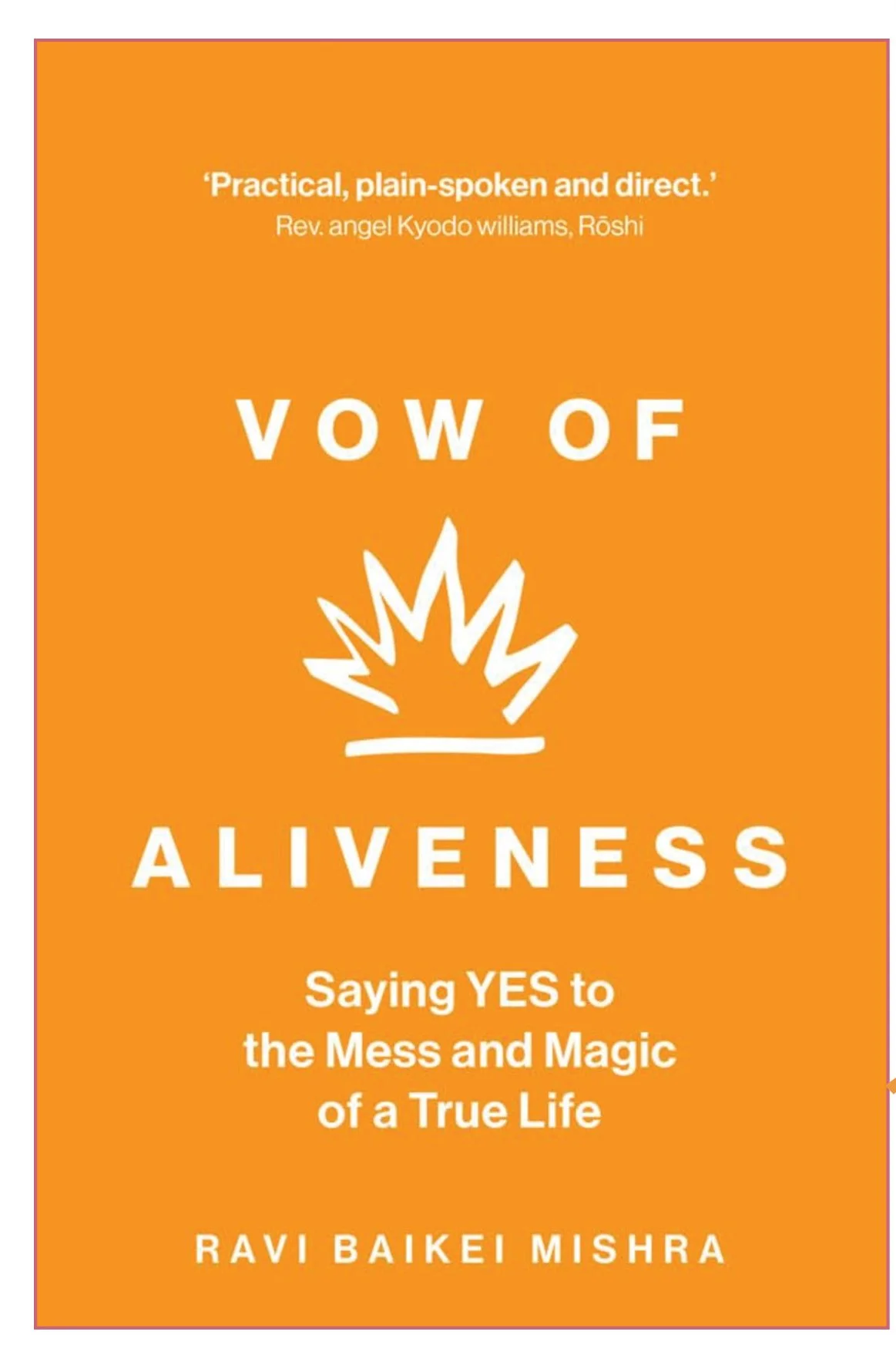
By Christine MacIntyre
Right from the first page, Vow of Aliveness offers a striking invitation to wake up—not just spiritually, but physically, emotionally, and existentially. The book begins with an introduction to the Zen evening gatha—a mindful reflection recited through chanting—as an “exhortation to practice and wake up, to examine and open our minds and hearts while we’re alive and have the opportunity to do so.” It’s a sentiment I’ve heard before but rarely expressed with such directness and clarity.
Ravi Baikei Mishra weaves a deeply personal memoir with a spiritual framework for reimagining how we engage with our inner and outer worlds. At its heart, Vow of Aliveness is a reckoning with the “default world”—a term Mishra uses to describe the consumer-driven, noise-saturated, status-obsessed culture that shapes our values and identities. From this critique emerges a guide for reclaiming something quieter and more true: a life led from within.
Mishra reflects on seasons of his life spent doing things for the wrong reasons—pursuing goals disconnected from the heart, getting caught up in busyness, pleasing others, and losing himself in the noise. These passages aren’t confessional for their own sake; they model the honest self-inquiry he urges readers to embrace.
“We need to understand how the background context of our lives reproduces itself within the logic of how we think, speak, and act if we are to ‘live a life true to ourselves.’” This line captures a core thesis: we must become aware of invisible forces—stories and patterns—that control us. The default world thrives on attention, impulsiveness, and a warped sense of worth. It teaches us to consume—to feel real—through stuff, status, distraction, or people. In the process, we lose contact with the miracle of being alive.
For Mishra, Zen isn’t about fixed doctrine. It’s a way of being—an embodied presence. He stresses meditation and stillness as foundational, not just spiritual extras, for returning to the body, breath, and now.
He argues that aliveness is not a blissful escape, but an act of opening to love, attachment, pain, and beauty alike. It’s gritty and grounded. And it takes intention.

“It was Aliveness, the natural consequence of being engaged in something that spoke to and flowed from my Inner World. The energy it gave me was natural, renewable, and opened up access to the best parts of myself.” This insight resonates deeply. Rather than chasing outcomes, Mishra invites us to shift focus: Does this nourish my aliveness? If not, what are we doing?
A central framework Mishra introduces is that of loops—self-perpetuating cycles that dictate how we live. Whether distraction, self-criticism, productivity addiction, or withdrawal, he shows how these patterns become habits and shape our identities.
“The moment-to-moment diversions lay the groundwork for the whole process, as daily behaviors become habits, habits turn into values, and these values work themselves into what we want to prioritize and who we are.”
Mishra describes how these loops exhaust our energy and obscure our connection to life. He even likens the numbing effects of the default world to a slow spiritual death, where autopilot becomes our primary mode of functioning.
“It’s not just that we’re not living a life true to ourselves—we’re dying, little by little, exhausting our life energy in keeping these loops spinning every day.” That line is a wake-up call to readers.
What’s refreshing about Vow of Aliveness is that it doesn’t stop at philosophy or critique. Mishra offers tangible, accessible practices for cultivating presence and what he calls the “Inner World.” He emphasizes curiosity, embodied awareness, allowing and feeling fully, designing life with intention, and making space for ritual and reflection. He doesn’t claim this work is easy, but insists it’s possible and necessary.

Through detailed insights and personal stories, Mishra helps readers notice when they’re stuck in loops, teaches mindful redirection of attention, and provides everyday tools to move toward what’s life-giving. He underscores that consistent practice—whether on retreat or in daily life—is essential for sensing aliveness and feeling that, at its core, everything is okay.
Mishra grounds the book in his own ongoing vow—to move through life in alignment with aliveness, rather than being pulled unconsciously by the tides of culture. “My Vow is to go in a different direction, to trust and follow the Aliveness I feel inside of me. What comes out of this Vow is more peace, energy, and less chaos and confusion. It’s a power that cuts through the default world and keeps me connected to the feeling of life flowing through my veins.” That sense of personal commitment—alongside his vulnerability—makes the book feel less like advice and more like an invitation.
By blending all these components, Vow of Aliveness emerges as a rare book—both intimate and instructive, spiritual and grounded, poetic and practical. Ravi Baikei Mishra combines memoir with mindfulness, Zen training with real-world modernity, and spiritual discipline with emotional honesty.
He doesn’t offer a silver bullet or a step-by-step fix. Instead, he gives us something more valuable: a path to wake up, to notice, and to begin again—right now, in this body, in this life.
If you’ve ever felt like you’re living on autopilot, drifting from your true self, this book will help you name that experience and directly offer guidance to reconnect with what’s alive. Through mindful observation, practical exercises, and reflection, Vow of Aliveness illuminates a way back to authentic living.
Read More Book Reviews:


















































































































































Elizabeth Kolbert has spent decades reporting from the fault lines of our planet—melting glaciers, vanishing species, rising seas, shifting microbial worlds. In Life on a Little-Known Planet: Dispatches from a Changing World, she gathers essays that feel at once intimate and planetary, investigative and philosophical. The title itself is telling. For all our satellite imagery and data modeling, Kolbert suggests we are still strangers here.