By Crazy Wisdom Journal Staff
CWJ: Thank you for sitting down with us to discuss Buddhist hospice and Buddhist grief support. What motivated you to found a Buddhist hospice and grief support organization?
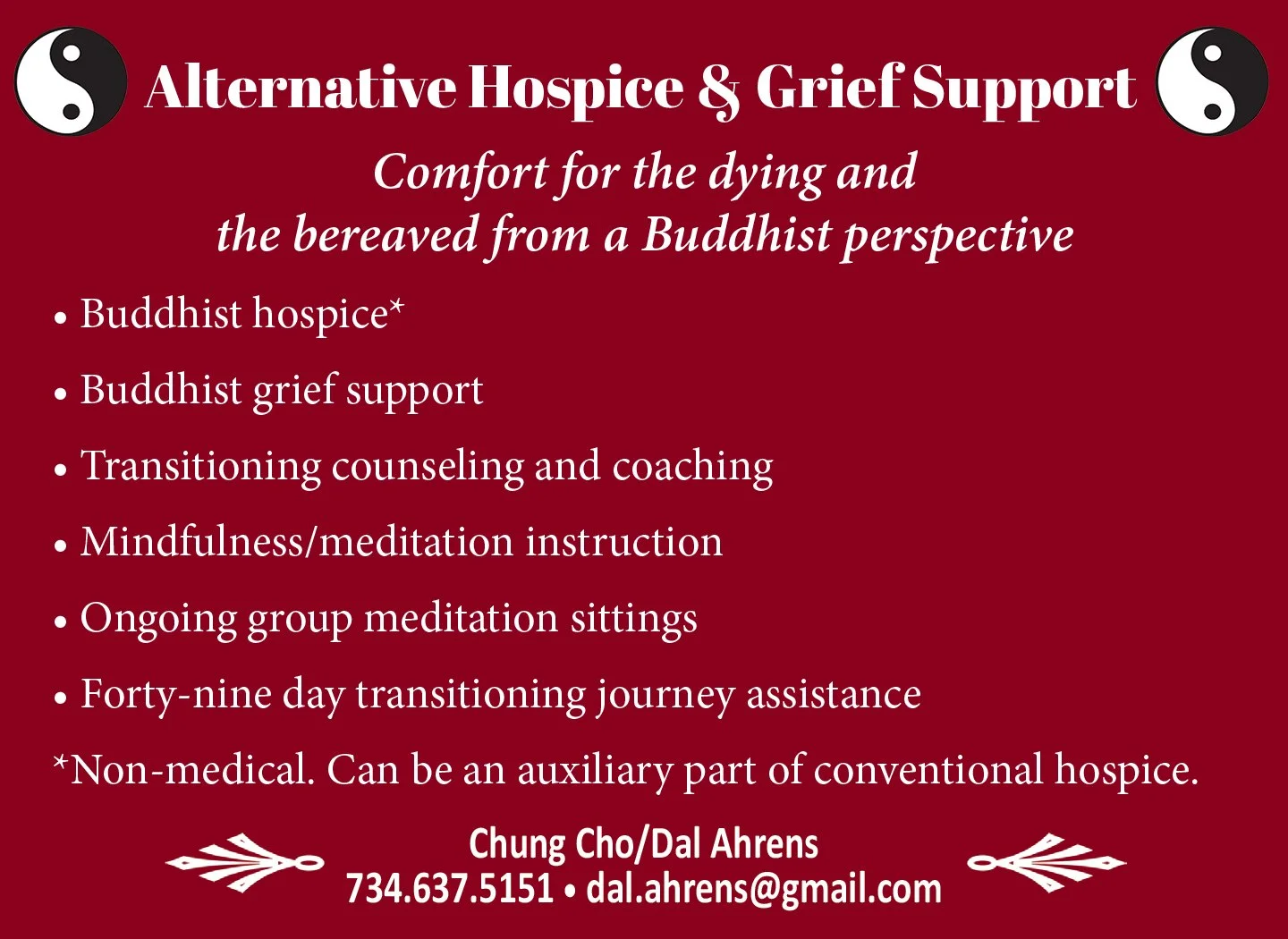
Well, there were a couple of factors. First, there was a clear absence in Southeast Michigan for a Buddhist perspective on death and dying. Most large metropolitan areas in the West, by which I mean Europe and North and South America, offer Buddhist hospice services, both medical and nonmedical. At this point, Gentle Ground Hospice and Grief Support is nonmedical. We are also non-denominational. Secondly, our team has the experience and passion to help fill this void. Besides Buddhists, we cater to atheists, agnostics, Christian curious, anyone really. By the way, we will never try to convert anyone.
CWJ: How does Buddhist hospice work?
Primarily, Buddhist hospice is about being present, compassionate, and calming. Sometimes there are extended periods of comfortable silence. Clients may be experiencing a wide range of emotions and allowing them the space to process those emotions is essential. Visits typically take place in the transitioner’s home, hospital room, or nursing facility. We try to avoid the words death and dying, as they carry dark, negative connotations in our society. Instead, we use the terms transitioner and transitioning, not to sound hip or trendy, but because they are more accurate. Transitioners often find this language comforting as well.

During the first meeting, we ask a few basic questions to establish an appropriate path forward. For example: Do you believe you are more than your physical body? How the client responds helps guide the direction of our discussions.
We also ask practical questions such as: Are you in pain? On a scale of 1–10? Would you like to talk about the pain? Do you want to limit our time together because of it? We also try to gauge the transitioner’s level of lucidity.
Another important aspect of Buddhist hospice is supporting friends and family, if desired. They may wish to sit with the person after bodily death, so helping create the appropriate atmosphere is important. Muffled sobbing or quiet crying is fine, but if loud wailing begins, it’s best that those individuals leave the room.
Optional chanting or soft singing can be beneficial for the transitioner. Idle chit-chat, however, should take place in another room.
We also offer assistance for traditional Buddhist funeral proceedings. Theravada, Mahayana, Japanese Zen, and Tibetan funeral proceedings vary widely. We will team up with the corresponding, local monk to conduct the ceremonial rites, if desired by the family.
What we do not do, unless specifically asked to, is attempt to teach the transitioner meditation, the Eightfold Path, or the Four Noble Truths, etc. This is not the time. Of course, the transitioner always dictates the direction of our conversations. Most are simply curious about “what’s next” from a Buddhist perspective.
It’s worth mentioning that what you believe or what I believe doesn’t change anything. It simply is what it is. That said, 2,500 years of Tibetan monks exiting their physical bodies during deep meditation to explore the Thodol Bardo and the subsequent interior bardo’s, then returning with remarkably similar descriptions is pretty impressive, yet, I digress.
With the client’s permission, we draw from the teachings of The Tibetan Book of the Dead, which describes what occurs from the moment of biological death and throughout the subsequent 49 days. Fortunately, E.J. Gold’s, The American Book of the Dead translates these teachings into contemporary American English while preserving their depth. The translation offers clear, practical instructions to guide the transitioner through the labyrinthine journey of spiritual transformation.
CWJ: Tell us about Buddhist Grief Support.
First and foremost, our role is to support through empathy and compassion. Grieving is healthy. Rather than trying to stop it, one should learn to slowly integrate grief into a happy, contented life. When sitting with someone who has experienced devastating loss, we listen. They are often in a mind-numbing state of unhappiness. We may gently encourage them to talk about their mental pain, lack of sleep, and other challenges.
In this state, it’s common to feel that no one else has ever suffered as deeply as they are suffering. That’s why I always recommend finding a grief support group where one feels comfortable. Grief is an incredibly lonely experience. Being with others who are “going through it” can be profoundly healing. It certainly was for me.
If someone wants a Buddhist perspective during their grief journey, we can introduce Buddhist concepts appropriate to where they are emotionally and spiritually. The universe provides varying degrees of grief for a reason. Ideally, the grieving person can navigate this journey in a healthy way and emerge more compassionate, wiser, and spiritually evolved.
Of course, this is nearly impossible to imagine when you’re staring down the dark tunnel of grief with no visible light at the end. The pain is extremely difficult to bear. These are sacred wounds.
CWJ: What led you to found this organization?
I have always felt a strong affinity for hospice and grief support. Years ago, I left conventional hospice work and began offering Buddhist hospice on my own.
However, the main qualifier was my wife’s passing. She died at age 43; I was 49. We were deeply in love, and she left me with three teenagers. My immediate state of mind can only be described as loss beyond comprehension. Her absence shattered my relationship with the world.
I did manage to navigate my grief journey successfully, but it was by far the hardest thing I have ever done. It took two years just to regain my sea legs, and five years to return to some semblance of “normal.”
Grieving is not an intellectual endeavor. It’s a journey no one wants to take, but you have two choices: you can endure the anguish and, over time, emerge more loving, caring, and compassionate or you can bury the grief, pretend you’re “fine,” turn to alcohol, and so on. Burying grief because it’s too painful to face is a poor choice.
CWJ: Thank you for sitting down with us today and sharing your description of your organization and your insights. How is your organization compensated, and how can people contact you?
You are quite welcome. Thank you for having me!
We don’t charge for our services. We are Pro Bono. If someone wants to contribute gas money, we’ll accept it, but there are no fees.
Dallas Ahrens is an experienced Buddhist grief support provider, certified hospice volunteer, certified End-of-Life Doula, facilitator of a young widows and widowers grief group, and has spent countless hours on the meditation mat. The best way to reach Gentle Ground Hospice and Grief Support is via email at gentlegroundhospice@gmail.com.