

By Michelle A. McLemore
Bundled up, Mom and I slogged through deep snow to do chores. The day had been long with school, club meetings, and an away volleyball match. Still, the animals needed to be fed and watered before I could eat and begin homework.
On the way back up the hill from the barn, Mom suddenly stopped in her tracks, dropped the water bucket, turned toward me with a slight smile, and then dropped backward. I was stunned for a moment as she lay there. Then, I saw her slowly slide her arms up toward her head while her legs fanned out. This fifty-six-year-old woman was making a snow angel! I hobbled another few steps without a word, plopped next to her, and slowly began making my own modest wings.
The earth and snow cradled our bodies. The stillness of the night and the twinkling of the stars carried our spirits upward. The catalpa tree stood sentinel, half lit by the back porch lights. It was a gallant guard between the animal barns, dark countryside, and the farmhouse with its expectations and routine. Reality paused.
Beauty, peace, refreshment, nurturing, familiarity—it was all simultaneous through etheric and physical knowing. It was more than reconnecting, it was temporarily leaving “human” business and remembering—no surrendering—ourselves back to the much larger natural world.
I’m not sure how long we stayed. Probably both long enough to avoid hypothermia and not quite long enough to completely bridge the gap between my teenage angst and her perimenopausal grief. But the trees and the stars stood witness to our moment of solidarity and agelessness.
Not all of our time together was as magical.
One night during late chores of carrying water buckets, graining the sheep, horses, and rabbits, the dark gulf between us was wide and I didn’t have the energy or strength to build a bridge. Maybe all I had was the resolution to stay silent and not agitate. I don’t remember the cause. I just know that when I made it to the foot of the hill that night, the porch light glow offered no comfort, no call to sanctuary. Without plan, I walked through the damp grass to the catalpa tree and paused only briefly to feel the rough bark under my palms before pulling myself up, like my sister had shown me: then curl to hook one leg over the branch, then the other. After a shimmy to the trunk, I climbed higher.
This was the perfect climbing tree—branches everywhere you needed them at almost every age of your growth. (They are fast growing trees.) It had a limb partly over the farm lane drive, which was handy for hanging upside down, for preparing to mount a horse, or to hang a flannel on that you didn’t want to drop and lose in the tall weeds.

This night, I climbed through the dark of my confusion to somewhere near the top quarter of the tree. I braced myself to sit on one branch, hooked my foot, and hugged the main trunk. It was solid but I could just make out a slight sway. I relinquished my human decision-making to a simple “just hold on”—something I’d later find out was a common moment (or phase) for most of humanity.
I listened. The breeze ruffled some leaves. Occasionally an owl hooted. The hills strategically funneled the sound of lone trucks motoring on the highway a few miles away. Then, I heard her. Was it the crunch of her boots? I can’t recall if it was late fall or early spring, but there was no snow or frost. She plodded halfway up the hill and called with her voice raising in question.
“Michelle?”
Why I didn’t answer, I don’t know. I could see her as I looked down. If she looked up, I knew she could see me. I wasn’t hiding from her. I just…did not respond. I sat, clinging to the tree, exhausted inside, numb inside…and watched.
She didn’t look up. She listened, took a breath, and just finished walking to the house. She was wearing barn boots (plastic black slip ons that she bought at a hardware or farm store—cheap), a worn-out, black zip up coat, and that ratty blue and purple plaid scarf over her hair and ears—she wore that scarf forever in the fields. (When she passed, I took it home and put it in my dresser drawer.)
I watched her walk all the way to the back door without looking any further for me.

Maybe I should have been concerned that she’d lock the door on me. Yet, I wasn’t. Maybe I knew, that she knew, I just needed to be with the trees and the stars and the night.
In fairness to me, I didn’t know she was battling the throes of hormonal changes and the strange journey of one’s entire body shifting uncontrollably from a dependable frame to…well to a constantly observable, seemingly fast and tangible state of discomfort. And in fairness to her, as the eldest sibling of her clan and only surviving female, she didn’t know how to navigate it well. How could she? Her generation didn’t talk about menopause even if they did have other females with whom to discuss it.
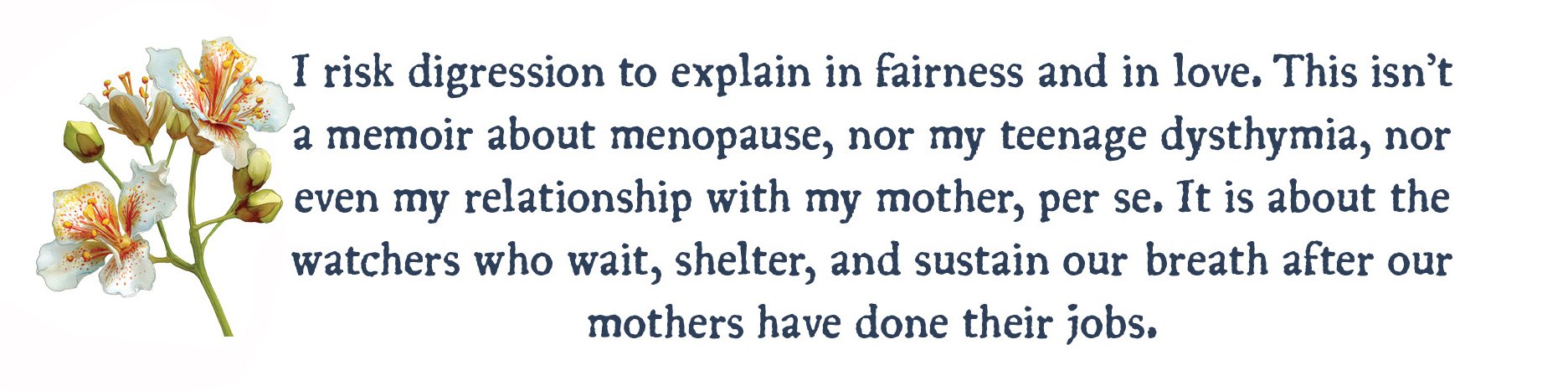
I risk digression to explain in fairness and in love. This isn’t a memoir about menopause, nor my teenage dysthymia, nor even my relationship with my mother, per se. It is about the watchers who wait, shelter, and sustain our breath after our mothers have done their jobs.
Every spring, the tree grew and casually showered faerie hats to the earth. Beautiful conical, ruffled hats with brilliant yellow and red stripes inside—each was a delightful gift for the curious, imaginative seeker. It also sent out long string-bean-like finger pods which eventually dropped. Its bark and branches were course, but strong like a father’s sun-tanned hide from field work—hard labor, hot labor, respectable labor. With room to grow it spread its branches out wider than most trees in the area and its heart-shaped leaves—larger than my hand, larger than my head—offered shade and shelter sufficient from sun and rain for kids finding their own amusement in the yard.

It had a character of its own. Our backyard catalpa was friendly, nurturing, and playful. The front yard catalpa held a soldier’s posture, making any veteran proud. It seemed taller than the farmhouse sitting on the hill. I heard it was already tall at the time my parents purchased the farm in 1950. Was it 70 feet, 80? Or Higher?
Shortly before the passing of my parents, the front yard catalpa sent up two babies right next to the front porch. There was too much to take care of for anyone to trouble pulling them up. Within the span of three years, both Mom and Dad passed and then came the decisions about how to prepare the house for sale.
“We should probably get rid of those,” one sibling observed. “It wouldn’t be wise to let them grow any bigger this close to the house.”
So, I took a shovel and started to dig around the base of the saplings. The smaller one was able to be extracted, and I planted it on a hill behind my house. The other already had a massive root too wide and strong to be dug out. I covered its roots again and gave it my blessing.
The first winter was hard for the sapling I planted as deer seemed to have chewed its new growth back. I chided myself for not being a better adoptive mom. I made sure to stake and provide the tree with boundaries the next year. Then one time, I became woeful to discover the leaves were chewed up seemingly overnight. I rushed out to discover over twenty furry caterpillars having a feast on the leaves. My first instinct was to knock them off thinking it must be like a tomato worm infestation, but as my hand neared, one shot out a stream of smelly liquid. (I would find out via research I had been “projectile vomited” upon as their defense mechanism.) I let them be and prayed for my tree.
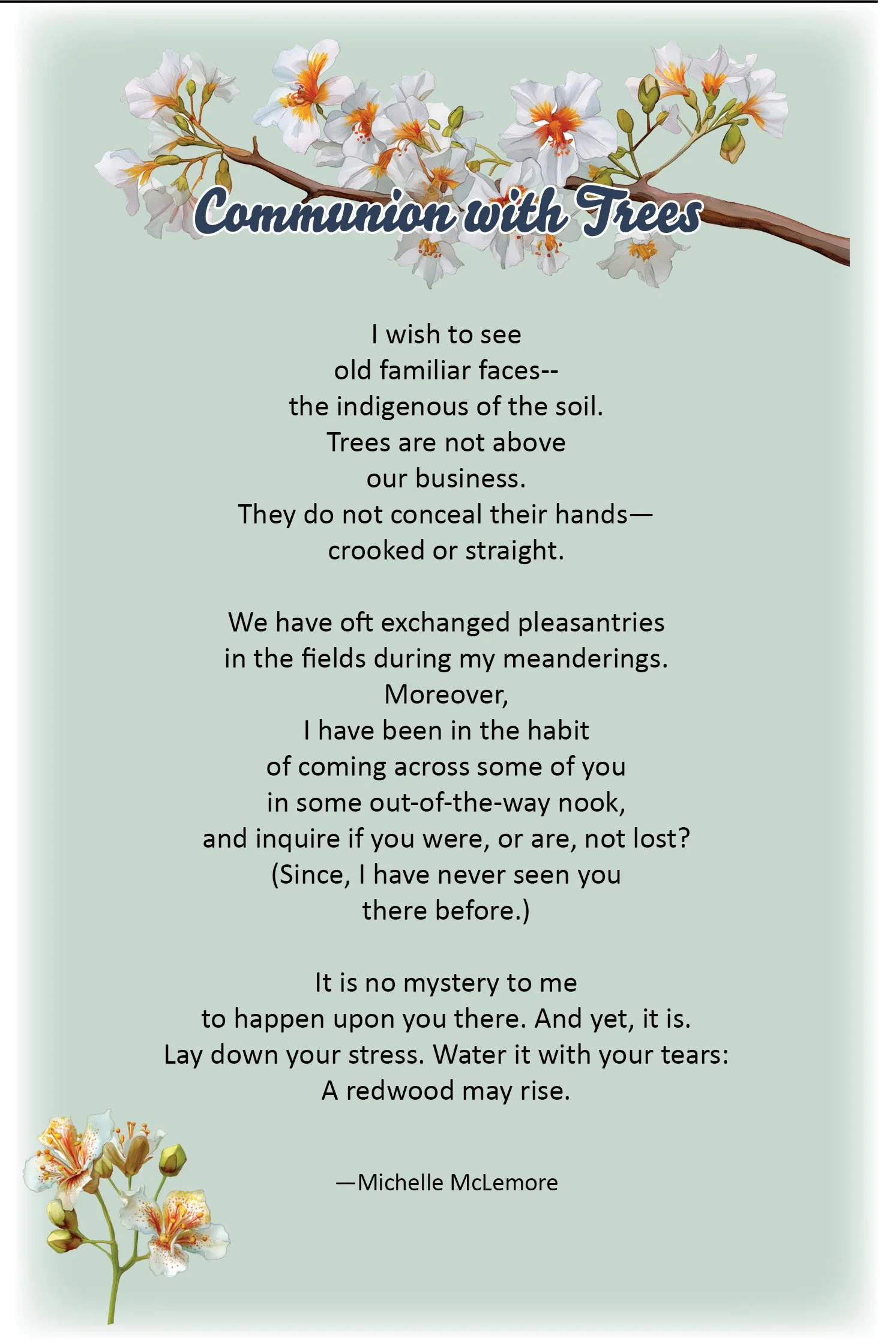
For five years now—I can’t believe it’s been five years—the transplanted catalpa has survived. It survived and is growing and spreading—it needs nothing from me—it is sturdy creature. Yet, I still call out to it to wish it a good day…to thank it for wanting to survive, and thrive, here and now.
It is the sole of its type on my property reminding me of my childhood home, reminding me of climbing with my sister Susan, escapes during my teenage years, and the various moments with Mom, Dad, and all the history that the catalpas witnessed—from first day of school photos on the front porch to training 4-H livestock in the backyard. Now, this one, this descendant, watches as my kids and grandchildren play softball, deal with falls and scraped knees, and the throes of their own complicated relationships.
It is taller than me already, but not ready for climbing. I hope I am still able to when, and if, it invites me. Regardless, I will go to the trees as long as I am able and bed down with them when I can no longer stand. They wait for us all to come home.
Michelle McLemore is a freelance writer, speaker, and energy practitioner. Her background as a psychology and writing teacher supports personalizing client self-care to create balance and vitality. Learn more at facebook.com/MichelleMcLemoreHealingGuide, michelle.mclemore on Instagram, and mclemore.substack.com. Email inquiries to energy@michellemclemore.com.
Read Related Content:





























































































A decade after falling in love with Hamilton's "Look around, look around at how lucky we are to be alive right now," this personal reflection explores shifting from optimism to unease in turbulent times. Drawing on Eliza's line—"Look at where you are, look at where you started. The fact that you’re alive is a miracle"—and Niall Williams' This Is Happiness, it affirms our role in carrying the past into the future with gratitude and perseverance.