
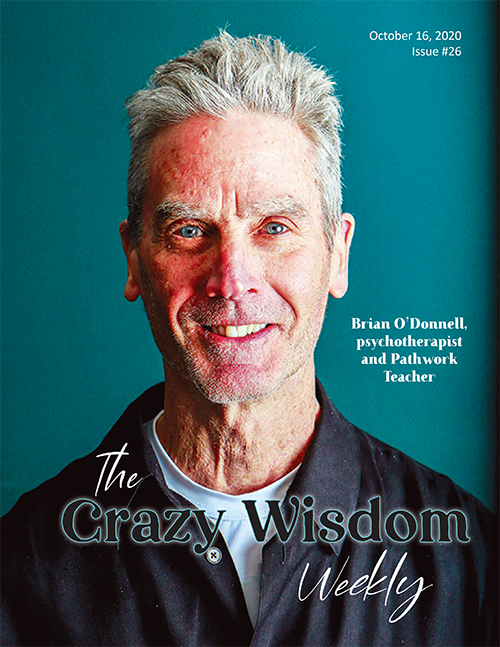
By Brian O’Donnell
Never in human history has the pull to wholeness and spiritual awakening been as strong and omnipresent as it is today. There is a growing appetite for freedom and truth, and a longing to experience oneness. This hunger for liberation has many sources of fulfillment. Even a cursory look at the internet will reveal the plethora of options yet, it requires powerful discernment and wise and loving support to guide an aspirant through the trials and joys of awakening to True Nature.
There are those rare few who answer this call and can sustain an active, dynamic relationship to Spirit in a solitary fashion—able to remain committed, focused and disciplined in their journey Home. For most of us though, we need the gifts of community, or sangha, to support our inner evolution. We realize it is too challenging to do this work alone. We need the container, refuge, and sanctuary of community to open to the possibilities of this brave new world.
Everyday life and culture feed the conditioned mind, which can leave us empty with its emphasis on external satisfaction. This conditioned mind often turns to false remedies to deal with the inevitable lack that is contained in its perspective. Our work, recreation, and family life all reinforce a conventional and limited perspective of reality. Thus, it is vital to have a dedicated and safe space to explore new possibilities of being.
Just as a rocket ship needs tremendous force to leave the power of the earth’s gravitational field, we also need a similar force to propel us out of the collective trance and into larger domains of knowing and acting. Spiritual community can be an essential part of this force.
As we transition into new realms, we are often hungry for authentic nourishment, as well as for an understanding and support with some of the inevitable and possibly frightening phenomena that can occur with spiritual awakening. This is where spiritual community can be an oasis. This oasis can offer encouragement, discipline, mirroring, a sense of belonging, and a continued refinement of the teaching.
Community can serve as an incubator for a new and evolved Self. This may be helpful as one can be tender and fragile when birthing a new Self. This new life asks us to shed our outdated identities and to grow new ways of being.
Community can also gift us by creating a laboratory for exploring inner territories we are reluctant to visit. Any genuine teaching will call us to go where we least want to go. It will motivate us to risk discomfort, self-confrontation, and to face unflattering truths about ourselves. Authentic spirituality is disillusioning. It invites us into a fresh look at reality that may challenge deeply held beliefs.
This laboratory metaphor can be extended to the idea of creating a dedicated space to practice new ways to deal with the inevitable reactivity that arises when in a group. Community leaders can demonstrate skillful means of addressing the most basic human reactions of irritation, judgment, impatience, submission, and withdrawal.

The ultimate promise of spiritual community is that it propels us through our immaturity into our integrated, individuated selves and ultimately toward surrender of the “me” into a greater ground of Being.
As essential as community life can be, it also offers tremendous challenges.
Just as there are universal forces that call us to wholeness and integrity, there are impersonal forces that want to distort spiritual teachings. Dark forces of resistance and distortion infiltrate the Universal Call in an effort to maintain the spell of separateness.
These forces align with and augment our personal levels of immaturity. Our unresolved emotional issues and unchallenged beliefs become the baggage that travels with us into all realms of relationship—be it partnership, friendship, or community life.
Students or followers can carry dependency, competitiveness, rebellion, aggression, and a tendency to withhold from community life. Students can unwittingly recreate and project unresolved family patterns onto their new family. Teachers and leaders can bring exploitation, tyranny, control, passivity, and general misuse of authority. These shadow elements can go unrecognized at best and at worst, be justified. At times those who dare challenge shadow elements can be shunned or ostracized.
There can be those who are attracted to community life because they see it as a refuge from being a full adult. A fear of standing on one’s own two feet is one of the motivating factors that ushers them into such a life. This pattern, if not recognized and dealt with, leads to further trouble for the community as these participants will have a tendency to do anything to belong. They may even look the other way if something is off, out of that need to conform and belong.
Cults are the metastasizing manifestation of these shadow factors. In a cult community there is a push to isolate from the outer world. There is a dualistic sense of “us” versus “them.” The outside world is seen as the enemy. There is no room for questioning or holding differing views. In such a wayward community there is often a push to proselytize and an emphasis on garnering new recruits for the fold. This can have multiple motivations—to swell the ranks and to quell any doubts or challenges. If I have to convince you of my way, I can ignore my own questions and misgivings.
One of the most powerful distortions of the gifts of community is the desire to gossip, malign, and keep secrets. This will rapidly zap the vitality of any group. It not only erodes trust, it escapes the necessary inner work and healthy confrontation that lay underneath such toxins.
Another familiar challenge in spiritual communities is the imbalance between givers and receivers. The over givers often end up feeling depleted while the takers never feel they receive enough.
Given that there are so many gifts in spiritual community and yet there are also so many perils, how is it we can maximize the former and minimize the latter? Ken Wilber, the influential source of the teachings on Integral Theory, uses the phrase “Grow Up, Clean Up, and Wake Up” to point to the remedy for what can ail community life.
Grow Up

What this means to me is that a mature community will encourage ongoing individuation and maturation. There will be an emphasis on healthy ego development alongside its role in relation to spiritual growth. There may be a short period when an aspirant is new to the community and is in a receiving mode from the teachers and seniors. Once the aspirant has ripened, he or she is then invited to stand on his or her own two feet and contribute to the endeavor.
A healthy community, or teacher, will never ask you to abandon your inner authority. It will ask you to deeply question your beliefs, behaviors, and attitudes yet will leave you free to choose. There will be an ongoing commitment to question authority. Paradoxically, there will be a questioning of your questioning authority as this can often arise from transference and unresolved parental issues.
In this same vein a dynamic community allows for doubts that are honest and not based on fear or pride. It makes room for these to be expressed and explored. There will never be a push to proselytize and to convince the other. The adage “When the flower blooms the bees come uninvited” is understood.
The balance of giving and receiving is held in a grown-up community. One will never be asked to sacrifice one’s real needs. The teaching may ask you to stretch yourself, to move past your comfort zones, but never to betray yourself.
Clean Up
A healthy community rests on the ongoing choice to keep interactions conscious. There is a commitment to deal with differences and process inevitable reactivity. This is done not only because it serves the community, but also because reactivity is seen as a sign of inner division and misconception in the person experiencing it. Thus, he or she will have an investment to expose and explore this disturbance in order to gain freedom.
Instead of gossiping and indulging in secrets, the community member will bring concerns directly to the people involved. If they need assistance in this step, it is expected that they will ask for help from a neutral party.
For the last thirty years I have been assisting leadership teams in spiritual communities all over the world. I have found that this step of cleaning up is the most challenging to the ongoing vitality of the communities. The avoidance of this step is not based in any lack of love for the teaching nor the understanding of the work. More often than not it is the sheer awkwardness and pain of the messiness of interpersonal dynamics. Slights, power grabs, and competition are just a few of the examples of unprocessed interactions that can trip a community up.
A community that values and practices such awareness, integrity, and process honors its members and offers the world at large a shining example.
Wake Up
“What more can a person gain in life than that God nature reveals itself to him.” –Goethe
We gather together in community to serve something larger than ourselves—this revelation of our Essence. We recognize that we are part of a greater plan to make whole all of life. This plan is our animating purpose. To Wake Up means releasing the grip of fear and its associated grasping and aversion. It is the birth of enduring and embodied joy, peace, and love.
“Wake Up” underscores growing up and cleaning up and is the foundation of both inner work and community life. All religious and spiritual traditions have maps for this ongoing and non-linear process of discovering the infinite blessing of our True Nature. In my tradition, the Pathwork, this Waking Up is described as basking in the inconceivable magnificence of creation. It is the Homecoming our souls have longed for.
In these times of what seems to be increasing coarseness and instability, where the poverty of egoic or conditioned reality has never appeared more apparent, we are also blessed with a new and emerging spiritual consciousness. The world can greatly benefit from the assets and gifts of wisdom teachings and awakened community life.
Brian O’Donnell PhD is a psychologist and Pathwork student and teacher who lives, works, and plays in Ann Arbor.
Read Related Articles:
















































































































Never in human history has the pull to wholeness and spiritual awakening been as strong and omnipresent as it is today. There is a growing appetite for freedom and truth, and a longing to experience oneness. This hunger for liberation has many sources of fulfillment. Even a cursory look at the internet will reveal the plethora of options yet, it requires powerful discernment and wise and loving support to guide an aspirant through the trials and joys of awakening to True Nature.