

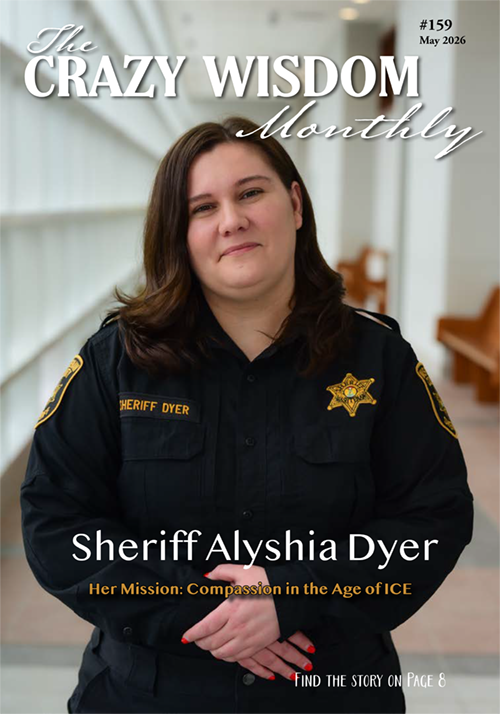
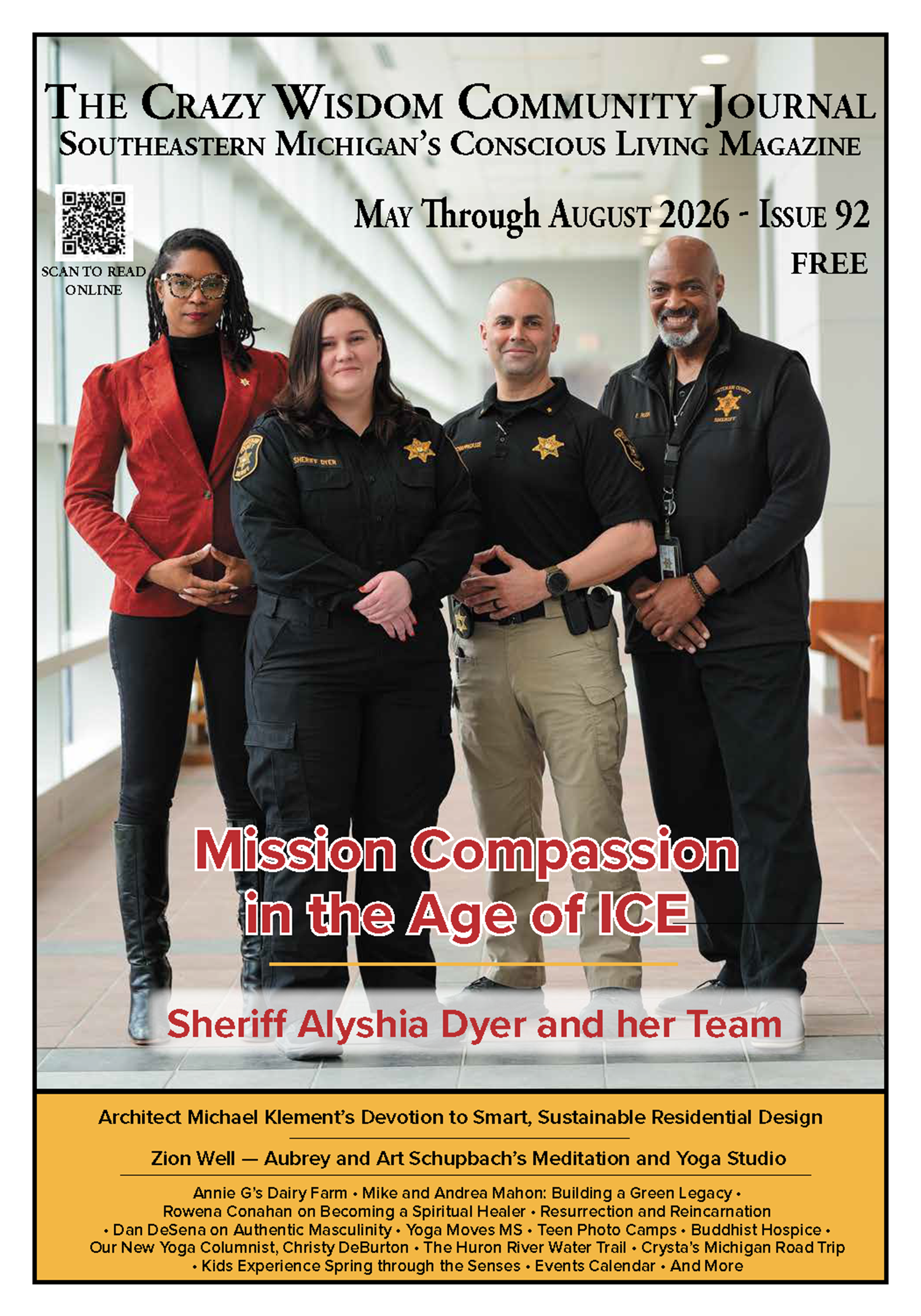
Crazy Wisdom sits down with Sheriff Alyshia Dyer to talk about her first year in office: ICE, Budgets, Karaoke, and learning to work together.
By Bill Smith and Anna Gersh
OUR NEW MISSION: COMPASSION
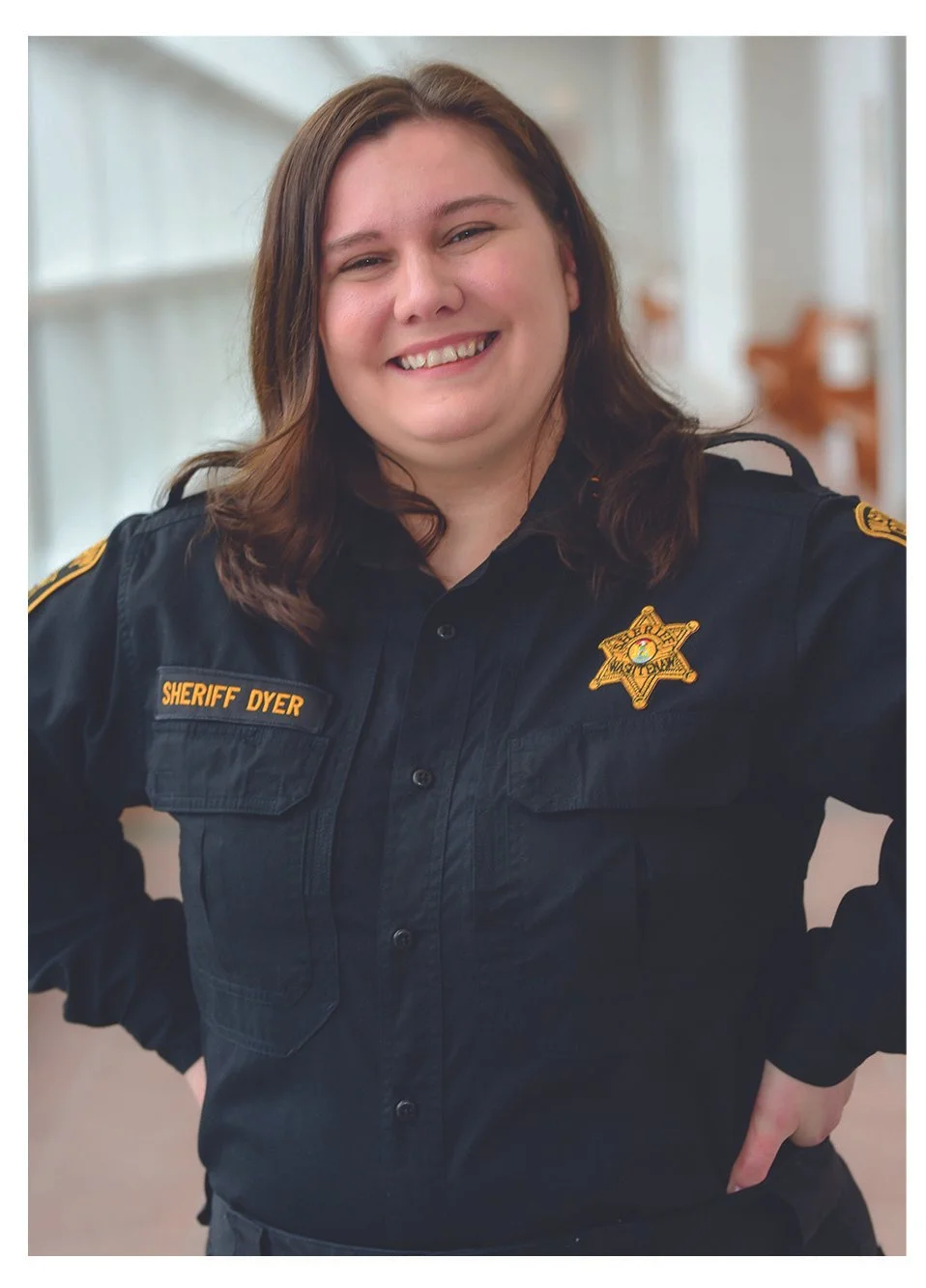
CW: Everyone is talking about what’s new at the Sheriff’s office. The word compassion keeps coming up. Tell us about your new mission.
AD: Compassion is a core concept for me. I am
a millennial woman serving as sheriff, which is new to our county. I bring a different perspective to the table. I come from a policy mindset and a social work mindset. Also, having been a road patrol deputy, I have on-the-ground experience which is unique. My identity matters, my lived experience helps me assess situations in a different way.
We are committed to building a safer, more just, and more compassionate county. Compassion is in our mission statement. We’re trying to bring more compassion into policing, into the legal system, and into the jail.
When the jails were built, there wasn’t much sense of compassion. The system was built to make money. It was built off the backs of the most vulnerable in our communities. We’ve made some progress, but we have a long way to go.
When I was running, I went across the county and talked to people. I talked to everyone. We took that information in and put it into our platform. That became my agenda, it was the community’s agenda.
Everyone has different values. I worked for Jerry Clayton my whole career. I saw what worked and what didn’t. We’re continuing the good things but adding our new vision. The previous administration started having deputies carry Naloxone, an opioid blocker. It is critical to keep that going. We’re continuing the community violence intervention work. We’re continuing SURE Moms, peer support for mothers of youth in the juvenile justice system. We really want to address first responder PTSD so we will continue building mental health and wellness initiatives for employees.
But bringing in a new vision means we’re taking a harder look at where we can take policy change a step further to truly create a county legal system without high racial disparities. Compassion means a county system focused on family reunification—finding a way that people in jail can actually see their loved ones.
Small things are important too. We have changed policies to curb low level traffic stops. We don’t need our deputies pulling people over for a crack in the windshield, a loud muffler, or even air freshener. My goal is to make everything safer. We need the community to be a partner thinking beyond 911 or police help. People may assume the answer is more enforcement presence. The question to ask is, “What would prevent this from happening again?” Part of our values are thinking innovatively. What actually may help is redesign of the roadways: adding curbs, putting sidewalks in, maybe bike lanes or proper lighting.
Of course, we are at the table when anyone calls. We’re coming and we’re going to help. But long term, making your neighborhood safer is thinking about how to prevent situations from happening in the first place.
ICE AND DHS IN WASHTENAW
CW: Under your leadership, the Washtenaw County Sheriff’s Office was one of the first law enforcement agencies in the country to officially resist ICE. How did you decide on this position so early in the game?
AD: I spent two years on the campaign trail telling the community I was going to end cooperation with immigration enforcement. The previous administration worked hard to only cooperate in specific situations, but still there was cooperation. It needed to stop. ICE is a bad influence on law enforcement. ICE tactics, the way the agents are trained, how they treat people, none of that is how we want Washtenaw deputies acting. So, when I started, we stopped all cooperation, including, cooperating on voluntary detainers in our jail.
A voluntary detainer is a request to local jails for ICE to take one of our detainees into custody after they are released. A voluntary detainer is a request. It is not a judicial warrant. The county has no obligation to comply, and arguably, it hurts people’s due process rights. We are innocent until proven guilty in our Constitution and our courts. The Constitution doesn’t say everyone “except people that are undocumented or those without visas.” It says all people have rights.
As a result of ending cooperation with ICE, I was sent a letter accusing the department of obstructing their work. We did not obstruct. We declined, which we have the right to do. The letter was directed at me. They specifically said because of my taking office that the relationship changed with the Washtenaw Sheriff’s Office.

The retaliation was to revoke the federal clearance of one of our detectives working with Homeland Security on child trafficking. Washtenaw County doesn’t need federal help to continue aggressively investigating child trafficking. Still, it is revealing that they pulled back on child trafficking investigations because we were not voluntarily cooperating on detainers that hadn’t been signed by a judge. The letter was turned over with FOIA and someone posted it on Reddit.
It is critical to maintain a separation between county enforcement and what is being attempted by a federal agency. We need our citizens to trust law enforcement. You never want a situation where people are afraid to see the law enforced. People in our immigrant community deserve police protection, to feel safe to call us when they’re scared, when their houses are broken into, or when their children are being followed.
None of this is new. ICE has been taking families from their homes for years. But certainly, the situation is more alarming now. I’ve learned so much from Washtenaw grass roots organizers. I also commend our County Board of Commissioners, the Ann Arbor City Council, and most importantly Michigan Immigrant Rights Advocates (MIRA) who pushed for our local municipalities to follow what Chicago and other areas are doing while still staying within the law. I also want to thank the county commissioners who have been supportive, particularly Commissioners Yousef Rabhi, Katie Scott, and Andy LaBarre. They are working with our office to ensure that we do all we can to protect our community.
There is this fear about talking about immigration, like, “Don’t talk about what you’re doing. You will be targeted. You don’t want to become Chicago or Minneapolis.” My argument is that those cities have also fought back, and stuck to their values. I commend leadership there. I believe every community should be looking at how to keep values front and center in this climate.
I am learning every day. The national law enforcement progressive community is strong. We are actively communicating with counties and localities around the country. The progressive sheriff space may be small, but we are mighty and we stick together.
TO BE YOUNG, FEMALE, AND MANAGING A $65 MILLION BUDGET
CW: At close to $65million, the Washtenaw County Sheriff’s Office budget is one of the largest in Michigan. In addition to county-wide law enforcement services, it covers corrections, parole monitoring and many community programs. Given your professional background as a deputy and a social worker, how did you prepare to manage this aspect of the work?
AD: A lot of people look at me and do a double take, like, “You’re the sheriff? You’re running the sheriff’s office?” Yes, I am, and, alongside my team we’re doing a really good job.
Our county has been around since 1823. There has never been a woman sheriff, let alone a sheriff under 40. I’m 35 now. The sheriff landscape is typically older, white, and male. Not a lot of women, not a lot of people of color, not a lot of younger people. There is a huge gap in representation.
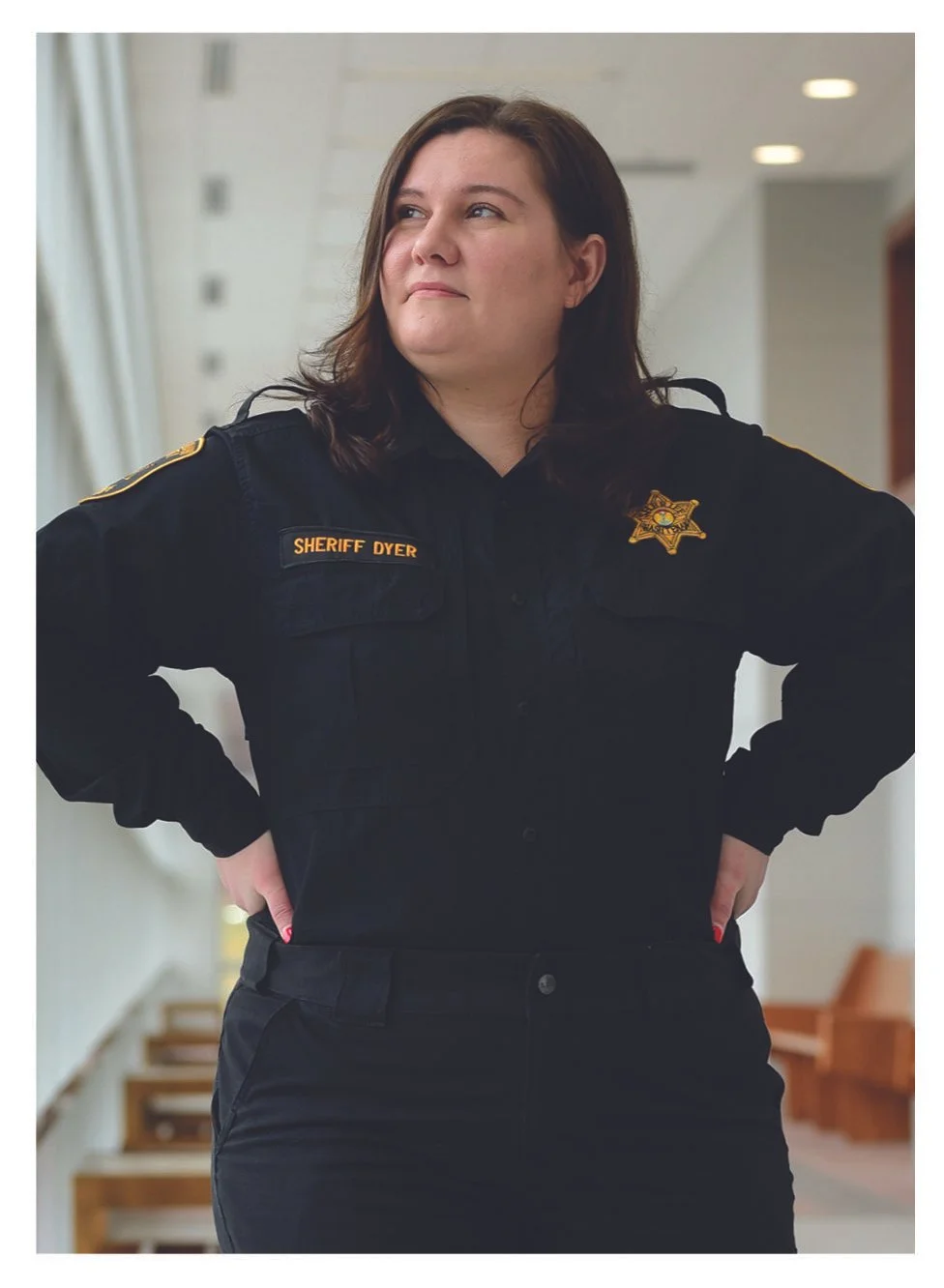
One thing that needs to get out is the bias against women law enforcement leaders. I am responsible for the public safety of our entire county. I ovesee a budget of $65 million with around 420 employees. My job is harder because of the biases around my identity, but those same issues make me stronger.
While I was running for office, I had two years to prepare for my job as sheriff. I went back to school and got master’s degrees both in Policy and in Social Work. During the transition I was able to consult with Jerry Clayton, our former Sheriff. And I spent my first year deeply studying the budget and assessing our processes.
There’s a narrative going around that we’re so over budget. It isn’t true. That was really about the county commission not following through with funding the contracts for the food and medical they had signed. Jail food and medical were extremely underfunded. On top of that, my 2025 budget had been reduced by $2.5 million because of a new calculation for vacancy savings. Given those two things, I started my term with a projected 4.3-million-dollar deficit.
It is really expensive to run a jail. I used to be all about reducing the jail population because it was the right thing to do. I still believe that. I would much rather have people get services without being in jail. But now, I’m also like, “Don’t put people in my jail if it isn’t needed because we have to pay for it.”
There are on average 300-350 people in jail at any time. Think about feeding 350 people three times a day. Then the food must meet calorie and nutrition standards. Then you have to consider allergies, health diets, and religious needs.
Trying to explain the importance of properly funding the jail at a time when the county was dealing with strained budgets was tough. Last year was tense, but in the end, we were able to remedy the shortfall.
I’m proud to say that after a tough year, the shortfall for food and medical costs has been remedied. Through really poring through the budget, I also found 2% savings which helped. In the end, our administration spent less than the previous sheriff’s administration. I’m proud of that. We were able to reduce costs and identify containment measures. Now we are on track to balance the budget.
Fiscal responsibility is extremely important to me. I will continue working to remedy longstanding issues and finding ways to save our county money.
MAKING IT MORE HUMAN, IN-PERSON VISITS
CW: Washtenaw is one of the first municipalities in the country to have rolled out in-house jail visitation. Tell us why this was a priority for your office?
AD: As of this year, we have made in-person visits operational. That means children are now able to see and touch their parent. It’s okay for people to hug each other or just hang out, talk, play games–to actually be with their loved ones.
In the 2000s there was a national move to phone and video visits. I think that was introduced in Washtenaw long before the pandemic. It was good that some restrictions were in effect during the pandemic. People could use the technology and still stay health protected. But that behind-glass move was made without fully understanding the human impact.
There are only a handful of other localities across the country that have moved to in-person visitation. The data shows that it reduces the use of force in the jail. It improves recidivism rates. Localities with in-person visitation have also seen a positive effect on staff. If you work as a corrections officer, you are naturally going to care about the other people in your environment.
There are obstacles to getting there. Through our first year, we’ve been assessing what works and what doesn’t. We are accessing a national toolkit developed for corrections professionals and residents, the Law Enforcement Action Partnership, which has been helpful. We’re not getting rid of phone and video. We’re just adding the in-person component. We are working through our housing units now and building up a visitors list. We built a draft policy and created signage. We’re working to make the visiting area look less like a jail. We’re pulling together toys, books, and games for families to share. We still have to get furniture. It’s still going to be a jail, but we can make it more human.
Word is out. People are talking, our staff, the residents and their families are getting the vision. People are excited. Things change when the residents can look forward to something. It creates a different culture.
KEEPING YOUNG PEOPLE OUT OF THE SYSTEM
CW: You’ve spoken a lot about young people in the justice system and your own experiences with law enforcement as a young person. How does your administration hope to improve the relationship between young people and the justice system?
AD: I am passionate about helping young people stay out of the system. I grew up in Ypsilanti. My mom raised me and my brother. There were issues, I ran away a lot. That’s how I had my first contact with the legal system.

I remember how I was treated by law enforcement. I had some good contacts and I had some pretty bad ones. I ran away for good when I was 17. A U-M professor let me stay with her family as a nanny. When I turned 18, she helped me get into Washtenaw Community College. I completed an associate’s degree in criminal justice and then ended up going to the police academy.
While I was in the road patrol division at the sheriff’s office, I worked closely with Washtenaw youth. I saw how young people were treated. I could see it even before they got into the system. You could see the path. They start getting in trouble at an early age for low level reasons. They don’t get resources, they don’t get help, they don’t get decent school grades. They just get criminalized. And once that starts, they never got out of the system. There is no real path to the future.
Having a social work background helps me think differently about young people in need. One thing I’m really proud of this first year, is our roll out of “RAPID” (Restorative and Preventative Intervention and Diversion), a pre-arrest program to divert 12-to-25-year-olds involved in low-level offenses. RAPID bypasses the justice system by offering mental health and job readiness support. It is an alternative to arrest, it connects young people and their families with resources for growth and stability, rather than formal system involvement.
Now, instead of arrests, officers submit a case report to our RAPID partner, Corner Health Center. Corner Health builds a first-case management program based on what the young person identifies as their own need. When it is a young person, we really need to ask them, “What do you need to be successful?” This is a great example of the kind of trauma informed care I wish we had had when I was a road officer.
When I was policing, I was on a call about a young person skipping school. The parents called all the time asking the police to get their kid to school. They didn’t know what else to do. I built a rapport with this young person, they told me, “I don’t have clothes to wear. If I show up at school, I’m gonna get bullied.” So, you get them some new clothes that they’re proud of and suddenly, no more skipping school. It was as small, as simple as that. Getting young people the support and resources they need.
I know a lot of people in Washtenaw support this kind of mindset. Listening more, being trauma informed, and acting creatively about keeping young people out of the system. If we can do that effectively, we’re making a safer community.
MISSION COMPASSION AND THE WSCO TEAM
CW: The Washtenaw County Sheriff’s Office employs approximately 425 people, including 120 sworn officers, across six divisions. Many of these employees worked for your predecessor. How are they responding to your new mission?
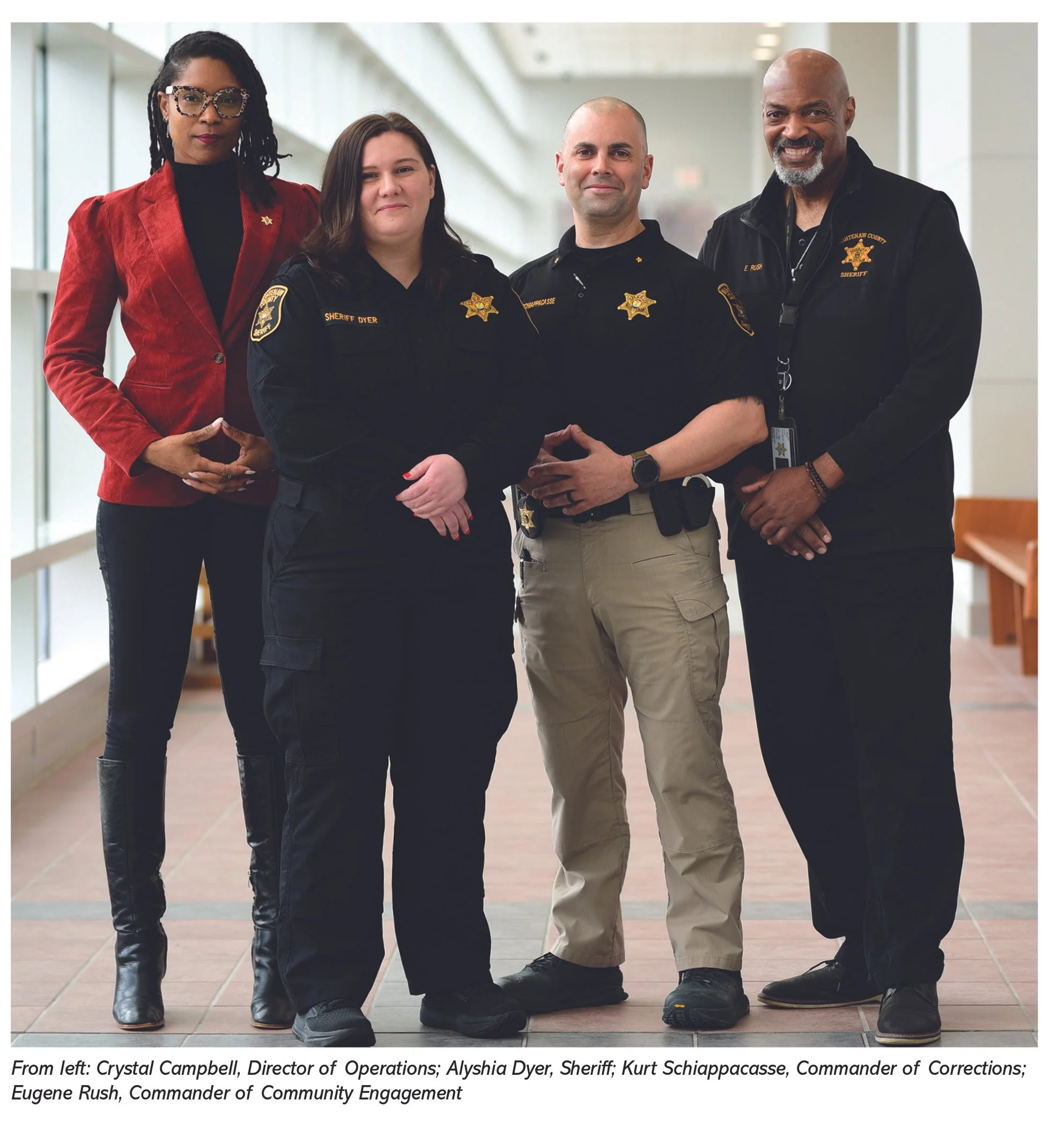
AD: We have so many good people that work here. I have a great team. My leadership style is collaborative, so my gaps are filled with the expertise of my team. They have been critical to the new mission’s success.
It is common practice for a new sheriff to replace the leadership team. I didn’t think that was the right move. Some of our best people were appointed by Jerry Clayton. Their institutional knowledge is a huge asset to our community. I chose to keep them in place to ensure we don’t miss a beat. My commander Kurt Schiappacasse has been here for 25 years-plus. He is one of the best jail commanders in the country. I would say the same about Renee Casey, our community corrections director. Matt Harshberger, our undersheriff, was formerly chief in both the Ypsilanti and Pittsfield Township police departments. My Director of Operations, Crystal Campbell, is brilliant and has worked in local as well as county government. Both the people from the previous administration and our new appointments have been doing a phenomenal job. One of the best things I have done is to build a great team.
I’ve learned a lot this year. I am continuously soaking up information and I’m paying attention. Seeing how much our employees really go above and beyond has been a big inspiration to me. Working in a jail is very different than working on the road or in a police office. Sometimes people that are great officers, can’t work in a jail, and vice versa. It’s got to be someone that can handle the jail environment, that means someone who is compassionate, someone that represents our mission and values—someone that really cares about the population in the jail.
I have enormous respect for my WCSO employees as so many of them made what we have accomplished doable. Our Plan of Action and Milestones (POAM) was critical during the transition and helped me get messages out to staff. Many frontline workers in our unions across county government also had my back, and the people that had worked in the former sheriff’s administration really looked out for me. That all mattered especially as there had not been a sheriff transition for 16 years before I took office.
Staffing was a huge issue when I came in. Our corrections team was just so understaffed. We made that a priority. We’re getting more people hired so now we don’t have staff working 16-hour, back-to-back shifts.
I thought there would be more pushback to our new mission. There was a rumor that there would be a mass exodus because I was too progressive, like “the crazy liberal sheriff.” We’re seeing the opposite. And we’ve had a ton of people applying to work here. People are saying, “I never thought about being a corrections officer until I heard about the work you’re doing.” Or, “I applied because of the new mission.” I feel so grateful when I hear that.
WORKING TOGETHER, COUNTY COLLABORATION AND COMMUNITY SUPPORT
CW: Your first year put you in the line of fire with some county officials. Do you see that as an obstacle moving forward?
AD: When I was running for sheriff, people saw me as controversial. I went up against the political establishment of Washtenaw County: entrenched wealth and power. We built a huge grassroots coalition of folks across the county, across divides, and we won.
But I’ve learned that it’s different running for office than being in office.
The politics of Washtenaw County have been the most surprising part of my first year. I thought winning was the hard part. I love the operations and the community work and I thought, “Now I get to focus on that.” But the politics don’t stop after the election. It’s not just the legal system that needs reform, it’s the politics too. There are people that are not happy that I’m in this seat. I don’t know if I’ll ever win them all over despite my best efforts. Luckily, they are not the majority.
The reality is the people elected me to be their sheriff, and this job is not easy. Everyday there are urgent matters to address. The work never stops, some change happens quickly, some things take longer and aren’t as easy. The last thing I want to worry about is our county government throwing a wrench in what we are fighting to accomplish.

Pair that with starting a first term under Trump 2.0. This work is the most rewarding thing I’ve ever done, but I would be lying if I said if some days weren’t hard.
I’ll be honest the transition was a challenge. I was naïve. I assumed that after the election people would be supportive. During the transition my mindset was collaboration, working with the county. We always want to do that. I am responsible for the public safety of our county.
But there were people who resented my win. I had to advocate and fight to bring my team in and make sure that the sheriff’s office people who stayed on to work for me were not harmed. I’ll give credit to our county administrator Greg Dill and Commissioner Rahbi who were focused on being helpful and on a smooth transition to the extent they could. There was a lot going on that we kept behind the scenes. Ultimately, we made it work but the first year was definitely not a walk in the park. The misinformation and rumors didn’t help either.
It is strangely liberating that my troubles with the county commissioners came out during the public board meetings. My hope is that this year things will calm down. My success is all our success. I’m feeling more positive--commissioners have started to be more supportive. Thankfully, the budget issues I started with were largely remedied.
I would like to work collaboratively moving forward, it’s what I’ve always wanted. Building relationships and seeing through differences to find ways to compromise is key. My biggest learning curve has been realizing I have to maintain a focus on the politics. The relationships are so critical. Now as sheriff, I say that I’m managing three tempos: the community; the operational; and the political.
My election as the sheriff is a testament to politics moving in a different direction. For a long time the same people controlled the Washtenaw political landscape. But now, the community is shaping election outcomes like never before. Our community is engaged and ready for change. That passion is a blessing. We will need broad community support for the work we are doing and will continue to do. At the end of the day, the community is what drives true change. If we can be innovative to reduce harm in Washtenaw, it will prove that people can do it in other places too. And that can improve public safety and people’s lives.
Read Related Articles:













































































































Crazy Wisdom sits down with Sheriff Alyshia Dyer to talk about her first year in office: ICE, Budgets, Karaoke, and learning to work together.