

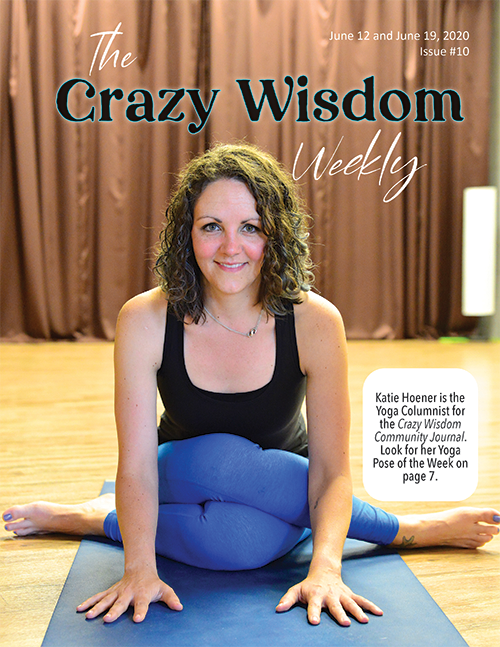
Whether you're a seasoned yogi or getting ready to roll out your mat for the first time, here you'll find a variety of useful tips from local yoga instructor, Katie Hoener.
Dear Katie,
My family and I have had a challenging time, which we agree is a shared experience, and are wondering if there is a posture we can share that can bring us together, and bring our stress levels down.
Marcus, Ann Arbor
Dear Marcus,
I agree this year has been unbelievably challenging, with multidimensional trauma, and challenges coming from all directions. It can be challenging to feel reset, and at times to be set at all. Through yoga there are a number of ways that we can come into our bodies and do our best to work toward a sense of balance, even if only for a moment. One key path is to slow down, focus, and reset, through an inversion. These spaces, where the base of the spine is elevated above the base of the skull, signals to the parasympathetic nervous system to kick into gear. This part of us is the ‘tend and befriend’ part of the nervous system that cares and comforts. A delightful way to come together in an asana place is through a Salamba Sarvangasana, a supported shoulder stand.
Here, I offer two versions. One is using your own body, and strength to support yourself, and the other is settling into supports. Whether we are using props, or using our own body is often dependent on the day. To come into Salamba Sarvangasana we want to be comfortable on our mats, with arms planted into the mat close to the body. On an inhale, core muscles engaged, we lift the legs toward the sky, planting the hands on the low back, and cradling the pelvis. The amount of lift through the pelvis is very much up to you. There are many variations of supported shoulder stand, and you will see many that show legs and body in one line, and others with more of an angle. The most important thing is that your core muscles are engaged, and feel lifted through the legs.


The other option, often called Candlestick, places a blanket or pillow under the pelvis, and allows the legs to reach up toward the sky. If you need a bend in the knees, take that adaptation. This variation is quite restorative, and is something that I practice for a few minutes before bed on most days. Though children may love a supported shoulder stand, you may find that family time holding Candlestick can be held for a little longer, and can offer you a space to offer balance to one another.
Namaste Katie,
You talk with many readers about the challenges of meditation, and I have been struggling. I am looking for something that I can use while at work when I cannot play a guided meditation, or use one of my other go-to tools. Do you have any suggestions during this hectic time?
Liz, Ann Arbor
Dear Liz,
This has been a time when meditation has been recommended a lot and has been more challenging than ever. I have found myself going back to the basics in many cases, as practices that are complicated or involved have, for me, felt overwhelming. In The Science of Breath by Yogi Ramacharaka there is a wonderful practice of pranayama that is itself meditative and fits the situation you are describing. It is called Yogic Rhythmic Breath, and involves connecting with your own heartbeat, and connecting your breath to the pace of your heart.
Find your pulse, perhaps on your wrist, or on your neck. Take a minute to find a place where this is easy, so that when you start the practice you are not searching or struggling. When you are ready you will begin counting the inhale to match six beats of your heart, allow the exhale to match six beats of your heart. Take ten breaths to feel comfortable with this practice, and if this is where you want to start, stay here. This is a beautiful way to connect deeply with yourself. If you would like to continue the practice, the space between the breath is half that of the length of the inhale and the exhale, so at this point, the count of three pulses. If the location and time allow, the length of the breath can be increased, as well as the space between. Check in that as you expand the breath you remain comfortable.
Yogi Ramacharaka recommends that we start with twenty rounds of this breath practice, adding more rounds if time and space allow. This connection with our own rhythms draws us into a place of concentration and can become a meditative place. Connections to the breath are the foundation of a mindful practice.
Dear Katie,
Recently as part of a workshop on positive psychology we were all assigned to start a gratitude journal. I was discussing this with my partner, and they suggested that I also look into other heart chakra practices. Are there ways to expand on this gratitude work?
Dan, Saline
Namaste Dan,
I am a big fan of gratitude journals and keep one myself. As you mentioned they are a part of a growing amount of research in a number of fields, including positive psychology. The Anahata Chakra, or the Heart Chakra, is the midpoint in the traditional chakra system, with three below and three above. Gratitude work is important to cultivating an open heart and forming connections with others.
To build on your work of gratitude journaling, transfer this intention and energy to a meditation practice, or into an asana practice, if you find that more accessible. Breathing in feelings of gratitude and opening ourselves up to recalling moments when we feel grateful builds our own abilities to come to these feelings and sensations over and over again. As discussed in positive psychology and in yoga, there are so many negative influences and attachments impacting us and attempting to steer us away from a compassionate and loving mindset. Gratitude is a powerful way to stay open and connected to others, and to our own ability to forge deep bonds. Whether through meditating on a particular moment of gratitude, or using a gratitude mindset as a sankalpa, see if there are ways to infuse this mindset into other practices to make your heart center shine!
Katie Hoener is an RYT 500, receiving her 200 and 500 hour trainings. She is also a Licensed Master Social Worker and a partner at Verapose Yoga in Dexter (veraposeyoga.com). Please send your own yoga questions to katie@verposeyoga.com.
Related Content:






















































































Unless we spend time exploring the underlying causes of our stress, ultimately nothing will change. A yoga practice can help us do just that. One of the gifts of yoga is that it helps us cultivate greater self-awareness. By getting on your yoga mat, you are taking time to slow down, be mindful, and see what you can learn about your body. With ongoing practice, you are better able to listen to your body and give it what it needs on a daily basis.