

Photos and Story by Hilary Nichols
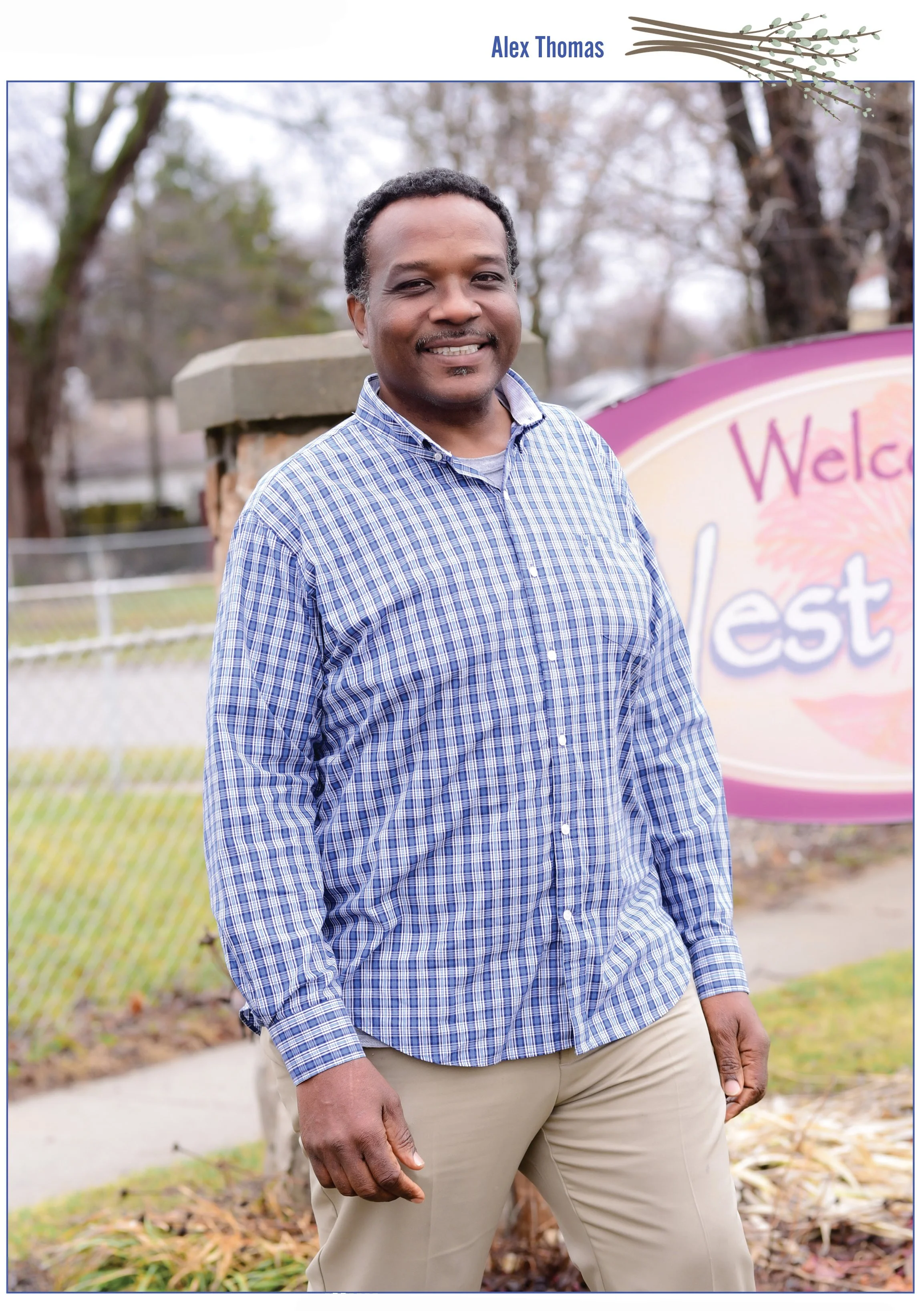
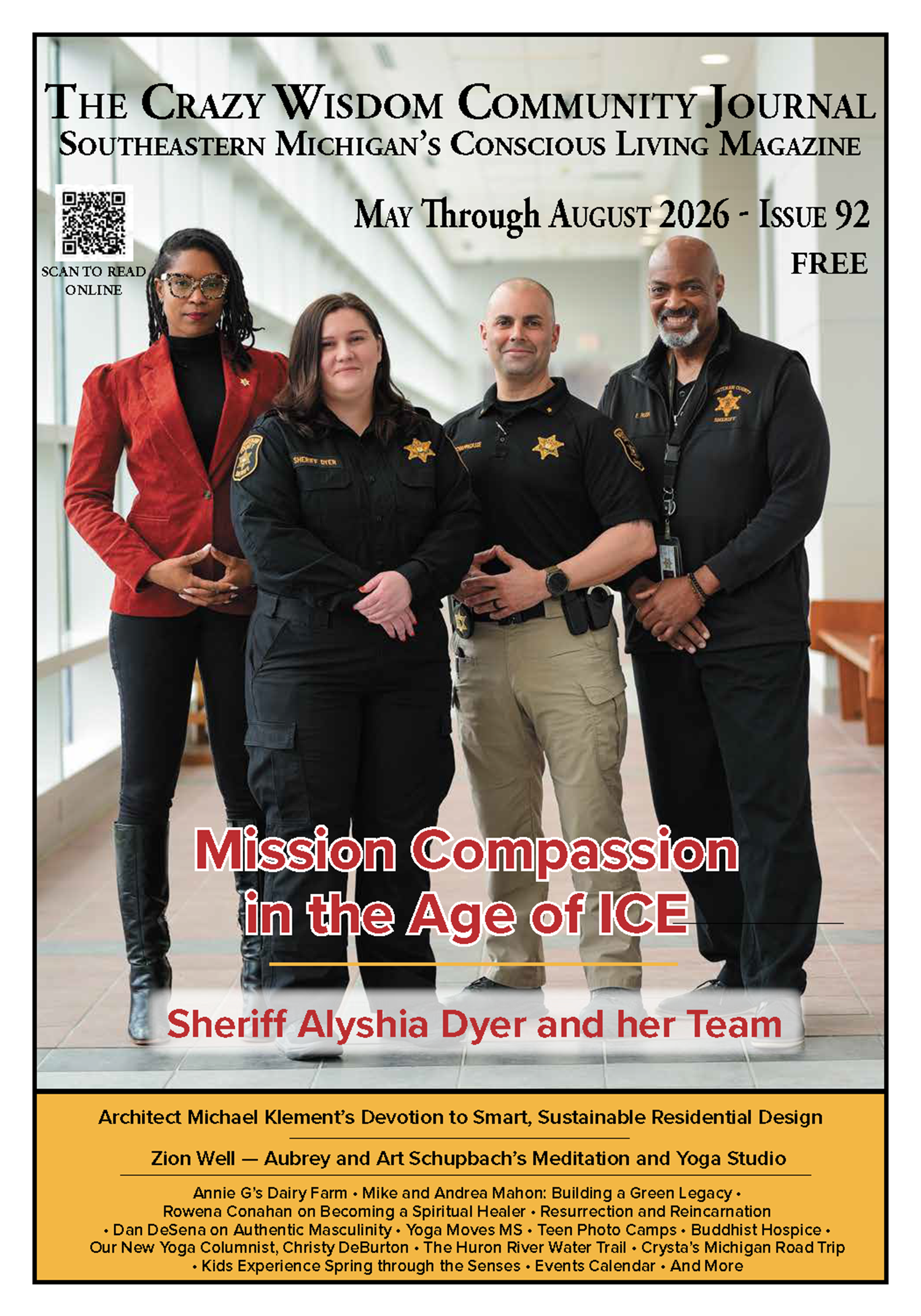
Alex Thomas has returned to Ypsilanti to care for his hometown. He is a West Willow Community advocate, and a Transformative Strategies Specialist, and he is Assistant to the Sheriff of Washtenaw County,
When he first returned, after nearly eight years teaching English in China, he expected nostalgia. What he found instead stunned him. His old school, Ardis Elementary, was now an empty field. “They had a great big wooden boat that we all loved to play on,” he remembered. “Our neighborhoods were structured around our schools.” And more alarming, the General Motors plant that had anchored his childhood town was shuttered. The pulse of West Willow had gone quiet. “Crickets,” Thomas said, shaking his head. “That plant was the breadbasket of our neighborhood—the backbone of our economy. And now it just stands empty.”
For generations, the industrial complex in West Willow had been the neighborhood’s economic heart. Built in 1943 by the Ford Motor Company, Willow Run produced B-24 bombers on a mile-long assembly line in the largest factory building in the world. During WWII it employed thousands of workers—including women as part of the “Rosie the Riveter” campaign named for Willow Run’s own Rose Will Monroe.
By the 1950s, the complex had transitioned to automobile manufacturing under General Motors, eventually employing as many as 14,000 people at its peak in the 1970s. The sprawling five-million-square-foot plant symbolized prosperity for the surrounding community. When General Motors shut the plant down in 2010 during its bankruptcy restructuring, that prosperity evaporated. The loss rippled through West Willow. A community once defined by stable union jobs and modest middle-class homes began to be labeled with a single word that Thomas rejects outright.
“People say it’s a ghetto,” he said. “And it is not.” The subdivision, built in 1956-2008, is the largest neighborhood in Ypsilanti Township with 1,050 homes and over 3,000 residents. “I’m not saying it’s perfect.” It just needs us to come together as a community.” Turning around both the perception and the lived experience in this neighborhood is what Thomas is all about.
“West Willow is where I’m from,” Thomas said proudly. His parents, both employed at the West Willow GM facility, were union Auto Workers—UAW members. “It was a Cosby Show upbringing,” Thomas recalled. “Two parents working good jobs, a nice house, safe neighborhood. I thought of myself as the nerdy Theo Huxtable of my family.” Thomas was a good student, but susceptible to peer pressure.

A few petty crimes landed him in lockup. He should have been sent to a youth facility but because of overcrowding they sent him to the adult facility. “It was not a good place for a kid.” Michigan’s Holmes Youthful Trainee Act (HYTA) designated that after a three-year probation period, his sentence would be expunged. Though the experience had a more lasting impact. Those early encounters with police harassment as a young Black man marked a turning point. “As a kid, I thought cops were the good guys. But when I got older and behind the wheel, that changed. Those experiences of being stopped and harassed opened my eyes to how broken systems shape broken communities.” Thomas added, “And without healthy spaces, there are so few places for Black youth to be themselves with positive role models.” Thomas understood the need.
Starting again, he found steady work at Wendy’s in the University of Michigan’s Student Union building, “But buses didn’t go to Willow Creek,” Thomas said of the lack of transit, so he relocated to Ann Arbor. “I moved into a transitional home.” Avalon Housing had just opened its nonprofit supportive housing for those formerly homeless. Thomas not only found stability but community—and a mentor in Avalon’s founder, Carol McCabe. “Carol saw something in me,” Thomas said. “She believed in the power of residents themselves to lead.” Through a grant-funded initiative known as the Pilot Light Project, Avalon employed Thomas as an organizer, identifying community goals and implementing shared projects. “It was tough,” he recalled. “But worthwhile.” He gained a lot of the organizing experience that serves him still.
In 2008, he took a leap and moved to China to teach English. “I thought I’d be there for the next twenty years.” But in 2016, Thomas returned to Michigan to care for his aging mother. “I recognized the need and made the choice to move home.” That need was broader than he’d expected.
“The Ypsilanti I came back to, wasn’t the Ypsilanti that I left,” he said. “And it didn’t seem like anyone was doing anything about it.” He began volunteering with the New West Willow Neighborhood Association, working in partnership with groups like Habitat for Humanity and the Washtenaw County Health Department. They tackled issues ranging from housing to public health, with increased urgency during the COVID-19 pandemic. “We had to reach people where they were,” Thomas said. “We built contact lists, checked on neighbors, got information out. In a lot of ways, we were a lifeline.” What they discovered through public health data was alarming. Local life expectancy had been declining steadily.

Death certificates reported local life expectancy declining from an average of 65 in 2020 to just 59 in 2024. “The numbers don’t lie,” Thomas said. “But the zip codes hide the truth.” Ypsilanti Township is divided into 19 precincts. Those 19 precincts cover two zip codes 48198 and 48197. “It’s too easy for data to reflect what the powerful want to see instead of the real story of poverty, racism, and neglect,” Thomas said. His efforts are all about visibility: ensuring that decisions about eastern Washtenaw County aren’t made by those insulated from its realities.
“It’s not about property owners,” he insists. “It’s about the people.” What we think of as Ypsi is both the city of Ypsilanti and the township. With a population of approximately 20,000, the city is a council-manager form of government with an elected mayor and six council members from three voting wards. The township is overseen by a supervisor and seven-member Board of Trustees for a population of roughly 55,000 residents. It is confusing and that may be serving the powers that be. “Decisions often hinge on a simple majority of four votes. That’s it,” Thomas explained. “Four people decide policy for fifty-five thousand people.” Thomas wants to change that. In 2024 he challenged longtime Ypsilanti Township Supervisor Brenda Stumbo, running in the Democratic primary. He didn’t win the seat against the incumbent. But that hasn’t discouraged his civic participation.
“I’d like people to better understand their local government and their local community power so they will participate,” he said. “It’s so important to know your neighbors and our power when we are informed.” His long-running partnership with Ypsi Nice has helped spread that message, celebrating local resilience while encouraging residents to show up at meetings, ask questions, and influence decisions that shape their lives.
When the American Rescue Plan—or ARPA—allocated funds to be distributed by the township board, community groups in Ypsilanti Township raised concerns. As co-chair of Ypsii NICE—Neighbors Improving Community Engagement —Thomas was interviewed by WEMU News. He reported that the board’s decision didn’t meet the residents’ priorities of children’s programs, mental health services and community centers. Thomas’ outcry for the community to “Demand a change and demand an explanation why they’re neglecting the most impoverished areas of the township they’ve been elected to represent” was a rallying call.
To deepen the conversation, Thomas launched a podcast called What Up in the Willow, later expanding the project into The Alex Thomas Show, recorded at Ypsilanti’s Riverside Arts Center. Along with residents, artists, activists, and local experts, he created a growing oral history of Ypsilanti as told by the people who live there. “The compilation tells the big story,” Thomas said. “From the newest residents to the oldest, from artists to architects, old school to new comers—it’s all part of the same Ypsi community.” For Black History Month, Thomas hosted historian Matthew Seigfried, calling the episode “one of the most important shows that I’ve done.” They discussed the area’s role in American history from the first Native settlers to William Lambert, a prominent 19th century African-American citizen and abolitionist, to the underground railroad and to the great migration. Siegfried centered Ypsilanti’s role in the national story. “We all have a part to play in history,” Thomas noted.
The recent loss of a local food-justice leader and community member, Melvin Parson, came to mind. “Melvin always said ‘kindness, dignity, and respect.’ He played a huge part in this area. He brought the community closer.” The outpouring of grief after Parson’s death revealed something Thomas had not fully appreciated before. “Seeing how many people were touched by his passing reminded me of the capacity of our community,” he said. “When we grieve together, we honor the true heart of the place we live, and we can see how powerful we are when we come together with care.”
“I used to look at our community and see all the broken parts,” he said. “But now I can see the strength.” “West Willow raised me,” he said, with his heartwarming smile. “Now it’s my turn to show up for West Willow.”
Alex Thomas encourages civic participation through local organizations such as: facebook.com/nwwna/ as well as liberatedontincarcerate.org/ and you can follow his lead with all his current information shared at facebook.com/alex.thomas.451903 or youtube.com/watch?v=Qzaety4jozY.
Read Related Articles:



































Matthew Keating discovered tango at twenty-one and fell hard. At once both sultry and stern, playful and serious, tango evokes a powerful theatrical expression. He recalled riding his bike home from work when he first encountered a milonga (a place or event at which the tango is danced) He heard the music drifting around a corner. “Like the scent of Grandma’s pies cooling in a window, I was drawn.