
By Cashmere Morley
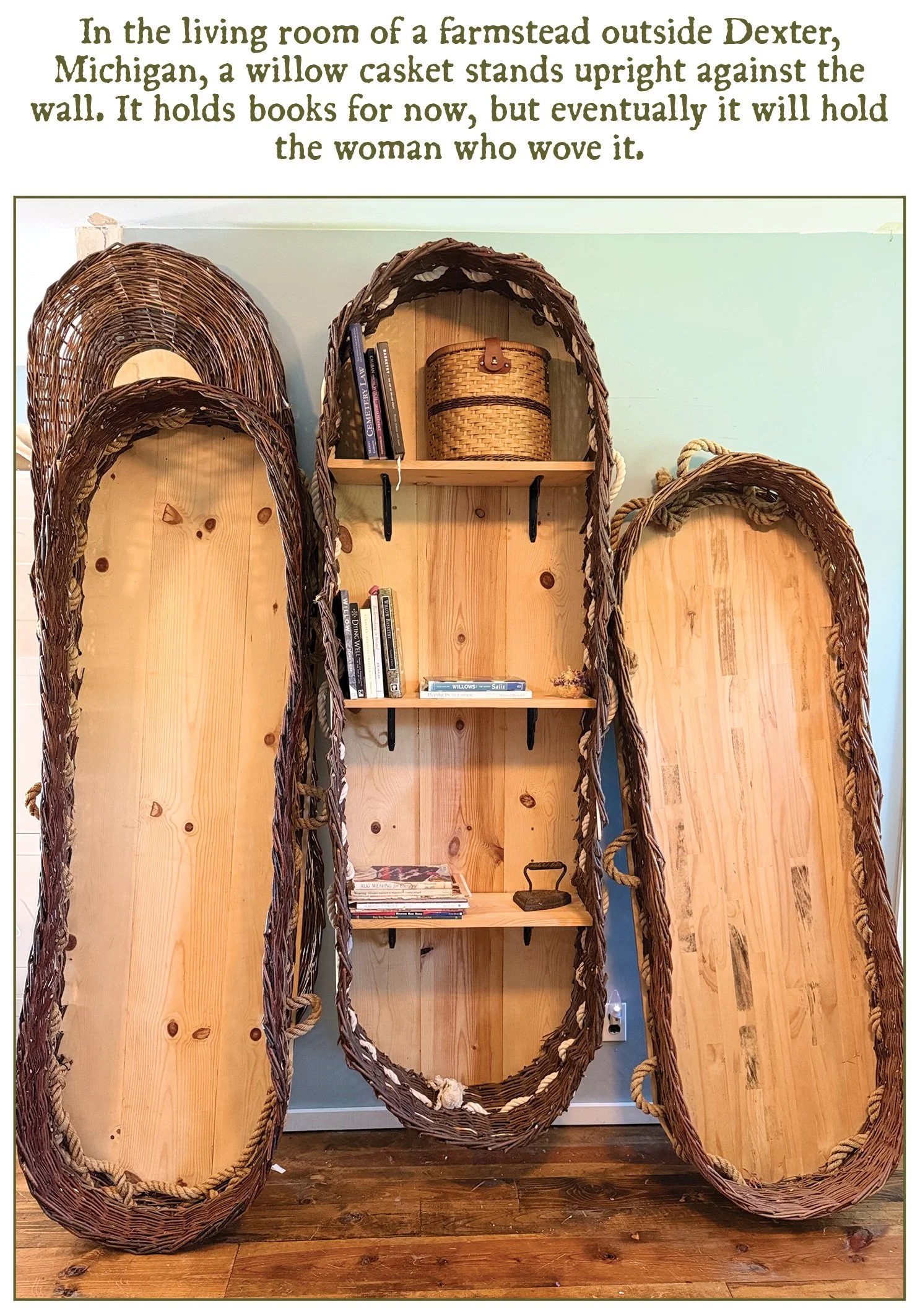
In the living room of a farmstead outside Dexter, Michigan, a willow casket stands upright against the wall. It holds books for now, but eventually it will hold the woman who wove it.
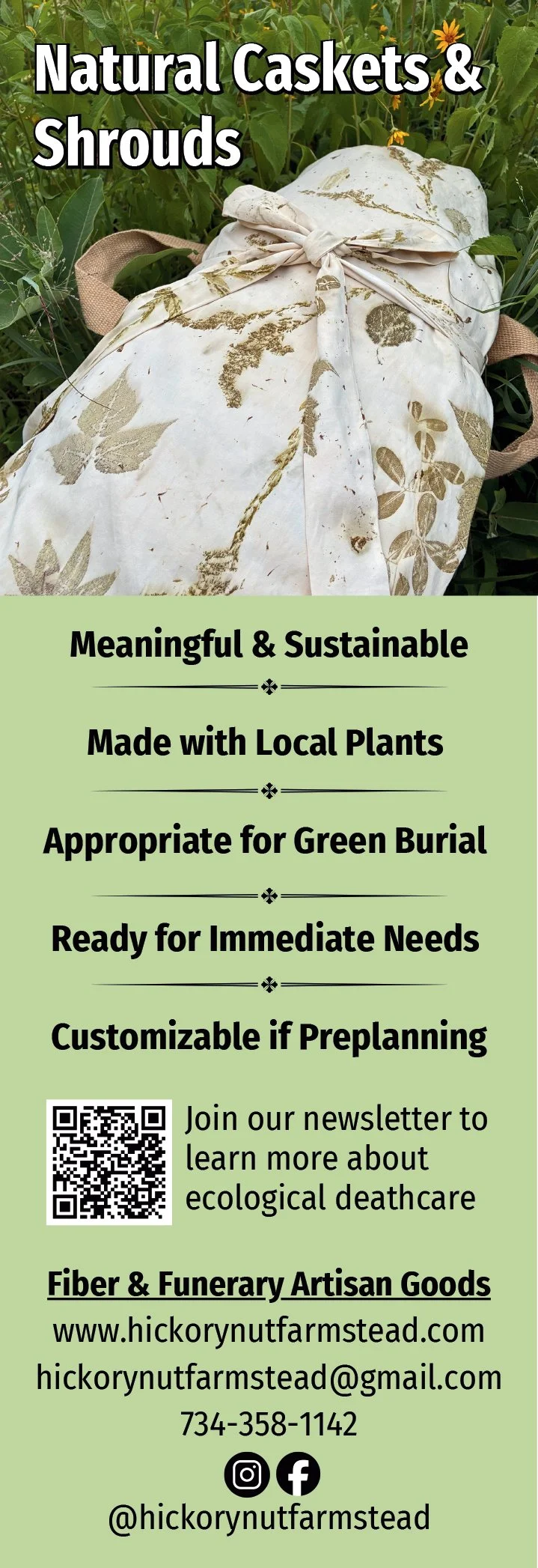
That woman is Michael Marie Schofield, a “fiber and funerary artisan.” Schofield weaves conventional basketry and dye work as well as teaches around Southeast Michigan. “But I also do funerary vessels,” she said. “I craft handmade caskets and burial trays and urns and plant dyed shrouds for use in more sustainable end of life options.”
From the outside, it is an unusual pairing of words: fiber and funerary, weaving and death. But for Schofield, the two are intertwined. Her work lives at the intersection of plant-based craft, ecological awareness, and the way we care for our dead.
Her path into this work began with a family member exploring natural burial options. She remembers touring a natural burial cemetery in Ohio at a time when she did not yet realize such spaces existed or that natural burial was even legal in Michigan. At that cemetery, staff showed them pictures of woven vessels and other alternatives to the standard metal casket. Schofield described herself then as someone who was just starting to wake up to the plants around her: what they were, how to grow them, and how to work with them.
Confronted with the idea that a loved one’s body could rest in something made from local plants and local hands, she felt an immediate pull. She fell in love with the idea of weaving a vessel for her family members and, eventually, for others in her community. Her entry into the craft was a journey of YouTube videos and books followed by the traditional transmission of sitting and weaving next to another person. That process led her to a funerary arts apprenticeship with a casket weaver on the East Coast. The apprenticeship took place only about three years ago, but it completely reoriented her life.
Her childhood in Battle Creek also laid the groundwork for that shift. She grew up around teachers rather than makers, but her family encouraged art and curiosity. Instead of family vacations to big-ticket destinations, they drove to campsites across Michigan. At the time, she sometimes felt like she was missing out, but those trips gave her an intimate sense of the state’s landscapes and seasons. They also helped root her in the natural world in a way that would later shape her material choices and ecological commitments.
Before she ever picked up willow to weave a casket, Schofield’s formal training and early ambitions were in science. She studied cellular and molecular biology, then microbiology and immunology, and initially pictured herself at a lab bench doing research. That scientific background still informs the way she thinks about life, bodies, and ecosystems today. The continuity between her scientific training and her current work runs through her fascination with living systems and cycles.
Her relationship with death also goes back to childhood. In a culture where death is often hidden or euphemized, Schofield grew up in a home where it was spoken about openly and frequently. Discussions of death, dying, grief, and different possibilities for what might happen after death were a normal part of family life. Only in adulthood did she realize that this level of candor was unusual. That early familiarity makes it easier for her now to sit with grieving families or with individuals planning for their own funerals, without flinching or turning away from the realities involved.
When asked about the history of the kind of funerary weaving she practices, Schofield resists the idea that this way of weaving is brand new. “It’s been going on for a long time,” she said, “but I feel like [this method of weaving] is coming back. So, it’s like an old-new thing, sort of.”
In her view, the renewed interest is inseparable from a broader cultural turn toward sustainability and a closer relationship with the land. As more people try to align their daily lives with ecological values, they are beginning to ask why their deaths should be handled in ways that feel industrial, distant, and resource intensive.
Despite the sense of rightness that her work carries for some, the practical challenges are significant. The first and largest hurdle is a simple lack of awareness. As she said, “I feel nine out of 10 people I talk to are just completely unaware that there are sustainable options [for death]—that you can have a natural burial, that you can make your own casket or get caskets from local artisans instead of the funerary industry.” It is hard to serve a need people do not know they can have.
“To combat that, almost exactly a year ago now, I joined forces with other alternative end of life care providers like death doulas or energy workers or people who are pet doulas, and small family funeral homes. We formed a nonprofit that is trying to work to reroot the care of our dead, dying, and grieving in our ecology and our community,” Schofield said.
Through that nonprofit, The Michigan Deathcare Collaborative, she and her collaborators host events, talks, and hands-on experiences that help people see and touch alternatives to conventional funerals. Her outreach takes many forms. “I table at a lot of different events, for sure. Death really belongs everywhere,” she said.
For Schofield, the heart of these activities is participation. When families or individuals join the making process, grief and fear can begin to shift. She has woven with people who are pre-planning their own funerals and with families preparing for a loved one’s death. Some invite relatives to join them on different days of a multi-day weaving process, allowing each person time with the work and with the reality it represents. The act of weaving provides a focus for the hands and the body that can make difficult emotions more manageable.
She describes crafting itself as therapeutic. “I think the craft itself provides a sense of its own protection from grief, even when working on a funerary casket.” Having time alone with the work between visits from families, she can continue weaving and pour her own feelings into the pattern of the casket before her. “I think crafting in general is an immense therapeutic tool for me, for that reason,” Schofield said.
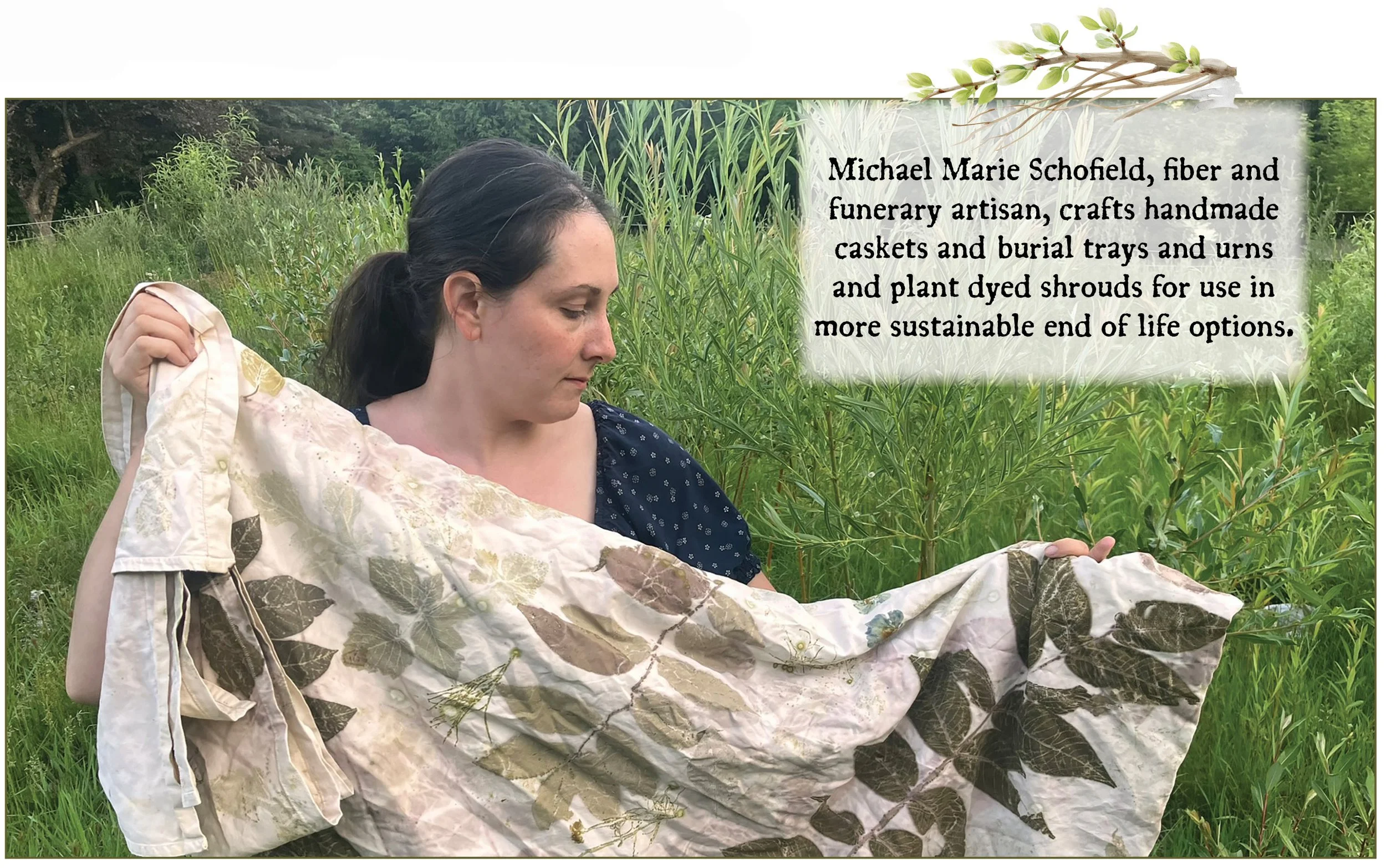
The materials she uses are themselves part of the story. She works with “all kinds of materials,” but that her “absolute favorite is willow, which is an amazing plant that grows on every single continent except Antarctica. So, no matter where people were in the world, if they wove baskets, they probably used willow among their plants.”
The tools used are minimal and rooted in a long history. “What’s beautiful about weaving is it’s such an old craft,” Schofield said. “It’s thought to be the second oldest craft in human history. You really don’t need very much to do it. All you really need is a sharp knife.” She adds a few practical tools to that core: hand pruners, clips, a wrapping iron, and bodkin that her husband blacksmiths for her.
Personalization is at the center of her funerary work. For families facing an immediate death, she keeps finished vessels on hand, so something is available. But when people plan ahead, there is time and space to shape the vessel around the person’s life. She invites them to incorporate plants from their own yards, fibers from animals they have raised, or other small objects that carry meaning. One family wove wool from their own sheep into a casket, and another added feather dusters for a man who loved cleaning. For shrouds, people can bring flowers from their gardens or leaves from trees in their favorite parks to be imprinted in the plant dyeing process.

Asked why someone might choose this path over a conventional funeral, Schofield points to both ecological and economic considerations. She describes a funerary industry dominated by a few large international companies that sell most of the caskets used in the United States. Those caskets are often made of metal and plastic, sometimes with toxic materials, and shipped long distances. In contrast, funerary artisans in Michigan and beyond are creating vessels from local materials at comparable prices, often with a much smaller ecological footprint. The Funerary Artisans Collective lists many of these makers, and the nonprofit Schofield assists maintains a directory including artisans who work in wood or glass and offer options like blown-glass urns that can incorporate ashes.
One persistent fear she encounters around natural burial is the idea that it will somehow pollute the environment. People worry that bodies placed directly in the ground, without vaults or heavy caskets, will be harmful. Schofield sees this as connected to a deep sense of separation from the natural world, a forgetting of the reality that our bodies are designed to return to the soil. She meets this fear with calm explanation and educational outreach, including a brochure that walks people through what natural burial is, how it works, and the legal landscape in Michigan.
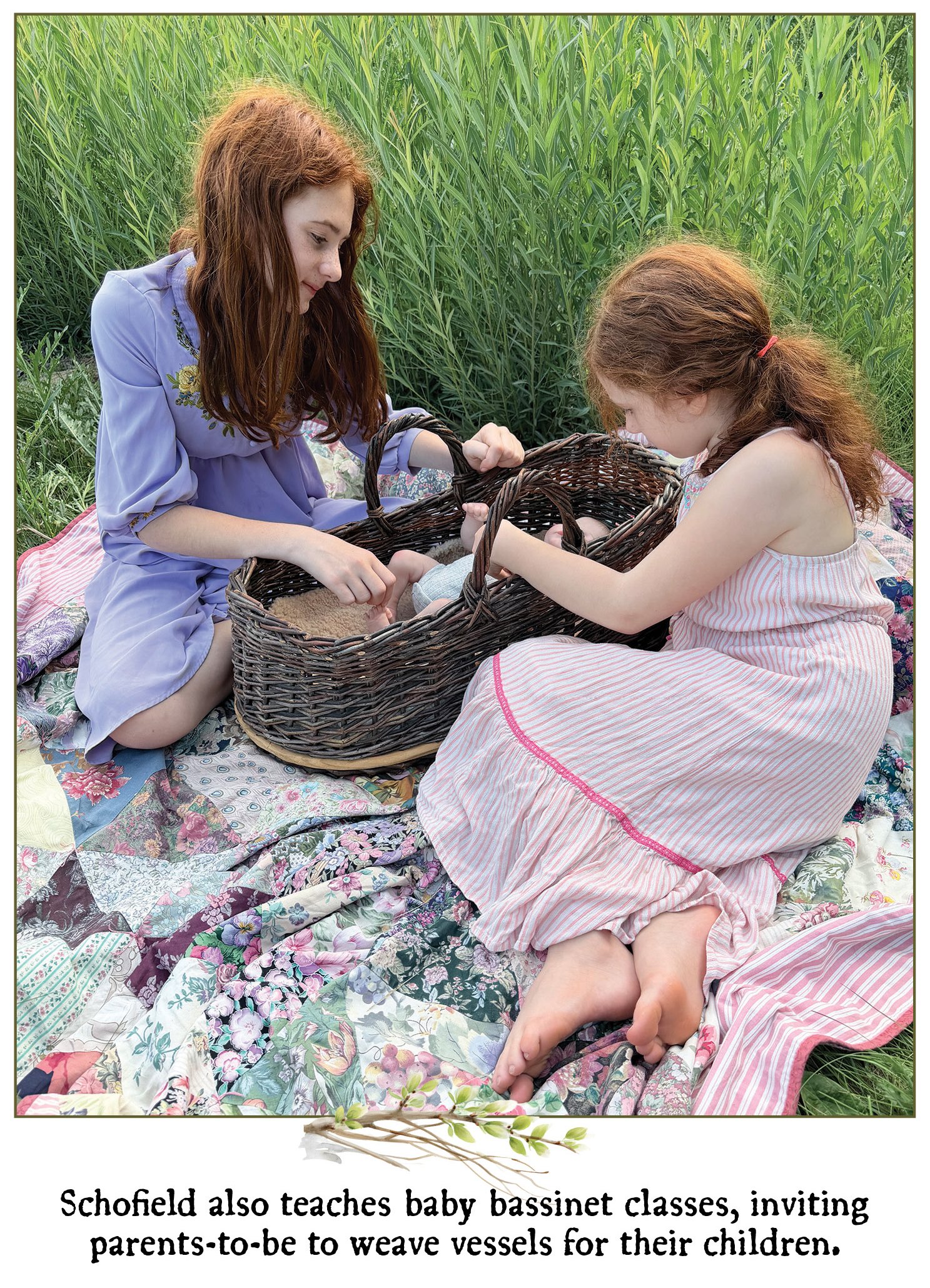
Schofield also teaches baby bassinet classes, inviting parents-to-be to weave vessels for their children. She loves being able to partake in the full life cycle, knowing that they are working on something that is going to be passed down for generations. The same hands that weave caskets also weave cradles, and that continuity feels meaningful to her.
When she imagines what she would most like to change about how death is handled in modern American culture, her answer is clear. “I would love to see death care become revillaged,” she said. “I’d love to see it become more community-focused again as it used to be.” She hopes that the lasting legacy of Hickory Nut Farmstead, fifty years from now, is that it has played some small role in that shift. “If I can play any part in having death be more community focused, I think that would be a lovely legacy to leave.”
If her work needed a single plant to stand in for everything it represents, she has no hesitation about which one that would be. “Willow, for sure,” she said. On her land, it rises and is cut back, year after year. In her hands, it becomes baskets for babies, tools for daily life, and vessels for the dead. In her vision, it also becomes a way to root death care back in local soil, local hands, and the communities that must live with loss long after the funeral is over.
Discover Hickory Nut Farmstead online at hickorynutfarmstead.com, on their FB: @HickoryNutFarmstead, and IG: @hickorynutfarmstead.
Read Related Articles:























In the living room of a farmstead outside Dexter, Michigan, a willow casket stands upright against the wall. It holds books for now, but eventually it will hold the woman who wove it. That woman is Michael Marie Schofield, a “fiber and funerary artisan.” Schofield weaves conventional basketry and dye work as well as teaches around Southeast Michigan. “But I also do funerary vessels,” she said. “I craft handmade caskets and burial trays and urns and plant dyed shrouds for use in more sustainable end of life options.”