By Susan Slack • Photos Courtesy of The Leslie Science & Nature Center and The Ann Arbor Hands-On Museum
Most Ann Arborites know the Leslie Science & Nature Center (LSNC) off Traver Road is free and open to the public. When was the last time you visited? Maybe you played around on the lawn, in the woods, or in the unique, tunneled playground on a school field trip. Or maybe you showed up for the Annual Earth Day Event or October’s Animal Haunts. The property is still there, better than ever, with a friendly crew to help you when you desire it. Some day you might just want to wander around, or let your mind relax on the Black Pond Woods nature trail.
As you approach the property, after the peaceful ride through the local neighborhood, you can’t help but notice the old home on the crest of a hill. There are stairs and inclines leading up to the group of buildings and classrooms.
To the right of the parking lot, you will see framed gardening plots. These are spaces open to the public and offered by a separate not-for-profit, “Project Grow.”
If you go into and then pass the garden plots, you will see the trail head (the entrance) to the Black Pond Trail, a 34-acre woodland nature area, currently part of the City of Ann Arbor Park system. There are slight inclines and some roots and rocks, so be mindful where you step. The full one-mile hike loops past the Black Pond, with a detour to climb down to a bridge to get a closer look. It is dark water, as you might be able to guess by its moniker. Experienced hikers call this an “easy hike,” but you can be the judge.
The largest building on the homestead property is on the right as you continue uphill, the Energy House. It’s on the former site of Leslie’s Lab, but now it holds the largest classroom on the campus. Many of Dr. Leslie’s inventions are displayed on the upper shelf around the room.
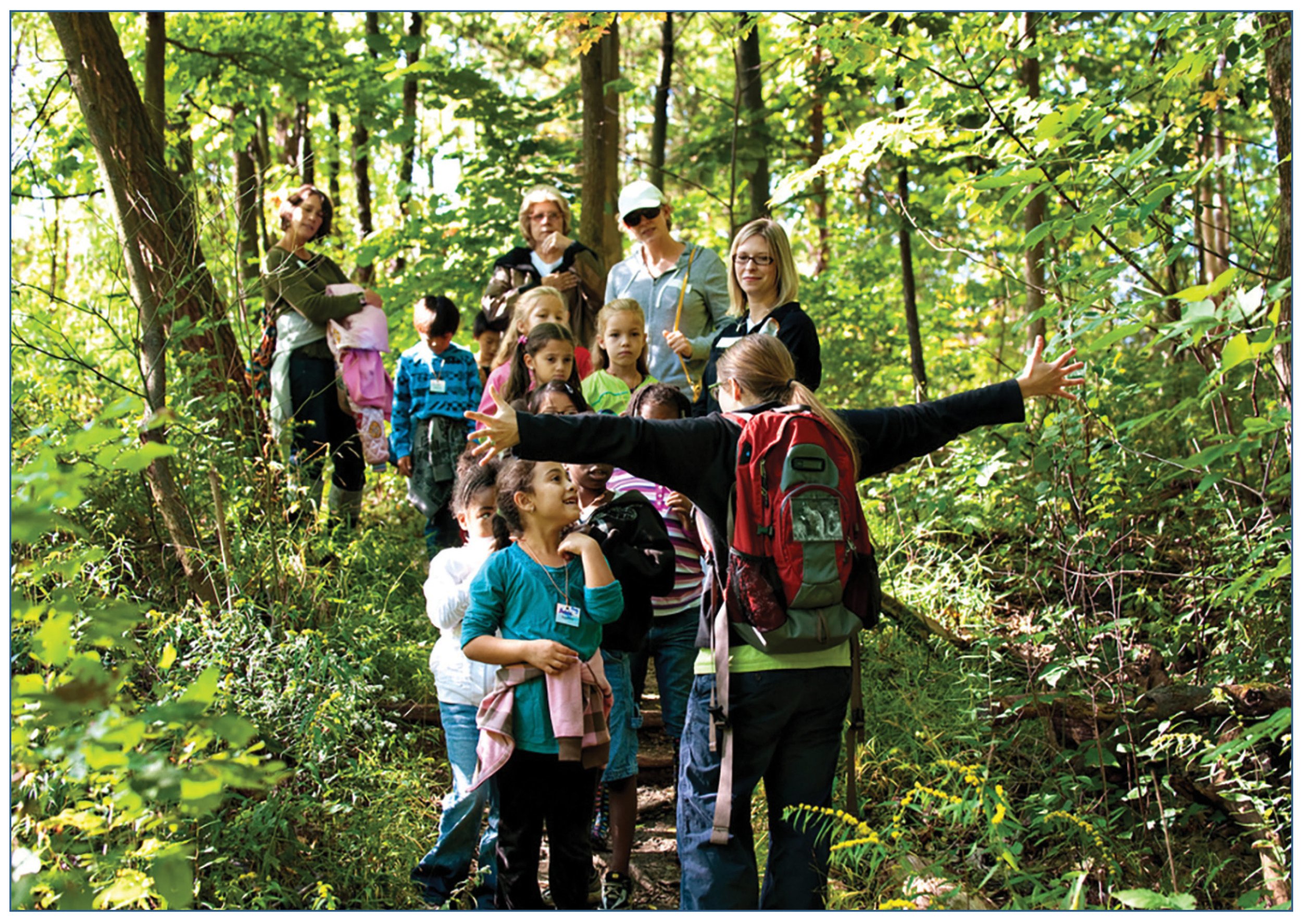
As you make your way uphill, you can see that the lovely homestead still stands. Its spacious porch with the unique ironwork overlooks our downtown in winter when the leaves have shed. You’re welcome to go on the porch and have a look. Inside the house (open only for programs) original bookshelves and a small kitchen in original condition are still there. Classes are taught in the living room. Continue up the main path and find the two arena-style curved field stone benches. What can happen in that space between the house and the seats? Anything! What would you like to see there?
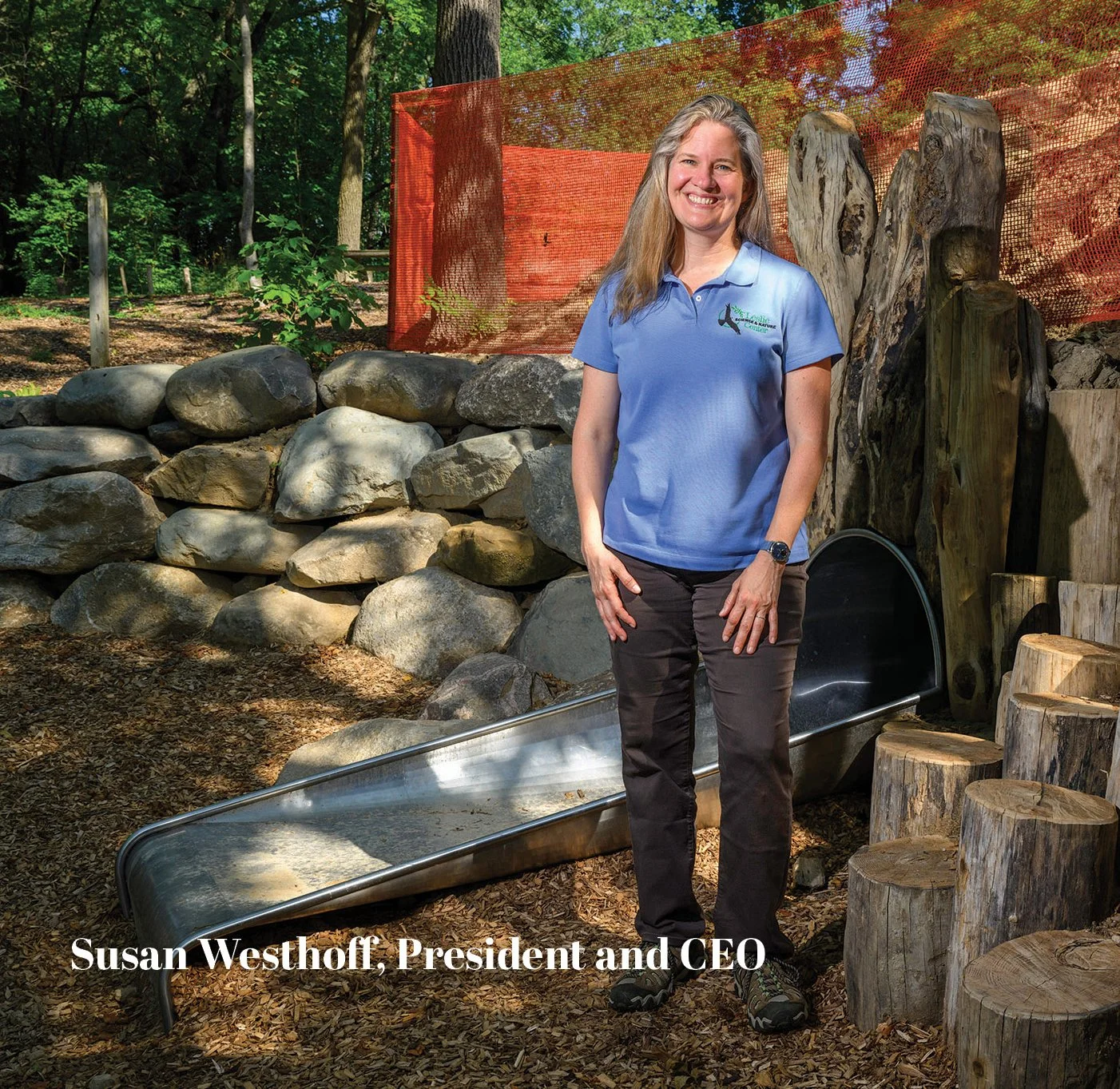
I was fortunate enough to be shown around by Susan Westhoff, President and CEO. Open, happy, smart, steady, and very helpful—she’s just the kind of person you hope would be at the helm of such an organization. Together we strolled the property, arriving at the outdoor enclosures called Raptor Loop that house native predator birds who cannot live in the wild.
Can we talk about that eagle? It is huge. Did you know eagles were that big?
“We don’t know what gender it is,” Westhoff explained when we queried. Of course, we followed up with asking why don’t they just look underneath? And she replied, “It’s not like that with raptors. We think she is female by her size, since they are usually bigger than males.”
Hoping for a big journalistic scoop, we asked its name. “This eagle isn’t named because it is not a pet, and we want kids to know that.” They offer the opportunity for financial “adoption,” which means you can donate (starting at $50 a year) to the upkeep of the animals. In exchange you receive discounts for classes offered at the center.
The popular Critter House is up there, too. It is housed in what used to be the Honey House, where Emily Leslie kept bees. There is a strong animal smell when you enter. That’s okay, let it wake your olfactory.
We took a quick peek into the old garage, which has transformed into a virtual teaching studio complete with a green screen. “We serve people in remote areas who are without access to a hands-on museum learning opportunity,” Westhoff said proudly.
You’ll find the fire pit up toward the top of the hill. Sit on a log in a circle around it and dream of drippy marshmallows, and everyone singing off-key folk songs such as “Oh, my darlin’ Clementine.” If you look toward the woods, you’ll see the other end of the Black Pond trail. Speaking of sitting, the Leslie Science & Nature Center has plenty of picnic tables and benches scattered around for a picnic lunch.
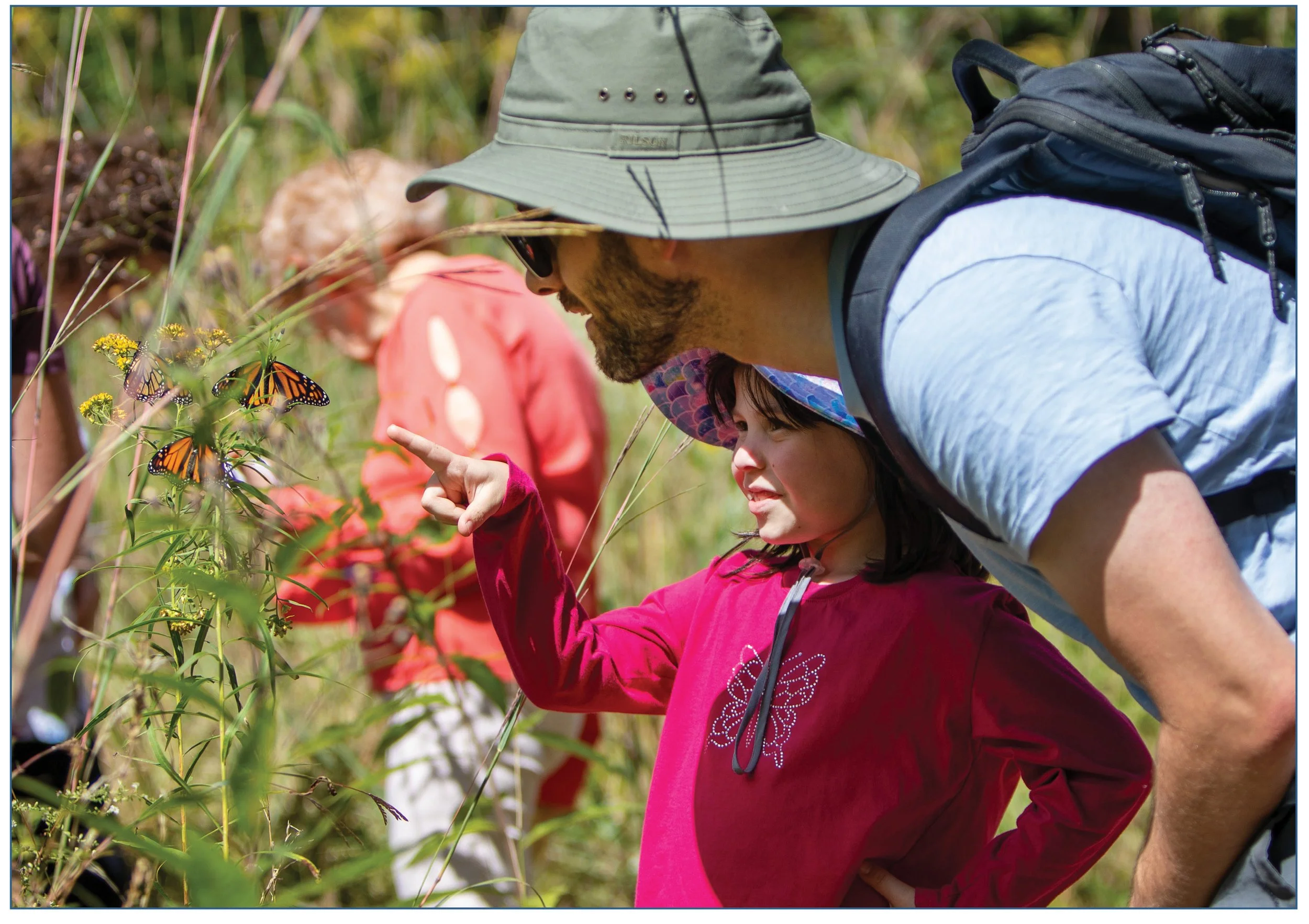
And how about that Nature Playscape, with slides and a tunnel to run through in which you are welcome to check for echoes? The water pump awaits your dry clothes. If you like watching children-in-the-wild, this is the place. There are enticing paths to small areas where kids and their imaginations make of it what they want.
The LSNC offers many scheduled programs for all ages throughout the summer. It simmers down as winter approaches, but they continue to offer many programs all year long. The best way to stay informed is to sign up for their newsletter on the website and check out membership options. Even if you’re not a member, you can rent areas for parties and events. All ages are welcome whether coming with a group or as a family.
Viki D. went on such a trip organized by the Turner Senior Resource Center which is part of Michigan Medicine. She’s 74 and frequently uses a walker. Did she have trouble getting around on the property?
“No,” she answered from her car when I asked. “There are walkways and you can always find a ramp. But it takes some doing.” She stressed that it’s not like walking in a mall. You have to pay attention. She said the only steps she encountered were the two going into the Critter House.
Westhoff reported that they have plans to improve accessibility. “We used to get a lot of Senior groups before Covid. We are hoping to build that back up.”
Referring to the presentation in the Critter House, Viki reported, “The talk that Lisa gave to our group was great. She’s been there with animals for thirteen years. Lisa told us she was grateful to talk with adults because she can use big words.”
Ten-year-old Penelope S. has been to LSNC many times with school field trips, and with her grandmother on Earth Day. “Sometimes my family goes on weekends when there’s nothing else to do.” Her favorite part is walking past the bird cages, especially the eagle. The second best is the playground with the giant slide and tunnel. She remembered going on the nature trails in the woods during a birthday party. She loved “hearing noises of the animals and bird calls.” When asked if she recommends LSNC, Penelope answered enthusiastically, “Yes! It’s really cool, especially for people who like birds.”
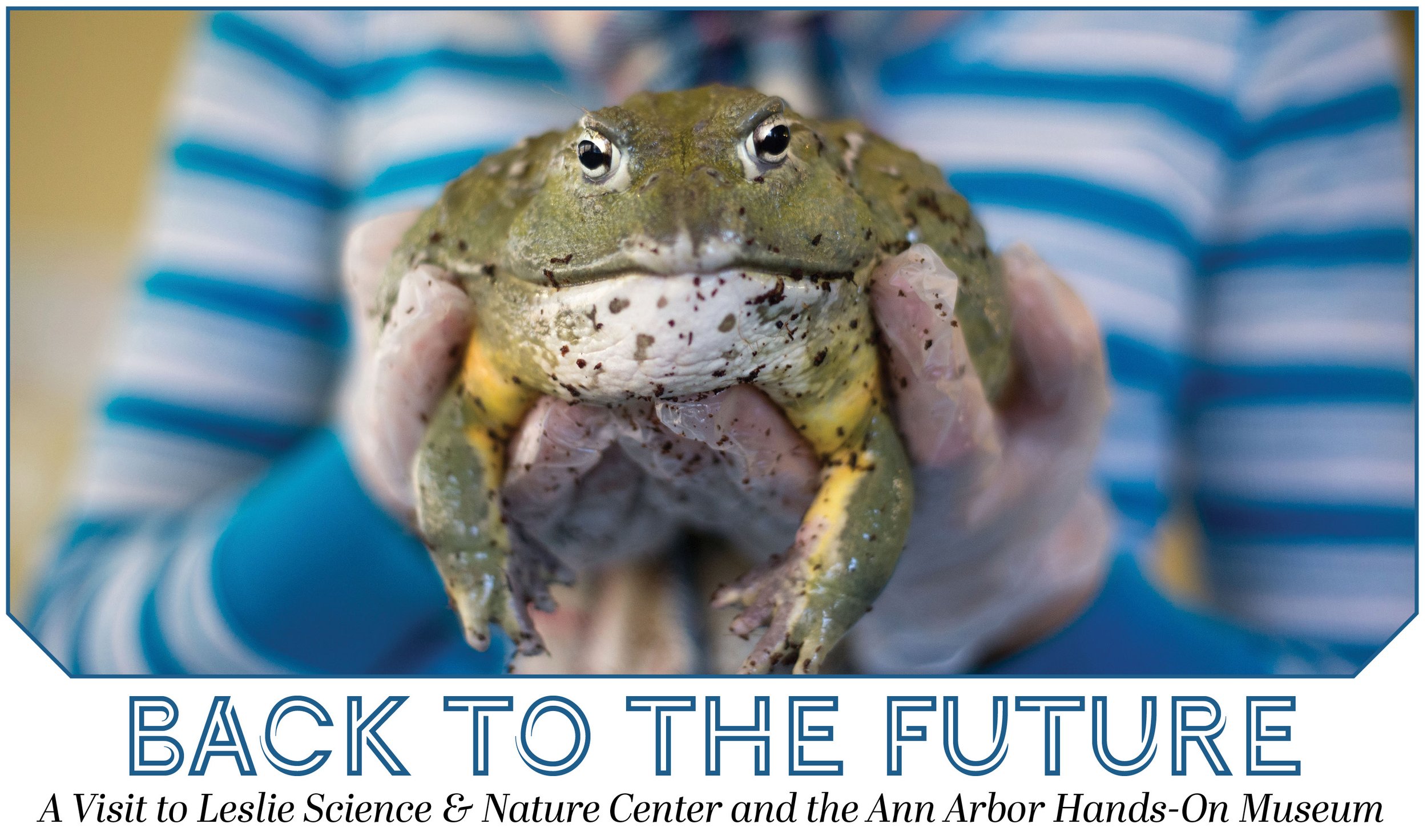
Back to the Future
Eugene Leslie met Emily Ebner at Columbia University where both were working on their PhDs. Leslie was a rock star at the very beginning of the petroleum industry. His doctoral dissertation in 1916 was titled, “The Decomposition of Hydrocarbons.” That was when most were still using horses for transportation. He traveled to Iran and Venezuela. Ebner’s degree was in Home Economics which was completely in sync for her future life. She was a trailblazer. Most women didn’t go to college then. She traveled solo in Europe and drove alone in her car to work with 4-H clubs in rural NY.
The couple married in 1917. In 1919, when Dr. Leslie could not return to his petroleum work because of adverse effects from the chemicals. He accepted a teaching position in Chemical Engineering at the University of Michigan and was instrumental in the development of that graduate department. In 1926 Eugene and Emily bought the property at 1831 Traver Road for $4600, which included five acres. Little by little, purchase by purchase, it slowly expanded to over 200 acres. Dr. Leslie built “Leslie Laboratories” just next to the house and continued to invent and experiment, often inviting his Chemical Engineering students to work with him there.
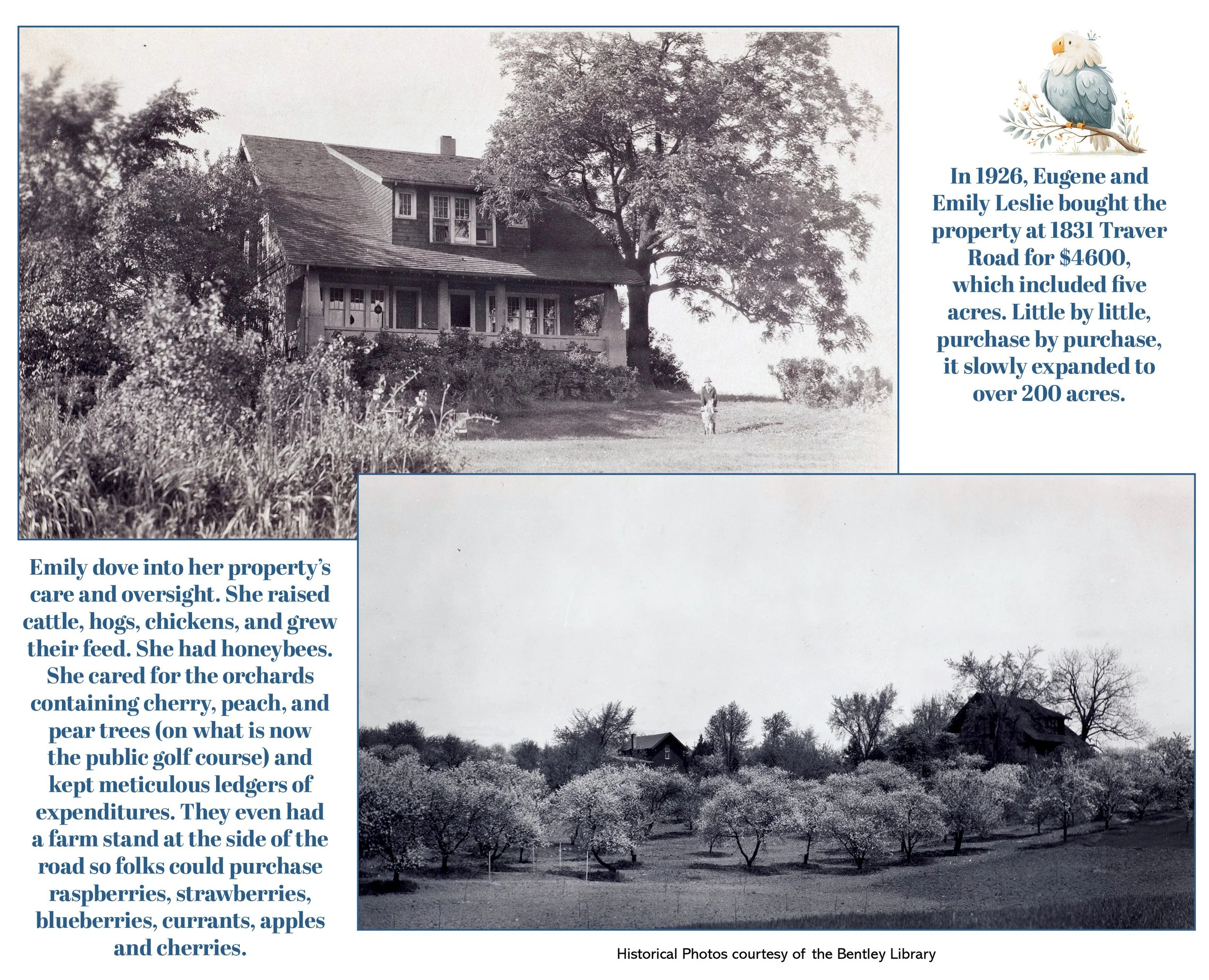
Emily, however, had another focus. She served as an active member of the Women’s Faculty Club at the University from 1919 until 1929. She was involved in the National Farm and Garden Association, as well as the Ann Arbor Garden Club, where she served as president for three years. She dove into her property’s care and oversight. She raised cattle, hogs, chickens, and grew their feed. She had honeybees, cared for the orchards containing cherry, peach, and pear trees (on what is now the public golf course), and kept meticulous ledgers of expenditures. They even had a farm stand at the side of the road so folks could purchase raspberries, strawberries, blueberries, currants, apples and cherries.
The charming home on the hill was no mansion, but very comfortable and suited their needs perfectly. As Dr. Leslie would tell you in a heartbeat, those rolling hills around them were formed when the glaciers moved in during the last ice age. They had no children of their own, but the property was surrounded by lovely middle-class homes with young families. The Leslies hosted community gatherings out under the trees. In my research for writing this article, I came across one child who recalled that Mrs. Leslie would hand out full-size Hershey bars on Halloween.

I spoke with Jan Benzinger, owner of Mudpuddles, located upstairs in the Market Building next to the Ann Arbor Farmers Market. Benzinger was one of the many neighborhood kids who explored the woods and built forts with what they found. They ran freely through the fruit orchards.
“We didn’t know it was anyone’s property,” Benzinger explained. “It was just the woods.” They never once heard a “Get off my lawn” or any such thing. She recalled Mr. Leslie in his later years as being a “sweet” man. He and Emily loved fruit from their orchard and several times Dr. Leslie asked Benzinger to climb up into a cherry tree and pick them a pint or two. In return he paid her a nickel and sometimes even more! “I think he was trying to teach me about how to handle money. I went and bought ice cream.”
The neighborhood kids thought the Leslies were rich, living high up on that hill and all…and the Hershey bars of course. In fact, Mr. Leslie was doing okay financially after all the industrial work he’d done, so for him the property was not used for subsistence but rather as a “refuge.” He wrote to a friend and called the homestead a “sideline” and his “safety valve from stress of my active industrial life.”
They lived out their retirement with a caretaker, Helen Bezzeg, living in the cottage a few feet away. From their peaceful porch they could look down the hill and watch the neighbor children playing around them. Even though he had pre-negotiated with the city regarding their stewardship and their duty to provide for the children, maybe in those moments they considered the undeniable benefits of kids playing freely in the outdoors. Was that the catalyst for their donation? Did those children teach the scientist something?
Emily passed in 1976, just months before Eugene. With only a short time left in this life, Dr. Leslie signed his Last Will and Testament. It read, “It is my wish that said land be used for a children’s park.” It also stipulated that the land was to be owned by the City of Ann Arbor with instructions that they would “maintain and improve my residence.” He set up a trust with a local bank to provide funding for the property upkeep which is still drawn upon. Even back then, he was aware that if he did not legally protect the land, developers would slowly bite off pieces until it disappeared.
Interesting to think about, with all the success he had in his career, that most people probably remember him for his kindness and generous gift. And hopefully we remember Emily who nurtured and cared for this land that we so deeply appreciate. And we acknowledge that previously, the land was taken care of by native peoples of the Three Fires Confederacy.
What Came Next?
Decisions had to be made about what to do with the property and how to keep close to the Leslies’ wishes. A Master Planning Advisory Committee formed and was tasked with creating a Master Plan for Land Use and Programming. It consisted of Ann Arbor City Council members, a Park Advisory Commission, City Parks and Recreation, and the Master Planning Advisory Committee of neighbors and community citizens. They covered every aspect of what was to happen, what needed to be decided, and they released their final report in 1983. In the meantime, the homestead started to show its age, and it took a couple more years to fix it up using interest from the trust fund. Programs were offered beginning in 1986.
In July 2007, Leslie Science Center separated from the city and became Leslie Science & Nature Center—an independent, 501(c)(3) nonprofit organization which allows you to receive a tax benefit for your contribution to LSNC. This transition provided the Center with the best governance structure for a sustainable future. The city continues to own and maintain the buildings and grounds.
Community input was essential to make this happen. Thank you to all those citizens who spent countless hours in meetings, offering input and commitment.Ann Arbor Hands-On Museum
When was the last time you visited the Ann Arbor Hands-On Museum? Maybe you have taken your children? It’s a wondrous experience for all ages. Your visit will start off easy, beginning with the five steps up to the first-floor main hallway. Surprise! The stairs play music as you step. You never know which curious display is going to catch your imagination—Water power? Electricity? How do all the things we use every day work? Plumbing? Car brakes? What’s inside an ambulance? There’s a pre-K area with a half fire truck to climb in and a play car mat complete with trucks. And you’ve got to see the ball escalator!
Further up on the second floor you’ll find large electric gizmos and an old-time store. On the third floor, it’s all about light and optics. There are classrooms downstairs on the lower level with tables and chairs just waiting for someone to come and learn something that may spark an interest for the rest of their lives. The whole place is very entertaining. It is set up to have fun as you discover scientific principles and explore the world around us.
What does The Hands-On Museum have to do with the Leslie Science & Nature Center?
First, we offer respect to Cynthia Yao, Founder and former Executive Director of the Ann Arbor Hands-On Museum who suggested, planned, and led fellow volunteers who worked to transform the city’s former fire station into the Ann Arbor Hands-On Museum which opened in 1982. As executive director, Yao added 50 percent more space to the museum in 1986, and in 2000 she re-opened the museum at four times its previous size and featuring 350 exhibits. She raised $12 million from foundations and corporations for the expansion. She’s received Governor’s Awards for spreading this opportunity for curiosities to grow through this hands-on approach in the U.S., Europe, and Asia.
The daughter of Chinese parents who immigrated to Jamaica, Yao found her way to Ann Arbor and earned a Master of Museum Practice from the University of Michigan in 1979. Yao is the first Asian American woman to found and direct a science center in the US. She was inducted into the Women’s Hall of Fame in 2005. That is quite a history, and we are so fortunate that she chose to bestow her gifts upon Ann Arbor.
In 2017, Susan Westhoff, then Executive Director at LSNC and Mel Drumm, CEO of the AAHOM shepherded a union of AAHOM and LSNC. The two organizations had been collaborating on some programs for years. By joining forces, she said, they could garner efficiencies and attract donors neither could attract on their own. They also shared staff and office work to help keep the budget manageable. It was a good melding and was done without compromising the attraction of either place.
Give that a thought for a moment. Why is this such a genius partnership? Well, as Westhoff’s predecessor used to say, “Nature came first.” Wisely, Westhoff pointed out that what science looks into is nature. It all starts there.
Do you have questions about why things are the way they are? They may be answered at the Hands-On Museum. We noticed on our visit, that many parents only watched as their kids messed with the exhibits. The day we visited, we observed only one family whose adults were exploring for themselves. Parents, go ahead and play! Explore! Your kids will learn to be curious by watching and you will have fun. Seniors and adults with a day off—you’re warmly invited to come and play as well.
You may want to consider a one-year family membership that includes grandparents and nannies and also gives discounts to LSNC classes, camps and rentals. Sign up for their one combined newsletter on the website that covers both places.
You can visit the Leslie Science & Nature Center at 1831 Traver Road in Ann Arbor. For more information call them at (734) 997-1553.
The Ann Arbor Hands-On Museum is located at 220 East Ann Street, downtown Ann Arbor between Division and Fifth. For more information give them a call at (734) 995-5439.
You can find open hours, admission fees, and other information for both the Leslie Science & Nature Center and the Ann Arbor Hands-On Museum online at discoverscienceandnature.org.
Susan Slack is an author, musician and a Dances of Universal Peace leader and mentor. Learn more about her at slacksusan.wixsite.com/susan-j-slack.