
By Lisa Viger-Gotte
For someone with a bachelor’s degree in biology, a master’s degree in ecology, and a career in endangered species biology, it was a startling discovery.
“I found it surprising that, despite working in endangered species biology and having a master’s degree in ecology, all here in Michigan, I had never heard of wild rice,” said Barb Barton, author of Manoomin: The Story of Wild Rice in Michigan. “That seemed odd to me. I wondered if maybe it was just very rare.”
That simple question launched Barton on a year’s-long journey through Michigan’s ecological and cultural history. What she discovered was that wild rice, known as Manoomin in Anishinaabemowin, was once abundant across Michigan’s lakes, rivers, and marshes. Today, many Michiganders have never seen it growing in the wild.
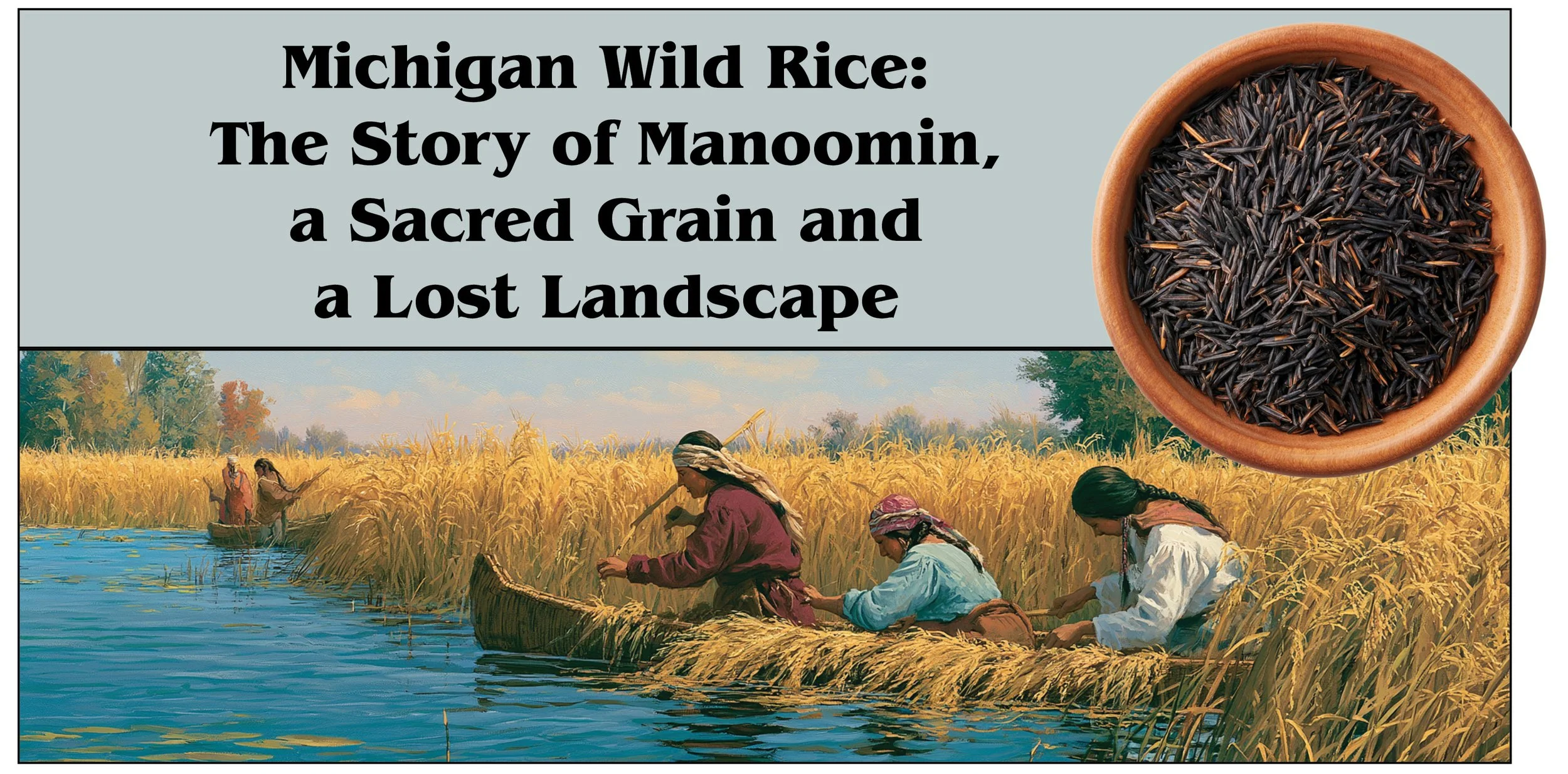
For the Anishinaabe people, Manoomin is far more than a grain. It is a sacred gift and an important part of cultural identity, history, and traditional lifeways. The name Manoomin is often translated as “the good berry” or “the good seed,” and it has sustained Indigenous communities throughout the Great Lakes region for generations.
What is Manoomin?
Despite its name, Manoomin is not actually rice. It’s an aquatic grass native to the Great Lakes region, particularly Michigan, Wisconsin, Minnesota, and parts of Ontario.
Manoomin grows in shallow lakes, rivers, and wetlands, producing long, slender grains that are harvested by hand from canoes using traditional methods that have been practiced for centuries.
The grain is rich in protein, fiber, antioxidants, and minerals, making it both nutritious and culturally significant. Yet, many Michigan residents know little about it. That lack of awareness was exactly what puzzled Barton.
“So, I started asking questions: Where are the wild rice beds in Michigan? Where were they historically?” she said. “Those questions sent me down a path of research that eventually became a deep dive into the history of wild rice in the state.”

The Life Cycle of Manoomin
Understanding wild rice begins with understanding its unique annual cycle.
During winter, the seeds lie dormant in the soft sediment at the bottom of lakes, rivers, and wetlands. Unlike many cultivated grains, wild rice requires a period of cold dormancy before it can germinate.
“In the wintertime, the seeds of Manoomin are down in the muck, in the bottom of the lake or riverbed,” Barton explained. “They’ll stay down there until springtime comes and the water warms up.”
As ice melts and temperatures rise, the seeds germinate and send up narrow floating leaves. “When you see Manoomin in that stage, to me, it looks a lot like long green hair flowing through the water,” Barton said.
This floating-leaf stage lasts through much of June. As summer progresses, the plant begins what Barton calls its “stand up” phase, sending stems above the water’s surface. By July and early August, the plants flower. In late August and early September, the seeds begin to ripen.
One of the most remarkable features of Manoomin is that the seeds do not all mature at once. “The seeds all ripen at a different time on the plants,” Barton said. “That’s why people can go back several times through the same rice bed during harvest and collect newly ripened seed.” This staggered ripening helps ensure that many seeds naturally fall back into the water, allowing future generations of rice to grow.
A Landscape Once Filled With Rice
Historical accounts suggest that wild rice was once widespread throughout Michigan. Early explorers, settlers, surveyors, and Indigenous communities documented extensive rice beds across the state. Large stands were found in the Upper Peninsula, throughout inland lakes and rivers, and along portions of the Great Lakes shoreline.
One of the most significant examples was the Monroe Marsh along western Lake Erie. Today, little remains of the vast wetland that once existed there. “The Monroe Marsh was internationally known for duck hunting,” Barton said. “People would come from all over in the fall because there was so much rice there.” Waterfowl depended on the grain as an important food source during migration, making the marsh one of the premier hunting destinations in North America. Historical records suggest the marsh may have covered between 4,000 and 5,000 acres, with much of that area supporting wild rice.
How Michigan Lost Its Wild Rice
The disappearance of wild rice in many parts of Michigan was not caused by a single event. Instead, it resulted from decades of habitat alteration, changing water levels, pollution, shoreline development, and river engineering projects. One of the biggest factors was the modification of waterways for shipping and navigation.
“The Army Corps of Engineers decided to start dredging the main rivers that flowed into the Great Lakes,” Barton explained. “They wanted to straighten them for shipping.” Over time, rivers were dredged, channels were deepened, and wetlands were drained or isolated from their natural water systems. As these changes accumulated, rice habitat declined. Water depth is especially important for Manoomin.
“Manoomin has to grow in water six inches to three feet deep,” Barton said. “It can grow a little deeper, but what happens is it has to put all the energy into the plant to grow up through the deep water and has nothing left to put out seed.”
High Great Lakes water levels can temporarily reduce rice habitat, while lower water levels often create more suitable growing conditions. When water levels are permanently altered through dredging, channelization, or wetland destruction, rice beds may disappear entirely. Over time, many of Michigan’s historic rice beds were lost.
A Sacred Relationship
For the Anishinaabe people, the loss of Manoomin represents more than the disappearance of a native plant. Wild rice is woven into migration stories, ceremonies, harvesting traditions, and community life.

Traditional harvesting remains a careful and sustainable process. Two people typically work together in a canoe. One person poles the canoe through the rice bed while the other gently bends stalks over the canoe and taps the ripe grains into the boat using wooden knocking sticks. Because only mature seeds are removed, many seeds fall naturally back into the water to regenerate the stand. This harvesting method has helped sustain Manoomin populations for generations. As Lac Vieux Desert Band member Roger LaBine said, “Rice is a sacred gift from the Creator.” That belief continues to guide restoration efforts today.
Restoring Manoomin in Michigan
Fortunately, efforts to protect and restore wild rice are growing. The Michigan Wild Rice Initiative, a partnership between the State of Michigan and the state’s twelve federally recognized tribes, brings together scientists, resource managers, and Indigenous knowledge holders to support conservation and restoration efforts.
In 2025, Michigan released We All Live Together in a Good Way with Manoomin: Stewardship Guide, a resource that presents wild rice through an Anishinaabe perspective while outlining goals for restoration and long-term stewardship.
Across the state, tribal nations, conservation organizations, and volunteers are collecting seed, restoring habitat, monitoring rice beds, and educating the public about Manoomin’s importance. These efforts recognize that restoring wild rice requires more than simply planting seed. It requires protecting water quality, preserving wetlands, respecting Indigenous knowledge, and maintaining the ecological conditions the plant needs to thrive.
Looking Forward
Barb Barton’s research began with a simple question: How could someone trained in Michigan ecology have never heard of wild rice? The answer revealed a larger story—one of abundance, loss, resilience, and restoration.
Today, awareness of Manoomin is growing. More people are learning about its ecological importance, nutritional value, and cultural significance. Restoration projects are expanding, and tribal communities continue their leadership in protecting this sacred grain.
Michigan may never look exactly as it did when vast rice beds stretched across its wetlands and marshes but understanding that history is an important step toward ensuring that future generations can once again experience the sight of Manoomin flowing across the water like “long green hair,” thriving where it has belonged for centuries.
Read Related Content:





























































































































































































For the Anishinaabe people, Manoomin is far more than a grain. It is a sacred gift and an important part of cultural identity, history, and traditional lifeways. The name Manoomin is often translated as “the good berry” or “the good seed,” and it has sustained Indigenous communities throughout the Great Lakes region for generations.