

By Christine MacIntyre
The moon has a way of catching a child’s eye. It lingers above treetops, follows the car home, disappears for a few nights, then returns—quiet, steady, familiar. For parents, it’s a reminder to pause, to notice, and to reconnect with something simple yet deeply grounding: the rhythm of nature itself.
Syndallas Baughman, executive director of the Nature Learning Community in Ann Arbor and a naturalist, has spent decades helping families do just that. “I’m an outdoor educator and science teacher,” she said. “One thing I think about a lot is how knowledge and noticing the world around us help ground people.”
Sharing the Moon’s Magic
Children live in a swirl of change—their bodies growing, teeth falling out, seasons shifting. “Kids have these experiences, all these things happen, and they don’t know why,” Baughman said. “They’re living on this planet where seasons are changing, day and night alternate. Any knowledge we can give them that helps them understand what’s happening makes rhythms more predictable and helps them feel more in control of their lives.”
When her children were young, Baughman found that watching the moon together became a fun family ritual. “I was a solo parent working long hours,” she said. “I was giving myself task on top of task, rather than just being together. But we could totally notice the moon every night.”
Baughman and her children would debate on whether it was truly full or talk about how to tell if it was waxing or waning. “It can be such a nice piece of knowledge,” she said. “Make time when the moon is full—especially in winter—to go for a walk, even a short one, in the evening when it’s getting dark.”
Baughman pointed out that the simplest experiences—a moonlit walk in a familiar spot or a few quiet minutes spent gazing out the window—can be deeply magical. “It doesn’t need to feel like a task,” she said. “Just a chance to notice.”

Moon as Rhythm Keeper & Friend
Walking and noticing create space for wonder. Parents can easily gift children small facts that spark awe: the same side of the moon always faces us, ancient storytellers said, because it’s keeping secrets. Or try a simple ritual—once a month, share a wish, worry, and wonder for the moon to hold until it’s full again.
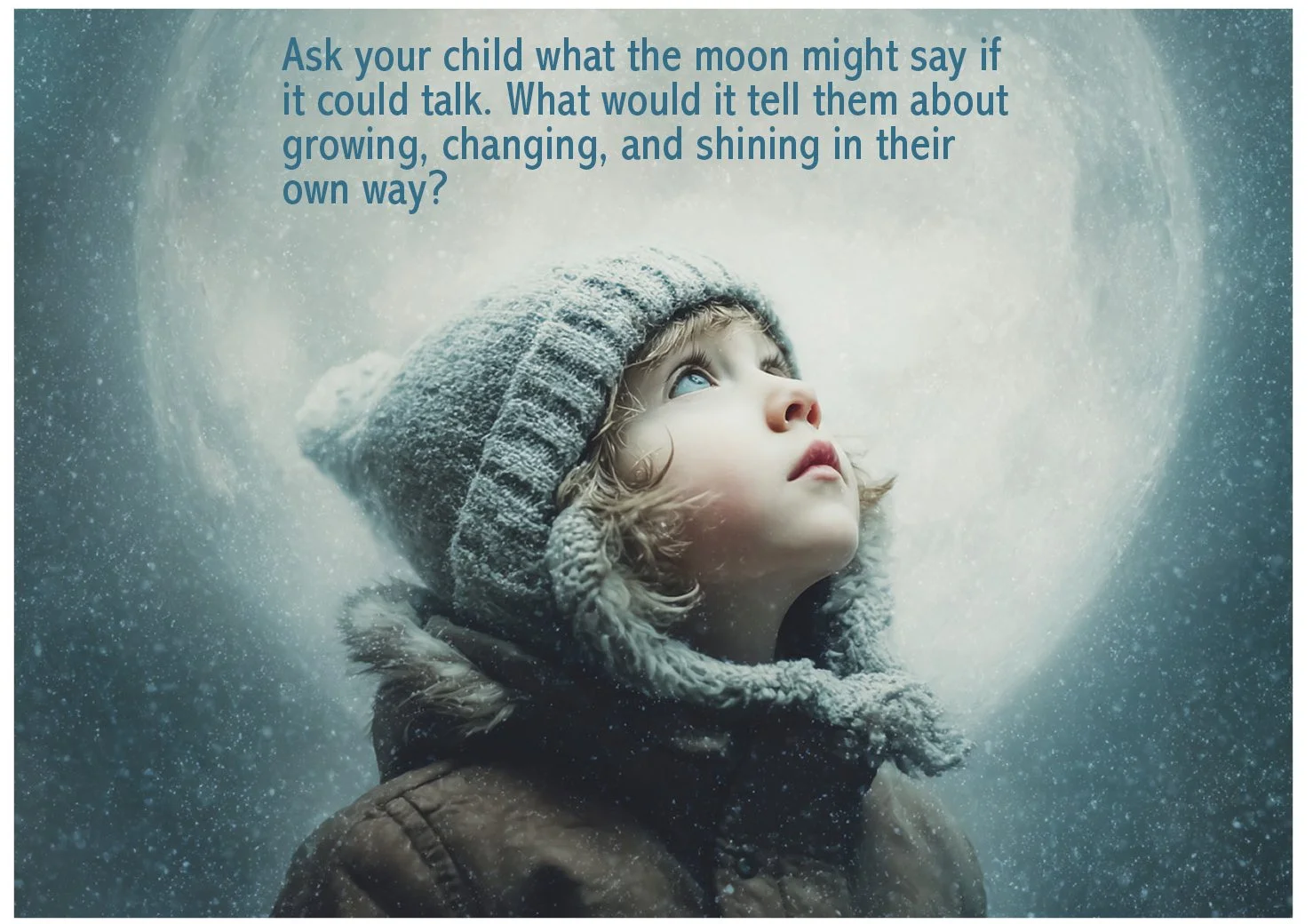
Ask your child what the moon might say if it could talk. What would it tell them about growing, changing, and shining in their own way? These reflections bridge imagination, mindfulness, and emotional awareness showing that, like the moon, we all move through phases of light and shadow.
Building moon awareness doesn’t require a telescope or a clear night, just curiosity. “Another great thing that ties the moon to culture,” Baughman said, “is knowing how it connects to holidays. Easter can be early or late because it follows the lunar calendar. It made sense—because the moon is so apparent, such a nice way to follow time in 28-day cycles.”
Learning the difference between solar and lunar calendars—or noticing how constellations shift overhead—deepens a child’s sense of place in the universe. “It’s all about helping them use the moon and stars to understand what’s coming and what’s behind us,” Baughman said. “It’s nice to hand kids some knowledge for themselves—and for them to think of the moon and stars as friends.”
Make the Moon Part of Your Family Rhythm
Mark the next full moon on your family calendar as if it were a holiday. Let the anticipation build—a small ritual that reminds everyone that nature has its own calendar too.
You don’t need an agenda: the act of being present is the ritual itself. Maybe bring a thermos of cocoa, a blanket, or a notebook to sketch what you see. Let your children notice how the moonlight touches the familiar—rooftops, trees, snowdrifts—and how it feels both new and old at once.
Over time, these small moments start to mark the months more meaningfully than the grid on a wall. You begin to live by the rhythm of light and dark, fullness and rest—the rhythm of the moon itself.
On a full moon night, plan an evening walk. Baughman suggests a specific time—“maybe a 6:30 p.m. hike when the moon is full,” she said—so it feels like an occasion, not an obligation. Dress warmly, bring a flashlight you might never use, and notice how much light the moon provides on its own. You can also play a game of ‘Moon Bingo’ where you mark off different lunar phases as you observe them during your walks.
Connect sky and story. Try a free app like Star Walk or Sky Guide. “You can point your phone at the sky, and it shows you planets, constellations, the moon…,” Baughman said. “Even in the day, you can see the moon—if it hasn’t risen yet, it shows it below the horizon [in the app].” Let kids discover Venus, track Jupiter, or find constellations as they move through the seasons. “[These apps] are so much fun and easy to use.”
Create a Simple Moon Water Ritual
On the next full moon, invite your child to help you make moon water—a simple way to capture the quiet energy of the night. Fill a small jar or bowl with clean water and set it outside (or on a windowsill where the moonlight can reach it).
As you do, talk about what you’re thankful for, or something you hope to “grow” this month. Leave the water overnight, letting it soak up the stillness and light.
In the morning, bring it inside. Let your child choose how to use it—watering a houseplant, dipping a paintbrush, or adding a few drops to a nature altar. The idea is about mindfulness: a reminder that the world around us is alive, and that intention can make even a cup of water feel sacred.
Create a Moon Journal
Invite your child to “check in” with the moon each night, just as they might check in with a friend. Ask them to look up and quietly wonder, what kind of mood does the moon seem to be in tonight?
They can draw it—maybe the moon looks sleepy, playful, shy, or bold. Encourage them to color the sky, add stars, or sketch how the world looks under that light. Over time, they’ll have a series of “moon moods,” a visual diary of awareness and imagination.
If they want, they can add a sentence or two: “The moon looks tired, like it’s taking a break” or “The moon looks happy tonight—it made the snow sparkle.”
Prompt older children to dig deeper, noticing what the moon looks like and how it feels—hazy, bright, sharp, hidden, far. Then, in a notebook or phone note, they can write a few sentences beginning with, “Tonight the moon feels…” and “Tonight I feel….”
Encourage them to see if there’s a connection between the two. Maybe a bright, bold moon mirrors confidence before a big event. Maybe a waning crescent feels like winding down after a long week.
Over time, this becomes a kind of emotional weather journal—a place to track not just moods, but awareness. It’s a quiet self-awareness practice disguised as observation. Teens learn to name feelings, recognize patterns, and find steadiness in nature’s rhythm without it feeling like “homework” or therapy.

Each small act, whether it’s drawing, walking, or simply noticing, turns the moon from something distant into something deeply familiar, a teacher of both science and wonder.
Moon-Watching in Ann Arbor
In Michigan, winter nights arrive early, winter deepens early, and the nights hold a stillness that the moon seems born to illuminate. The moon becomes our quiet companion—glinting off frozen ponds, tracing silver across snowdrifts, turning the bare trees to lace. This is the season when the moon feels closest, when even its tiniest sliver brightens the deep blue hush of evening.
January’s full moon is known as the Wolf Moon, a name that reaches back to ancient midwinter traditions. In long-ago northern climates, wolves were often heard howling through the cold—voices echoing across frozen landscapes when food was scarce and nights were long.
Today, the Wolf Moon reminds us of instinct, connection, and endurance. It’s a time to listen closely to the natural world, to our families, and to ourselves. Under its silver light, even quiet places feel alive. The Wolf Moon calls us back to community and to the wild, reminding us that, like wolves, we are meant to belong.
One of the most magical ways to connect with the moon is to make it place-based, tied to where you live.
Cherry Hill Nature Preserve Loop
Cherry Hill Nature Preserve in Superior Township offers a peaceful place for a moonlit stroll with kids. The half-mile-square preserve winds through gentle hills, meadows, and woods perfect for an easy walk under the glow of the Wolf Moon. Listen for owls, spot a few night birds, and enjoy the calm of nature after dark.
For more information, call (734) 647-7600 or visit mbgna.umich.edu/nichols-arboretum. Cherry Hill Preserve Nature Loop is located at 6375 Cherry Hill Rd, Superior Charter Twp.
Gallup Park
At Gallup Park, the moon rises over the Huron River like a lantern. Its reflection rippling beside drifting ducks and bending willows. Families pause on bridges or grassy banks to watch the water shimmer with twin moons—one above, one below. The park’s gentle trails and open sky make it a perfect place for an evening walk, where calm feels close and wonder is easy to find.
Gallup Park is located at 3000 Fuller Rd, Ann Arbor. Call them at (734) 794-6240, or visit a2gov.org/parks-and-recreation/parks-and-places/gallup-park/ for more information.
Leslie Science & Nature Center / Black Pond Woods
Just beyond city lights, 50 acres of woods, prairies, and meadows stretch quietly. Trails cradle moonlit shadows, and open clearings invite stargazing. The boundary with Black Pond Woods deepens the sense of wilderness within reach.
Development Coordinator Nathan Phillips said there are a couple of great spots for catching the moon’s glow. “We have a one-mile trail through the Black Pond Woods,” he said, adding that while it’s a pleasant trail in the spring, summer, and fall, it can be more difficult in the wintertime when there’s snow on the ground. He added that the open prairie near the front of the property is another option. “There is a clearing without much tree cover there,” Phillips said. Just be sure to dress warmly and wear snow-friendly shoes or even bring snowshoes if the ground is covered.
Check their calendar for upcoming New Moon Hikes which will restart in April.
For more information, call (734) 997-1553 or visit their website at discoverscienceandnature.org. They are located at 1831 Traver Rd, Ann Arbor.
Judy and Stanley Frankel Detroit Observatory
On a hill of old campus grounds, the observatory opens its dome to the night. As the sky darkens, telescopes peer into lunar craters, star clusters, and planets. Families gather—whispers of “look there” passing between adults and children—to watch the cosmos together. The Judy and Stanley Frankel Detroit Observatory is one of the few remaining historic observatories with original instruments. They are a public museum where visitors can observe the moon using a telescope from 1857.
“We love when families visit…” said director Gregory Parker. “The moon is a real crowd pleaser, and it’s a great entry point to get kids interested in astronomy. They might see the moon regularly at home but viewing it through a telescope truly brings it to life, enhancing all of its nooks and crannies.”
Call the Observatory at (734) 764-3440 or visit their website, detroitobservatory.umich.edu, for more information. Their address is 1398 E Ann St, Ann Arbor.
Nature Learning Community
In the quiet woods of southeast Michigan, the Nature Learning Community gathers people back to the Earth and to wonder. Beneath open sky and whispering branches, families learn to slow down, listen, and look up.
Their moonlit walks and forest classes invite you to see the world as children do: alive, breathing, and full of small miracles. It’s the kind of place where you don’t just watch the night sky—you belong to it.
For more information, visit naturelearningcommunity.org or email naturelearningcommunity@gmail.com. They often lead classes at Nature and Nurture Farm in Dexter, as well as outdoor “classrooms” such as Bird Hills Natural Area, County Farm Park, Lilly Park, Matthaei Botanical Gardens and Nichols Arboretum, and Honey Creek Community School.
Read Related Articles:

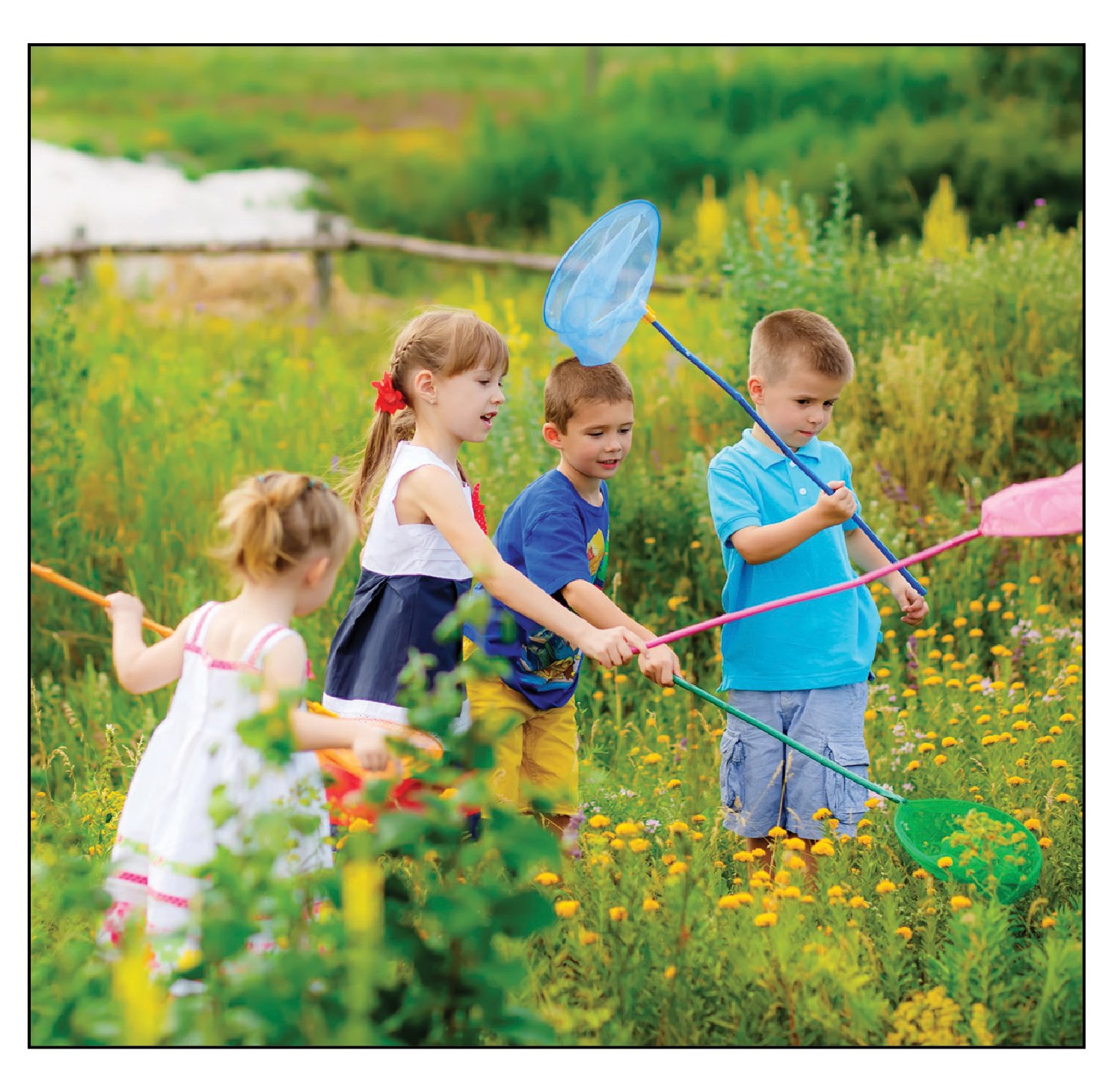















































































































































Before the calendar changes, before the jackets disappear, before adults agree that winter is finally over, kids start pointing things out. The light looks different. The sidewalk feels warmer. The air smells like wet dirt, not cold metal. Something has shifted, even if no one can quite name it yet. In Ann Arbor and surrounding areas, spring reveals itself in small, almost secret ways—and those clues teach kids something important about the world and about themselves.