Posts filed under Columns

Book Reviews: New Reads From Long-time Favorites

pages58header.jpg
intimate-conversations-large.png

By Catherine Carlson

Both Caroline Myss and Julia Cameron are well-known authors in the self-help, healing, and spirituality genres. They both burst onto the scene around the same time, nearly 30 years ago. Since that time each of them has produced an entire shelf of books unto themselves and each became classroom teachers of their work. Coincidentally, both grew up in the Chicago suburbs. Devotees of their work can’t help but wonder what else might Caroline or Julia might have to offer, so I decided to read and review their newest books.  

Author, and spiritual teacher, Caroline Myss was an original and powerful voice in the self-help genre back in the 1990’s, beginning with books such as Anatomy of the Spirit: The Seven Stages of Power and Healing. Her gift of medical intuition was a new concept. Her newest release is called Intimate Conversations with the Divine: Prayer Guidance and Grace. The pre-press preface was written at the onset of the shift of 2020 and addresses the global Covid-19 pandemic. She’s quick to point out that, “We have been living in a psychic pandemic of fear for many years,” and this prayer book seeks to address that fear.  

Myss is the product of a Catholic upbringing which gave her a foundation for connecting to the divine in a unique way, bridging spirituality with healing. This is the theme in all her books. Myss also teaches her work. Several years ago, at the end of her classes, Myss would share her prayers with her students. Much to her dismay, they began to request copies.  Out of the many requests for copies grew the birth of this book. Sharing her own personal spiritual practice with the world was not something she ever thought she would do, but realized it was something she had to do.  

According to Myss, people have been praying in one form or another for centuries, but it is a language that has become absent in our daily lives. Prayer books are not new, but Myss’ own prayers may be. At first glance, I expected to see pages full of simple stanzas surrounded by white space. Instead, they are actually short chapters, 100 in total, each devoted to a relatable theme. I randomly opened to a page to see what came up (something she suggests doing). It was Prayer 39 called Healing Night Flights, a prayer for repairing one’s “depleted soul. . . weary body and . . . burdened heart,” while asleep. As we follow her conversation, she talks about the work we have to do ourselves and writes, “There is no such thing as a small act of darkness just as there is no such thing as a small act of love.” There you have it. This is not a light and airy prayer book. 

The prayers read more like essays, or soliloquies on different topics, much like reading a sermon, only very intimate, deep, and relatable. Each two-to-four-page chapter is divided into Prayer, Guidance, and Grace, and ends with an italicized message as in chapter 39 above, “Lord grant me the grace to awaken—truly awaken—and the courage to embrace that mystical experience.” This is the part that is what you might expect a traditional prayer book to look and sound like. Other chapters have titles such as: Confronting my Frightened Inner Self, Sharing Blessings, and The Gift of Aging. What is labeled Prayer is essentially her conversation to the Divine about a certain subject. In the Prayer section of the chapter There but for the Grace of God Go I, she discusses her encounter with a homeless man who joins her on a park bench. He asks her for an iced tea, she agrees and offers to get him a sandwich as well. She becomes uncomfortable when he asks her to eat with him, not wanting to be alone. She obliges him and shares her—not often seen—vulnerability in this experience. She has another meeting with another woman she feels has the signature of a saint and muses as to how the Divine is choosing them these days.  

The sections on Guidance involve Myss going deeper into the subject matter of the related Prayer. Here she asks questions and may share a relevant story. In the chapter called Only You Could Change the World so Fast, she says the current virus is the agent of bringing the world to a stop but not the mystical agent—the agent behind the scenes, so to speak. She says “We haven’t really grasped that ‘creating our own reality’ is a mystical truth, not a behavioral one.” The Guidance here is to understand the truth that we have the power to create through every choice we make.

In the Grace portion of a chapter on faith she says faith and trust go hand in hand and they are the foundations of self-esteem. In typical fashion, she does not mince words. “If you cannot Trust yourself, you can never—ever—Trust another person.” The thing you have to appreciate about Myss is that she’s going to take you deeper than you might be comfortable with so you’ll do your own inner work. She’s a strict teacher and regularly raps the spiritual ruler on the reader’s knuckles. 

Myss makes a tight case for prayer in our lives and her book provides us with the medicine. She points out that we are in a historical crisis of sorts. Where the “majority do not know what they believe in.”  Humanity is vulnerable. Not knowing where we stand, we might believe the loudest, strongest voice around even if it’s negative, even in the context of religion.

Prayer or words, can help or heal and she defines the true meaning of prayer as “a request for help in how to see.” To find the words and the hope to guide you in this life. In this most personal work of hers yet, Myss gives us an opportunity to join her in asking for help through prayer. 

listening-path-cover.jpg

Book Review: 

The Listening Path

 by Julia Cameron

Switching gears, readers and students of Julia Cameron’s 1992 original creativity course, The Artist’s Way, will undoubtedly have their ears perk up upon hearing about her new book, a six-week Artists Way Program titled The Listening Path: The Creative Art of Attention. Creativity is the foundation of Cameron’s teachings and her new book builds on this with the concept of listening. She seeks to answer the question—how does listening feature into our lives as creatives?  

At this point in her career Cameron is a seasoned teacher. Her long-time students and readers are seasoned as well. The Listening Path refines the creative process even more. The introduction explains the three main tools of The Artist’s Way:  Morning Pages, The Artist’s Date, and The Daily Walk. One need not have read any of her prior books to understand these. 

Morning Pages are the work portion, an opportunity for you to be heard, by you! These are three completely imperfect handwritten pages of whatever is in your head written each morning upon waking. My experience is when morning pages are done consistently, they make everything a little easier. The Artist Date brings in the fun factor. Often resisted, giving yourself this special time to focus on your inner artist, you can’t help but listen. A period of strong writing followed one student’s artist date to a pet store where she got to pet the baby rabbits.  Lastly the Daily Walk “brings us into the present moment.” We can’t help but look and listen to our environment as we move through it. These three pieces are the foundation of her Artists Way programs. 

Read related article: Book Review: Being at Your BEST When Your Kids Are at Their Worst

By Kim John Payne, M.ED.

The first three weeks of The Listening Path are all about listening to what is in your immediate vicinity: the sounds in your environment, other people, and your higher self. Cameron writes at length about part of her day with respect to the entirety of sounds around her: The loud noise of a hail storm and the effects it has on her dog. She says by tuning out sounds we do ourselves a disservice. For example, tuning in to the alarm clock noise you despise may inspire you to take the action of getting one you like better. Liking your alarm clock sound will have the added effect of making you happier, and you will be more likely to tune in further. Listening to pleasant sounds makes us more pleasant. “Happiness is a primary characteristic of the Listening Path,” says Cameron.

When it comes to listening to others Cameron points out there can be the tendency to interrupt, have your response ready ahead of time, or listen without saying anything. She interviews fellow artist friends and shares with us how listening factors into their own creative processes. This is a non-intimidating workbook with simple “Try this…” invitations for our ears peppered throughout. She took what she heard from her actor and writer friend and turned it into one of those suggestions. Try this: Plan to meet a friend for a chat with the intention of listening carefully to learn. Afterward, consider what you learned and discovered. It’s a great opportunity to practice being curious. 

Working with the previous Artists Way tools can make us feel more ready to listen to our higher self. Cameron shares how writing to her “inner elder,” calmed her anxiety about buying a home for the first time in many years. She addressed the naysayers: the inner critic and others who claim this is just our imagination. There are a series of questions she asks herself when faced with any troubling situation, such as: “What do I need to accept?” Tuning into our intuition provides comforting guidance.  

The following weeks invite us to consider something we may have never in our lives actively listened to—voices beyond our immediate environment such as listening to those beyond the veil like deceased loved ones or historical figures, and lastly, listening to silence. Here Cameron shares that she communicates regularly with close friends that have passed on. I was surprised how simple and easy she made it sound. “Can I hear from Jane?” she asks and immediately, Jane responds. Having her friends’ supportive messages are encouraging. 

Similarly, Cameron listens to voices of public figures that are no longer living. She says the intention is key here. Who do we admire? Cameron admires and writes to Bill Wilson, the co-founder of Alcoholics Anonymous. He offers appreciation and reassurance of her work. Cameron has previously shared that the late famous duo—Rogers and Hammerstein, helped her write musicals. Writing music was something new that her Morning Pages suggested she try. She has now completed three musicals and two collections of children’s songs. Cameron points out that to communicate with our heroes builds connections that strengthen ourselves. Why not make an attempt to listen to someone you find wise, who has all the time in the world to speak to you?

The final chapter on listening to silence may be challenging to many. “We quake in its unexpected emptiness.” So many of us live with constant background noise, be it TV, radio, or even going shopping with earbuds in. Cameron encourages her silence avoiding friend to try sitting in silence for five minutes. He calls her after the experiment and reports that although it was different, he remembered something important and had some new ideas for his week. Cameron insists the silence isn’t silent at all, it is filled with a benevolent presence. For those that seek silence it can also be difficult to find it, especially in the city. She suggests finding the quietest environment you can. It could be a church or a library (when open), and tuning into the silence to discover what you hear within it. After time spent in silence, our senses are undeniably sharper and more alert. As I was enjoying a bit of silence at a park recently, I picked up a safe but unpleasant burning smell from a distance which I might not have noticed otherwise. 

Once I began this book, I immediately found myself paying closer attention to my environment and others. I noticed listening takes patience and time, but that’s also what it gives you. On the cover of the book is a single Conch shell, a perfect illustration of a seemingly silent object found in nature—an ideal image to capture the essence of The Listening Path.  

As it turns out Caroline and Julia do have more to tell us, more to teach us. These two books, unique on their own, actually fit together nicely as a pair. Each book highlights an aspect of conversation, one is about communicating, the other listening. The invitation to participate in either requires very little on our part and by all accounts seems more than worth it.

Related Content:

Posted on May 1, 2021 and filed under Book Review, Columns, entertainment, Issue #77.

Namaste, Katie...Our Yoga Column, Spring 2021

Namaste-katie-header.jpg

Whether you're a seasoned yogi or getting ready to roll out your mat for the first time, here you'll find a variety of useful tips from local yoga instructor, Katie Hoener.

Dear Katie,

My family and I have had a challenging time, which we agree is a shared experience, and are wondering if there is a posture we can share that can bring us together, and bring our stress levels down. 

Marcus, Ann Arbor

Dear Marcus,

I agree this year has been unbelievably challenging, with multidimensional trauma, and challenges coming from all directions. It can be challenging to feel reset, and at times to be set at all. Through yoga there are a number of ways that we can come into our bodies and do our best to work toward a sense of balance, even if only for a moment. One key path is to slow down, focus, and reset, through an inversion. These spaces, where the base of the spine is elevated above the base of the skull, signals to the parasympathetic nervous system to kick into gear. This part of us is the ‘tend and befriend’ part of the nervous system that cares and comforts. A delightful way to come together in an asana place is through a Salamba Sarvangasana, a supported shoulder stand. 

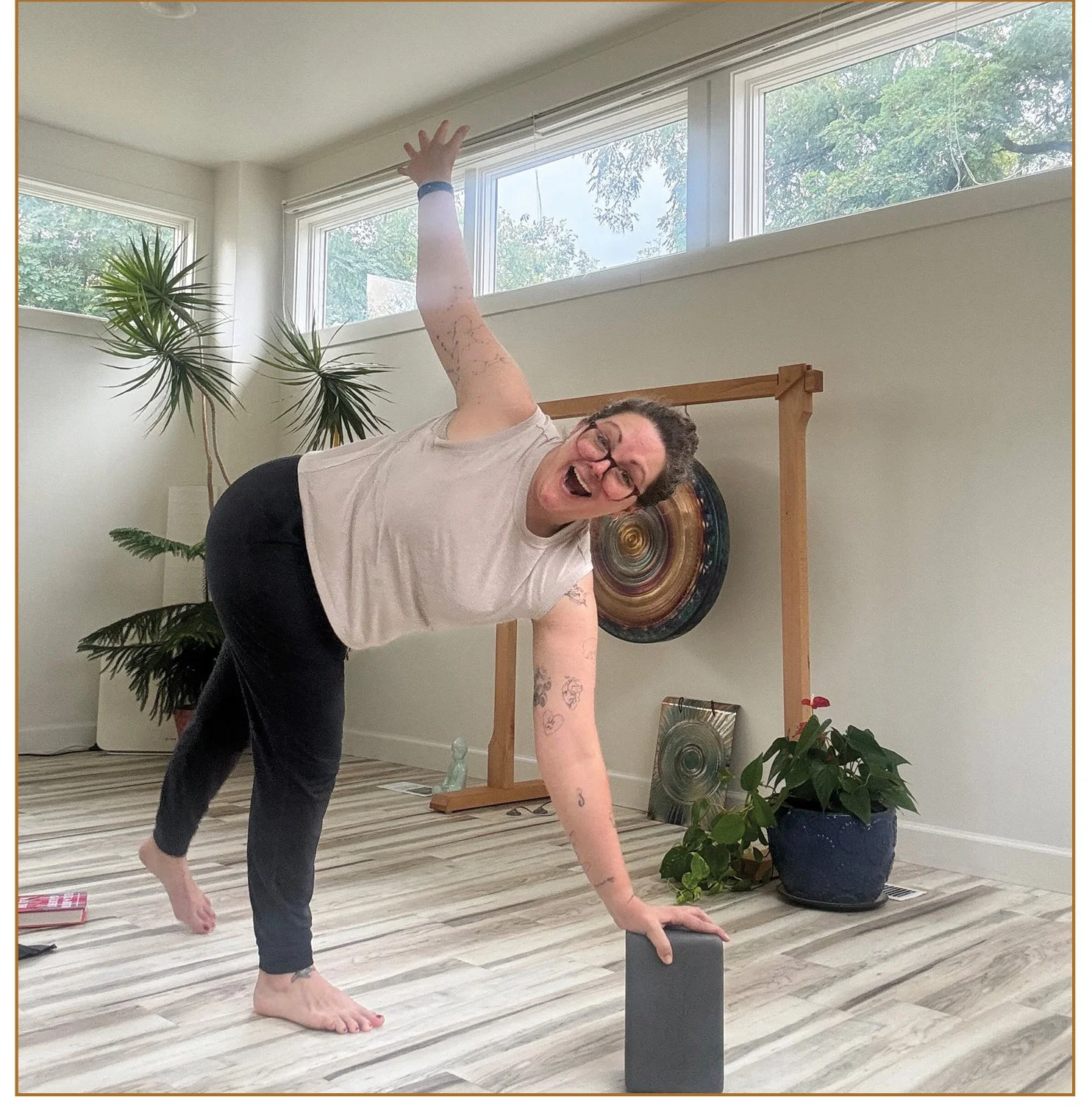
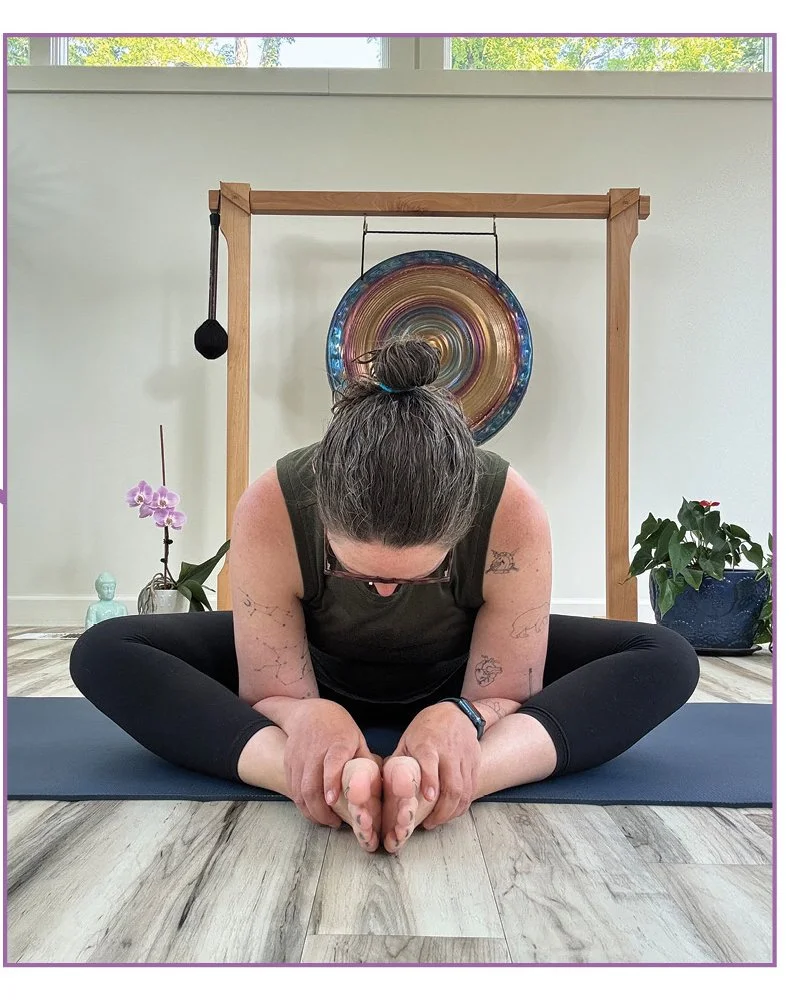
Here, I offer two versions. One is using your own body, and strength to support yourself, and the other is settling into supports. Whether we are using props, or using our own body is often dependent on the day. To come into Salamba Sarvangasana we want to be comfortable on our mats, with arms planted into the mat close to the body. On an inhale, core muscles engaged, we lift the legs toward the sky, planting the hands on the low back, and cradling the pelvis. The amount of lift through the pelvis is very much up to you. There are many variations of supported shoulder stand, and you will see many that show legs and body in one line, and others with more of an angle. The most important thing is that your core muscles are engaged, and feel lifted through the legs. 

IMG-0921.JPG
IMG-0906.JPG

The other option, often called Candlestick, places a blanket or pillow under the pelvis, and allows the legs to reach up toward the sky. If you need a bend in the knees, take that adaptation. This variation is quite restorative, and is something that I practice for a few minutes before bed on most days. Though children may love a supported shoulder stand, you may find that family time holding Candlestick can be held for a little longer, and can offer you a space to offer balance to one another. 

Namaste Katie,

You talk with many readers about the challenges of meditation, and I have been struggling. I am looking for something that I can use while at work when I cannot play a guided meditation, or use one of my other go-to tools. Do you have any suggestions during this hectic time?

Liz, Ann Arbor

Dear Liz,

This has been a time when meditation has been recommended a lot and has been more challenging than ever. I have found myself going back to the basics in many cases, as practices that are complicated or involved have, for me, felt overwhelming. In The Science of Breath by Yogi Ramacharaka there is a wonderful practice of pranayama that is itself meditative and fits the situation you are describing. It is called Yogic Rhythmic Breath, and involves connecting with your own heartbeat, and connecting your breath to the pace of your heart. 

Find your pulse, perhaps on your wrist, or on your neck. Take a minute to find a place where this is easy, so that when you start the practice you are not searching or struggling. When you are ready you will begin counting the inhale to match six beats of your heart, allow the exhale to match six beats of your heart. Take ten breaths to feel comfortable with this practice, and if this is where you want to start, stay here. This is a beautiful way to connect deeply with yourself. If you would like to continue the practice, the space between the breath is half that of the length of the inhale and the exhale, so at this point, the count of three pulses. If the location and time allow, the length of the breath can be increased, as well as the space between. Check in that as you expand the breath you remain comfortable. 

Yogi Ramacharaka recommends that we start with twenty rounds of this breath practice, adding more rounds if time and space allow. This connection with our own rhythms draws us into a place of concentration and can become a meditative place. Connections to the breath are the foundation of a mindful practice. 

Dear Katie,

Recently as part of a workshop on positive psychology we were all assigned to start a gratitude journal. I was discussing this with my partner, and they suggested that I also look into other heart chakra practices. Are there ways to expand on this gratitude work?

Dan, Saline

Namaste Dan,

I am a big fan of gratitude journals and keep one myself. As you mentioned they are a part of a growing amount of research in a number of fields, including positive psychology. The Anahata Chakra, or the Heart Chakra, is the midpoint in the traditional chakra system, with three below and three above. Gratitude work is important to cultivating an open heart and forming connections with others. 

To build on your work of gratitude journaling, transfer this intention and energy to a meditation practice, or into an asana practice, if you find that more accessible. Breathing in feelings of gratitude and opening ourselves up to recalling moments when we feel grateful builds our own abilities to come to these feelings and sensations over and over again. As discussed in positive psychology and in yoga, there are so many negative influences and attachments impacting us and attempting to steer us away from a compassionate and loving mindset. Gratitude is a powerful way to stay open and connected to others, and to our own ability to forge deep bonds. Whether through meditating on a particular moment of gratitude, or using a gratitude mindset as a sankalpa, see if there are ways to infuse this mindset into other practices to make your heart center shine!

Katie Hoener is an RYT 500, receiving her 200 and 500 hour trainings. She is also a Licensed Master Social Worker and a partner at Verapose Yoga in Dexter (veraposeyoga.com). Please send your own yoga questions to katie@verposeyoga.com.

Related Content:

Posted on May 1, 2021 and filed under Columns, Exercise, Health, Issue #77, Yoga.

Conscious Parenting: Dealing with Disappointment Mindfully
Parenting is challenging. Being a parent during a pandemic is even more difficult. How can we help our children cope with the disappointments that come their way while dealing with our own? Over the last year, Covid shutdowns have canceled many activities that our children enjoy—birthday parties, school, soccer games—even visits with grandma and grandpa. Some older children have missed milestone moments like getting a driving license, going to prom, or attending a graduation ceremony. Losing these precious times, as well as contact with friends, teachers, and other special people, has been hard on us as adults, but even more devastating to our children. How can we help our children respond to these many cancellations?

Leaps of Faith: This That, and the ODDer Things
Claire Broderick waited with the world, trying to grasp the fallout of the Covid-19 pandemic. Even though she wanted so badly for 2020 to be the year she would manifest her dream of opening a retail shop filled with her collection of what she calls “uniquities,” there was reason to pause. In the meantime, she kept dreaming, researching, and collecting. Adding a taxidermy octopus here, reaching out to a bone jeweler there. She knew how important it was to persist and keep planning.

Mutual Aid in Washtenaw County--Can the Pandemic Have a Silver Lining?

It’s likely that most Americans will remember the year 2020 as one of the worst in their lifetimes. But if we take a step back, we might find that the year also brought many inspiring reminders of the capacity of the human spirit to overcome adversity and lend comfort to strangers.

Out of My Comfort Zone, Spring 2021, Susan Westhoff and David Hall

Crazy Wisdom Journal asked a number of leaders in southeastern Michigan’s conscious living community to reflect upon times in their lives that they’ve left their comfort zones to venture out in new ways. In the distant past or much more recently, we asked, what did you do, what inspired you, did it change you, inside or outside, big or little? Did you attend a new class, take an adventurous trip, go skydiving, stretch beyond a long entrenched boundary, start a new relationship or end an old one, take a leap, retire, join the Peace Corps, go on a night trek in the wilderness, or just do something way out of your ordinary?

Posted on May 1, 2021 and filed under Columns, Issue #77, Local.

Tea Time With Peggy-- Tea--More than a drink!

Spring and summer happen to be my two favorite seasons. I enjoy spending time playing in the dirt. My herb and flower gardens are my happy places and I have been known to spend hours out in my garden rearranging plants to a better location and even mowing the lawn. Unfortunately, too much time in the sun results in a nice sunburn. I know of nothing more miserable in the summer than being burnt to a crisp. While sipping a nice, iced glass of sun tea doesn’t help you cool down the sting, the wet tea bags will.

Posted on May 1, 2021 and filed under Columns, Food & Nutrition, Herbal Medicine, Issue #77.

How Your Grandmother Paved the Way for Green Living

My grandmothers were many things. Wise, kind, the best at giving hugs, and the best at baking cookies, as I’m sure your own grandmothers were. When I look around at things as they are today, I often wonder what my maternal grandmother, who lived her life as a farm wife, would have thought of the fast pace of our current world. I don’t have to wonder what she could have taught me about the ongoing efforts I make to live more sustainably, though. I learned those tips from watching both of my grandmothers throughout my life

All Creatures Great and Small: Pippen— Our Own Little Mafia Boss

By Jenn Carson

My husband and I have been together for almost 30 years. In that time, we’ve raised four boys and six dogs. Well… six and a half if you count the puppy we raised for my mom for the first five months.

pip-jenn.jpg

Most of our dogs have been of the “big” variety—labs and lab mixes. Our first dog we had together, Meghan, was adopted from the Huron Valley Humane Society. I was told she was a shepherd/lab mix, but we always wondered because she wasn’t built like either of the two breeds. She had long, slender legs, petite feet, a glossy coat, and a fan tail that curled up. It wasn’t until recently, when my husband’s aunt and uncle brought an English Shepherd puppy home that we had an aha moment—Meghan had been an English Shepherd.

Neither one of us ever considered getting a little dog—they were yappy, biting little creatures (or so we thought). Big dogs were safer—they kept strangers away from our kids, foxes away from the chickens, and our feet warm in bed. So, what made us change our mind?

Read related article: Sit. Stay. Go Home.

As life moved on, our priorities shifted. Everyone in our family is now an adult. Constant supervision is no longer something our children need, which leaves my husband and I free to explore the country—to see all the things we didn’t get to because we started a family when we were young instead of sowing wanderlust. We bought a small motorhome in order to do this, but a 90-pound lab and a small motorhome don’t really go together all that well. We knew we’d never leave a dog behind for three or four months, and we knew we wouldn’t want to be without the companionship of a dog. So, the search began—for a small dog with a big dog attitude.

Boy, was this a lesson in framing your wants to the universe correctly!

We got a small dog with a very big attitude.

Pippen was a sweet-looking, less than three pounds, little bundle of brown and white fur. A cocker spaniel, poodle mix. We’d never paid more for a pup than we did for her, plunking down 800 hard earned dollars. The first weekend we had her she wiggled under the claw-foot tub in our Victorian house—and came out with a blue pill in her mouth. A struggle ensued—she didn’t like to give found treasures up. A few months previous my husband had dropped his blood pressure medicine—he thought he’d picked them all up—obviously he didn’t get them all. I scrambled to the phone and called the emergency vet, since it was a Sunday morning. The receptionist was very calm until I told her that Pippen only weighed three pounds.

pip2.jpg

Needless to say, a whole day at the vet on IV’s, and $600 later, we came home with a little ball of fur with two shaved front legs and a lesson learned—small dogs can get into places you’ve never even thought of. Looking at this positively, the floor under the tub has never been so clean.

Even though Pippen is the smallest dog in the house (only 11 pounds)—we still have a 90-pound male lab, and an old girl who weighs about 65 pounds—she is the dominant dog—most of the time. Our old girl will still put her in her place occasionally, but our male dog lets her boss him around something fierce. It’s comical most of the time, but sometimes momma has to step in, like when the other dogs want to wake me up in the morning. As soon as they approach the side of the bed Pippen starts to guard me. While I appreciate the fact that she wants to let me sleep, the fact that she’s standing on my head growling at the other dogs doesn’t really help all that much.

Pippen can also be very demanding.

I trained her to ring a bell when she has to go potty. I was so proud of how smart she was! She learned this little trick in about four days, and even trained the other dogs to know that when the bell rings, everyone can go outside. But now I wonder if I trained her or if she trained me? She now rings the bell when she wants to go out to potty, but she also rings it if she wants to distract the big dogs, if she wants to sit on the porch steps in the sun, or wants to go for a walk. If I don’t get up right away she walks into the room I’m in and cocks her head as if to say, “What are you doing hooman? I rang the bells! Are you deaf?” The look on her face is priceless and always makes me laugh (and groan at the same time because I’ve been interrupted for about the tenth time that afternoon).


Pippen can also be very insecure.

When I put my shoes on, she starts to lose her mind. She steals and runs away with the shoe I haven’t gotten on yet and she attacks my fingers when I’m trying to tie my laces. I’ve started kenneling her up when I have to leave without her before I put my shoes on or putting her harness on first if I am going to take her with me—that way she knows she’s going. Thankfully, she has also developed a bond with the boys who still live at home, so if I do have to leave her, I feel better about it—but she definitely prefers to be with mom.

Okay—so having a puppy has always been like having an infant—I knew that going into this, but I didn’t think I was getting a new mafia boss in the house. I’m hoping that she’ll calm down a little as she gets older—and for right now, I’ll just remember that it feels good to be so loved, even if she does try to boss me around. 

Related articles:

Posted on January 1, 2021 and filed under Animals, Columns, Issue#76, Pets.

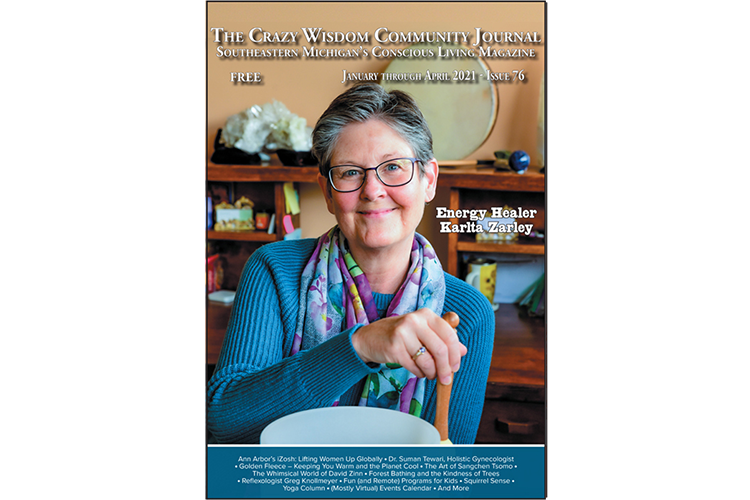
Healers of Ann Arbor: Greg Knollmeyer Reflexologist and T’ai Chi Instructor

You can try a new type of massage or read a chiropractor’s online reviews, but how do you really know when a healing modality is right for you? Columnist Laura K. Cowan goes in depth with local healers to give you a behind-the-scenes look at what they really do to help people relax and heal.

Out of My Comfort Zone

Crazy Wisdom Journal asked a number of leaders in southeastern Michigan’s conscious living community to reflect upon times in their lives that they’ve left their comfort zones to venture out in new ways. In the distant past or much more recently, we asked, what did you do, what inspired you, did it change you, inside or outside, big or little? Did you attend a new class, take an adventurous trip, go skydiving, stretch beyond a long entrenched boundary, start a new relationship or end an old one, take a leap, retire, join the Peace Corps, go on a night trek in the wilderness, or just do something way out of your ordinary?

Posted on January 1, 2021 and filed under Columns, Issue#76, Personal Growth.

A Charming Faerie Baby

Oh, the last days of fall! Soon the flowers will be snuggling into their winter beds, the birds will fly south, and little faeries will begin to hibernate. In the spirit of these little environmental sprites, I’ve designed a cute little faerie baby reusing a plastic deli container (I’m sure you have some of those laying around since we’ve all been supporting our local restaurants delivery service through the pandemic). You can use the plastic bauble you make as a magnet, make a pin or a charm, or tie it to a lovely winter gift.

On Forest Bathing and the Kindness of Trees

For as long as I can remember, I have been a tree-loving, tree-hugging kind of gal. At 4’11” tall I had a small body and strong arms that made it easy for me to climb trees. For years, I could follow my two children up any tree as high as they could go. But somewhere along the way I gained some weight and fear of heights, and my tree-climbing days were over. Nevertheless, I have never gotten over my deep reverence for trees. It should be obvious to anyone that they are higher life forms.

Conscious Parenting: Focus on Connection

Parents are under a high degree of stress right now. Racism and its effects, a pandemic, an election year, environmental disasters—all are our backdrop as we surf waves of work and kids’ schooling. Now more than ever, it’s essential to bring ourselves—and our parenting—back to the basics.

Posted on January 1, 2021 and filed under Children, Columns, creativity, Issue#76, Parenting.

Tea Time With Peggy-- Kombucha Tea

Good Bacteria! Many of us are aware that there is such a thing as good bacteria, however it tends to be killed daily along with the bad bacteria. In a Covid-19 world most products talk about how they kill viruses and bacteria. The overuse of germ, virus, and bacterial fighting products kind of makes me cringe with fear.

What Should We Ask Of Our Ten-Year-Olds?

It’s no secret that it’s a challenging full-time job to raise our children to be capable, contributing adults, especially during a pandemic. Yet, we don’t want to miss that critical middle ground to develop our children’s life skills—the window between the delight of infants starting to walk and the anxiety of teens starting to drive. Since we all have much more time at home with our kids right now, it’s a good time to practice these practical skills. When my own kids started to launch into their adult lives, it was suddenly and starkly apparent that the base of any competency had started years ago.

Random Acts of Kindness-- Saved By the Squirrels

From the moment I woke up, I knew it was going to be a bad day. Not because it was a Monday, though that didn’t help. And the cold rain pelting against my windows didn’t help, either. No, I knew that it was guaranteed to be a Very Bad Day because I had slept through my alarm clock and woke up two hours late. I’m in business for myself so normally my boss would have cut me some slack, but on this particular Monday, I was on deadline to write an article and hand it in by 5 p.m.—just seven hours away. I didn’t have a first draft and hadn’t even decided on a topic yet. Sometimes, with the help of adrenaline, I can wing it, but I was sure that I wouldn’t be able to this time.

Posted on September 1, 2020 and filed under Animals, Around town, Columns, Issue #75, kindness.