By Christine MacIntyre
Spring doesn’t arrive all at once. It doesn’t knock. It doesn’t announce itself. It shows up quietly—like it’s not sure it’s allowed to stay yet.
Spring is the in-between season. And kids are usually the first ones to notice.
Before the calendar changes, before the jackets disappear, before adults agree that winter is finally over, kids start pointing things out. The light looks different. The sidewalk feels warmer. The air smells like wet dirt, not cold metal. Something has shifted, even if no one can quite name it yet.
In Ann Arbor and surrounding areas, spring reveals itself in small, almost secret ways—and those clues teach kids something important about the world and about themselves.
What spring teaches us through sound
The city changes its voice first.
Birds return before leaves do. Water moves again. Windows crack open. Laughter carries farther. A bike bell rings down Main Street. Someone practices music near campus, and the notes drift through the air like they’ve been waiting all winter to be heard.
When kids listen closely, they learn this: sound means we’re not alone.
Hearing spring unfold reminds us that others are waking up too—animals, neighbors, the whole city stretching after a long sleep.

Eleva Potter, who leads children’s programming through Ann Arbor Parks & Recreation, says spring programming focuses on “lots of changes as nature wakes up from the winter.” As the snow melts, she noted, “worms and bugs start to emerge. There is more bird song to hear as birds find mates and make their nests. Frogs and toads start to call.”
Even the quietest sounds—wind moving through budding branches, sneakers on damp pavement—become proof of shared life.
As the days warm, new sounds layer in. Skateboard wheels begin to hum and clack at local skate parks. The echo of boards against ramps replaces winter’s hush. The rhythm is different—faster, hopeful, a little daring…the sound of someone trying again after a fall.
One peaceful place to practice listening is Mill Creek Park in Dexter where wooden boardwalks stretch gently over the Huron River. The steady rush of water, the creak of boards underfoot, the layered bird calls overhead—it’s a natural soundtrack to early spring. A short stroll can feel like a reset button for the mind.
Listening this way teaches kids something powerful: when we pause and tune in, we feel more connected—to nature, to our community, and to ourselves.
Try this: A Neighborhood Sound Walk
Choose one block, one park path, or one stretch of boardwalk. Walk it slowly. For one full minute at a time, no talking. Afterward, ask: What did you hear that surprised you? Was it close or far away? Did it make you feel calm, curious, excited?

Create a community sound map by drawing your street or park and labeling the sounds you hear. Revisit it in a few weeks and notice how it changes.
Spring teaches that listening isn’t just about hearing. It’s about belonging.
Mill Creek Park is located at 8140 Main St. in Dexter. For more information, call (734) 426-0887 or visit dextermi.gov/government/departments_and_services/parks_and_trails.php
What spring teaches us through sight
Spring doesn’t explode into color. It arrives gently. It gathers itself.
Tiny green buds appear before the leaves commit. Moss brightens along tree trunks like a soft highlighter. Sidewalk chalk returns in swirls and hopscotch grids. Storefront windows trade winter’s dimness for light.
Eleva Potter from Ann Arbor Parks & Recreation says an exciting part of spring programming is watching the landscape transform. “Buds and flowers appear on trees and start to leaf out,” she said. “Spring flowers begin to add pops of color—yellow Trout Lilys, pink Spring Beauties, purple Wild Geraniums, and white Trilliums.”
Further afield, wildflower hikes at Draper-Houston Meadows Preserve invite families to walk slowly through meadows and woods where those blooms emerge from beneath last year’s leaves. Kids learn that beauty often begins quietly and close to the ground.
At Nichols Arboretum, the ground begins to glow before the canopy fills in. In Kerrytown, outdoor tables reappear like small celebrations.
The Ann Arbor Farmers Market opens for the season, and suddenly color arrives in crates—greens, reds, yellows. Kids can see what’s growing now and what isn’t quite ready yet. Spring teaches patience through what is in season and what is still becoming.
Around the city, volunteers gather at Kuebler Langford Nature Area and Furstenberg Nature Area to remove invasive shrubs and protect local biodiversity. Kids who witness this learn something important: caring for the earth is active work. Spring isn’t just something that happens to us—it’s something we participate in.
Nichols Arboretum is located at 1610 Washington Heights in Ann Arbor. To learn more, call (734) 647-7600 or visit mbgna.umich.edu/nichols-arboretum.
Draper-Houston Meadows Preserve is located at 578 Mooreville Road in Milan. To learn more, call (734) 971-6337 or visit washtenaw.org/366/draper-houston-meadows-preserve.
The Ann Arbor Farmers Market takes place at 315 Detroit Street in Ann Arbor. For more information, call (734) 794-6255 or visit a2gov.org/parks-and-recreation/parks-and-places/ann-arbor-farmers-market.
The Kuebler Langford Nature Area is located at 101 West Huron River Drive in Ann Arbor, and the Furstenberg Nature Area is located at 2626 Fuller Roa. in Ann Arbor.

Downtown invites kids to notice—and imagine
Through the Ann Arbor Downtown Development Authority Elevate program, local chalk artist David Zinn has created Unseen Adventures of Ann Arbor—a citywide scavenger hunt featuring ten installations of Nadine the mouse tucked into unexpected corners throughout downtown. (See the Crazy Wisdom Community Journal article on David Zinn from Issue #76 at crazywisdomjournal.com/thecrazywisdomjournalonline/2020/12/17/the-whimsical-world-of-david-zinn.)
Families can search for each scene, collect a button at every location they find, and even write their own stories about what Nadine might be doing in each tiny world. It’s not just a scavenger hunt: It’s a practice in noticing.
Kids learn that big discoveries often hide in small spaces. That imagination lives in cracks in the sidewalk. That art isn’t always framed inside a building—it can be under your feet, waiting for you to slow down and notice.
Ann Arbor DDA Program Specialist Sandra Andrade said the public art installation is designed to spark joy for all ages. “We have some more projects coming up that we’re excited about, too, including ‘Elevating History: A Mural Series from the Living Oral History,’” she said, noting that additional Elevate installations are anticipated in fall 2026 and spring 2027.
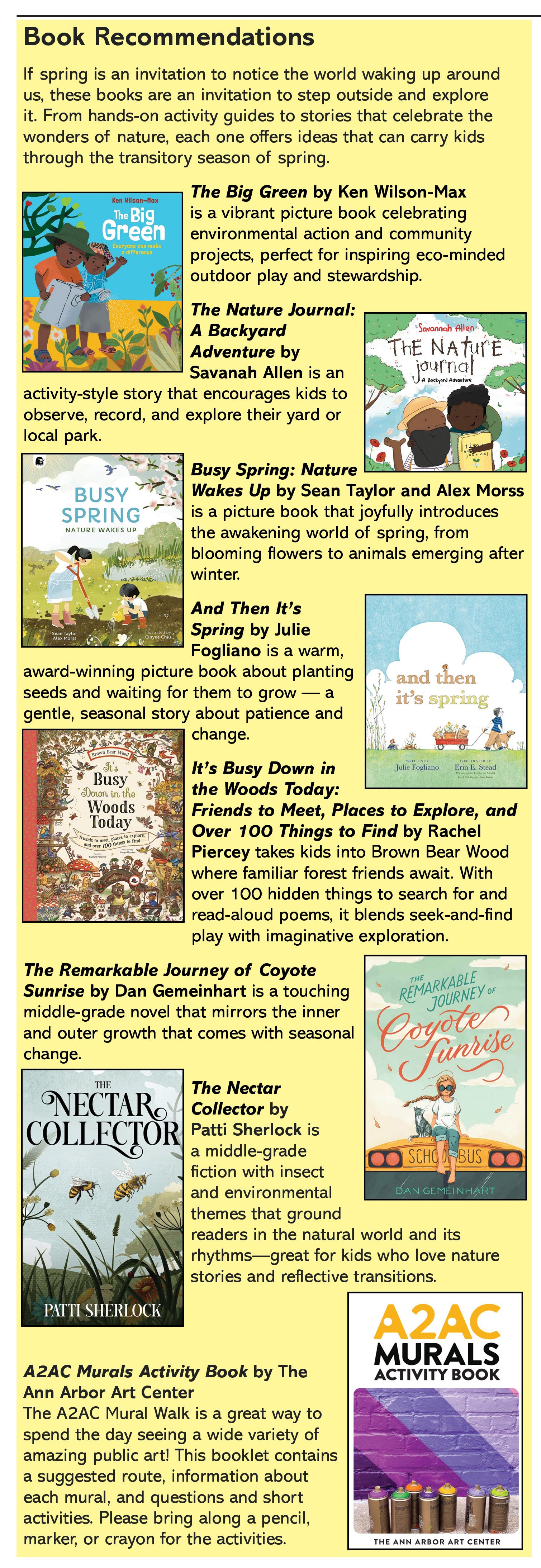
The Ann Arbor Art Center also offers a free mural activity book online that includes a map of local murals, coloring pages, and descriptions of Ann Arbor’s public art.
If you head out on a mural walk, invite kids to become art detectives. How big does the mural feel when you stand beneath it? What colors jump out first? What emotions does it bring up? Murals aren’t just pictures—they’re stories told at full volume.
And sometimes, noticing leads somewhere even smaller.
In Ann Arbor, fairy doors have long invited kids (and grown-ups) to kneel, look closely, and imagine who might live just beyond the brick. Tucked into storefronts and hidden along walls, these tiny portals reward careful eyes.
Fairiologist and Ann Arbor native, Johnathan Wright said there does seem to be a seasonal rhythm to their appearances.
“There does seem to be some correlation,” he said. “Much like humans, I believe that the fairies, largely (on a small scale), are more active in nicer weather. But not quite as much parallel with lizards (for example, iguanas falling out of trees in Florida) which leads me to hypothesize that the urban-fairies are not cold-blooded.”
It’s a playful answer—but also an invitation.
Small art. Small doors. Small details. Big imagination.
Spring teaches that wonder lives close to the ground. That curiosity belongs alongside science. That even in a city of brick and sidewalks, there is always room for something small and mysterious to appear.
Kids don’t just see a tiny door. They see a story beginning.
Unseen Adventures spans 10 locations throughout downtown Ann Arbor. Visit a2dda.org/unseen-adventures/ to find a map or call the Ann Arbor DDA at (734) 994-6697 for more information.
The Ann Arbor Art Center is located at 117 West Liberty Street in Ann Arbor. Call (734) 994-8004 or visit annarborartcenter.org for more information.
Spring isn’t only something we observe. It’s something we join.
In nearby Saline, family bird walks invite kids to slow down and listen for returning songbirds. Teen make-and-take programs offer chances to build planters and craft bird feeders. As the weather warms, the Saline District Library expands nature-focused offerings that help kids explore birding, planting, and seasonal change in playful, meaningful ways.
And as spring settles in, the river begins to call people back, too.
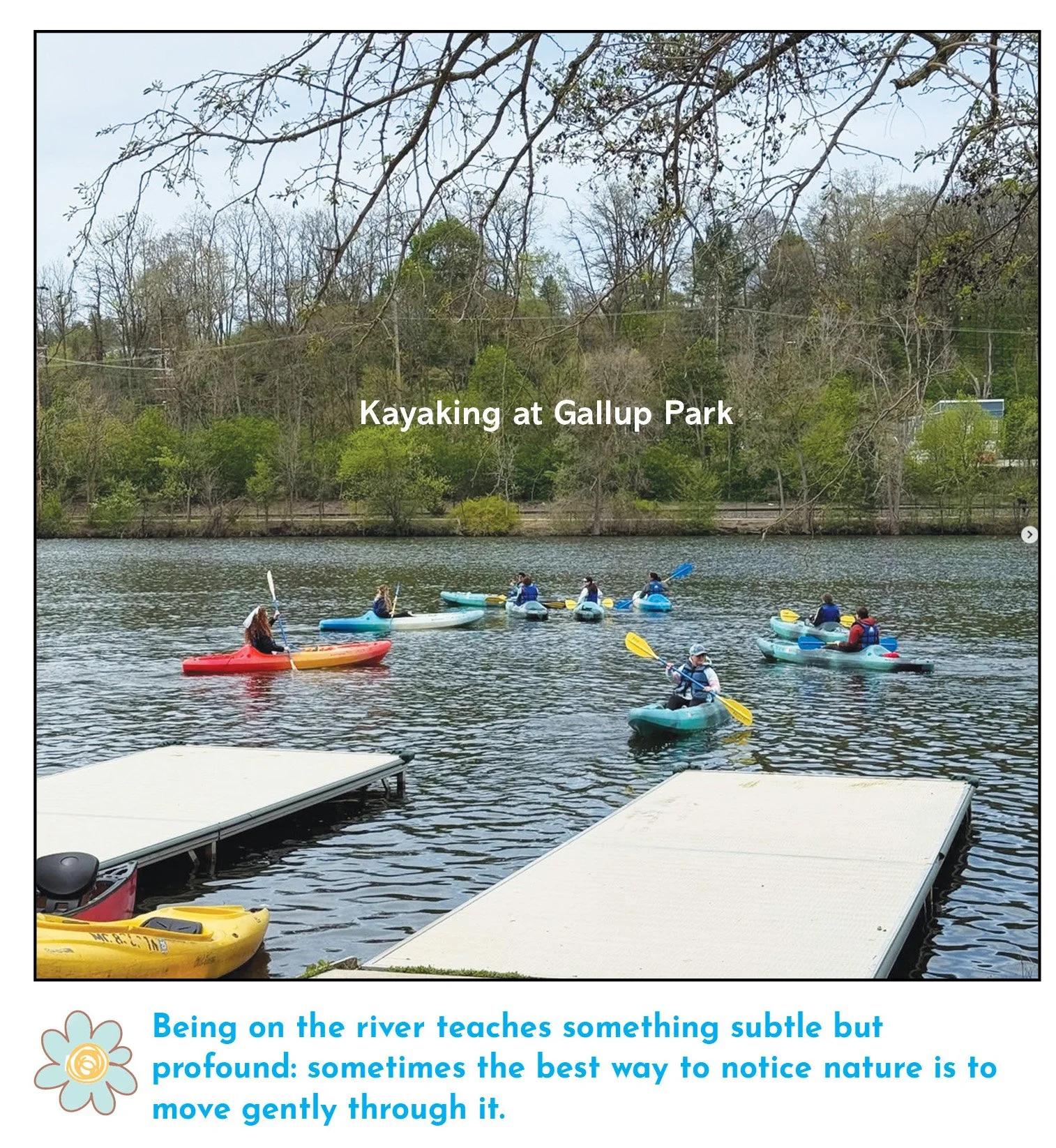
Each April, Argo Park Livery and Gallup Park Livery reopen for the season. While it may still be too cold for swimming, paddling a canoe or kayak becomes its own kind of spring ritual. Birding by water offers a different perspective—quiet, steady, eye-level with the riverbank. Kids might spot herons standing tall in the shallows, turtles sunning on logs, or red-winged blackbirds flashing their bright shoulder patches.
Being on the river teaches something subtle but profound: sometimes the best way to notice nature is to move gently through it.
When kids plant berry seeds and imagine the jam they might make one day, they’re learning patience in real time. When they paddle quietly beneath budding trees, they’re learning attentiveness. When they name the birds they hear, they’re learning belonging.
Spring teaches that we belong to the season—not just beside it.
Visit the Saline District Library at 555 North Maple Road in Saline. Call (734) 429-5450 or visit salinelibrary.org for more information.
Argo Park Canoe Livery is located at 1055 Longshore Drive in Ann Arbor. Call them at (734) 794-6230. Gallop Park Livery is located at 3000 Fuller Road in Ann Arbor. Call them at (734) 794-6240. View Gallup and Argo Livery rental fees, schedule, and reservations at a2gov.org/parks-and-recreation/activities/canoe-kayak-and-tube.
What spring teaches us through smell — and taste
Before the trees are fully green, before the days feel reliably warm, the air shifts.
It smells like wet earth and thawing soil. Like rain on pavement. Like grass waking up. Sometimes it smells fresh and clean. Sometimes it smells muddy and alive.
Spring doesn’t smell perfect. It smells real. And that’s part of what it teaches kids.
Smell reminds children that growth is earthy and a little messy. That new beginnings don’t arrive polished. Mud means something is happening underground. Rain means roots are stretching. The scent of damp bark and river water tells us the world is working, even when we can’t see the progress yet.
But spring isn’t just something we smell. It’s something we taste.
The season shows up in what’s on the tables at farmers markets, restaurant specials, and food truck offerings. Early greens. Fresh herbs. Crisp radishes. Asparagus. Foods that weren’t there in January. Kids can see what’s in season and what isn’t quite ready yet. They learn that strawberries don’t rush. Tomatoes need more sun. That nature keeps its own schedule.
And as downtown warms, food trucks begin to pop up again. The breeze carries the scent of sizzling onions, warm pretzels, sweet waffles, and tacos on the grill. The smells drift through streets near Main and Liberty. They signal something more than hunger: people are out again. We’re gathering. We’re lingering.
Spring teaches kids to notice how the weather shapes what we crave. In winter, hot soups and cocoa feel right because they warm us from the inside out. When the sun returns, something shifts. Cold lemonade tastes brighter. Ice cream feels celebratory. A crisp salad feels like relief against warm air.
Taste becomes another way to understand the season.
Why do we want warm, hearty foods when it’s cold? Why does a frozen treat feel perfect after an afternoon at the park? Kids begin to see that their bodies are responding to the world around them.
Smell and taste teach that seasons are shared experiences. When you catch the scent of fresh-cut grass, street food, or early blossoms, you’re breathing in the same air as everyone around you. When you bite into something grown nearby, you’re tasting the same sunlight and rain that shaped it.
It also teaches memory. One deep breath of spring air—or one bite of something that only appears this time of year—can bring back memories of last year’s bike rides, park visits, festivals, or walks along the river.
Spring doesn’t just look different.
It smells different.
It tastes different.
It feels like a beginning you can breathe in—and sometimes, even savor.
Wonder as a way of experiencing spring
Spring in Ann Arbor isn’t just about weather. It’s about participation.
It’s volunteers clearing invasive plants. It’s skateboarders testing ramps again. It’s farmers unloading early harvest. It’s artists chalking stories onto sidewalks. It’s kids learning birding basics at Gallup Park or planting berry seeds at a warming hut, imagining the sweetness to come.
That’s the quiet lesson spring keeps offering: Pay attention. Look again. Listen longer. Breathe it in.
Kids understand this instinctively. They feel the in-between. They notice the almost-there buds. They hear the almost-loud birds. They smell the almost-warm air drifting through open windows.
Spring doesn’t shout its arrival. It whispers it.
And when children learn to recognize spring through sound, sight, smell—and participation—they’re learning something bigger than the season. They’re learning how to stay curious. How to feel connected. How to trust that change—even when it’s small and quiet—is already on its way.