By Rachel Pastiva
I don’t have health insurance, but I bet I receive better health care than many people who do. Friends and family often understandably express concern about my lack of insurance, but I marvel at how often they then proceed to share with me the troubling experiences they have with the healthcare system: waiting months to get an appointment with their primary care doctor, not being allowed to share all their health concerns during a doctor’s appointment, and the most troubling of all, life threatening circumstances that result from overlooked diagnoses. Though well-meaning, these loved ones don’t seem to understand the relationship health insurance has to the health care—or lack there of—they are receiving.
Insurance-based Healthcare
What we consider the traditional healthcare model in the United States is really insurance-based. This means that insurance companies (not hospitals, healthcare clinics, or your doctor) dictate the quality of care you receive.

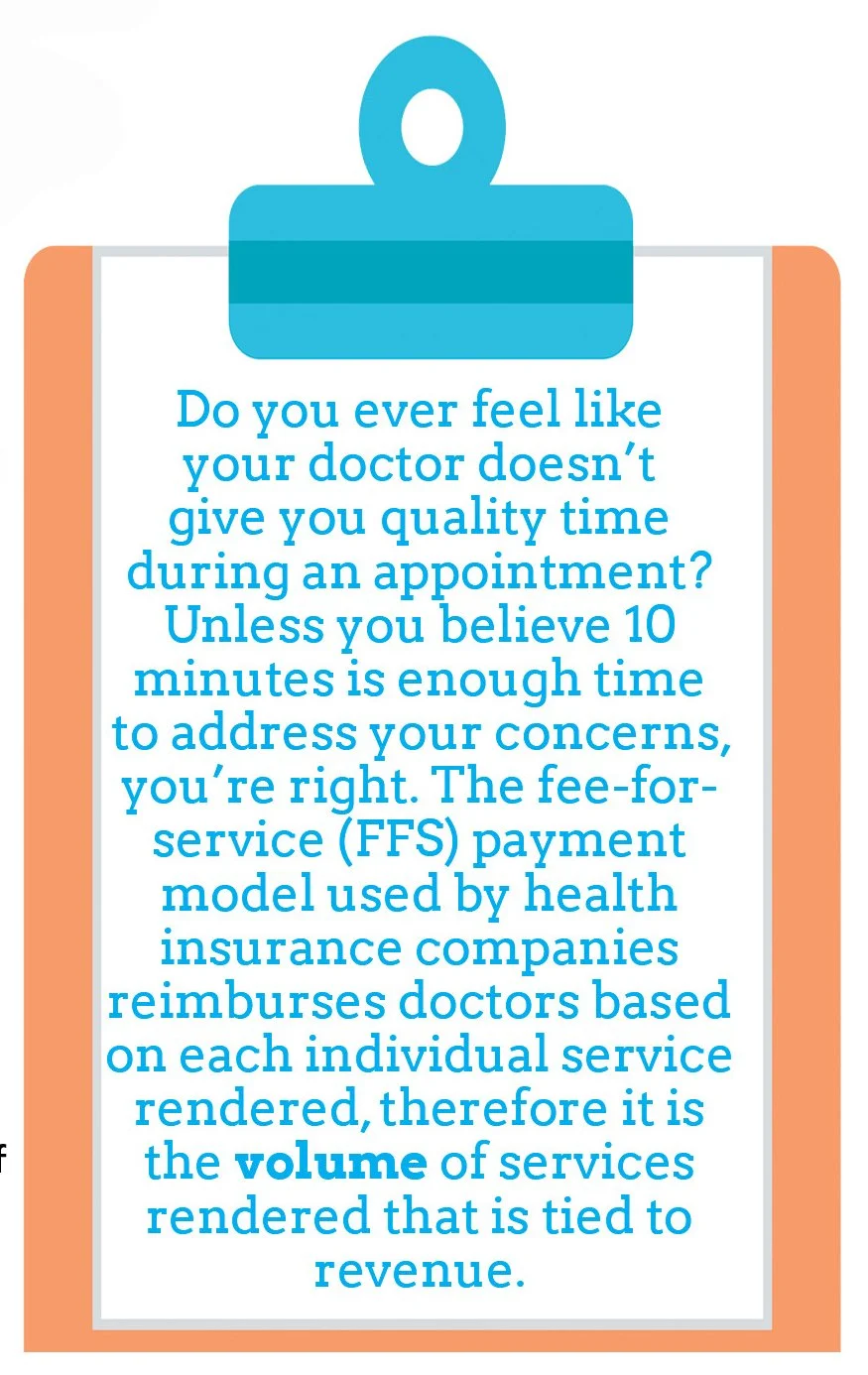
Do you ever feel like your doctor doesn’t give you quality time during an appointment? Unless you believe 10 minutes is enough time to address your concerns, you’re right. The fee-for-service (FFS) payment model used by health insurance companies reimburses doctors based on each individual service rendered, therefore it is the volume of services rendered that is tied to revenue. In order for doctors and clinics to pay overhead costs while also making a living, they are forced to schedule 25 to 30 patients a day. Those doing the math might point out that 25 patients in an 8-hour day allows about 20 minutes per visit. Yet those 20 minutes include medical assistant time (rooming, vital signs, preventive care checklists) and physician history gathering, exam, discussion of diagnosis and treatment options, documentation, coding, and completion of the after-visit summary. And usually, even more checklists are dictated by insurance or the government!
Have you ever struggled to receive a medication your doctor prescribed or a test or lab they recommended? Due to prior authorization (PA), it is often the insurance company, not your personal physician, who decides if a particular drug, lab, or test, is necessary. Spoiler alert: insurance companies don’t like expensive tests and treatments, and they are unlikely to approve them if a more affordable alternative exists whether or not it is what’s best for the patient. According to a 2025 physician survey on prior authorization conducted by the American Medical Association (AMA), “more than one in four physicians (26%) report that PA has led to a serious adverse event for a patient in their care.” Twenty percent report that PA led to hospitalizations, and 8% report that PA led to physical disability or death. In addition, “more than one in three (35%) physicians report that PA criteria are rarely or never evidence based.”
These are some examples of the poor state of health care in our country. It is dictated by health insurance companies (i.e. corporations) not health care professionals. And because of this, it is profit-driven not health-driven. According to the Commonwealth Fund’s U.S. Health Care from a Global Perspective, 2026, “For over four decades, the United States has spent more on health care than any other nation. In 2024, the U.S. spent 18 percent of gross domestic product on health care, among the highest rates in the world.” And yet, “the U.S., on average, has the poorest health outcomes of any high-income country.”
Why do we, both patients and doctors, continue to participate in a healthcare system that we all know is broken? Because most of us don’t know we have a choice.
I mentioned at the beginning of this article that I don’t have health insurance, but I receive great health care. How can that be? It’s because I participate in Direct Primary Care.
Direct Primary Care
Direct Primary Care (DPC) is a model of healthcare that empowers primary care doctors to operate independently of the health insurance industry. Instead of charging fee-for-service, this model relies on monthly or annual membership fees paid directly from patients. Eliminating dependence on health insurance reimbursements gives DPC doctors the freedom to practice medicine as it was intended: by having quality time to build personal relationships with their patients. The magic of more time gives DPC doctors the ability to learn not only about each patient’s health struggles, but their jobs, relationships, diet, physical activity, and mental health—all things that contribute to someone’s overall state of health. Armed with this understanding, DPC doctors are able to customize health care plans unique to each patient, thereby focusing on preventative health not just the management of illness.
The DPC movement originated in 1997, when Dr. Garrison Bliss and Dr. Mitchell Karton opened their practice, Seattle Medical Associates, in Washington.
Dr. Bliss calculated an affordable monthly fee, based on age, that would allow the practice to support a panel of 600-800 patients (not the 1600-1800 most primary care offices handle). Their practice was able to offer care to their patients for a monthly fee between $30 and $50 and the practice was filled in just over a year.

Dr. Bliss’s inspiration for building a new model of healthcare came when his son, Michael, began suffering from what they would eventually discover was a brain tumor. In his blog, The Origins of Direct Primary Care, Dr. Bliss powerfully articulates the impact of facing a terminal diagnosis within the current healthcare model. “Having a son with a brain tumor altered my perspective in ways that cannot be undone. Through caring for him, I saw the effort, commitment, and ability of care providers. I also saw their remarkable lack of critical knowledge, poor service, and the ignored needs of both patients and their families.”
In 2007, Dr. Bliss helped pass legislation in Washington State creating the term “Direct Primary Care” and has since moved on to support the DPC movement on a national scale. In 2009, he helped establish the Direct Primary Care Coalition (DPCC) to incorporate DPC into the Affordable Care Act (ACA). Recently, the DPCC has been advocating the passage of two bipartisan bills at the federal level: the Medicaid Primary Care Improvement Act and the Primary Care Enhancement Act.
The Medicaid Primary Care Improvement Act (MPCIA) in part clarifies that Medicaid programs at the state level have the authority to expand healthcare access to Medicaid beneficiaries including through Direct Primary Care. The bill passed the House in March of 2024 and is currently referred to the House Committee on Energy and Commerce.
The Primary Care Enhancement Act’s main objective is to change the IRS code for DPC fees from health insurance, which it is not, to a medical service, which it actually is. This allows DPC to be a qualified service covered by Health Savings Accounts (HSAs), allowing HSA holders the ability to pay for DPC services through this pre-tax savings account. HSAs are accounts available to individuals with high-deductible insurance coverage which includes approximately 40 million Americans. Although this statute did not pass into law, the provisions it sought were passed as part of the One Big Beautiful Bill Act and went into effect on January 1, 2026.
As illustrated above, DPC is not a fringe concept. It’s a practical, legitimate solution to the many problems inherent in the insurance-based healthcare system, and even a bipartisan cohort of the federal government recognizes its benefits for the American public. Many seasoned and well-respected primary care doctors are choosing to leave the insurance-based model of medicine to participate in this model that offers the public a choice in what kind of health care they receive. There are currently over 2,300 DPC practices operating in 48 states and Washington D.C. serving over 300,000 patients. Fortunately, we have access to some of them in our own community.
Local Direct Primary Care Doctors
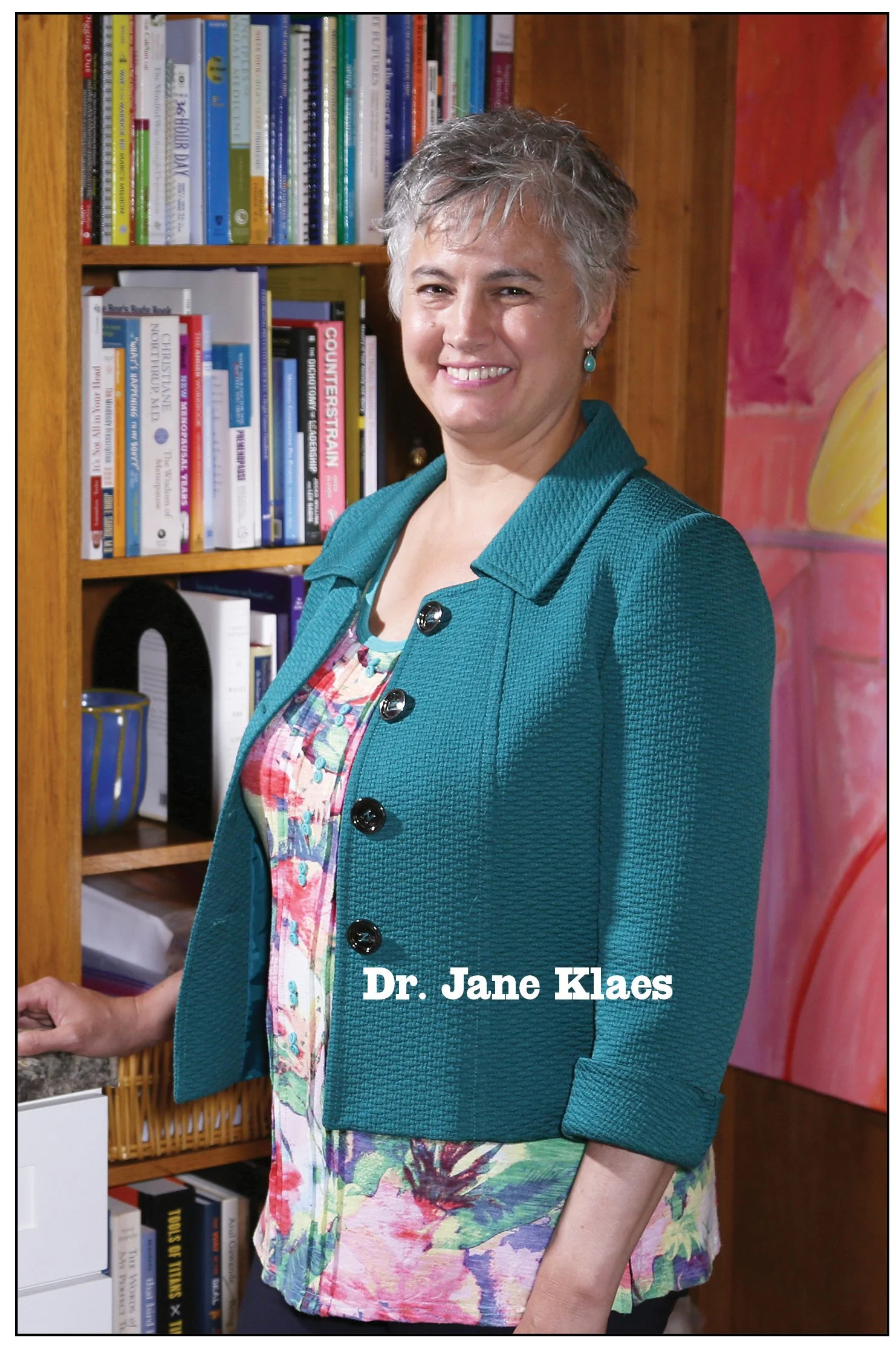
Dr. Jane Klaes graduated medical school from the MSU College of Osteopathic Medicine in 2004 and completed a residency in Family Medicine in 2007. From there she participated in the National Health Service Corps (NHSC) program which provides health care to under-served communities by supporting health care professionals who serve there with scholarships and loan repayment programs. Dr. Klaes practiced family medicine in rural West Virginia for four and a half years. “It was a place of stirring natural beauty: the hills, rivers, gorges and winding roads were magical. Many patients preferred not to travel to the city, so I became comfortable with procedures like skin biopsies, joint injections, and managing a variety of conditions that in an area with more access may have been referred to specialists.”
Though she loved her time in West Virginia, Dr. Klaes yearned to return to Ann Arbor. When she did, she sought out Integrated Health Associates (IHA) on West Liberty. “I loved that it was a physician-owned and led organization. I loved their philosophy and culture. The leadership had a lot of integrity, and they were focused on providing great patient care. The office was set back against the woods and was small enough that we all knew each other; it felt like home.”
But eventually, IHA entered a partnership with Trinity Health and things began to change. “Things changed a little culturally. Things became bigger, more administrative… we had less control over what our practice would be.” Despite continuing to enjoy working with her colleagues, who were all passionate about the work they did, directives from the administration and insurance companies resulted in more time constraints during patient visits which impacted her ability to give her patients the care she wanted to. Klaes noted:
It was a setup for me to feel stressed all day long. I felt that a part of my brain was on the timer rather than sinking into the visit with the person, especially if I got behind and I knew there were two or three patients waiting. My stomach would be tense pretty much the whole day because I wanted to take good care of people. Someone prepared for the visit and had been thinking about the visit and has seven things on their list that they put together very carefully for what they want to address. And I can do three. You know, even doing three in eight minutes is a feat, as well as making a connection with someone.
Fortunately for Dr. Klaes and her future patients (me among them), she learned about Direct Primary Care when a colleague quit the practice to join a DPC practice in Brighton. Her colleague felt strongly that Dr. Klaes would enjoy the DPC model and encouraged her to pursue it, but Dr. Klaes was hesitant. “At first, I just didn’t really think it was possible because it seemed like such a big leap from where I was.” It took her a while to come around to the possibility, and she began taking online classes, including one with Dr. Pamela Wible, a board-certified family physician working to revolutionize patient-centered healthcare. “She encourages people to start what she calls ‘micro practices.’ In the class, she talked about the different models you can use and DPC was one of them. She felt like at any time, I and others could just go off and do it. She encouraged people not to think about it too much, not to get into the weeds too much, just do it. She said, ‘all you need is your stethoscope.’”
Armed with more knowledge of the model, and with encouragement from her former colleague and Dr. Wible, Dr. Klaes took the leap, and in 2020 opened her personal DPC practice at her home off of West Liberty in Ann Arbor. “I got my plan together for the practice, and as everybody said, it really was easier than I thought it would be. There were things I didn’t know, but there are guides out there for how to start your DPC practice. I picked the brains of a couple people who were already doing it, then implemented the plan step by step, and opened my doors in August 2020.”
Now Dr. Klaes gets to reap the rewards of going from a patient panel of 1500-1600 to roughly 180. “The pace and the setup of it feels very natural. It feels like I’m just myself, and it just seems to flow nicely. I’m able to settle in, listen, and enjoy my patients’ company while helping them with their health concerns.”
Her patients get to benefit from the slower pace too. Todd Baker, a patient of Dr. Klaes’ since 2022, appreciates the atmosphere she has created. “While in Dr. Klaes’ office I feel more relaxed than in a traditional doctor’s office. I never feel rushed during our appointments. When discussing a problem with my health, she takes time to ask multiple questions and bounce ideas off of me about what could be going on. There was one time when I was feeling anxious about a particular issue. She offered me tea and her sweet dog Leo curled up in my lap as my worries eased. You can’t get that type of calming care at a regular doctor’s office.”
Dr. Klaes’ experience beautifully illustrates the fact that doctors established in the traditional medicine model have a choice in how they want to practice medicine, and they can choose to change how they do so at any point in their careers. Because Direct Primary Care is a new model, many established doctors are still discovering it. But fortunately for the future of healthcare, new doctors coming out of medical school are learning they have options before they even start to practice.
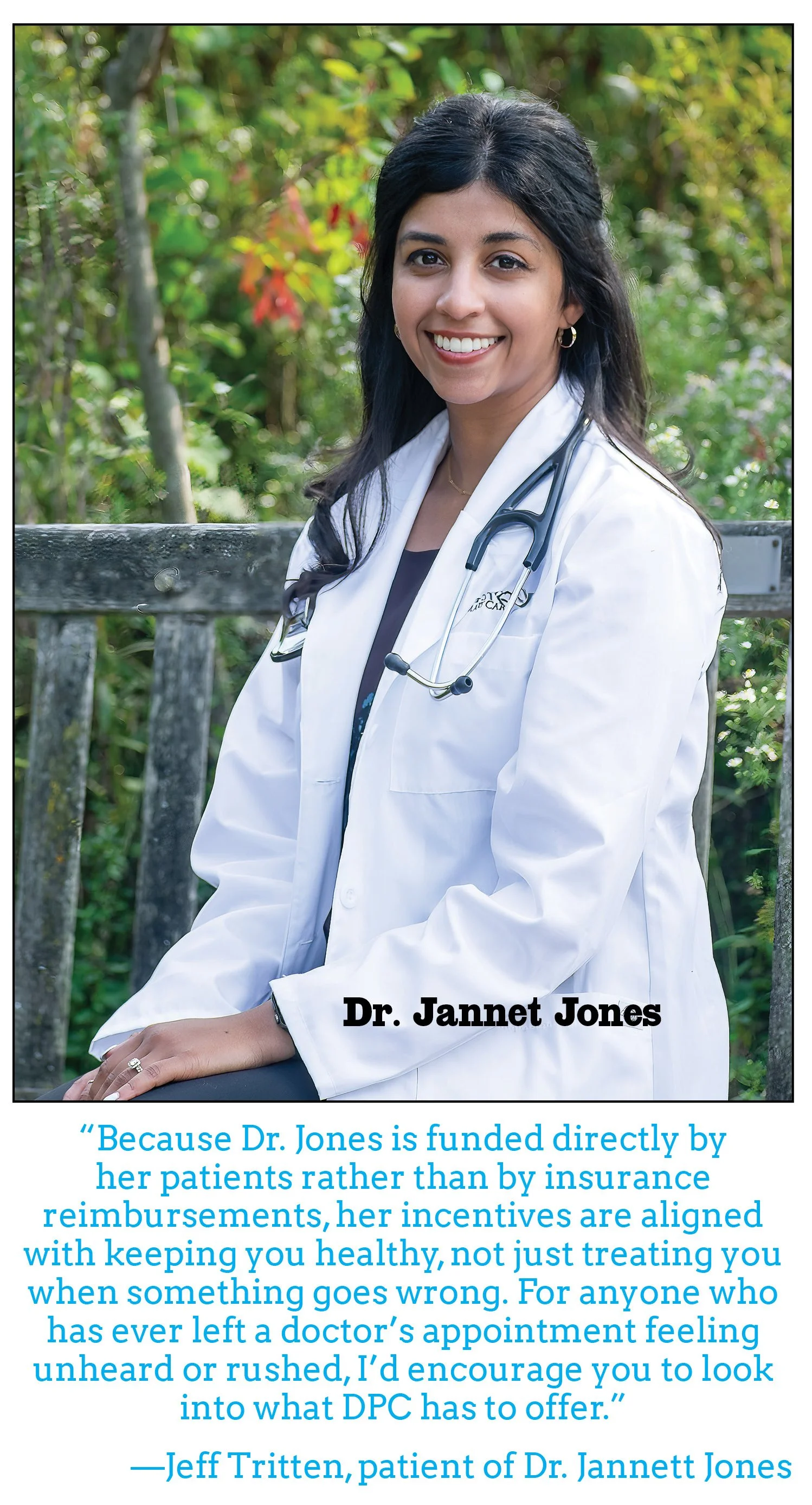
Dr. Jannet Jones graduated from MSU School of Osteopathic Medicine in 2021. Growing up she always knew she wanted to pursue a field that allowed her to help people, and while in college, she got more clarity on what she wanted to do. “During my undergraduate career, I minored in something called HPS (History, Philosophy and Sociology of Science). Essentially it taught me a lot about our healthcare system, the history of healthcare in the U.S., and it taught me that our healthcare system is very broken right now. I came to the realization that we don’t have enough emphasis on primary care, so that inspired me even more to go into a primary care specialty.”
But when she went on to medical school, and did her rotation in primary care, she experienced first-hand some of the ways the system is broken. In addition to the doctors seeing 20 to 30 patients a day and being given only 10-15 minutes with each of them, Dr. Jones also saw the challenges with health insurance and billing. “Costs were insane, and you never knew what insurance was paying for, so that wasn’t really a question the physicians could answer. It was something you had to talk with the billing department about. There were just so many downsides that I saw in primary care, and that scared me a little bit.”
Fortunately, Dr. Jones learned she had options when Dr. Paul Thomas, founder of Plum Health Direct Primary Care based in Detroit, came to speak at the medical school. He introduced the concept of Direct Primary Care and Dr. Jones was intrigued. She knew that if she became a primary care physician she would pursue DPC. “I was like, I’m really going to try to become a DPC physician because I think that’s just such a better way to practice family medicine and primary care, and I will be able to give much better quality care to my patients.”
When starting her third year in medical school, Dr. Jones began looking for job opportunities in Direct Primary Care and discovered Beyond Primary Care, a DPC clinic in Ann Arbor founded by Dr. Jeff O’Boyle in 2018. She did a rotation with Dr. O’Boyle and afterward, he offered her a job in his clinic. Dr. Jones began practicing at Beyond Primary Care in September 2024 and purchased the clinic from Dr. O’Boyle in March of this year. And now she has something most primary care doctors would find unbelievable: a healthy work-life balance. “I think one of the biggest things is not only am I able to take care of my patients with the quality of care that I think is appropriate in primary care, I’m also able to take care of myself as a physician. There’s that saying, ‘you can’t fill the cup of others unless you fill your own cup.’”
Because primary care doctors are given so little time with their patients, they are often required to complete notes and other paperwork after work hours which can dramatically impact their home lives. “I didn’t have children [while I was] in residency, but I know co-residents that did. They would tell me they’d put their kids to sleep, and then 11 PM is when they’d start writing their notes.”
Because the DPC model allows Dr. Jones quality time to see each of her patients, she’s able to take notes on their care in real-time instead of having to catch up at the end of her day. Since she has become a DPC doctor, Dr. Jones has not once spent her personal time catching up on paperwork and instead gets to enjoy quality time with her family. “I come home and all my attention is on taking care of my kids, taking care of my family, eating dinner, and going to bed at a decent time and getting enough sleep so I’m ready for that next day—which is such a game changer. As a physician, I always want to make sure I, myself, am functioning well, so that I’m taking care of my patients well.”
For Dr. Jones, an important part of taking care of her patients is about preventative health—something our traditional healthcare system doesn’t put much emphasis on:
We’re a first world nation that’s still struggling so much with our healthcare system. And I think it’s because we’re not focusing enough on preventative care and primary care in general. There are many patients who aren’t regularly getting their checkups or getting to be seen by a PCP at least on an annual basis. I think preventative care is the cornerstone of long-term health. If we catch things early, if we’re staying on top of our health, doing things we’re educating ourselves on: how we should eat, how we should exercise, how we should live our lives, how we can manage our stress levels—that can prevent so much disease pathology as we age. And right now, I feel like that whole preventative aspect is being ignored. I think as Direct Primary Care is getting more momentum and becoming more well known, we can slowly start to encourage patients a little bit more on that primary care, the importance of that preventative care as well.
Direct Primary Care’s focus on preventative health is a significant benefit to the model and one that patients value. Jeff Tritten decided to seek a doctor who practices DPC after hearing a presentation by Dr. Paul Thomas back in 2019. (Yes, the same Dr. Paul Thomas who founded Plum Direct Primary Care in Detroit and inspired Dr. Jones when she heard him speak in medical school.) “I was intentionally seeking a DPC model, as most DPC doctors practice lifestyle and/or integrative medicine, and it is reasonable for those without insurance. My health insurance became unaffordable this year due to changes in federal health policy.” Jeff became a patient of Dr. Jones’s earlier this year and it was easy for him to see the difference in having a doctor who wasn’t influenced by health insurance. “Because Dr. Jones is funded directly by her patients rather than by insurance reimbursements, her incentives are aligned with keeping you healthy, not just treating you when something goes wrong. For anyone who has ever left a doctor’s appointment feeling unheard or rushed, I’d encourage you to look into what DPC has to offer.”
Direct Primary Care also addresses two challenges that Dr. Andrew Chambers, of YourChoice Direct Care in Brighton, believes are inherent in the traditional healthcare model: Insurance hurdles and price transparency. “In the insurance system, when you ask your primary doctor, the imaging center, and your insurance company how much a test will cost out of pocket, it seems like no one can answer. When you do receive an answer, there are often additional fees, deductibles, co-insurance, etc. that complicate the costs further. In contrast, with DPC, we collaborate with imaging centers that provide point-of-service pricing often at 10% of the insurance cost. I can tell a patient exactly how much a test will cost, and that cash price is often still less than their insurance co-pay.” For example, Dr. Chambers’s practice can offer an MRI for the lumbar spine for approximately $370 instead of the $3,700 it would cost through insurance. “We can also obtain generic medications at unbelievable prices: 90 days of blood pressure medication for less than $2, and an antibiotic prescription for 30 cents.”
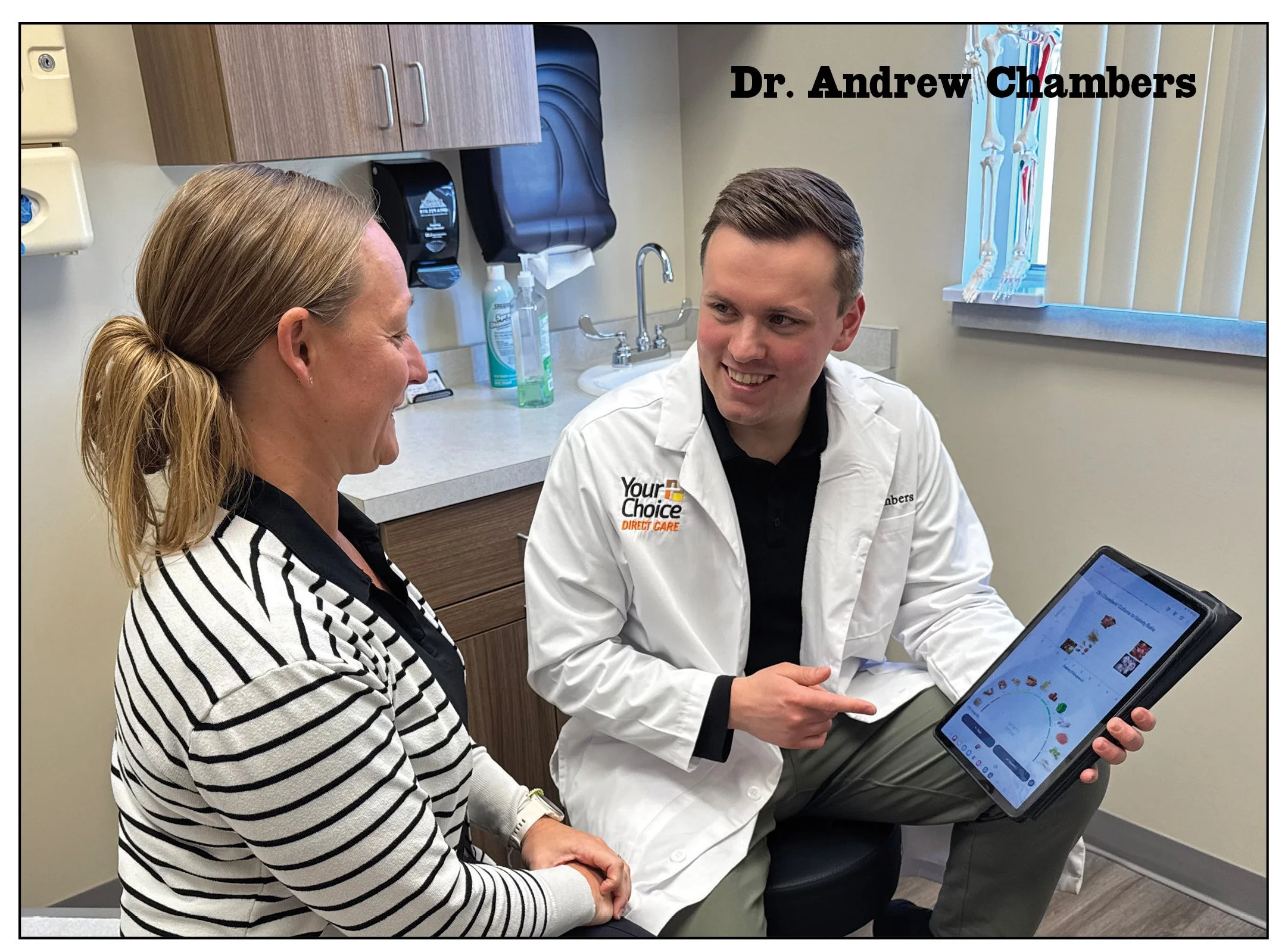
Dr. Chambers witnessed the power of medicine at a young age when his mother suffered from a rare autoimmune disease for over a year before receiving a diagnosis. She consulted many specialists before she found a doctor who took it upon himself to hit the books and uncover the answer. Once diagnosed, she received treatment that resolved her symptoms and returned her to her previous health. “I wanted to be that doctor and have that kind of impact on people’s lives.”
Dr. Chambers graduated from the Campbell University School of Osteopathic Medicine in North Carolina in 2022 and completed his Family Medicine Residency at Trinity Health in Livingston in June of 2025. “I recently graduated from residency. Our resident clinic functioned much like a traditional insurance-based medical practice, and by my third year, we were working under the same time constraints as a health system primary care office. I was connected with Dr. Savage, the founder of YourChoice Direct Care, through our church. After rotating with him as a resident, I realized this is what primary care was meant to be.”
Now Dr. Chambers has the time and freedom to be the kind of doctor that healed his mother when he was young. “I love being able to go the extra mile for my patients. I can ‘hit the books’ like that rheumatologist did for my mom. I can read studies and guidelines and conduct multiple levels of evaluation and treatment before considering a specialist referral. In an era where many primary care providers are forced to become cogs in the specialist referral machine due to time constraints, the DPC model allows me to invest the time to do more for my patients. If I don’t know something, I have the opportunity to find out!”
The Role of Health Insurance in Direct Primary Care
Direct Primary Care is a model that anyone can benefit from, but as Dr. Chambers observes, it seems that people who tend to discover it are those with limited or no health insurance. “Typically, individuals who find DPC have experienced issues with insurance companies. Whether it’s frustration with the system or being self-employed and realizing that insurance can be financially unapproachable without a large corporation subsidizing premiums, these individuals seek alternative options, discover DPC, and often combine it with a more affordable coverage product. They frequently wonder, ‘Why doesn’t everyone do this?’ They often become our best advocates.”
Dr. Chambers believes the DPC model could be a terrific benefit for employers to offer employees as well.
A study conducted by the Society of Actuaries suggests that DPC can lead to a 40% reduction in ER visits and a 20% reduction in hospitalizations. This translates to a lower risk population for employers, which becomes less expensive to insure over time when risk adjustments are made. Furthermore, it can be marketed to employees as a perk: ‘We offer 24/7 direct access to a primary care physician as part of our benefits package!’ Employers can save money (or at worst break even) while providing better access and a superior product to their employees. Thus, it’s a win-win-win situation: better care for employees, better pricing for employers, and a better practice model for doctors.
To be clear, DPCs are not a form of insurance, but they offer access to quality primary care in a way the insurance-based healthcare model cannot. In his book, Direct Primary Care: The Cure for Our Broken Healthcare System, Dr. Paul Thomas (yes, still the same one from Detroit!) explains what DPC is in relation to health insurance.
The idea is this: we all have to have auto insurance which is a financial tool that we use to protect us from financial loss in the case of an accident or catastrophe. Yet, for the rest of our car’s needs, we use the marketplace for maintenance and enhancements. Importantly, we don’t use our car insurance to pay for oil changes or new wiper blades...[Likewise], it does not make sense to buy insurance for primary care services. Insurance is meant for big, unforeseen expenses, not routine services. Primary care services are less expensive and delivered at a higher level of quality when paid for directly. Asking a third-party payer, like a large insurance company or Medicare, to pay for primary care services only inflates the cost of care and decreases quality and transparency.
But what about those big, unforeseen expenses? No one enjoys having high-deductible health insurance coverage, but those plans partner perfectly with DPC. Dr. Chambers says, “According to 2025 estimates in Michigan, a high-deductible plan can save you $105 to $336 for family coverage per month. This savings can cover a substantial portion (if not the entirety) of a DPC membership especially if you use an HSA to pay for that membership which makes it a pre-tax expense. You can then use your HSA to access cash prices for primary care medications, imaging, and lab testing, saving significant money while still having insurance for high-cost events like hospitalizations, surgeries, or specialty care.”
Another affordable option to protect against large, unforeseen medical expenses that pairs well with DPC is participation in a HealthShare. According to healthshareguide.org, “Modern HealthShares, also known as health care sharing ministries (HCSM), are nonprofit organizations that facilitate medical cost-sharing communities which share in fellow members’ eligible medical expenses. With roots in decades-old religious communities that pool their resources to help members of their parish in need, HealthShares are a quality alternative to traditional health insurance.”
Jana Healy, a patient of Dr. Klaes’, has found that participating in a HealthShare is a more affordable option than health insurance. “When I stopped working full time back in 2013 to help care for my parents and newborn granddaughter, I no longer had healthcare insurance through my employer. I didn’t know about HealthShares then, so for a few years I was paying close to $700 per month for my own health insurance policy. Because I was healthy, I felt like this was a waste of money and not really affordable. When Dr. Klaes started her Direct Primary Care practice, I became her patient again and she recommended a HealthShare. Being in good health, I chose the catastrophic plan which saved me around $500 per month.”
Choosing Direct Primary Care
We are living in a time in which we feel we have less and less control over what happens around us, and in the case of healthcare, to us. Without reasonable options, it’s easy to become complacent to the deficiencies of the healthcare model available to us. Direct Primary Care is, to borrow part of a famous quote from the 20th century futurist Buckminster Fuller, “building a new model that makes the existing model obsolete.” The DPC model signals new hope for a system that currently favors profit over health. The more people know they have a choice, the more people will choose the more affordable, higher quality, option for care. Dr. Jones agrees. “I think Direct Primary Care is gaining momentum. People are just becoming more aware of it. And I think that the biggest thing we can do is spread the word. There’s a good thing here in healthcare and we need to let people know about it so that other people can get good healthcare too.”
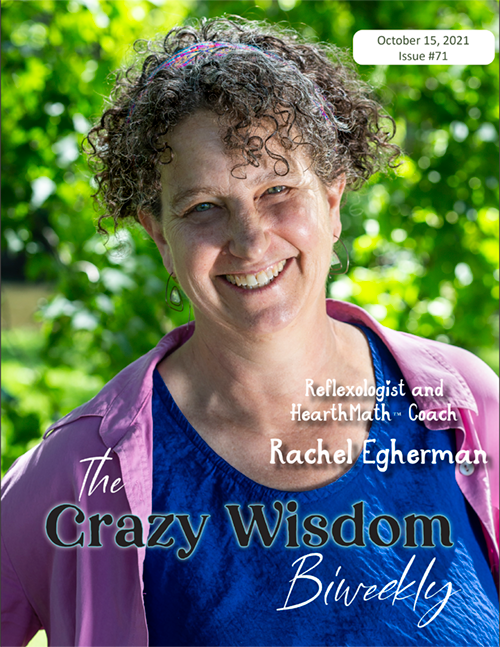
Rachel Pastiva has been a bookseller for almost 30 years, and is a passionate advocate of people and organizations who are building a better future for all living things. She and her husband recently moved to Saline after living on Ann Arbor’s Westside for almost 20 years.