The 5 Love Languages in My 32-Year Marriage: Real-Life Lessons
By Michelle A. McLemore
“I can’t wait until you get home. I have a surprise for you,” Mike exclaimed during a phone call.
“Ooh, nice. As long as you didn’t cut a hole in my car roof.”
Silence.
I don’t know what made me say it.
“How did you know?” He was shocked (and a little frightened, or so he told me later—not because of the claircognizance but because of not knowing how to undo what was already done.)
The few times I used to go away on business trips, my husband enjoyed arranging some “surprise” for me. Often it was home improvement tweaks. One time he hired someone to weed the gardens so that I wouldn’t feel pressured to do it immediately when I arrived back home. This time, he had decided to have a sunroof installed in my car without us ever discussing the topic… and without me wanting one. (Bright light and high heat have always given me headaches.)
I remember being slightly surprised and amused to the elevator floor-dropping swoon on the other end of the phone. Yet, I simply paused and said something to the effect of, “Well, I’m sure it’ll be fine.” I thanked him for wanting to do something nice for me.
Another year, for Christmas, my husband gave me a vacuum. (Did you groan reading that? I groaned typing it.) Yes, I needed a vacuum, no doubt. Yes, it was a powerful one. No, there was no other gift—nothing sexy, chocolatey, or cuddly.
Now at this point you might be questioning the intellect of my husband. However, I witnessed him take an IQ test and the results were over 130 on the Wechsler-Binet scale placing him three tiers above average. Still, his desire to give gifts hasn’t always produced the elation for which he may have hoped.
We are 32 years married (36 years together). We have come through for better or worse, for richer or poorer, in sickness and health, in love, tolerance, intolerance, and into a deeper respectful love. In those multiple decades, despite my psychology background, I never paid any attention when people went on about their “love language.” In the mid-2000s it seemed just another trendy phase I presumed made popular by some woman’s magazine. You know, the ones whose covers scream “5 ways to X” or “10 ways to Y.”
When I finally got around to looking up the basics of Dr. Gary Chapman’s famous book, The 5 Love Languages: The Secret to Love that Lasts, with chagrin I realized the basics did resonate with some truth.
Understanding the common five communication modes of expressing and perceiving respect and love, it seems valid that relationships could be deepened as well as many misunderstandings possibly prevented if we could vocalize what we crave to our partners, family members, and possibly friends.
I pondered how each of the five have factored into my marriage.
Acts of service demonstrate having listened to or keenly observed your significant other and then willingly spend energy and time acting upon that information as a surprise or per a request for assistance.
For several years I directed and produced plays for my local high school. Mike agreed to help me with set and tech. It wasn’t for pay, and he could’ve said no. I didn’t pressure nor guilt him into it. But I can say, without his skill, knowledge, and patience, I could never have brought about the admirable sets and audio experiences that we did. He used his abilities to further and enrich mine and my students’ collective dreams.
This method of love also can also be demonstrated in smaller actions. Early in our marriage I experienced a time of immense full body pain. At times it was all I could do to hold my fork at mealtime. He would observe, reach over, and cut up my meat or arrange things so that I could more successfully feed myself and retain some dignity. We didn’t talk about it. He just did it.
In more recent years, at least once a summer he details my car. Also, when we go out, he notices and tucks in my stubborn shirt tag. Often, he holds up my jacket for me to put on and then carefully lifts my long hair out from under it if it gets caught. Small or large, the acts of service show consideration.
Verbal expressions of affinity, when it comes from someone we respect, may offset self-criticism or shifty hormonal doubt. Yes, “I love you” is important. But consider the weight of hearing, “I am proud of you. You are creative. You are kind. You have a beautiful heart. You are inspiring. You are a great problem-solver. You are an asset to the team. You make others feel comfortable with your mere presence….” The spoken word has a powerful energy vibration, and the waves can wash through the biofield and nervous system with soothing, empowering strength.
I started experimenting with cooking these last few years and an opportunity came to cook for a work crew of about 10 men. Each time I did a lot of research to produce healthy, colorful, tasty meals.
One day, Mike paused next to me during meal prep and said, “I’m proud of you.”
I scoffed amused, and responded, “For cooking?”
He stated, “For trying new recipes. Keep it up and I’ll buy you a restaurant.”
He was joking about the restaurant, but it was a compliment. He observed my dedication, the positive results, and verbalized it so I knew he didn’t take my actions for granted. (It was a work crew in which he was a member.)
Sometimes people wait their entire lives to hear phrases that they have craved since childhood. Sometimes it’s not about healing lifelong trauma but recognizing someone’s efforts in the present and showing gratitude for their care and commitment. Verbal communication ensures your loved one hears the exact message you want to transmit and that they may need to hear.
Physical affection reinforces connectiveness in the third dimension. It’s the intimacy of having permission to touch someone safely and be touched safely— a way to speak volumes when words may fail. The touch is the message: I am glad we are together. I am thankful for your existence. I am with you. The actions may seem simple such as a reach for your hand, a hug, soft strokes of your hair, a casual shoulder squeeze as they walk by, or even reaching to hold a thigh in the car or while watching tv?
There is a beautiful rendition of “More than Words” by the hosts of The Voice, Blake Shelton, Gwen Stefani, Kelly Clarkston, and John Legend. The lyrics address the point: “What if I took those words away? / Then you couldn’t make things new, / just by saying, ‘I love you.’” The song is all about physical affection (which does not have to be sexual).
When my husband reaches for my hand in public it stirs something deeply within. If one of us is walking by the other at home, or on the way out, it has become an unstated agreement, we hug or kiss. Whereas massaging each other’s hands or neck is a service out of love, the spark of a touch anytime during the day (without it being intentional foreplay) can be beautiful and deeply harmonizing.
Quality time together generally requires sharing space, presence, and energy focused on each other or experiencing the same thing together to be able to discuss or reminisce later about it. Sitting near each other while one reads and the other watches videos may not fit my definition of quality togetherness despite meeting the proximity criterion. But, if occasionally there is discussion or sharing of what is being read or watched, then it upgrades the experience completely.
Quality time could be asking about each other’s day and sharing conversation over coffee or dinner. It could be taking a trip together or engaging in some other entertainment—games, movies, service projects. It most likely will require both your awareness of the other in the moment and investment in the shared experience.
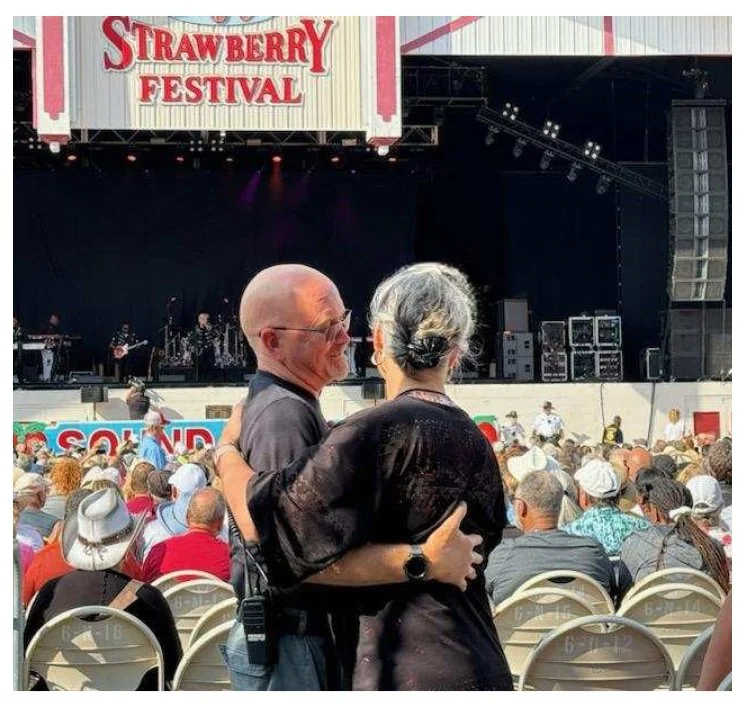
With a busy audio engineer for a husband, attending his concerts was often the only time we would see each other during daylight hours. I’d sit grading papers or writing and occasionally we’d make eye contact and share a smile as he moved from sound board to stage and back again. It was pleasant near each other. However, the quality of the time elevates when a slow song comes on. He takes a few steps away from the console and invites me to dance. In that next three minutes and twenty odd seconds, we create a world of our own in a four by four-ish square of dance floor. It satiates our hearts and spirits more than an hour of simple proximity could ever do. Looking into each other’s eyes, we move in rhythm, joke about who is leading, laugh, sing, and breath together—resynching and recharging each other.
Gift-giving for surprises and non-holidays suggests someone thought about you when there was no societal compulsion to do so. They took their time—and often money—to purchase or create something hours, days, or weeks in advance of the presentation time. The more personalized a gift, the more reassurance there is in the depth of their knowing you. For some, a monetary gift proves they are “worth” something to their significant other whereas for others, hand-made or constructed gifts are more valued.
One of the most beautiful gift surprises I received was when Mike hung a chandelier in my office/art studio. I had bought the piece for my production of “You Can’t Take it With You.” Here it was in my Victorian-themed get-away space lit up with a simple flip of a wall switch. I was speechless (and of course cried some). It was a gift with multiple layers of sentimental value. It was practical (as I didn’t have a fixture in that area yet). And it was a complete surprise—a perfect gift for me.
Other times he has watched when I’ve paused longer than normal in front of a painting or piece of clothing and suddenly, they appear at home. Then of course, based on the phase of moon, sometimes I’ll walk into the kitchen and see he has set out a Coke and a Hershey with almonds chocolate bar for me. “For emotional support,” he states with a small smile.
What methods feel the most authentic transmission of another’s love and respect to you? If you aren’t seeing them in your relationship, perhaps it is time to have an honest discussion with your significant other. My husband used to think I should know that he loves me without having to say it. He felt the same about our relationship quality. I thought intermediate check ins made sense. We’ve come to an agreement that if something is wrong or making him unhappy, he will tell me sooner rather than later. If he doesn’t tell me something is wrong, then there isn’t.
Yet, over the years we have worked in separate U.S. states for weeks or months at a time while other times we may have been under the same roof, but our excessive work schedules reduced both our energy levels and free time. When I began to feel agitation and anxiousness disturb my flow, I shared a need: “I need to hear you say that you love me. I also need to hear from you at the beginning of each day to know you are okay.”
He heard and strives to accommodate. It might simply be a “Good morning. Have a great day” text when work takes him miles away overnight. It might be a ten-minute phone call. The interaction length of time doesn’t seem to matter. It is the verification he is safe on the road. Then, I can go about my day.
I know he has felt a difference from it as I’ve heard him suggest the action to other husbands when they share marital strife from being on the road.
Vocalize what you need. Don’t expect your partner to read your mind. (Yes, they probably can if you are connected well, but don’t expect them to do it.) It is not a complaint or attack on how they have loved you in the past. It is a desire to bring more closeness, strength, and peace to the relationship.
I don’t believe we all have a priority order for love languages per person, but I do know the impact of having experienced the variety over the years and can admit I have needed, or craved, different ones at different times of my life. I am grateful we are in a place that I can feel safe to share with him what I really need and thank goodness he can feel safe enough to listen and not feel defensive or under attack.
We are not in relationships by ourselves. It is a give and take—a building of bridges, presence, present, and future together.
A common hiccup with love language use is that people often treat others as they, themselves, want to be treated. Yet partners do not always value the same love language. Other times we rely upon what we witnessed parents or guardians did (or did not do). That can cause unnecessary complications and unease in relationships.
If gifts are only given after someone has made a huge blunder, it may come off as insincere or buying forgiveness or affection. If someone says, “I love you” frequently but acts otherwise, it may make anything vocalized seem disingenuous.
I began this article to share how the love languages could clarify our affections to others. In defining examples, it became a personal gift. How does my spouse love me? Let me count the ways. And may I be as attentive and considerate in response to him, my family, and friends.
Michelle McLemore is a freelance writer, speaker, and energy practitioner. Her background as a psychology and writing teacher supports personalizing client self-care to create balance and vitality. Learn more at facebook.com/MichelleMcLemoreHealingGuide, michelle.mclemore on Instagram, and mclemore.substack.com. Email inquiries to energy@michellemclemore.com.